How to Improve Communication Skills at Work for Career Growth
If you want to get better at communicating at work, you’ve got to move beyond just “speaking clearly.” The real secret lies in tackling four key areas together: sharpening how you speak, mastering body language, owning the room in meetings and over email, and learning to truly listen.
This isn’t just about generic tips. It’s a structured approach to build real confidence, cut down on those frustrating misunderstandings, and make a much bigger impact in your career.
Why Great Communication Is Your Biggest Career Advantage

Let’s be honest: great communication isn’t just a “soft skill.” It’s the engine that drives your career forward. It’s the invisible link between your brilliant ideas and actual results, between your hard work and the recognition you deserve.
When communication works, projects sail smoothly, teams click, and collaboration just happens.
But when it breaks down? The fallout is huge. Poor communication is a quiet productivity killer. A staggering 86% of employees and executives blame it for most workplace failures. This isn’t a small problem—it causes 28% of employees to miss deadlines and leaves 63% feeling like their time is constantly being wasted.
The cost is real, especially for senior staff, who can lose up to 63 workdays per year to communication breakdowns. That’s a massive hit to the bottom line.
Thinking of Communication as a Strategic Tool
The first mental shift you need to make is to see every interaction as strategic. Every Slack message, every email, every presentation is a chance to build trust and show you know your stuff.
This isn’t about faking a new personality. It’s about building a toolkit to get your ideas across with precision and impact. A huge part of that is clarity—it’s worth taking a moment to understand how your accent really affects your career and how you can ensure you’re always understood.
This guide is designed to be that toolkit. We’re going to skip the vague advice and get right into practical, actionable steps you can use in real-world situations.
The single biggest problem in communication is the illusion that it has taken place.
This classic quote really nails it. It’s why you can’t just assume you’re being understood; you have to be intentional about it.
What You’ll Learn in This Guide
Before we dive in, let’s get a clear picture of what we’ll be working on. This guide is built around a few core pillars, each designed to help you communicate more effectively in the workplace.
We’ll start with the fundamentals and build from there, giving you a complete framework you can put into practice immediately.
| Pillar | Focus Area | Key Benefit |
|---|---|---|
| Self-Assessment | Identifying Your Communication Blind Spots | Pinpoint exact weaknesses to focus your efforts where they’ll have the most impact. |
| Verbal & Non-Verbal | Sharpening Your Delivery and Body Language | Speak with more authority, confidence, and clarity in any situation. |
| Channel Mastery | Excelling in Meetings, Emails & Presentations | Learn specific tactics to make your voice heard in the most critical business settings. |
| Listening & Feedback | Becoming an Active Listener | Build stronger relationships by truly understanding others and providing useful input. |
| Action Plan | Creating a 12-Week Practice Routine | Turn these new skills into permanent habits that drive long-term career growth. |
This roadmap will give you a well-rounded skill set. To dig even deeper, it’s worth exploring some comprehensive business communication best practices that complement what you’ll learn here.
Finding Your Communication Blind Spots
Before you can build new skills, you have to get brutally honest about your current habits. Improving how you communicate at work isn’t about becoming a whole new person. It’s about spotting the small, specific habits that might be holding you back. Forget generic quizzes—this is about practical self-discovery.
The goal here is to shift from a vague feeling like, “I need to communicate better,” to a concrete list of things you can actually work on. That clarity is the foundation for any real improvement.
Start with Reflective Analysis
Think back over the last few weeks. Can you pinpoint a moment where your communication just didn’t land? Don’t just gloss over it; really pull that moment apart.
Maybe you fired off an email that started a long, confusing reply chain. Or perhaps you pitched an idea in a meeting, only to be met with blank stares—a clear sign your point was completely lost. These moments are your data.
- The Confusing Email: Did you assume everyone had the same context you did? Was your key message buried in a wall of text?
- The Unheard Idea: Did you ramble without a clear structure? Maybe your tone was so uncertain that your proposal sounded more like a question.
- The Awkward Conversation: Did you struggle to find the right words during a performance review? Did you use passive language when you really needed to be direct?
Jot down two or three of these specific scenarios. This simple reflection exercise turns that abstract frustration into tangible problems you can start solving.
Gather Objective Feedback
Self-reflection is powerful, but it’s only half the story. We all have blind spots—patterns in how we speak or write that we don’t even notice. The only way to uncover them is to ask for outside perspectives from people you trust.
This doesn’t mean asking a vague question like, “Am I a good communicator?” That’s a surefire way to get a polite, unhelpful response. You have to be specific and tactical.
Example questions to ask a trusted colleague:
- “In our last team meeting when I presented the Q3 data, was my main point clear? Is there anything I could have done to make it more impactful?”
- “When you read my project update emails, do you always know exactly what I need from you? Or do you sometimes have to re-read them to figure out the next step?”
- “I’m working on being more concise. Can you give me a heads-up the next time you notice me rambling or taking too long to get to the point?”
This kind of targeted feedback is absolute gold. It helps you see yourself the way others do, which is an essential first step.
The most crucial part of self-assessment is accepting that how you think you communicate and how you are actually perceived can be two very different things. Bridging that gap is where real progress begins.
Analyze Your Speaking and Listening Habits
Your verbal patterns play a huge role in how you’re perceived. So many professionals unknowingly undermine their own authority through common speech habits they aren’t even aware of.
For many non-native English speakers, this goes beyond simple word choice. Intonation, rhythm, and the pronunciation of key sounds can dramatically impact both clarity and confidence. If you suspect this might be a focus area for you, getting a professional opinion can provide a clear roadmap. You can learn more about this with a personalized accent reduction assessment designed to pinpoint specific speech patterns.
Consider these common verbal hurdles:
- Filler Words: Do you lean on “um,” “ah,” “like,” or “you know”? These can make you sound hesitant and unsure.
- Uptalk: Do you end your statements with a rising intonation, making them sound like questions? This can seriously erode your authority.
- Pacing: Do you talk a mile a minute when you’re nervous? Or do you speak so slowly that people start to tune out?
By the end of this self-assessment, you should have a clear, personalized list of 3-5 specific communication challenges. This isn’t just a to-do list; it’s your personal curriculum for turning a vague goal into a truly actionable plan.
Sharpening Your Verbal and Nonverbal Impact

Once you’ve identified your communication blind spots, the real work begins. It’s not just about what you say, but the entire package of how you say it. Your tone, pace, and articulation carry just as much weight as your words, shaping how your message is received and whether you come across as credible and confident.
Mastering this delivery is what separates an idea that lands with impact from one that gets lost in the noise. This is where we move from theory into practical, actionable drills to sharpen both your spoken words and your silent signals.
Commanding Attention with Your Voice
Your voice is a powerful instrument. A monotone delivery can make even the most exciting news sound dull, while a rushed pace signals nervousness. The goal isn’t to become a stage actor, but to develop a vocal presence that is both authoritative and engaging.
Start by recording yourself. It’s simple. Just use your phone to record a short, impromptu summary of a project you’re working on. Then, listen back—not for the content, but for the delivery.
- Pace: Are you speaking a mile a minute, leaving your listeners behind? Or are you so slow that you risk losing their attention?
- Tone: Is your pitch flat and monotonous, or does it vary? A varied intonation is what adds interest and emotional weight to your words.
- Volume: Can everyone in the room hear you clearly, without you having to shout?
This simple exercise will reveal vocal habits you probably don’t even realize you have. From there, you can start making conscious adjustments. For instance, try deliberately pausing at the end of a key sentence. Just a beat. That small change can dramatically increase your perceived authority and give your point time to sink in. For a deeper dive, there are great resources on improving verbal communication skills.
The Power of Precise Articulation
Mumbling or slurring your words is an instant credibility killer. Clear articulation, or enunciation, ensures your message is heard exactly as you intend. This is especially crucial in high-pressure situations like a big presentation or an important client call.
Often, poor enunciation just comes down to lazy mouth movements or speaking too quickly. The fix is to treat it like a physical exercise—warming up the muscles you use to speak. If clarity is a consistent struggle for you, our guide on how to enunciate better offers detailed exercises you can practice daily.
Pro Tip: Before a big meeting or presentation, try practicing a few tongue twisters. It might feel silly, but it’s an incredibly effective way to warm up your facial muscles and prime your mouth for crisp, clear speech.
Decoding the Unspoken Language of Work
What you don’t say is often more powerful than what you do. The silent signals you send through your body language can either reinforce your message or completely contradict it. Paying attention to these nonverbal cues is a massive part of effective communication.
Research really drives this home, showing that up to 93% of communication is nonverbal. In a professional setting, this is huge. Think about it: 85% of people emphasize the importance of eye contact, and 70% value facial expressions like smiling to build rapport and trust.
This means your posture, your gestures, and where you look are constantly being interpreted by your colleagues and clients.
Projecting Confidence Through Body Language
So, instead of just being told to “make eye contact,” let’s get strategic about how you use it in different workplace scenarios.
- In a One-on-One: Maintain steady, gentle eye contact to show you’re listening and engaged. Holding it for about 4-5 seconds at a time before looking away briefly feels natural and builds trust.
- In a Group Meeting: Don’t just lock eyes with the most senior person in the room. Scan the group and make brief eye contact with multiple people. This technique, sometimes called “lighthousing,” makes everyone feel included and valued.
Posture is your nonverbal first impression. Slouching in your chair can signal disinterest or a lack of confidence, even if you’re completely dialed in. Sitting or standing tall with your shoulders back doesn’t just project confidence to others—it actually makes you feel more confident.
Imagine you’re about to pitch a new idea to your manager. Before you even open your mouth, your body has started the conversation. Walking in with an upright posture and a firm handshake communicates conviction before a single word is spoken. These nonverbal signals set the stage, making it far more likely your verbal message will be received positively.
Winning at Meetings, Emails, and Presentations

This is where the rubber meets the road. All the practice with individual sounds and intonation patterns comes together in the three key arenas of workplace communication: meetings, emails, and presentations. Your career is built in these moments.
Mastering these channels is non-negotiable if you want to make a real impact. But here’s the thing—each one demands a completely different strategy. A powerful presentation voice won’t fix a confusing email, and a perfectly worded email won’t help you command a room. Let’s get into a specific playbook for each.
Making Your Voice Heard in Meetings
Ever feel like meetings are just a battle for airtime? The goal isn’t just to talk—it’s to contribute with impact. I’ve seen countless great ideas get completely lost simply because they weren’t delivered effectively. The key is to be concise, confident, and strategic.
Before you even join the call, decide on one or two key points you want to land. This simple prep work prevents rambling and makes sure you’re adding real value. When you find your moment to speak, try using the PREP method to frame your thoughts. It’s a game-changer for clarity.
- Point: Start with your main conclusion. “I think we should delay the feature launch by one week.”
- Reason: Quickly explain why. “The initial user feedback shows significant confusion around the new UI.”
- Example: Back it up with a specific. “For instance, over 40% of beta testers couldn’t find the new settings menu without help.”
- Point: Restate your conclusion to drive it home. “That’s why a one-week delay to refine the UI is critical.”
This structure makes your contribution incredibly easy to follow and almost impossible to ignore. You’ve framed your idea with logic and data, instantly giving it more weight.
Crafting Emails That Actually Get a Response
Your inbox is a war zone of competing priorities. The only way to win is to send emails that cut through the noise with absolute clarity. A vague email doesn’t just waste your time; it wastes the recipient’s time and kicks off a soul-crushing cycle of follow-ups.
The most effective emails I see all share two traits: a crystal-clear purpose and an unmissable call to action.
| Email Element | Before (Confusing) | After (Clear & Actionable) |
|---|---|---|
| Subject Line | Project Update | Project X: Feedback Needed on Draft Proposal by EOD Friday |
| Opening Line | “Just wanted to circle back on the proposal…” | “I’ve attached the final draft of the Project X proposal. Please provide any critical feedback by 5 PM Friday.” |
| Call to Action | “Let me know what you think.” | “Focus your review on Section 3 (Budget) and add your comments directly to the document.” |
See the difference? The “After” version leaves zero room for misinterpretation. It tells the reader exactly what this is, what they need to do, and when they need to do it by. That simple shift can slash your response times and kill those endless back-and-forth threads.
An effective email respects the reader’s time. By making your purpose and desired action immediately clear, you not only get a faster response but also build a reputation as a focused and efficient communicator.
Delivering Presentations That Captivate and Convince
A great presentation is not just a bunch of slides with data points. It’s a story. Your job is to guide the audience from a problem they recognize to a solution you’re offering. So many professionals get bogged down in cramming facts onto slides that they forget to tell the story.
Always start by framing the “why”—why should anyone in this room care? Connect your topic to their immediate challenges, goals, or pain points right from the get-go.
When companies invest in these skills, the payoff is huge. Overall productivity can jump by as much as 30%, and businesses with strong internal communication are 3.5 times more likely to outperform their peers. This is even more true in our remote world, where clarity is everything. In fact, 73% of knowledge workers say generative AI tools are already helping them avoid miscommunication.
Of course, beyond the narrative, your delivery is what sells it. This is especially true for virtual presentations, where you’re fighting a constant battle for your audience’s attention. Maintaining a strong, clear voice is non-negotiable. If you’re looking for practical ways to improve how you sound, check out our guide on how to speak English more clearly on video calls and presentations.
Finally, don’t treat the Q&A as an afterthought. Anticipate the tough questions and prepare your answers. When you get a challenging question, repeat it back to the audience. This move is brilliant—it gives you a moment to think, ensures everyone heard it, and positions you as a calm, confident leader who is in complete control.
Becoming a Master Listener and Feedback Giver
Great communication isn’t a monologue; it’s a dynamic exchange. I’ve found that the most influential people at work are rarely the loudest speakers—they’re the most perceptive listeners. They get that communication is a two-way street, where receiving information matters just as much as sending it.
This half of the conversation is so easy to overlook, but it’s where the magic happens. It’s how you build trust, navigate conflicts, and spark real collaboration. The moment you shift your focus from “What will I say next?” to “What are they really saying?” is the moment you start changing your relationships and your impact.
Mastering the Art of Active Listening
Active listening is so much more than just staying quiet while someone else talks. It’s a focused effort to understand the complete message—the words, the tone, the body language. It’s how you show respect and make colleagues feel valued, which is the bedrock of any strong team.
Let’s be honest, most of us are guilty of passive listening. We hear the words, but our brains are busy planning a rebuttal, glancing at our phones, or running through our to-do lists. To really level up your communication at work, you have to move from just hearing to truly engaging.
Here are a couple of practical techniques you can start using in your very next conversation:
- Paraphrase for Clarity: After someone makes a key point, try summarizing it back to them in your own words. A simple, “Okay, so if I’m understanding correctly, you’re saying…” does wonders. It confirms you’re on the same page and gives them a chance to clarify anything you missed.
- Ask Insightful Questions: Move beyond basic “yes” or “no” questions. Ask open-ended questions that invite them to elaborate. Think along the lines of, “Can you walk me through your thought process on that?” or “What was the biggest snag you hit with this part of the project?”
These moves show you aren’t just waiting for your turn to speak. You’re genuinely invested in understanding their perspective, and that’s a game-changer for effective teamwork.
Giving Feedback That Builds People Up
Few things stir up more anxiety at work than giving or receiving feedback. We tend to either avoid it entirely or deliver it in a way that feels vague and personal. But when you get it right, constructive feedback is one of the most powerful tools for helping people—and the whole team—grow.
The goal is to be helpful, not hurtful. To pull that off, you need a simple framework that strips out personal judgment and hones in on observable actions and their results.
Effective feedback is a gift. It’s an investment in someone’s growth, delivered with the intention of helping them succeed, not proving them wrong.
A fantastic model for this is the Situation-Behavior-Impact (SBI) framework. It gives you a straightforward, structured way to deliver clear and actionable feedback without immediately putting the other person on the defensive.
Let’s see how SBI transforms a vague, unhelpful critique into a constructive conversation.
Vague Feedback: “You really need to be more prepared for client meetings.”
SBI Feedback:
- Situation: “In the client meeting this morning with the marketing team…”
- Behavior: “…when they asked for the Q3 performance data, you had to search for the file for a few minutes.”
- Impact: “…which interrupted the flow of the conversation and made us look a little unprepared.”
See the difference? This approach is specific, objective, and focuses on the consequence of the action, not a personal judgment. It opens the door for a productive discussion about solutions, like having key documents ready to go next time.
Ultimately, strengthening both your listening and feedback skills comes down to empathy. It’s about creating real two-way channels and feedback loops that let everyone improve. In fact, a staggering 96% of employees say they want more empathy from their organizations. You can dive deeper into the research on workplace communication trends to see just how critical this is. By making people feel heard and supported, you create the kind of psychologically safe environment where everyone can do their best work.
Your 12-Week Communication Skills Action Plan
Real change doesn’t happen overnight. It comes from a smart, structured plan. Forget feeling overwhelmed by all the communication advice out there. This 12-week roadmap breaks down the process into focused, manageable sprints.
Think of each week as building on the last, creating a powerful momentum through consistent, deliberate practice.
This isn’t about achieving flawless communication in just three months. That’s unrealistic. The real goal is to build the foundational habits that will serve you for the rest of your career. We’re aiming for tangible progress, not perfection. For more on this mindset, you can find strategies for setting realistic goals for accent improvement in 3 months that fit perfectly with this timeline.
Weeks 1-4: Building a Foundation of Awareness
The first month is all about observation and making small, intentional changes. Your primary job is to listen more than you speak and become more mindful of your everyday interactions. This phase is critical—it sets the stage for everything that follows.
- Week 1: Focus on Active Listening. Your mission is to paraphrase a key point in every important meeting you attend. Before jumping in with your own opinion, try saying, “So, if I’m hearing you correctly…” to confirm you’ve truly understood.
- Week 2: Focus on Email Clarity. Before you hit ‘send’ on any email this week, review it with one goal: cut 10% of the words while making the core message and call-to-action even stronger.
- Week 3: Focus on Nonverbal Cues. Pay close attention to your posture in meetings. Are you open and engaged, or closed off? Practice “lighthousing”—making brief, intentional eye contact with different people around the room to create a more inclusive feel.
- Week 4: Focus on Eliminating Filler Words. Grab a small notebook or open a digital note. For one full day, make a tally mark every time you catch yourself saying “um,” “uh,” or “like.” Just noticing is the first step to control.
The visual below maps out the three core stages of mastering communication. It’s a journey from listening and absorbing to processing your thoughts, and finally, to speaking with impact.
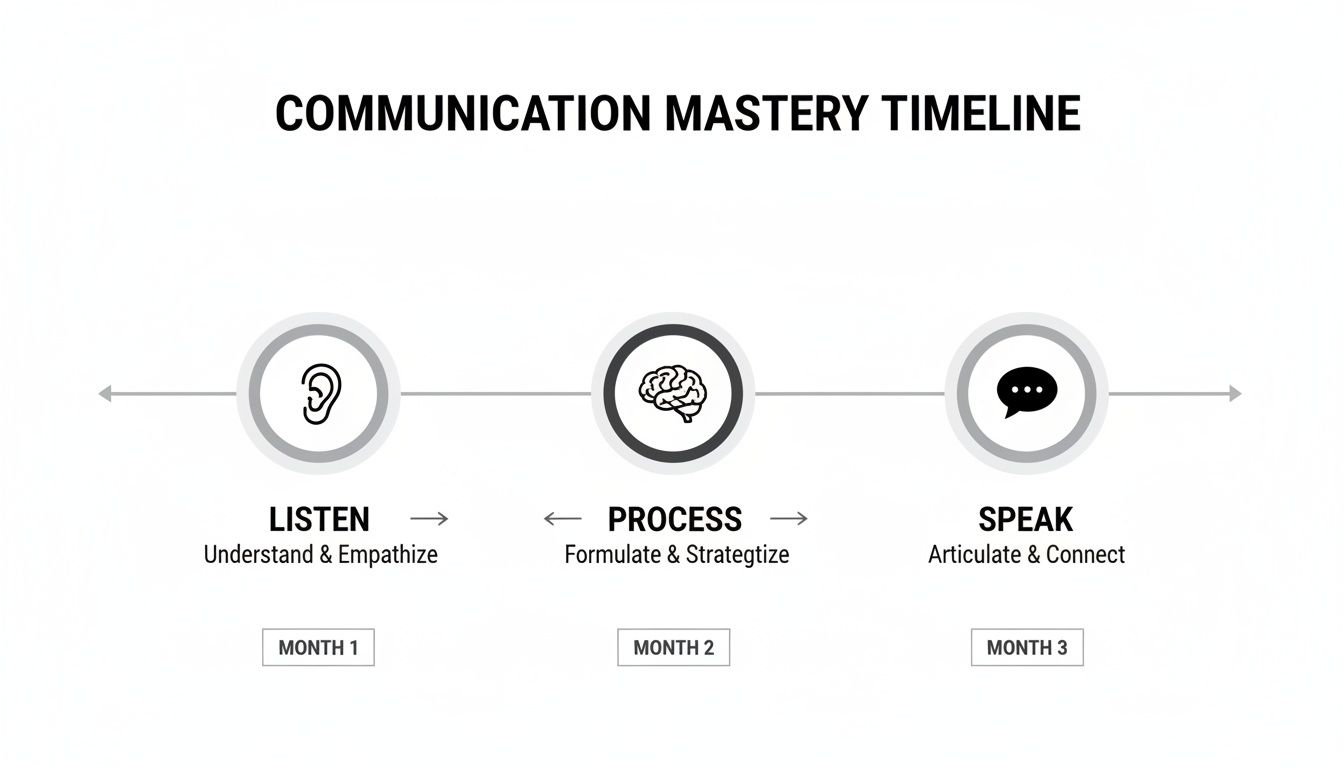
This highlights a key truth: powerful speaking isn’t just about talking. It’s the final product of deep listening and careful thought.
Weeks 5-8: Active Practice and Application
With a solid foundation of awareness, it’s time to start actively applying new techniques, especially in higher-stakes situations. This is where you move from passively noticing to actively doing.
- Week 5: Focus on Structuring Your Thoughts. When you contribute to a meeting this week, use the PREP method (Point, Reason, Example, Point) at least twice. It’s a game-changer for sounding coherent and confident on the spot.
- Week 6: Focus on Giving Better Feedback. Find one opportunity to give constructive feedback using the Situation-Behavior-Impact (SBI) framework. It turns vague criticism into actionable advice.
- Week 7: Focus on Presentation Pacing. If you have a presentation coming up, record yourself practicing. If not, just record a two-minute summary of a project you’re working on. Listen back specifically for your pacing and vocal variety.
- Week 8: Focus on Handling Tough Questions. In your next Q&A session, practice repeating a complex question back to the group before you answer it. This buys you thinking time and ensures everyone is on the same page.
Weeks 9-12: Integration and Refinement
The final month is all about making these new skills feel like second nature. You’ll work on consistency and adapting your approach to different people and situations, cementing all the progress you’ve made.
These skills are exactly what employers are looking for. In fact, 57% rank communication as the most important skill for new hires. They specifically value verbal skills (55%), presentation skills (47%), and active listening (36%) even more than technical know-how.
- Week 9: Focus on Leading a Discussion. Volunteer to facilitate a small part of a team meeting. Your goal is to keep the conversation on track and ensure everyone has a chance to speak.
- Week 10: Focus on Proactive Updates. Send a project update email to your manager that anticipates their questions before they even have to ask them. This demonstrates foresight and builds trust.
- Week 11: Focus on Navigating Disagreement. The next time a colleague disagrees with you, consciously focus on understanding their perspective before you restate your own. Try saying, “Help me understand your thinking on this.”
- Week 12: Focus on Reflection and Future Planning. Look back at your progress. What one or two skills made the biggest difference for you? Create a simple plan to keep practicing and refining them going forward.
To help you visualize this journey, here’s a sample schedule.
Sample 12-Week Communication Practice Schedule
This table breaks down the 12-week program into a simple, actionable format. You can use it as a starting point and customize the tasks to fit your specific role and goals.
| Week | Focus Area | Actionable Task Example |
|---|---|---|
| 1 | Active Listening | In one meeting, paraphrase someone’s point before you respond. |
| 2 | Email Clarity | Cut 10% of the words from every important email you send. |
| 3 | Nonverbal Cues | Practice “lighthousing” eye contact in a team discussion. |
| 4 | Filler Words | Tally your use of “um” or “like” for one full day. |
| 5 | Structured Speaking | Use the PREP method to make a point in a meeting. |
| 6 | Constructive Feedback | Give feedback to a colleague using the SBI framework. |
| 7 | Vocal Variety | Record a 2-minute project summary and check your pacing. |
| 8 | Answering Questions | Repeat a complex question before answering it in a Q&A. |
| 9 | Facilitation Skills | Lead a 15-minute segment of a team huddle. |
| 10 | Proactive Communication | Send a status update that anticipates your manager’s questions. |
| 11 | Managing Disagreement | When challenged, first ask questions to understand their view. |
| 12 | Reflection & Planning | Identify your top 2 skills and plan how to continue practicing them. |
This isn’t just a checklist; it’s a roadmap for building habits. Consistency is far more important than intensity. Stick with the plan, and you’ll build the skills and confidence to communicate more effectively in any professional setting.
Frequently Asked Questions
Even with the best intentions and a solid plan, you’re going to run into some real-world communication snags. It happens. Here are some of the most common questions I get, along with some practical advice for navigating them.
What If My Boss Just… Doesn’t Communicate?
Dealing with a manager who’s a black hole of information is incredibly frustrating. The key here is to shift from being passive to proactive. You can’t just wait for them to give you what you need.
Instead of hoping for an update, take control by scheduling brief, regular check-ins. When you do, frame your questions to be as specific and action-oriented as possible. Don’t ask, “Any updates on Project X?” Instead, try saying, “To move forward with Project X, I need your decision on A or B by tomorrow.” This makes it easy for them to give you a quick answer and keeps things moving without needing a long, drawn-out conversation.
How Do We Adapt All This for Remote Teams?
When you’re working remotely, clarity isn’t just important—it’s ten times more important. You lose all those non-verbal cues like body language and tone of voice, which means you have to be much more deliberate in how you communicate.
The best rule of thumb? Over-communicate. Be crystal clear about your status and when you’re available.
A few practical tips:
- Use descriptive email subject lines so people know exactly what you need at a glance.
- Make sure every message has a clear call to action. What do you want the other person to do?
- If a topic is getting complex, don’t get stuck in a long, confusing email or Slack thread. Just hop on a quick video call. It’ll almost always be faster and more effective.