Mastering the General American Accent for Professionals
Ever wonder what makes the voices on national news broadcasts or in Hollywood blockbusters sound so clear and universally understood? You’re hearing the General American accent in action.
Think of it less as a lack of an accent and more as a ‘universal key’—a way of speaking that unlocks clear communication across North America and, increasingly, the world.
Understanding The General American Accent
Often called “GenAm” or the “Standard American Accent,” General American is really a non-regional dialect. Its greatest strength lies not in what it sounds like, but in what it lacks: the strong, identifiable markers that tie an accent to a specific place.
Unlike the distinct sounds of Boston, New York City, or the Deep South, GenAm comes across as neutral to most American listeners. This neutrality is exactly what makes it such a powerful tool for professionals—especially non-native speakers. It ensures your ideas, not your pronunciation, become the focus of every conversation.
How Did One Accent Become The Standard?
So, how did one way of speaking become the default? The story of GenAm is tangled up with the rise of mass media in the 20th century. While its roots are often traced back to the American Midwest, its big break came with the explosion of radio and television.
After World War II, broadcasters needed a clear, accessible form of speech that could connect with audiences from California to Maine. The Midland dialect, with its lack of sharp regional edges, was the perfect candidate. Media networks adopted it, and by the 1950s, surveys showed over 60% of Americans already considered it the ‘standard’ way to speak. This history is key to understanding why it holds so much influence today.
Why It Matters For Professionals
That influence now extends far beyond TV screens. GenAm has become the unofficial dialect of international business, technology, and academia. For any professional, getting comfortable with this accent offers some serious advantages.
- Enhanced Clarity: Your message lands exactly as you intend it, without the risk of misinterpretation that can come with strong regional or foreign accents.
- Increased Confidence: When you know you’re being understood clearly, you naturally feel more self-assured during presentations, negotiations, or high-stakes client meetings.
- Broader Accessibility: Your ideas resonate with a much wider audience, from colleagues across the U.S. to international business partners.
The goal isn’t to erase your identity. It’s about adding a strategic communication tool to your professional toolkit—one that ensures you’re understood clearly and effectively the first time you speak.
By focusing on the core elements of American English pronunciation, you can build a more universally understood speaking style that lets your expertise shine through in every single interaction.
The Core Sounds That Define the Accent
To really get a handle on the General American accent, you have to break it down into its most basic parts—the specific sounds that give it that trademark clarity. Think of it like learning the key spices in a recipe. Once you know what they are and how they taste, you can start combining them to create the final dish.
Without a doubt, the most defining ingredient of this accent is its rhoticity.
This might sound like a complex linguistic term, but the idea is actually very simple. Rhoticity just means the ‘r’ sound is pronounced everywhere it appears in a word’s spelling. This is probably the single most recognizable feature that separates the General American accent from many British accents and even some regional American ones.
The Power of the American R
In a rhotic accent like General American, the ‘r’ is never silent. You hear it distinctly at the end of words like car and never, and right in the middle of words like hard and work. This consistent pronunciation is a cornerstone of the accent’s clarity and why it’s so widely understood.
Let’s look at a quick comparison:
- Word: Car. In General American, it’s pronounced with a hard /kɑːr/ sound. In a non-rhotic accent (like many in England), it sounds more like “cah.”
- Phrase: Hard work. The ‘r’ sounds in both words are fully articulated, giving the phrase a strong, crisp quality.
Getting this rhotic ‘r’ right is a massive step toward sounding more natural. It requires a specific tongue position—curled back just a bit, without touching the roof of your mouth. It’ll feel strange at first, but with a little practice, it becomes second nature.
This rhotic ‘r’ isn’t just some modern quirk. The General American accent grew out of a mix of dialects, especially from the Midwest and West, as settlement patterns shifted in the 19th century. Its global reach is really a story about media. Starting with the radio boom of the 1920s, it quickly came to dominate 80% of national broadcasts by 1940, effectively exporting it to the world.
This clarity and lack of strong regional tells made it perfect for mass communication, helping to power Hollywood’s global box office success, which hit $42 billion in 2019.
Distinguishing Key Vowel Sounds
Right after the ‘r’, vowels are the next piece of the puzzle. English has a ton of vowel sounds, and General American relies on making clear distinctions between them to avoid mix-ups. Getting a single vowel wrong can completely change a word’s meaning.
For instance, the only difference between “ship” and “sheep” is a short vowel sound (/ɪ/) versus a long one (/iː/). These tiny shifts are everything. You can dive deeper into the complexities and importance of English vowel sounds in our comprehensive guide.
A crucial feature of natural-sounding American speech is how unstressed vowels get reduced to a neutral “uh” sound. This is called the schwa (/ə/), and it’s the most common sound in all of English. You hear it in words like about (the ‘a’) and sofa (the final ‘a’).
Using the schwa correctly is the secret to capturing the natural rhythm and flow of the General American accent. Without it, your speech can sound a bit stiff or even robotic.
The Subtle Art of the T-Flap
Finally, let’s talk about a consonant sound that is a true hallmark of an authentic General American accent: the t-flap. This is what happens when a ‘t’ sound, caught between two vowels, softens into a light ‘d’ sound.
This isn’t lazy speaking; it’s a standard feature that makes speech smoother and faster.
- The ‘t’ in water sounds more like /ˈwɑːdər/.
- The ‘t’ in city sounds like /ˈsɪdi/.
- The phrase get it often comes out sounding like “geddit.”
Mastering the t-flap is one of those subtle details that closes the gap between sounding like you’re reading from a textbook and speaking with real, conversational fluency. When you combine it with a strong rhotic ‘r’ and clear vowels, you get the unmistakable sound of the General American accent.
How General American Compares to Regional Accents
To really get a feel for the clarity of the General American accent, it helps to put it side-by-side with its more colorful regional cousins. I like to think of GenAm as a foundational color like white or black; its power comes from its neutrality. Regional accents, on the other hand, are like vibrant, distinct hues—beautiful and expressive, but you know them the second you see (or hear) them.
Comparing them reveals exactly why General American has become a sort of common ground for clear communication. The differences often boil down to just a few key phonetic markers that instantly signal where a speaker might be from. By sidestepping these strong markers, GenAm maintains its widely understood quality.
So, let’s break down how the core sounds of GenAm differ from the unique signatures of other prominent American dialects.
The Rhotic R: Boston vs. General American
One of the most immediate contrasts comes from the East Coast, especially with the classic Boston accent. The defining difference here is rhoticity. As we’ve covered, General American is fully rhotic, meaning the ‘r’ sound gets pronounced every single time it appears in a word.
The Boston accent, however, is famously non-rhotic. This means the ‘r’ gets dropped at the ends of syllables or before a consonant.
- General American: “Park the car.” (Both ‘r’ sounds are hard and clear.)
- Boston Accent: “Pahk the cah.” (The ‘r’ sounds vanish, replaced by a soft vowel.)
This one feature creates a massive difference in sound and perception. While charming, that non-rhotic ‘r’ is a powerful regional identifier that General American speech carefully avoids. It’s a key reason for its perceived neutrality. You can learn more about how this quality contributes to the idea of a neutral American accent in our detailed guide.
Unique Vowel Sounds: The New York City Signature
Moving just a bit south to New York City, we find an accent largely defined by its unique vowel pronunciations. While a traditional New York accent is also non-rhotic, its vowels are what truly make it stand out from the crowd.
A classic example is the vowel in words like “coffee” or “dog.” In General American, this is a relatively open, simple sound. In a traditional New York accent, it often becomes a distinct diphthong—a two-part vowel sound—that comes out closer to “caw-fee.”
What to Listen For
General American maintains consistent, predictable vowel sounds across words. In contrast, many regional dialects feature vowel shifts and diphthongs that are specific to that area, making them instantly recognizable.
This regional vowel system is a core part of the accent’s identity. Because General American sticks to more standardized vowel sounds, it sidesteps these hyperlocal pronunciations, allowing it to be more universally understood without a listener needing to adjust their ear.
This concept map shows how these core sounds—like rhoticity, vowel consistency, and the T-flap—form the very foundation of General American pronunciation.
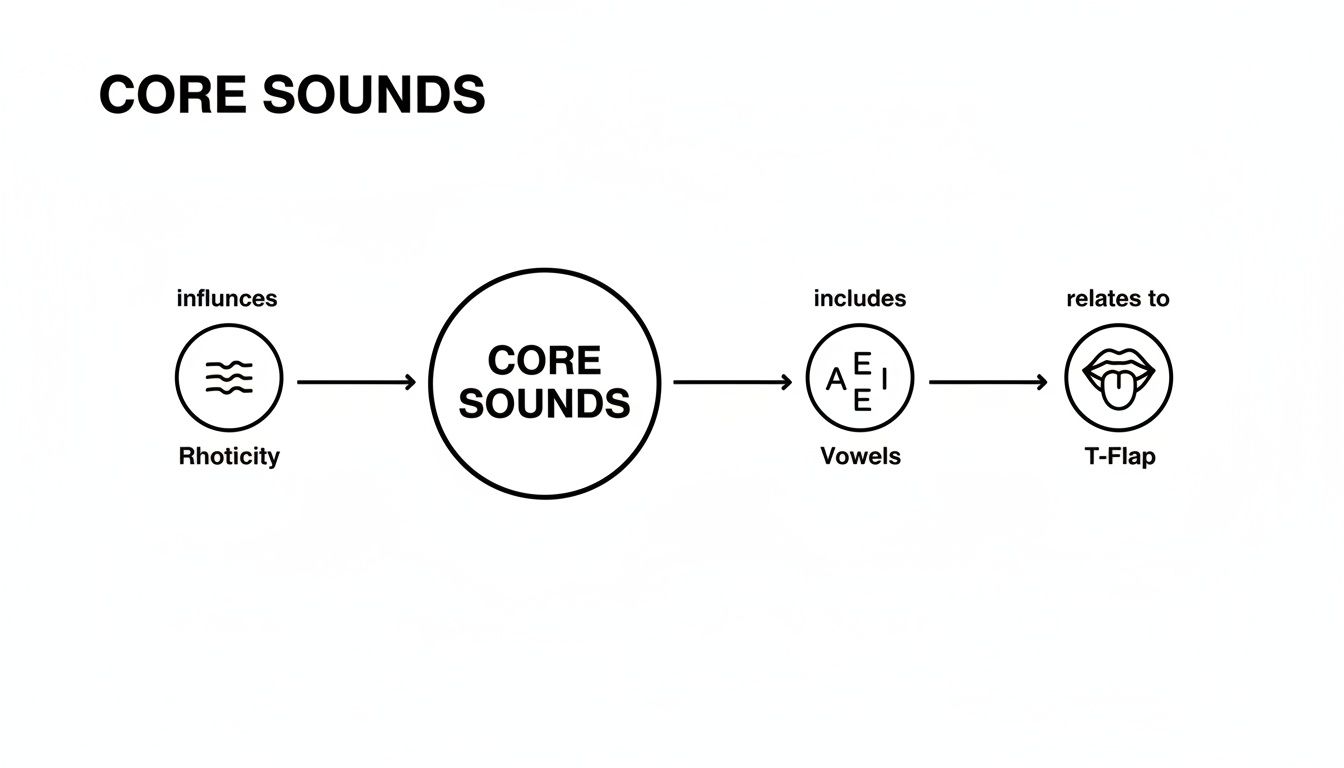
This visual really drives home how mastering these fundamental elements is the key to achieving the clear, neutral sound characteristic of this accent.
Melody and Cadence: The Southern Drawl
When we talk about the Southern American accent, it’s less about specific vowel or consonant changes and more about intonation and rhythm—what’s often called the “Southern drawl.” This involves elongating certain vowel sounds and a more melodic, almost musical pitch pattern.
For instance, a word like “right” in General American is short and crisp. In many Southern accents, it might be stretched into something like “raaaht,” with the vowel sound drawn out. This creates a slower, more relaxed cadence that’s instantly recognizable.
General American vs. Regional US Accents
Here’s a quick look at how these key features stack up against each other. This table really highlights the specific phonetic choices that set these accents apart.
| Feature | General American | Southern American | New York City Accent |
|---|---|---|---|
| Rhoticity | Fully rhotic (hard ‘r’) | Mostly rhotic | Non-rhotic (‘r’ is dropped) |
| Vowels | Standard and consistent | Vowels are often elongated | Unique diphthongs (‘coffee’) |
| Rhythm | Even and stress-timed | Slower, more melodic | Faster pace |
As you can see, General American maintains a more even, predictable rhythm without the significant vowel elongation you find in the South. These comparisons make it clear that the “neutrality” of the General American accent isn’t an absence of features. Instead, it’s a deliberate adherence to a set of phonetic norms that avoid the strong, beautiful, but ultimately regional markers of other dialects.
The Professional Edge of a Clear American Accent
Polishing your American accent is about much more than just pronunciation—it’s a genuine strategic career move. In a globalized world, clear communication is the ultimate currency. Think of the General American accent as a universally understood version of that currency. It helps ensure your expertise is the first thing people notice, not the effort it takes to understand you.
Picture yourself leading a virtual call with stakeholders scattered across different continents. When you speak with a familiar rhythm and clarity, you instantly lower the cognitive load for everyone listening. They can stop trying to decipher your words and start focusing on your message, your data, and your vision. This leads to more productive discussions and quicker buy-in. It’s not about changing who you are; it’s about adding a powerful tool to your professional toolkit.
Enhancing Credibility and Authority
In high-stakes situations—like an investor pitch or a board meeting—confidence is everything. A clear, steady accent projects authority and builds trust almost subconsciously. When your speech flows smoothly and predictably, it signals to listeners that you are in complete command of your subject.
This simple shift removes communication friction that might otherwise create hesitation or doubt in their minds. The result? Your ideas land with more impact, and your arguments become far more persuasive. You can learn more about how your accent affects your career and the practical steps you can take to turn it into an asset.
Navigating a Global Business Landscape
It’s a common misconception that most Americans speak with the General American accent. In reality, it’s used by a minority—statistical estimates suggest only about 10.7% of the US population, or around 33.4 million people.
So, where does its power come from? It comes from global familiarity. The US has 247.7 million native American English speakers, making it the world’s largest native English-speaking population. Amplified for decades by global media and business, this familiarity is what makes the accent function so well as a professional standard.
This global recognition provides tangible benefits:
- Reduced Misunderstanding: Clear pronunciation of industry-specific jargon ensures technical accuracy and helps prevent costly errors.
- Improved Networking: Approaching new contacts at conferences becomes much easier when your speech is immediately clear and engaging.
- Greater Leadership Potential: Leaders who communicate effortlessly are often perceived as more capable of guiding diverse, international teams.
The core benefit is simple: when you remove the barrier of a hard-to-understand accent, you close the gap between your true expertise and how others perceive it. Your professional value becomes instantly more apparent.
Real-World Scenarios and Technological Aids
Imagine a software engineer presenting a complex system architecture to non-technical stakeholders. By using a clear, well-paced American accent, they can break down complicated ideas into digestible information. The consistent rhythm and intonation guide the listener’s attention, making the entire presentation more effective.
Beyond human coaching, the demand for this kind of clarity has also spurred technological solutions. For those creating content who need professional-sounding narration, there are now a variety of AI Voiceover Tools for Marketing Videos that aim to replicate this clear style of speech.
Ultimately, mastering the General American accent helps you compete on a level playing field, where the strength of your ideas—not the clarity of your speech—is what determines your success.
Actionable Steps to Master the Accent

Moving from knowing about the accent to actually doing it can feel like a massive jump. But for busy professionals, it’s not about finding extra hours in the day. The secret is weaving smart, consistent practice into the routine you already have. Forget boring drills—we’re focused on effective techniques that create real, noticeable progress.
The path to mastering the General American accent is paved with focused listening and targeted repetition. It’s a lot like training for a sport. You have to build muscle memory in your tongue, lips, and jaw, and that only comes from a steady workout regimen.
Start with Active Listening
Before you can make the right sounds, you have to be able to hear the right sounds. This is where active listening comes in. It’s way more than just having English-language media playing in the background; it’s about consciously tuning your ear to the specific rhythms, pitches, and individual sounds of the General American accent.
Your mission is to soak in its musicality—the way the pitch rises and falls, the syllables that get the stress, and the connected speech that makes it all sound so smooth.
Here are a few gold mines for active listening:
- NPR Broadcasts: National Public Radio anchors are pros, trained for vocal clarity and sticking closely to a standard American accent.
- Podcasts with Clear Narration: Shows like “This American Life” or “Freakonomics Radio” have hosts with crisp, easy-to-follow speech patterns.
- Audiobooks: Look for non-fiction books read by the author or a professional narrator known for their clear delivery.
As you listen, zoom in on one thing at a time. One day, you might listen only for the rhotic ‘r’. The next, you could track how speakers use the t-flap in words like “water” or “city.” This kind of focused listening trains your brain to pick up on the subtle patterns you want to eventually copy.
Embrace the Shadowing Technique
Once your listening skills are getting sharper, it’s time to start talking. One of the absolute best methods for this is called shadowing. The idea is simple: you mimic a native speaker in real-time, repeating what they say almost as soon as you hear them say it.
Shadowing is a game-changer because it forces you to match not just the pronunciation, but the entire package—the rhythm, stress, and intonation of the speaker. It’s a shortcut to moving past word-for-word translation from your native language and helps you internalize the natural flow of American English. You can dive deeper into how to use the shadowing technique to improve your accent fast to get started.
When you first try shadowing, don’t stress about catching every single word perfectly. Your goal is to capture the melody and cadence of the speech. Focus on the flow, not just the isolated sounds. You’ll be amazed at how quickly your own speech starts to sound more natural.
To get even more out of this, you might use screen recording for training. This lets you watch a native speaker while recording your own imitation, giving you powerful visual and audio feedback to compare against.
Use Targeted Drills for Problem Sounds
While shadowing helps with the big picture, targeted drills are your secret weapon for conquering those specific sounds that trip up most non-native speakers. These exercises isolate your problem spots and build the muscle memory you need to get them right every time.
Here are a few classic exercises to work into your routine:
- Minimal Pair Drills: This involves practicing words that differ by only a single sound, training both your ear and your mouth to make tiny but critical distinctions. For example:
- Ship vs. Sheep (to practice the /ɪ/ and /iː/ vowel sounds).
- Sit vs. Seat (another great pair for short vs. long vowels).
- Thin vs. Fin (to nail the difference between “th” and “f” sounds).
- Tongue Twisters for the American ‘R’: Since the rhotic ‘r’ is a pillar of the General American accent, tongue twisters are a great way to practice it over and over in different word positions.
- “Around the rugged rock, the ragged rascal ran.”
- “The thirty-three thieves thought that they thrilled the throne throughout Thursday.”
- Poetry and Prose Reading: Reading out loud is a fantastic tool. Poetry, with its built-in rhythm and meter, is especially good for internalizing the musical side of the accent. Start with something simple and even a little humorous to keep it engaging.
The real key here is consistency. A focused 15-20 minutes of practice every day will do far more for you than a long, two-hour session once a week. It’s that steady, daily repetition that rewires your brain and builds the new habits for a clear, confident General American accent.
Common Questions About Learning the General American Accent
Jumping into any new skill kicks up a lot of questions, and learning the General American accent is no different. Professionals I work with often ask about the timeline, what the real goal is, and how to practice without sinking hours they don’t have. Getting straight answers sets the right expectations and gives you the confidence to get started.
Let’s tackle some of the most common hurdles and concerns people have when they start this journey. My goal is to give you a clear, practical roadmap so you can begin with a solid plan.
How Long Does It Take to Learn?
This is always the first question, and the honest answer is: there’s no magic number. Your progress really boils down to a few things—your native language, your starting point with English pronunciation, and most importantly, how consistently you practice.
That said, there’s a general timeline most people follow. With focused practice of about 15-20 minutes, 3-4 times a week, most professionals see real, noticeable improvements in their clarity and confidence within 3 to 6 months. Think of this phase as building the initial awareness and muscle memory for new sounds.
Getting to a point where the new speech patterns feel completely second nature? That often takes a year or more of sustained effort. But the secret isn’t cramming for hours. It’s about weaving short, focused practice sessions into your daily routine. Consistency always wins out over intensity.
Is the Goal to Eliminate My Original Accent?
This is a huge one, and it’s based on a common misunderstanding. Let me be clear: the goal is accent modification, not elimination. Your accent is a part of who you are—it tells the story of your background and your life. We never want to erase that.
Instead, think of it as adding a powerful new tool to your professional toolkit. You’re learning a specific way of speaking for situations where absolute clarity is a must, like a high-stakes client presentation or a global team call.
The real objective is to speak so clearly that your listeners focus on what you’re saying, not how you’re saying it. It’s about removing communication friction so your expertise can shine through, while still honoring where you come from.
Many of the most successful professionals I know are multilingual and can switch between accents or languages depending on the context. This skill, often called code-switching, is a huge professional asset. Adopting a General American accent for work doesn’t mean you’re losing your voice; it means you’ve gained a new one.
What Are the Best Free Resources for Practice?
You definitely don’t need to shell out for expensive programs to get started. There’s a ton of high-quality, free material out there that can help you build a solid foundation. The most effective training is a mix of listening, mimicking, and checking your own work.
Here are some of the best free resources you can start using today:
- Listen to Professional Broadcasters: Tune into sources known for their crisp, standard American speech. NPR (National Public Radio) and the PBS NewsHour are goldmines. Their anchors are professionally trained for clarity and provide fantastic models for rhythm and intonation.
- Leverage High-Quality Podcasts: Shows like ‘This American Life‘ feature narration that is a perfect example of the General American accent used in natural storytelling. It’s a great way to internalize the cadence of American English.
- Watch Reputable YouTube Channels: Channels like Rachel’s English are amazing. They offer incredibly detailed visual lessons on pronunciation, often using slow-motion video to show you the exact mouth and tongue positions for those tricky sounds.
- Use Your Smartphone’s Voice Recorder: This might be the most powerful free tool of all, and it’s totally underused. Recording yourself reading a paragraph helps you hear the gap between where you are and where you want to be. Regular self-review is the key to tracking your progress and knowing what to work on next.
By pulling these resources together, you can build a really solid self-study plan that fits your schedule and budget. The trick is to engage actively—listen with purpose, practice with intention, and review your own speech with a critical (but kind!) ear.
Ready to move beyond free resources and get expert, personalized guidance? Intonetic offers a structured 12-week coaching program designed for busy professionals. Book a free assessment today and receive a no-strings PDF starter guide to kickstart your journey toward clearer, more confident communication. Learn more at Intonetic.com.