What Is the Unstressed Syllable in American English
An unstressed syllable is the quieter, quicker, and often reduced part of a word. Think of it as the soft background music that connects the louder, more important sounds, making American English flow naturally.
The Unstressed Syllable Explained in Simple Terms
If you've ever felt your English sounded a bit robotic or "heavy," the unstressed syllable is likely the missing piece of the puzzle. It’s the secret ingredient that creates the natural rhythm and musicality of American English.
Imagine a word as a small piece of music. The stressed syllables are the strong, definite downbeats, while the unstressed ones are the soft, rapid upbeats in between. Mastering these weak sounds is the key to unlocking clearer, more confident speech.
When you learn to reduce and quicken these syllables, you're not just improving pronunciation—you're adopting the core rhythm that native speakers use and expect to hear. This small change has a huge impact on your overall intelligibility. While both syllable stress and sentence stress shape how we speak, understanding the unstressed syllable within individual words is your foundational first step. For a deeper dive into how this fits into the bigger picture, you can read more about the difference between syllable stress and sentence stress.
Stressed vs Unstressed Syllables at a Glance
So, what exactly sets a stressed syllable apart from an unstressed one? It comes down to four key characteristics.
This quick comparison table breaks down the core differences. Understanding these distinctions is the first step toward hearing them correctly in native speech and, eventually, producing them yourself.
| Characteristic | Stressed Syllable | Unstressed Syllable |
|---|---|---|
| Length | Longer | Shorter, quicker |
| Volume | Louder | Quieter |
| Pitch | Higher pitch | Lower, flatter pitch |
| Vowel Sound | Clear, full vowel sound | Reduced or neutral vowel (often schwa /ə/) |
Think of the stressed syllable as taking center stage—it's longer, louder, higher in pitch, and has a very clear vowel. The unstressed syllable, on the other hand, is the supporting actor. It’s quick, quiet, and its vowel sound often gets "reduced" to a lazy, neutral sound. This contrast is what gives American English its characteristic rhythm.
Why Weak Syllables Create Strong Communication
Getting a handle on the unstressed syllable isn't just a minor pronunciation tweak; it's the key to unlocking the very rhythm of American English. Here’s why: English is a stress-timed language. This means its cadence is built around the time between the strong, stressed syllables, not the total number of syllables in a sentence.
I like to use a rubber band analogy. Imagine stretching a rubber band between two posts. Those posts are the strong, stressed syllables in your sentence. The rubber band itself represents the fixed amount of time between them.
Now, what if you have to squeeze several weak, unstressed syllables onto that rubber band? They have no choice but to shrink and compress to fit into that space. This is exactly what happens in spoken English. Unstressed syllables are spoken faster, quieter, and with a reduced vowel sound (like the schwa) to keep the rhythm consistent.
This concept map breaks down the fundamental difference between a loud, clear stressed syllable and its quiet, reduced counterpart.
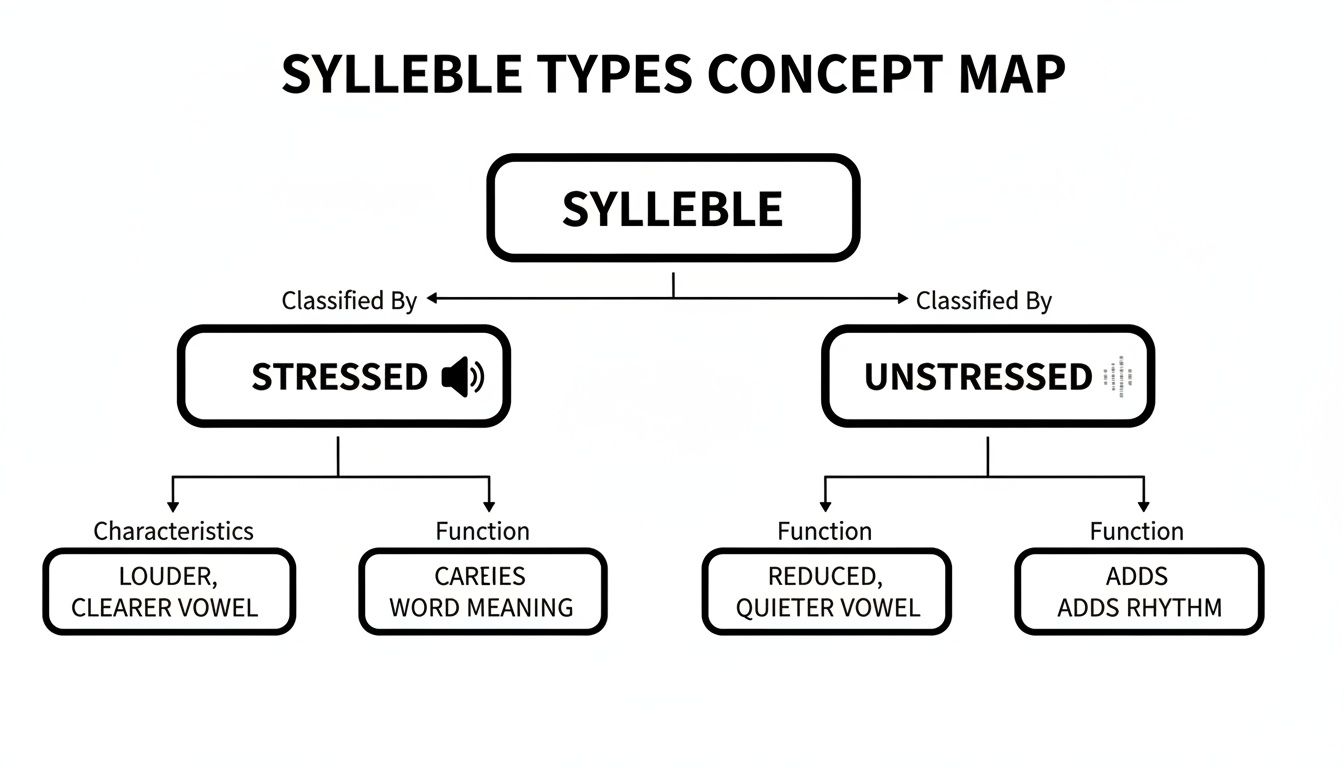
As you can see, stressed syllables are designed to be acoustically prominent. Unstressed syllables, on the other hand, are intentionally minimized to maintain that rhythmic flow we've been talking about.
The Rhythm Divide: Stress-Timed vs. Syllable-Timed Languages
This rhythmic structure is a world away from syllable-timed languages like Spanish, French, Italian, or Japanese. In those languages, every syllable gets roughly the same amount of time and emphasis. This creates a more even, staccato, almost machine-gun-like rhythm.
If your native language is syllable-timed, your natural instinct is to give every English syllable equal weight. While perfectly logical, this habit directly clashes with the core rhythm of English. It can make your speech sound robotic or unclear, forcing native listeners to work much harder to follow along.
By failing to reduce the unstressed syllable, you are essentially breaking the rhythmic contract of American English, forcing your listener to work harder to understand you.
This isn't just a small accent issue; it has a real, measurable impact. Waveform analysis shows that native English speakers shorten unstressed syllables by 40-60% compared to stressed ones. When professionals from syllable-timed language backgrounds miss this rhythm, it can cause a significant drop in their intelligibility during crucial conversations.
Why Mastering Reduction Matters
Learning to weaken your weak syllables is one of the most powerful things you can do to sound natural, authoritative, and easy to understand. When you correctly reduce those unstressed vowels and shorten their duration, you're aligning your speech with the exact patterns native listeners are wired to expect. It makes your communication feel fluid and effortless.
It’s a foundational skill that’s deeply connected to other aspects of fluency. For example, getting this reduction right is a huge part of understanding how connected speech and sound changes work together to create smooth, flowing sentences.
This concept is so fundamental that it’s not just for human learners. Even the most advanced AI voice generators are programmed to master syllable stress to sound authentically human. By focusing on this, you're learning the "source code" of natural American English rhythm, which will directly strengthen your communication and boost your professional presence.
How to Actually Hear Unstressed Syllables
Okay, the theory is one thing. But training your ear to catch an unstressed syllable in the wild—during a fast-paced conversation or a presentation—is a completely different skill. It takes active, focused listening.
Think of it like trying to spot a specific bird call in a noisy forest. At first, it all just blends into a wall of sound. But once you know what to listen for, you can pick it out effortlessly.

The key is knowing exactly what you're listening for. Unstressed syllables have three distinct acoustic fingerprints that make them stand out by not standing out. You just have to tune your ear to these quiet but crucial signals.
Listen for the Acoustic Cues
When you hear a native speaker say a word, the unstressed syllable will always have these characteristics when compared to its stressed neighbor. Start listening for them on purpose.
- A Drop in Pitch: The speaker’s voice gets flatter and lower on the unstressed syllable. It's the valley between the mountain peaks of the stressed syllables.
- A Decrease in Volume: It’s simply quieter. The unstressed syllable is spoken with less breath and energy, making it fade into the background.
- A Shorter Duration: This is probably the most important cue. The unstressed syllable is spoken fast, almost like the speaker is rushing to get to the next stressed beat.
By actively listening for these three cues—pitch, volume, and length—you stop being a passive hearer and become an active analyst of English rhythm. This is the bedrock skill for self-correction.
A fantastic way to build this muscle is to consciously train your ear to recognize English sounds accurately. Doing so builds the specific auditory awareness you need to pinpoint these subtle differences in everyday speech.
Spotting the Signature Schwa Sound
If there's one secret weapon for identifying an unstressed syllable, it's hearing the schwa /ə/ sound. This is the single most common vowel sound in the entire English language, and it shows up almost exclusively in unstressed positions.
The schwa is a lazy, neutral, "uh" sound. It’s the sound you hear at the beginning of "a-bout" and at the end of "sof-a." Because it takes almost no effort to make, it’s the perfect sound for a syllable that needs to be quick and quiet. When a clearer vowel like 'a', 'e', or 'o' gets de-emphasized in a word, it very often morphs into this indistinct schwa.
Let's look at a classic example of how stress can completely flip a vowel's sound.
Consider this word pair:
- PHO-to-graph: The first 'o' is stressed. It's long and clear, making a distinct /oʊ/ sound. The second 'o' is unstressed and gets reduced to a weak schwa (gra-ph /ə/).
- pho-TO-gra-pher: Now the stress moves to the second syllable. The first 'o' is no longer important, so it gets reduced to a schwa (phə–TO).
See that? The same letter—'o'—sounds completely different depending on whether it lands on a stressed or unstressed beat. The moment you hear that weak "uh" sound, you can be almost certain you’ve found an unstressed syllable. Learning to spot the schwa is like getting a backstage pass to the rhythm of English.
Common Mistakes That Disrupt Your English Rhythm
Just knowing what an unstressed syllable is isn't enough; you also have to sidestep the common traps that keep you from actually using them. So many learners unknowingly bring speech habits from their native language into English, which creates a rhythmic clash that native listeners can feel, even if they can't explain why.
Spotting these patterns in your own speech is the first real step toward fixing them. Once you become aware of these tendencies, you can start to consciously reshape your pronunciation habits and build a more natural, fluid delivery.
Giving Every Syllable Equal Weight
This is by far the most common mistake I see, especially from speakers of syllable-timed languages like Spanish or French. It’s the habit of giving every single syllable the same length and punch. This turns a word like "pro-ba-bly" (which natives often squish into "PROB-ly") into a very deliberate "pro-ba-bly," with each part getting equal stage time.
This habit completely flattens the natural music of English. You’re essentially forcing your listener to process more sound than they expect, which can slow down their comprehension and make your speech sound a bit heavy or robotic. Real fluency is often about learning what not to say, or at least, what to de-emphasize.
Mastering unstressed syllables is about subtraction, not addition. It's the art of knowing which sounds to reduce, quicken, and quiet down to let the stressed syllables shine through.
This idea is the bedrock of natural American English rhythm. If you want to dive deeper into how all these patterns create that rhythm, our guide on rhythm and timing in American English is the perfect next step.
Misplacing the Word Stress Entirely
Another frequent issue is putting the emphasis on the wrong syllable completely. For example, stressing the second syllable in "DE-vel-op-ment" by saying "de-VEL-op-ment" can make the word tricky for a native speaker to recognize right away, even if every individual sound is perfect.
Word stress in English isn't random; it's a fixed code for each word. Getting it wrong is like dialing a phone number with two digits swapped—the call just won't go through. This is exactly why practicing common stress patterns is so vital for building the right muscle memory.
Failing to Reduce Vowels to Schwa
The final major hurdle is the resistance to letting go of full, clear vowel sounds in those weak, unstressed positions. I often hear learners pronounce the "o" in "com-put-er" as a distinct /ɒ/ or /oʊ/ sound, when it needs to be reduced to that quick, neutral, almost lazy schwa: /kəmˈpjuːtər/.
This failure to shorten and neutralize the unstressed vowel is a classic tell of non-native speech. In fact, one study on Japanese learners of English found that the length of their unstressed syllables was a huge factor in how fluent they sounded. Native speakers had a stressed-to-unstressed syllable duration ratio of about 2.5:1, but the learners averaged only 1.8:1. That might seem like a small difference, but it was enough to significantly drop their fluency ratings in the study.
Mastering the unstressed syllable is a huge piece of the puzzle for achieving natural English rhythm. You can get a much bigger picture by understanding prosody in speech, which explores how rhythm, stress, and intonation all work together to create meaning.
Practical Drills For Mastering Word Stress
Knowing the theory behind unstressed syllables is one thing, but actually training your mouth to produce them correctly takes real, focused practice. This is where we shift from just knowing to actually doing. Think of this as your workout plan for building the muscle memory needed for that natural American English rhythm.
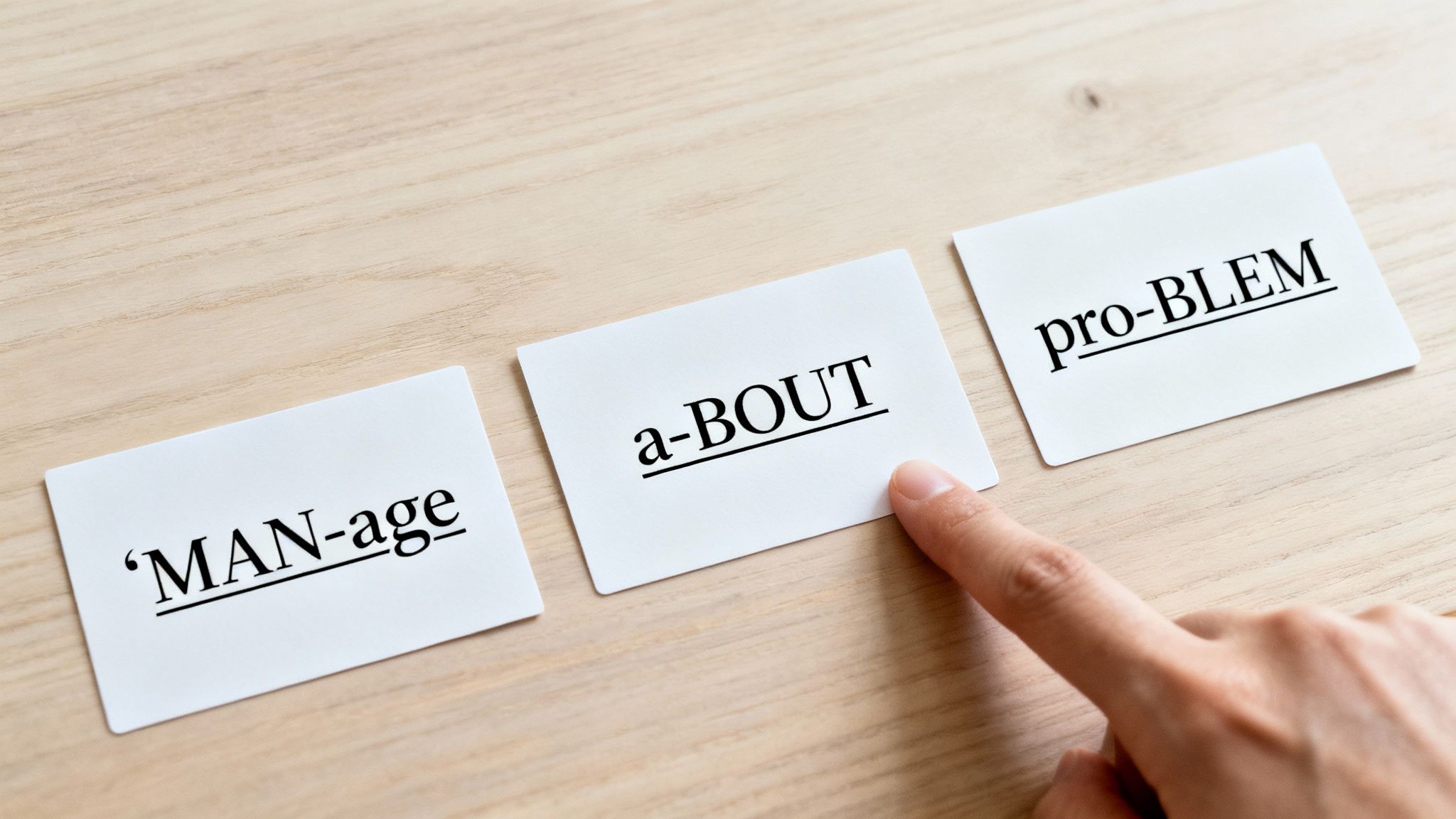
The name of the game here is high-volume repetition. We want these stress patterns to become so automatic that you're not even thinking about them in a real conversation. Let's dig into the most common rhythms you’ll use every single day.
Drill 1: The Strong-Weak (Trochaic) Pattern
This is, without a doubt, the most dominant rhythm in American English. The pattern is a classic DA-da, with a strong, clear first syllable followed by a weak, quick one. In fact, over 70% of two-syllable content words in English follow this exact pattern.
This strong-weak pulse is baked right into the language. It’s so fundamental that research shows toddlers learning English will drop the initial unstressed syllable in words 25% of the time, defaulting to this stronger first beat. If you're curious, you can read more about these fascinating language acquisition findings on PubMed.
To get the hang of this, say these words out loud. Really exaggerate the first syllable—make it longer, louder, and higher in pitch. Then, crush the second syllable, making it incredibly short and quiet.
- PROB-lem
- MAN-age
- PRES-ent
- DOC-tor
- HAP-py
Now, pop them into short sentences, keeping that rhythm locked in: "I have a PROB-lem." "Can you MAN-age it?" The goal is to physically feel the huge contrast between the strong and weak parts.
Drill 2: The Weak-Strong (Iambic) Pattern
While it’s not as common as the first pattern, the weak-strong (da-DA) rhythm is absolutely essential for tons of verbs and prepositions. With this one, the unstressed syllable comes first, acting like a little pickup note before you hit the main, stressed beat.
You hear this rhythm all the time in words like "a-BOUT" or "re-CEIVE." The first syllable is often just a tiny, quiet "uh" sound—the schwa—that you barely pronounce before landing firmly on that second, stronger syllable.
- a-BOUT
- be-LIEVE
- re-PORT
- de-CIDE
- ex-PLAIN
Try saying them. "Let's talk a-BOUT it." "I can't be-LIEVE that." Can you feel how that first syllable is just a little stepping stone to get to the more important one?
To help you get comfortable with these two core patterns, here is a table of common words to practice.
Common Stress Patterns for Practice
Use this table to drill the most common strong-weak (trochaic) and weak-strong (iambic) stress patterns in American English. Say them out loud and exaggerate the stressed syllable.
| Pattern Type | Stress Pattern | Example Words |
|---|---|---|
| Strong-Weak | DA-da | PENCIL, WATER, STUDENT, TABLE, ALWAYS, ANSWER, SUMMER |
| Weak-Strong | da-DA | AGAIN, BELOW, MYSELF, TODAY, EXCEPT, ARRIVE, CONTROL |
Getting these two foundational rhythms down will dramatically improve your clarity and flow.
Drill 3: Contrastive Pairs For Nouns vs. Verbs
Here's where English stress can feel a little tricky. Sometimes, the exact same word changes its stress pattern depending on whether you’re using it as a noun or a verb. This drill is fantastic for building the mental and physical flexibility to switch between patterns on the fly.
For this exercise, the rule of thumb is simple: nouns are often stressed on the first syllable (DA-da), while their verb versions get stressed on the second (da-DA).
Practice these pairs by saying them one after the other. Physically feel the emphasis shift from the front of the word to the back. This is a high-impact exercise for your pronunciation agility.
- OB-ject (noun) vs. ob-JECT (verb)
- CON-trast (noun) vs. con-TRAST (verb)
- REC-ord (noun) vs. re-CORD (verb)
- PRO-gress (noun) vs. pro-GRESS (verb)
At the end of the day, consistent practice is what cements new habits. If you're ready to go deeper into this process, check out our guide on how to train yourself to recognize and produce American English stress. Think of these drills as your starting point for truly transforming how you sound—and feel—when speaking English.
Your Questions About Unstressed Syllables Answered
Even after we’ve covered the core concepts, a few practical questions always come up. This is completely normal. It’s one thing to understand an idea, and another to feel confident applying it.
Let’s tackle the most common questions I hear from professionals. Think of this as a quick debrief to clear up any lingering confusion so you can move forward with your practice.
Does Every Multi-Syllable Word Have an Unstressed Syllable?
Yes, for all practical purposes, every English word with two or more syllables has this crucial contrast. The entire musicality of American English is built on this push-and-pull between strong, stressed beats and weak, unstressed ones. This isn't just a stylistic choice; it's the fundamental architecture of the language's rhythm.
Even in longer words that have a secondary stress (a syllable with medium emphasis), you'll still find unstressed syllables that get completely reduced. Take a word like "in-for-MA-tion." The primary stress lands on "MA," but that first syllable, "in-," is still significantly weaker and faster, creating the rhythmic contrast that native listeners expect to hear.
Can I Be Understood Without Mastering This Skill?
You can certainly get your basic point across, but your clarity, authority, and fluency will take a serious hit. Failing to reduce unstressed syllables is one of the biggest tells of a non-native accent, and it can make your speech sound choppy and robotic to a native ear.
In a fast-paced business meeting or a technical discussion, this forces your colleagues and clients to work much harder to decode your message. Mastering this skill is a direct path to more effortless, high-impact communication, ensuring your brilliant ideas land with the clarity they deserve.
The goal isn't just to be understood, but to be understood effortlessly. Properly using unstressed syllables removes a major processing barrier for your listener, allowing them to focus on what you're saying, not how you're saying it.
That shift from basic comprehension to effortless clarity is what truly elevates your professional presence.
How Long Does It Take to Improve?
There's no magic timeline, as it really depends on your native language's rhythm and—most importantly—the consistency of your practice. That said, with focused, high-repetition drills and targeted feedback, many of my clients feel a real difference in their rhythm and flow within a few months.
The key is to remember you're building new muscle memory. This isn't just an intellectual exercise; it's a physical skill, like learning a new golf swing. Consistent, deliberate practice is what rewires those speech habits over time, making the reduction of unstressed syllables an automatic, natural part of how you speak.
Is the Schwa Sound the Only Unstressed Vowel?
The schwa /ə/ is definitely the star of the show. It's the most common vowel sound in the entire English language—that lazy, neutral "uh" sound that pops up everywhere. However, it's not the only reduced vowel you'll find in unstressed positions.
- A short /ɪ/ (like the 'i' in 'it') is also quite common. You hear it in the second syllable of words like "mu-SIC" or "bas-KET."
- A short /ʊ/ (like the 'oo' in 'book') can make an appearance, though it's much less frequent.
Despite these variations, the most effective strategy is to focus your practice on mastering the schwa. It applies to the vast majority of cases and will create the most dramatic improvement in your rhythm. Getting the schwa right is a massive step toward sounding more natural and clear.
Ready to stop wondering and start transforming your professional communication? The Intonetic method provides the structured drills, expert feedback, and personalized plan you need to master the rhythm of American English. Book your free assessment today and take the first step toward clearer, more confident speech at https://intonetic.com.