What are stressed and unstressed syllables? Learn natural English rhythm now
Stressed and unstressed syllables are the fundamental beat of spoken English. Think of stressed syllables as the strong, deliberate drumbeats in a song—they’re longer, louder, and often a bit higher in pitch. The unstressed syllables are the softer, quicker notes in between that tie everything together, creating the natural, musical flow of the language.
Understanding the Rhythm of Spoken English

Picture English as a piece of music with its own distinct rhythm. Some notes get the emphasis—held longer and played louder—while others are just quick, quiet transitions. This pulse is the secret to sounding clear, confident, and natural. Once you get a feel for it, you move beyond just being understood to sounding truly authoritative.
For professionals, this isn’t just an abstract concept; it’s a powerful tool. In meetings, presentations, and client calls, mastering this rhythm means you can guide your listener’s focus. You decide what’s important simply by how you say it.
The Key Differences
So, what really sets a stressed syllable apart from an unstressed one? It boils down to a few core acoustic qualities. A stressed syllable is designed to grab attention, while an unstressed one is there to keep the sentence moving smoothly.
The main giveaways are:
- Length: You’ll notice that stressed syllables are held for just a fraction of a second longer.
- Volume: They are spoken with more force, making them louder than the syllables around them.
- Pitch: A speaker’s voice often rises slightly on the stressed syllable, making it stand out.
The core idea here is that we don’t give every syllable equal weight. If we did, our speech would sound flat and robotic. It’s the contrast between the strong and soft beats that creates clarity and keeps your listener engaged.
This musical quality is what makes English a “stress-timed” language. Getting a handle on this interplay between strong and weak beats is absolutely essential, as it’s the foundation for both rhythm and timing in General American English..
To put it all together, here’s a quick comparison of the two syllable types.
Stressed vs Unstressed Syllables at a Glance
This table breaks down the core acoustic and perceptual differences between the two types of syllables in American English.
| Characteristic | Stressed Syllable (Loud) | Unstressed Syllable (Soft) |
|---|---|---|
| Duration | Held longer, more drawn out | Spoken quickly, often shortened |
| Loudness | Higher volume, spoken with more energy | Softer volume, spoken with less force |
| Pitch | Often higher in pitch, creating a peak in the word | Lower and more neutral in pitch, creating a valley |
| Vowel Sound | Clear and fully pronounced (e.g., the “A” in FA-ther) | Often reduced to a weak “schwa” sound (e.g., the “a” in a-BOUT) |
| Clarity | Articulated distinctly | Can sound mumbled or compressed |
| Function | Carries the primary meaning and focus of the word | Connects the stressed syllables, ensuring smooth flow |
Think of stressed syllables as the load-bearing pillars of a word, and unstressed syllables as the hallways connecting them. Both are essential for the structure to work.
Why This Rhythm Matters
Getting this right has a massive impact on how easily people understand you. Native listeners are subconsciously tuned into these stress patterns to process speech quickly and efficiently. When the rhythm is off, it forces them to work much harder to decode your message.
For anyone looking to dive deeper into the nuts and bolts of English phonology and related topics, you can explore diverse aspects of language and culture. Ultimately, building a solid foundation in syllable stress is the first and most important step toward becoming a more influential and effective communicator.
Why Syllable Stress Is Your Key to Clear Communication
Getting syllable stress right is so much more than just sounding “correct”—it’s about actually being understood. Think of it like a confusing subject line in an email. If the subject is garbled, the important message inside might get completely ignored. In the same way, incorrect stress patterns force native listeners to work much harder to decode your words, which can chip away at your clarity and even your perceived authority.
This happens because native English speakers are hardwired to use rhythm to process speech at lightning speed. When the beat they’re expecting is off, it’s like listening to a song where the drummer is just a little bit out of sync. It’s jarring. It takes extra mental energy to follow along, pulling their focus away from your actual message and onto the mechanics of your speech.
The Real-World Impact on Professionals
In high-stakes professional settings, the consequences of misplacing syllable stress can be huge. A simple word pair shows this perfectly. Take RE-cord (the noun, like a document you keep) versus re-CORD (the verb, the action of documenting something).
If you’re in a business meeting and say, “We need to re-CORD this quarter’s sales,” when you actually mean “We need to re-CORD this quarter’s sales,” you create a moment of confusion. It’s a tiny hiccup, but it can cause a crucial breakdown in communication, forcing your audience to backtrack and figure out what you intended to say.
Getting the rhythm right isn’t about perfection; it’s about reducing the listener’s cognitive load. When your speech is rhythmically predictable, your ideas flow effortlessly to your audience, allowing your expertise to shine through without distraction.
This principle goes way beyond single words. The overall musicality of your speech, created by this dance between stressed and unstressed syllables, is what signals confidence and polish. And while individual words are the building blocks, it’s essential to understand the difference between syllable stress and sentence stress, which controls the rhythm of an entire thought.
Boosting Intelligibility on a Global Scale
For the 1.5 billion English learners worldwide, mastering this contrast between strong and weak syllables can boost intelligibility by up to 65% in evaluations—a game-changer in high-stakes presentations. Picture a software engineer pitching a brilliant new idea to U.S. investors. If their speech sounds flat and robotic because every syllable gets the same emphasis, it can unintentionally erode trust and undermine their credibility, no matter how good the idea is.
Ultimately, correct syllable stress isn’t just a minor pronunciation detail. It’s a fundamental tool that makes your communication seamless, powerful, and persuasive. It ensures your audience doesn’t just hear your words—they understand your message and feel confident in the person delivering it. By focusing on this key aspect of spoken English, you build a much stronger bridge between your ideas and your listeners.
How to Confidently Identify Syllable Stress
Trying to memorize a giant list of pronunciation rules is a recipe for frustration. A much smarter approach is learning to feel the rhythm by recognizing common, predictable patterns in English words. When you develop this intuition, you can look at a new word and instantly know how to say it, making your speech clearer on the fly.
The good news is that English, despite its quirks, leaves clues hidden inside the words themselves. A word’s spelling, especially its ending (the suffix), is often a dead giveaway for where to place the stress. Learning to spot these is like having a cheat sheet for clear pronunciation.
Getting this right isn’t just a minor detail; it’s the core of being understood. When your rhythm is off, the entire message can get lost.
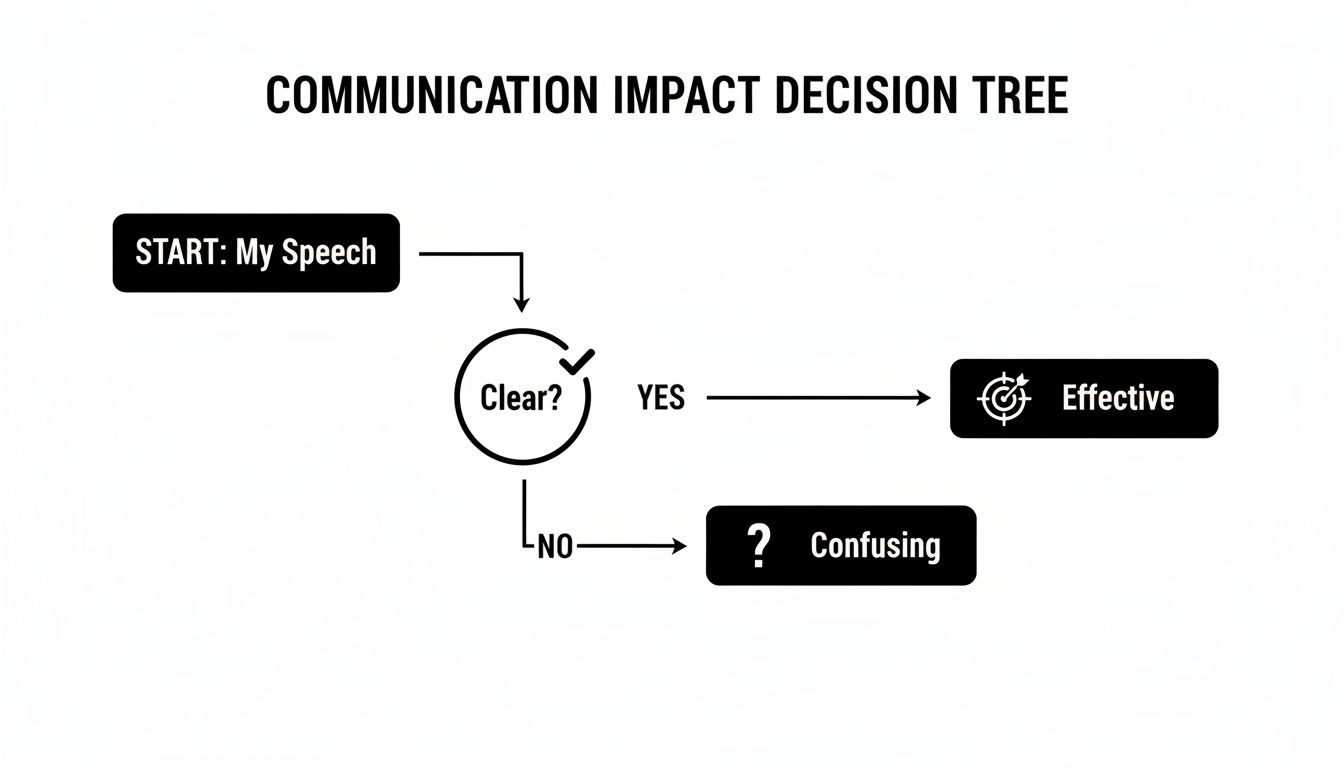
As the flowchart shows, clear pronunciation driven by correct stress is the direct path to effective communication. Without it, you risk confusing your listener.
Spotting Stress with Suffixes
One of the most powerful shortcuts for professionals is looking at a word’s suffix. Certain endings almost always tell you which syllable gets the emphasis. This is incredibly helpful for the kind of specialized vocabulary you run into in business, tech, and healthcare.
I’ve put together a table with some of the most reliable patterns you’ll encounter. Think of these as your go-to rules for decoding multisyllabic words.
Common Word Stress Patterns for Professionals
| Word Ending/Type | Stress Pattern Rule | Examples |
|---|---|---|
| -tion, -sion, -ic | Stress the syllable right before the ending | appli-CA-tion, de-CI-sion, eco-NO-mic |
| -graphy, -logy, -metry | Stress the syllable two places before the ending | pho-TO-graphy, bi-O-logy, ge-O-metry |
| -ate (for verbs with 3+ syllables) | Stress the syllable two places before the ending | GRA-du-ate, O-per-ate, in-VES-ti-gate |
| -ity | Stress the syllable right before the ending | a-BIL-i-ty, com-PLEX-i-ty, se-CUR-i-ty |
Learning these few patterns will instantly help you correctly pronounce hundreds of important professional terms without having to look them up.
When Stress Changes Everything
Now for a crucial concept: words that completely change their meaning depending on which syllable you stress. These are all over professional English, and mixing them up can lead to some seriously confusing moments.
It usually boils down to this: for the noun, you stress the first syllable. For the verb, you stress the second.
Think of stress as a spotlight. By moving the spotlight from one syllable to another, you completely change what the listener focuses on—and therefore, what the word means.
Here are a few pairs you’ll definitely run into:
- CON-duct (noun: a person’s behavior) vs. con-DUCT (verb: to lead or manage)
- OB-ject (noun: a physical thing) vs. ob-JECT (verb: to voice disagreement)
- PRE-sent (noun: a gift) vs. pre-SENT (verb: to show or give a presentation)
Getting these pairs right is a high-impact way to boost your clarity. As you start mastering these patterns, you can dive deeper with our guide on how to train yourself to recognize and produce American English stress and intonation for more advanced techniques. By focusing on these predictable rules, you can stop guessing and start speaking with conviction.
The Secret Power of the Unstressed Syllable

Most English learners pour all their energy into hitting the stressed syllable hard. But here’s a little secret from the pros: the real magic behind a natural, native-like rhythm lies in the unstressed syllables.
The key isn’t just to emphasize the strong beats. It’s about learning to effectively de-emphasize the weak ones. This single skill is often the missing piece that transforms choppy, robotic speech into something smooth and connected.
Think about a rubber band. To stretch one part really far (that’s your stressed syllable), you have to let the other part shrink and contract. That contrast is what creates the musicality of English. Without it, your speech sounds flat and lacks the dynamic punch native listeners are wired to expect.
The Art of Reduction
So, how exactly do you de-emphasize a syllable? The two most powerful tools you have are shortening its duration and reducing its vowel sound.
Unstressed syllables are quick, quiet, and often contain a schwa (ə). That’s the soft, almost lazy “uh” sound you hear in words like “a-bout” or “sof-a.”
This reduction isn’t sloppy speech—it’s a fundamental feature of English that makes the language sound like, well, English. It’s what allows the stressed syllables to really pop, guiding your listener’s ear to the most important parts of your message.
Mastering the unstressed syllable is really about learning to let go. When you soften these sounds, you create the space for the stressed syllables to stand out. That right there is the essence of English rhythm.
And this isn’t just a theory; it’s backed by research. When scientists measured syllable durations, they found that learners who got the hang of shortening their unstressed syllables were rated as having a 43% more comprehensible rhythm by native judges. You can read more in the study on rhythm and pronunciation. It just goes to show that how you handle the “weak” beats has a massive impact on how clear you sound.
From Choppy to Smooth
When unstressed syllables get too much time and attention, speech becomes disjointed. Each word feels like an isolated island, completely separate from the next.
But once you master the art of reduction, you start building bridges between those islands. The quick, soft unstressed syllables are the glue that links words together into a seamless flow.
This is what creates that fluid and connected sound you hear from native speakers. If you want to dive deeper into how sounds blend together, check out our practical guide to connected speech sound changes in American English. Honing your unstressed syllables is a crucial first step toward achieving that natural flow.
Ultimately, by focusing on the quiet parts of your speech, you unlock a whole new level of fluency and authority. It’s the subtle art of saying less on certain syllables so you can say more with the ones that truly matter.
Practical Exercises to Build Your Rhythm

Knowing the theory behind what is stressed and unstressed syllables is one thing. Actually building the muscle memory to produce them? That’s a whole different game. This is where we shift from thinking to doing.
These simple, powerful drills are designed with busy professionals in mind. They turn spare moments into productive practice, creating a clear path to improvement.
The point isn’t just to repeat words—it’s to internalize the physical feeling of English rhythm. You need to connect the sound of the stress to a physical action. This helps your brain and your speech muscles learn the patterns much, much faster.
The Tapping Method
One of the most effective ways to feel the beat is the Tapping Method. It’s incredibly simple: as you say a word, tap your finger on a desk or your leg.
For the stressed syllable, give it a firm, loud tap. For the unstressed ones, make the tap very soft and quick.
Let’s try it:
- A-na-lyze: LOUD-soft-soft
- Com-PU-ter: soft-LOUD-soft
- In-for-MA-tion: soft-soft-LOUD-soft
This physical feedback makes the abstract idea of stress tangible. You’re not just hearing the difference anymore; you’re feeling it.
The Humming Technique
Sometimes, the words themselves can get in the way. The Humming Technique strips everything back to the pure music of the language—the pitch and length—without you having to worry about vowels and consonants.
Take a sentence or a multi-syllable word and just hum its rhythm. For the word “communication,” instead of saying it, hum it: “mm-MM-mm-MM-mm.”
You’ll naturally notice your pitch rising on the stressed parts and the length changing. This is a fantastic drill for training your ear to hear the melody of English.
The point of these drills is consistency, not intensity. Five minutes of focused practice while waiting for a meeting to start is far more effective than an hour of mindless repetition once a week.
Minimal Pair Practice
Minimal pairs are words that are almost identical, but their meaning changes based on the stress pattern. Practicing these is like weightlifting for your ear and tongue. It trains them to hear and produce those subtle but crucial differences.
Here’s a quick list to get you started. Say each pair aloud and really exaggerate the stressed syllable.
- OB-ject (noun) vs. ob-JECT (verb)
- RE-cord (noun) vs. re-CORD (verb)
- IN-sult (noun) vs. in-SULT (verb)
Recording yourself and playing it back is a powerful way to check if you’re hitting the mark. Another fantastic drill to fold into your routine is shadowing. To see how it works, you can learn how to use the shadowing technique to improve your accent fast.
It’s also worth remembering that playful language exercises, even from other languages, can dramatically boost your speech mechanics. For instance, trying some Korean tongue twisters can be a fun way to challenge your articulation. These varied exercises build the foundation for clear, confident, and natural-sounding English.
Accelerating Your Progress with Expert Feedback
While self-study drills are great for building a solid foundation, nothing beats personalized feedback when you’re ready to get serious about your clarity. An expert coach is like a mirror, reflecting back the subtle error patterns you simply can’t hear on your own—especially the ones baked in by your native language’s rhythm.
This kind of targeted guidance is a game-changer. In today’s global business world, where 75% of multinational teams are made up of non-native speakers, even tiny mistakes in word stress can slash perceived competence by 25-35% during evaluations. A coach helps you sidestep that pitfall by creating a practice plan that gets you real, noticeable results. You can read more about these findings on professional communication and their impact.
A Strategic Investment in Your Voice
Think of coaching not as a punishment for making mistakes, but as a strategic investment in becoming an elite-level communicator. It gives you a tailored roadmap, making sure your limited practice time is spent on the specific habits that will make the biggest difference in how you sound.
An expert can help you:
- Find your blind spots: They’ll pinpoint those subtle stress misplacements that you’re completely unaware of.
- Nail your industry’s vocabulary: You’ll get to practice the specific rhythm of the terms you use every day at work.
- Build lasting accountability: Structured check-ins and support keep you on track when motivation dips.
Coaching takes you from just knowing about stressed and unstressed syllables to truly internalizing the rhythm of English. It’s about learning to shape your ideas with maximum confidence and impact, ensuring you’re understood the first time, every time.
Ultimately, this personalized approach is what builds the muscle memory you need for effortless clarity. It closes that frustrating gap between knowing the rules and actually applying them automatically in high-stakes conversations, presentations, and meetings. This is how you develop a voice that doesn’t just speak, but commands attention.
Of course, even after you get a handle on the basics, you’ll probably still have some specific questions pop up when you try to put it all into practice. Let’s tackle some of the most common ones I hear from clients to clear up any lingering confusion.
Does Every Single Word in English Have a Stressed Syllable?
Pretty much, yes. Any word with two or more syllables will have one primary stressed syllable—that’s the anchor of the word. Even most single-syllable words that carry meaning (like nouns and verbs such as run, desk, or think) get stressed when you say them in a sentence.
The exception? Those little single-syllable “function words” like a, the, in, or of. They’re usually unstressed, acting like the soft, connecting tissue between the more important, meaning-packed words in your message.
Think of it this way: if a word carries real meaning, it gets the stress. If its job is purely grammatical, it stays in the background.
How Can I Figure Out the Right Stress for a New Word?
While the patterns we’ve covered are a fantastic starting point, your most reliable tool is a good online dictionary like Merriam-Webster. Don’t just look at the definition; find the phonetic spelling. You’ll see a little apostrophe mark (‘) placed right before the syllable that gets the stress.
But here’s the real pro tip: always listen to the audio pronunciation. Hearing the rhythm is the key to actually internalizing the sound and making it a natural, automatic part of your speech.
Is It Really Possible to Master English Stress If My Native Language Has a Totally Different Rhythm?
Absolutely. It’s a common concern, but I see clients do it all the time. Your native language gives you a default rhythm, but English stress is just a skill. Like any skill, it can be learned through focused, consistent practice. What you’re really doing is building new muscle memory for your tongue, jaw, and breath.
This is where targeted drills and expert feedback can make a huge difference. They help you become consciously aware of the old rhythmic habits you’ve carried over from your first language. From there, you can systematically replace them with new, clearer pronunciation patterns that finally align with the natural beat of English.
Ready to speed up your progress and get personalized feedback on your pronunciation? Intonetic offers a proven coaching program designed to help you master the rhythm of American English.