What is speech intelligibility and How It Boosts Professional Clarity
At its core, speech intelligibility is about one simple thing: how clearly a listener can understand you. It’s not about having a “perfect” accent or speaking at a certain speed. It’s purely about whether your message gets through, clean and clear, without making your listener strain to catch your meaning.
Why Clarity Is the Real Goal in Communication
Have you ever been in a meeting, confident in your expertise, only to feel like your point didn’t quite land? It wasn’t because your idea was weak, but because how it was heard created a barrier. You’re definitely not alone. For countless international professionals, the true aim isn’t to sound like a native speaker—it’s to be effortlessly understood. That is the essence of speech intelligibility.
Think of it like tuning a radio. You’re not trying to change the announcer’s voice. You’re just trying to get rid of the static so the broadcast comes through perfectly. For non-native English speakers, shifting the focus from erasing an accent (which is part of your identity!) to refining clarity is a total game-changer. It means you can keep your unique voice while ensuring your ideas are received with the impact and authority they deserve.
The Global Standard Isn’t Accent—It’s Understanding
This need for clear, intelligible speech is exploding. While there are roughly 375 million native English speakers in the world, they are vastly outnumbered by the 750 million people who use English as a second or foreign language.
What does that mean for you? In most international business settings, you’re more likely to be speaking with another non-native speaker than a native one. In that context, a shared, clear understanding is infinitely more valuable than a “perfect” American or British accent. You can dig into more of the data on speech intelligibility and why it’s so critical in today’s global workplace.
The Hidden Factors That Influence Clear Speech
Clear speech is about so much more than just getting individual words right. True speech intelligibility rests on a hidden architecture—a combination of elements that all have to work together to make sure your message lands exactly as you intend it to.
If you think of individual sounds as the bricks of your speech, then things like rhythm, stress, and intonation are the architectural blueprint. That blueprint is what gives those bricks shape and meaning.
Take the words “PRE-sent” (a gift) and “pre-SENT” (to give something). The bricks—the sounds P-R-E-S-E-N-T—are identical. But a tiny shift in emphasis, or word stress, completely flips the meaning. That’s the power of the blueprint, and it’s where most professionals find the biggest and fastest gains in their clarity.
This concept map helps visualize how intelligibility is the central goal. It’s influenced by your accent and fluency, and it’s the direct path to making sure your listener truly comprehends what you’re saying.
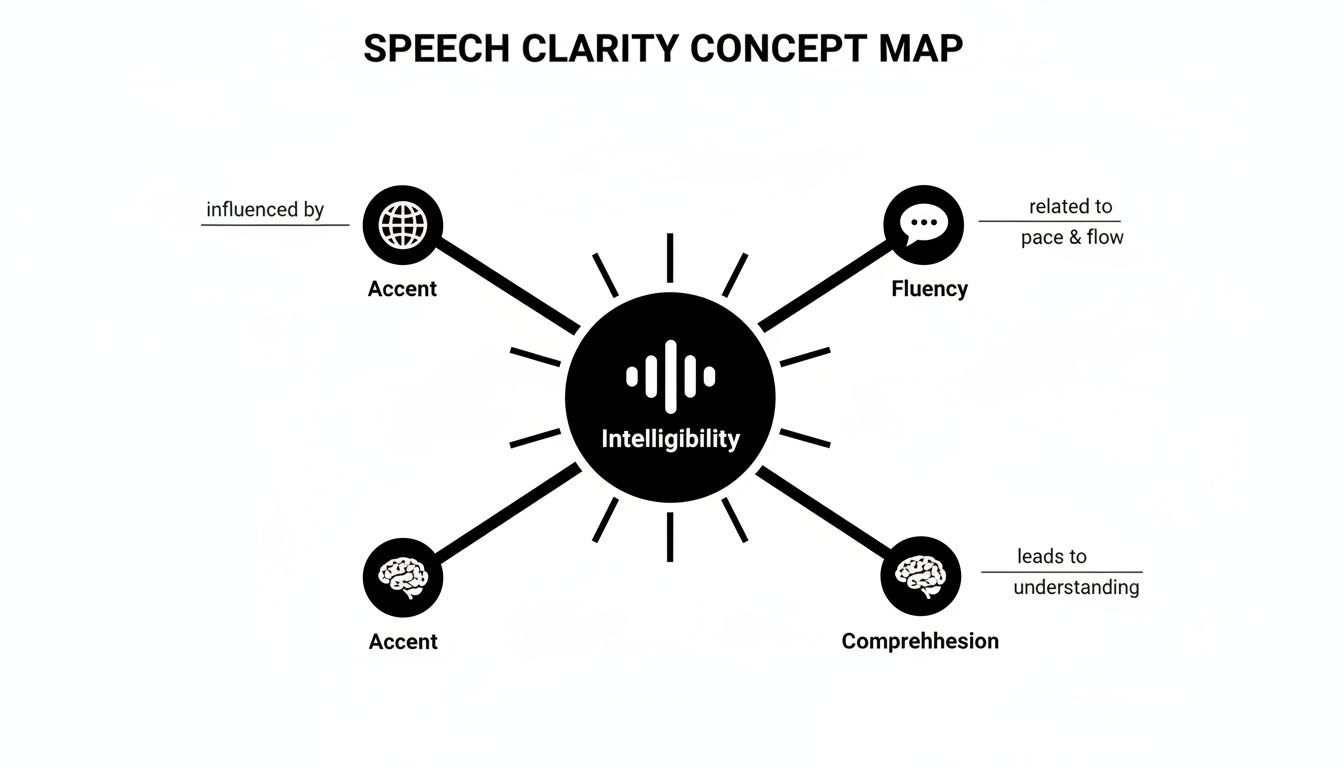
As you can see, while these concepts are all related, they aren’t the same thing. Targeting intelligibility is the most direct way to be understood.
The Two Pillars of Intelligibility
To really get a handle on what makes speech clear, we need to break it down into two main categories: things the speaker controls, and things the listener and environment control.
1. Speaker-Controlled Factors (The “How You Say It”)
These are the elements you have direct influence over—the fundamental tools you use to shape clear and authoritative speech.
- Segmentals (The Bricks): These are the individual vowel and consonant sounds of a language. A simple mispronunciation, like saying “ship” instead of “sheep,” can throw a listener off in an instant.
- Suprasegmentals (The Blueprint): This is the melody and rhythm of your speech. It covers word stress, sentence-level emphasis, intonation (the rise and fall of your voice), and pacing. Honestly, getting this right is often far more critical for overall intelligibility than perfecting every single sound. You can dive deeper into the power of rhythm and timing in our dedicated article.
Your vocal melody—your intonation—is an incredibly powerful tool. A rising pitch at the end of a statement can make you sound uncertain, almost like you’re asking a question. A downward inflection, on the other hand, conveys confidence and finality. Mastering this is key to being perceived as an authority.
Interestingly, research has shown that certain acoustic patterns are just inherently clearer. A landmark study that analyzed 2,000 sentences found that, on average, female speakers were more intelligible. This wasn’t random; it was tied to factors like producing more distinct vowel sounds—a pattern that anyone can learn from to make their own speech clearer.
The External Influences on Clarity
Even if your articulation is perfect, other factors can get in the way of your message. Being aware of these external variables helps you adapt to different situations and head off potential misunderstandings before they happen.
2. Listener and Environmental Factors (The “Context”)
These are the elements outside of your direct control, but they have a huge impact on how your message is received. Knowing what they are is the first step to managing them.
- Background Noise: Whether it’s a noisy office, a bustling café, or just bad audio quality on a video call, competing sounds can easily mask parts of your speech. This forces your listener to work overtime just to piece together what you’re saying.
- Listener Familiarity: This one is huge. A listener who is familiar with your specific accent will find you far more intelligible than someone hearing it for the first time. Their brain has already adapted to your unique speech patterns.
- Listener Attention and Hearing: You also have to account for the person on the other end. The listener’s level of focus and their own hearing ability play a major role. An inattentive or hearing-impaired listener will naturally struggle more with any speech that isn’t crystal clear.
By understanding both the internal mechanics of your speech and the external context you’re speaking in, you can start making strategic changes to how you’re heard. For most people, the best place to start is by mastering that “blueprint”—the rhythm and melody that truly bring your words to life.
How Professionals Measure Speech Intelligibility
If you want to genuinely improve your clarity, you have to be able to measure it. We’re not talking about vague, subjective opinions like “sounding good”—we’re talking about turning speech intelligibility into a quantifiable skill you can actually track over time.
Think of it like getting a fitness assessment. A good personal trainer doesn’t just tell you to “get stronger.” They first measure your baseline strength with specific exercises. In the same way, we need a clear starting point to make targeted, meaningful improvements to your speech.
Subjective Listener Ratings
One of the most common approaches is surprisingly straightforward: subjective listener ratings. Trained listeners simply score a speech sample based on how easy it is to understand, often using a simple numerical scale, like 1 to 5.
This method is quick and does a great job of capturing the “cognitive load” on the listener—in other words, how much mental effort they have to put in to figure out what’s being said. While it isn’t purely objective, it gives us a real-world snapshot of the listener’s experience. After all, the ultimate goal is for others to understand you effortlessly.
Objective Transcription Tests
For a more data-driven approach, professionals lean on objective transcription tests. It works exactly like it sounds: listeners transcribe words or sentences they hear, and the intelligibility score is the percentage of words they got right.
This method cuts through the guesswork. A score of 90% intelligibility gives you a concrete number, meaning listeners correctly understood nine out of every ten words you said. It’s a clear, solid benchmark for how to measure your accent reduction progress accurately.
These kinds of standardized tests are incredibly important, especially when you think globally. The World Health Organization reports that around 1.5 billion people live with some degree of hearing loss, which makes easily understood speech even more essential. Tools like the Speech Intelligibility Rating (SIR) scale ensure that these measurements are consistent and reliable, no matter who is listening.
The Real-World Cost of Being Misunderstood
Low speech intelligibility isn’t just some abstract academic concept; it has a tangible, real-world price tag that can quietly shape a professional’s entire career path. When your words don’t land clearly, the consequences ripple outward, touching everything from team collaboration and leadership potential to client trust and even funding opportunities. The problem is never a lack of expertise, but a communication gap that stops that expertise from being fully seen and valued.
Let’s think about a talented software engineer—we’ll call her “Maria”—who has figured out a brilliant fix for a persistent bug in her company’s code. During a critical team meeting, she lays out her innovative approach. But because her sentence stress and rhythm are unfamiliar to her colleagues, her most important points get lost in translation. They ask her to repeat herself a few times, the meeting’s momentum grinds to a halt, and you can feel the frustration building in the room.
Finally, a native-speaking colleague rephrases Maria’s idea, and suddenly, everyone gets it. The solution is praised, but the credit has subtly shifted. Maria is left feeling invisible and her confidence takes a hit—not because her idea was flawed, but because its delivery was unclear.

From Misinterpreted Advice to Missed Opportunities
And this isn’t just a tech world problem. Picture a compassionate physician, “Dr. Chen,” advising a patient on a complex new medication. He carefully explains the dosage and potential side effects, but his specific intonation patterns cause the patient to miss the urgency in his voice. The patient walks away confused and doesn’t stick to the prescribed regimen, which unfortunately leads to a preventable health issue.
In this case, Dr. Chen’s medical knowledge was perfect, but low intelligibility created a dangerous gap in understanding that eroded the patient’s trust. As you can imagine, the real-world impact of having a foreign accent in our detailed article can be huge in high-stakes fields.
Now, think about a startup founder, “Anil,” pitching his groundbreaking business to a room full of venture capitalists. He’s passionate and has all the data to back up his vision. But his rapid pace and flat intonation make him sound hesitant and hard to follow.
The investors struggle to connect with his message. They interpret his lack of vocal variety not as a language difference, but as a lack of confidence in his own business. They pass on the investment—not because the idea was weak, but because the pitch failed to inspire conviction.
In every one of these stories, the professional cost is enormous: missed promotions, damaged trust, and a perception of incompetence that is completely disconnected from a person’s actual ability.
Take Control of Your Professional Narrative
These stories all point to one crucial truth: being an expert isn’t enough if you can’t communicate that expertise clearly. The emotional and financial toll of being misunderstood is real and significant. But the good news is that improving speech intelligibility is an achievable goal that puts you back in the driver’s seat. It’s not about changing who you are; it’s about giving yourself the tools to be heard accurately and effectively.
Practical Strategies to Improve Your Intelligibility
Knowing the why behind speech intelligibility is a great start, but the real magic happens when you start putting that knowledge into practice. Improving your clarity isn’t about grinding away for hours with unfocused effort. It’s about targeted, consistent work on the few habits that give you the biggest return.
The goal here is to build new muscle memory. You want clear speech to become your default setting, not something you have to constantly think about. This means focusing on that small handful of English sounds that cause the most confusion, mastering stress to guide your listener’s ear, and controlling your pace to project confidence. A little bit of focused work each day adds up faster than you’d think.
Target High-Impact Sounds and Stress Patterns
Not all sounds carry the same weight. In English, a surprisingly small number of vowels and consonants are responsible for the vast majority of misunderstandings. Think about the difference between “ship” and “sheep,” or “leave” and “live”—getting those wrong can derail an entire sentence. Zeroing in on these high-impact sounds is one of the fastest ways to level up your clarity.
Likewise, word and sentence stress are your secret weapons. Stressing the right syllable (like “PRO-ject” the noun vs. “pro-JECT” the verb) or the right word in a sentence tells your listener exactly what’s important. It’s like using a vocal highlighter to make your message impossible to miss.
Think of it this way: if you try to fix every single sound at once, you’ll get overwhelmed. But if you focus on the 10-12 sounds that cause 80% of the confusion, you’ll see dramatic improvements with much less effort. This targeted approach is the foundation of effective speech training.
To really make progress, you need a simple, structured routine. Consistency beats intensity every time. A short, focused practice session each day builds the neural pathways you need for lasting change. For a deeper dive into articulation, you might find our guide on how to enunciate better helpful.
Build Your Self-Paced Learning Plan
Let’s be real—not everyone has the time or budget for one-on-one coaching. For professionals who want expert-led guidance on their own schedule, a self-paced program is the perfect middle ground. It gives you the flexibility to learn when you can, but with a clear roadmap to follow.
This is exactly why we created Intonetic Accent Studio. It’s a monthly subscription service with two programs designed to help you master your accent and clarity on your own terms.
- $7 per month: Perfect for self-starters who want a structured curriculum, targeted drills, and a clear path forward.
- $27 per month: Includes everything from the first plan, plus you get personalized feedback on your progress from an expert coach to make sure you’re on the right track.
These programs put you in the driver’s seat of your own development. You can build clearer, more confident communication skills without having to juggle the scheduling demands of personalized coaching. And the benefits extend beyond just being understood in meetings; clear, confident speech can even help improve social media engagement if you’re creating video or audio content.
To help you get started, here’s a sample weekly schedule you can adapt. The key is to structure your self-practice for maximum impact by focusing on different components of intelligibility.
Your Weekly Intelligibility Practice Routine
| Day | Focus Area (15-20 Minutes) | Activity Example |
|---|---|---|
| Monday | High-Impact Vowels (e.g., /iː/ vs /ɪ/) | Practice minimal pairs like "leave/live" and "sheep/ship." Record yourself and listen for the difference. |
| Tuesday | Word Stress | Pick 10 multi-syllable words from your field. Look up their stress patterns and practice saying them correctly. |
| Wednesday | Sentence Rhythm & Intonation | Read a short news article aloud. Exaggerate the stress on key words and the rise/fall of your pitch in questions. |
| Thursday | Pacing & Pausing | Record yourself explaining a complex topic. Listen back and identify where you could add pauses for emphasis. |
| Friday | High-Impact Consonants (e.g., /θ/ vs /ð/) | Practice tongue twisters with "th" sounds, like "Thirty-three thousand feathers on a thrush's throat." |
| Saturday | Connected Speech (Linking) | Practice saying phrases where words link together, like "an apple" sounding like "a napple." |
| Sunday | Review & Application | Review your recordings from the week. Have a casual conversation focusing on just one of the week's skills. |
Whether you follow a structured program or build your own routine, the most important thing is to start small and be consistent. The journey to greater clarity is a marathon, not a sprint. Every focused step you take moves you closer to being understood the first time, every time.
Ready to start your journey? You can explore the Intonetic Accent Studio programs here.
Got Questions About Speech Intelligibility? Let’s Clear Things Up.
To wrap up our deep dive, let’s tackle a few of the most common questions that come up. Think of this as the final piece of the puzzle, designed to solidify your understanding and get you ready for the next step.
Is Improving My Intelligibility the Same as Losing My Accent?
Absolutely not, and this is a big one. The goal is never to erase your cultural or linguistic identity. It’s all about enhancing clarity so you’re easily understood the first time.
A skilled coach hones in on very specific elements—like the vowel sound in “ship” versus “sheep,” or where you place stress in a word like “DEVelopment”—that have the biggest impact on whether a listener gets your point. Your unique accent remains, but the little snags that cause communication friction are smoothed out.
How Long Until I See a Real Improvement?
While everyone’s journey is different, most professionals report a noticeable boost in both their confidence and their clarity within 8-12 weeks of consistent, focused practice.
The trick is to zero in on the high-impact areas rather than trying to perfect every single sound at once. A structured program makes this much faster by giving you a clear roadmap and cutting out the guesswork.
Can I Really Do This Without a Coach?
You can certainly make progress on your own. Self-study, especially recording and listening back to yourself, is fantastic for building awareness of your own speech patterns.
However, a coach or an external listener acts as a massive shortcut. We often can’t hear our own pronunciation quirks. An expert ear can pinpoint issues you’d never notice and give you targeted drills to fix them efficiently. It’s the difference between wandering in the right direction and taking a direct flight.
Why Is This So Much More Important in Online Meetings?
This is a huge factor in today’s world. Virtual meetings strip away so many of the non-verbal cues—body language, lip-reading, subtle facial expressions—that we all unconsciously lean on during in-person conversations.
On top of that, you’re often battling unpredictable audio quality. This puts an immense amount of pressure on your vocal clarity alone. When your speech intelligibility is high, your message cuts straight through the technical glitches and lack of visual context. It makes you a more effective, authoritative, and respected voice in any virtual room.
Ready to stop being asked to repeat yourself and start being heard with the authority your ideas deserve? Intonetic provides a clear, structured path forward. It’s time to take control of how you’re heard.