
Mastering Stressed and Unstressed Syllables
Ever feel like your English is technically perfect, but something just sounds… off? You’ve mastered the grammar and have a great vocabulary, but it doesn’t flow naturally. The missing piece isn’t another rulebook; it’s the hidden music of the language, built on the simple pattern of stressed and unstressed syllables.
Getting a handle on this rhythm is probably the single biggest leap you can take toward clearer, more confident communication.
Why Syllable Stress Is the Key to Sounding Fluent
Think of syllable stress as the heartbeat of the English language. Some beats are strong and powerful (stressed), while others are weaker and quicker (unstressed). This constant pulse is what gives American English its signature rise and fall. When you master it, you stop sounding like you’re just reciting words and start speaking with genuine authority.
For non-native speakers, this concept is an absolute game-changer. I’ve seen it time and time again: misplaced stress is one of the most common hurdles to being understood. In fact, it often causes more confusion than a small grammar mistake. Nailing the stress pattern means your colleagues, clients, and managers can focus on what you’re saying, not struggle with how you’re saying it.
The Impact on Professional Communication
In a professional environment, clarity is everything. When you get syllable stress right, you’ll see a direct impact on your performance in those moments that matter most:
- Engaging Presentations: Using stress correctly makes your key points pop, keeping your audience hooked from start to finish.
- Clearer Meetings: Your ideas and contributions will land the first time, cutting down on frustrating back-and-forths and misunderstandings.
- Increased Confidence: It’s simple—when you know you sound more natural, you feel more confident. That confidence helps you command attention and speak with conviction.
The challenge here is very real. Research has shown that non-native speakers can misplace word stress in up to 45% of cases, a barrier that directly affects how fluent others perceive them to be. You can find more on these lexical stress findings from Cambridge University Press.
This isn’t about memorizing complex phonetic charts. It’s about training your ear to hear the music of English and then learning to replicate it yourself. It’s a core skill in many accent reduction techniques that aim for clarity, not perfection. For a deeper look at what goes into sounding more natural, check out this guide on how to sound more fluent in English with accent reduction techniques.
Ultimately, mastering syllable stress is a foundational step in developing truly fluent speech and elevating your professional presence. If you’re looking to build stronger verbal skills all around, exploring concepts like effective communication skills training can also be incredibly valuable. The journey starts right here, by learning to hear the rhythm behind the words.
How to Hear the Difference Between Stressed and Unstressed Syllables
Training your ear to catch the rhythm of English is less about abstract theory and more about tuning into a few key acoustic qualities. A stressed syllable isn’t just randomly louder; it’s consistently longer, louder, and slightly higher in pitch than the syllables around it. Think of it as the peak of the word’s melody.
Unstressed syllables are the exact opposite. They’re quick, quiet, and their vowel sound often softens into a relaxed, neutral sound called the schwa (ə). These are the valleys between the peaks—absolutely essential for creating the word’s shape, but not the main focal point.
Feel the Stress with a Simple Technique
Reading definitions is one thing, but feeling the stress is what makes it stick. Let’s try a simple “call-out” technique. Imagine you’re trying to get a friend’s attention from across a busy park.
Let’s use the name “Amanda.” You wouldn’t yell “A-man-da” with equal force on each part, would you? Your instinct would be to call out, “a-MAN-da!” That one syllable you naturally make longer and louder is the stressed syllable.
Now, try calling out these words:
- ba-NA-na
- com-PU-ter
- im-POR-tant
See how one syllable in each word just naturally pops out with more energy? Tapping into that intuitive emphasis is the core of learning to identify stress.
A Quick Comparison Guide
To give you a reliable mental checklist, here’s a breakdown of what separates these two types of syllables. This table lays out exactly what you should be listening for when you hear a word spoken.
| Stressed vs Unstressed Syllable Characteristics |
| :— | :— | :— |
| Characteristic | Stressed Syllable | Unstressed Syllable |
| Duration | Longer | Shorter, quicker |
| Loudness | Louder, more prominent | Quieter, softer |
| Pitch | Higher in pitch | Lower or neutral in pitch |
| Vowel Sound | Clear and distinct | Often reduced to a schwa (ə) |
Recognizing these differences is the first real step toward being able to replicate them in your own speech. If you’re ready for a deeper dive with audio examples, check out our guide on how to train yourself to recognize and produce American English stress and intonation.
This infographic really drives home how mastering rhythm directly leads to clearer speech and a big boost in confidence.

As the visual shows, learning this musical side of English isn’t just a technical exercise. It’s a direct path to speaking more clearly and feeling more self-assured in any professional setting. When you focus on getting the rhythm right, you’re building the very foundation of impactful communication.
Unlocking the Patterns of Word Stress
While English word stress can sometimes feel chaotic, it’s not as random as you might think. Native speakers don’t memorize every word; they intuitively follow a set of reliable patterns. Think of them as “rules of thumb” that help you make an educated guess on which syllable to punch.
Learning these patterns is one of the biggest shortcuts to sounding more natural.
One of the most useful patterns applies to two-syllable words. Get this one down, and you’ve instantly improved your pronunciation for a massive chunk of everyday English vocabulary. For many two-syllable nouns and adjectives, the stress falls on the first syllable. For many two-syllable verbs, it’s on the second.
Nouns and Verbs with Two Syllables
Let’s see this pattern in action. It’s fascinating how the exact same spelling can change its sound, meaning, and function just by shifting the stress.
- Noun: Can you find the OB-ject? (Stress hits the first syllable)
- Verb: I ob-JECT to that statement. (Stress moves to the second syllable)
This isn’t a one-off trick. It happens all the time.
- PRE-sent (a gift) vs. pre-SENT (to give)
- RE-cord (a file) vs. re-CORD (to document)
- PRO-gress (advancement) vs. pro-GRESS (to advance)
This fundamental dance between nouns and verbs is a cornerstone of American English rhythm. When you learn to shift the stress, you’re not just pronouncing a word correctly—you’re signaling its grammatical job and its exact meaning in the sentence.
Of course, English loves its exceptions, but internalizing this rule gives you a powerful tool for making the right choice in the middle of a conversation. This is just one of many sound changes that happen in natural speech. To go deeper, check out our guide on connected speech sound changes in American English.
How Suffixes Change Word Stress
Another huge pattern involves suffixes—those little endings we tack onto words. Certain suffixes act like magnets, pulling the stress to the syllable that comes right before them. Master just a few of these, and you’ll instantly clarify your pronunciation of hundreds of longer, more complex words.
Recognizing these endings is especially powerful for academic and professional vocabulary.
Here are some of the most common stress-shifting suffixes:
- Words ending in -ion, -ic, -ity, -ical: Stress the syllable right before the suffix.
- in-for-MA-tion
- e-co-NOM-ic
- a-BIL-i-ty
- po-LIT-i-cal
- Words ending in -graphy, -logy: Again, stress the syllable before the suffix.
- pho-TOG-ra-phy
- bi-OL-o-gy
Consider how a word’s stress can completely shift. The word PHO-to-graph has its stress right at the beginning. But when you add the ending “-graphy,” the stress jumps forward to pho-TOG-ra-phy. It’s a totally different rhythm.
The goal here isn’t to memorize a dictionary. It’s about absorbing these core patterns so they become second nature. They give you a reliable framework that will boost your accuracy and help you speak with far more clarity and confidence. These patterns are the very building blocks of natural English rhythm.
How Sentence Stress Creates the Natural Rhythm of English
Now, let’s zoom out from single words and look at the bigger picture. When you put it all together, the back-and-forth between stressed and unstressed syllables is what creates the unique music of a full sentence. American English has what linguists call a stress-timed rhythm. This just means that the beat of a sentence comes from the steady pulse of the stressed syllables, not from counting every single syllable.
Think of it like crossing a river on stepping stones. The big, solid stones are your stressed syllables—the ones you land on with confidence. The little pebbles in between are the unstressed syllables that you quickly skip over to get to the next firm footing. This creates that smooth, flowing sound, keeping you from sounding choppy or robotic. You can dive deeper into this idea in our guide to rhythm and timing in American English.

Content Words vs. Function Words
So, how do you find this rhythm in your own speech? The secret is in understanding two simple categories of words.
- Content Words: These are the heavy lifters. They carry the real meaning of your sentence—the nouns, main verbs, adjectives, and adverbs. Because they’re so important for conveying information, we naturally give them the stress.
- Function Words: These are the grammatical glue. They connect everything together—words like articles (a, the), prepositions (in, on, at), pronouns (he, she, it), and helping verbs (is, are, can). We tend to glide right over these, leaving them unstressed.
By punching the content words and softening the function words, you’ll automatically start producing the signature beat of natural English.
This is all tied to a concept called vowel reduction, where the vowels in those unstressed function words often relax into a neutral “schwa” (ə) sound. It’s not a mistake or lazy speech; it’s a feature that has been evolving for centuries to make English more efficient and rhythmic.
How Stress Changes Your Message
Sentence stress does more than just create a nice rhythm. It’s a powerful tool for directing your listener’s attention exactly where you want it to go. By strategically emphasizing a different word in the same sentence, you can completely change its focus and hidden meaning. This is absolutely critical in professional settings, where every bit of nuance matters.
Let’s take a simple statement you might hear in any office: “I didn’t approve the budget.”
Watch what happens when we just shift the stress.
- “I didn’t approve the budget.”
- Meaning: Someone else did, but it wasn’t me. I’m shifting the responsibility.
- “I didn’t approve the budget.”
- Meaning: This is a firm denial. You’re correcting a false assumption that you did approve it.
- “I didn’t approve the budget.”
- Meaning: I did something else with it. Maybe I reviewed it, or even rejected it, but approval was not given.
- “I didn’t approve the budget.”
- Meaning: I approved something else, just not that specific thing. Maybe I approved the project plan, but the budget is a different story.
By simply changing which word gets the spotlight, you control the narrative. This technique allows you to subtly clarify, defend, or redirect in any conversation, making your communication far more precise and impactful. It transforms your speech from a flat statement into a dynamic tool for influence.
Practical Exercises for Professional Scenarios
Knowing the theory is one thing, but real progress happens when you start putting it into practice. Think of it like learning an instrument—you can read all the music theory books you want, but you won’t get better until you actually play. The goal here is to build muscle memory, making the natural rhythm of English so second nature that you don’t even have to think about it in a high-stakes conversation.
These drills are designed specifically for the professional world. They target common situations you’ll face at work, helping you shift your speech from hesitant to confident and clear.
Exercise 1: Presenting Key Data
When you’re presenting data, clarity is everything. Your audience needs to instantly catch the important numbers, trends, and takeaways. By stressing the right words, you make your key metrics pop, ensuring your message lands with the impact it deserves.
Try reading these sentences out loud. The capitalized syllables are your stress points. Focus on making them a little louder, longer, and slightly higher in pitch.
- Our PROF-its DOU-bled this QUAR-ter.
- We saw a TWEN-ty per-CENT IN-crease in SALES.
- The pro-JECT will be com-PLE-ted by the END of the YEAR.
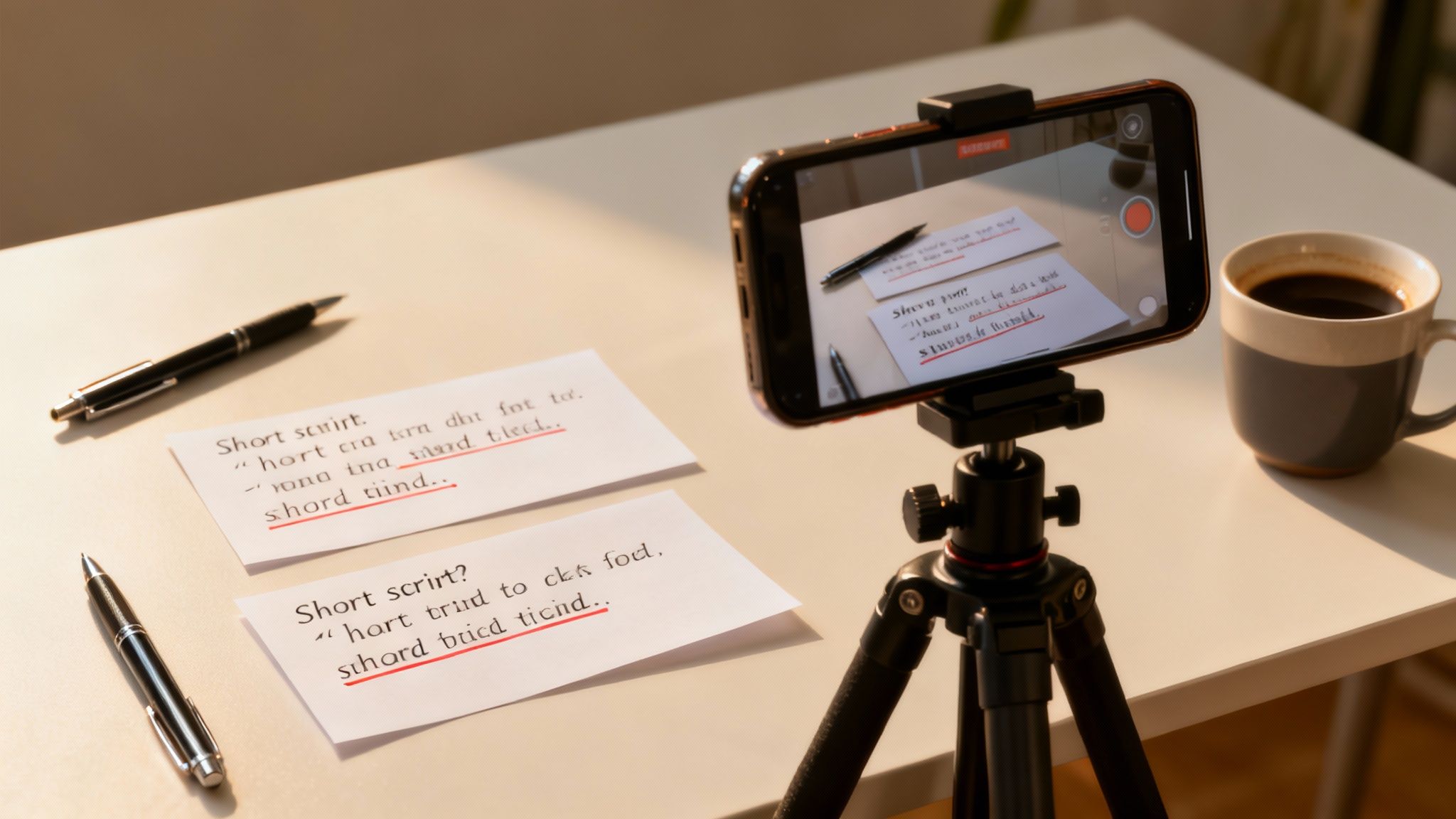
Here’s a pro tip: record yourself on your phone and play it back. Does the rhythm sound natural? Does it match the pattern you were aiming for? This simple feedback loop is one of the fastest ways to tune your ear and refine your pronunciation.
Exercise 2: Stating Opinions in a Meeting
In a fast-paced meeting, you need to sound decisive. Using natural sentence stress is a subtle but powerful way to make your opinions sound more assertive and convincing. This drill is all about emphasizing the key content words—the ones that carry the real weight of your message.
Practice these common meeting phrases, really leaning into the bolded words. You’ll notice the little function words (like “I,” “a,” “that”) just get passed over quickly.
- I think we should con-SI-der a new ap-PROACH.
- My main con-CERN is the BUD-get.
- That’s an EX-cel-lent POINT, but have you thought a-BOUT the TIME-line?
Repetition is your best friend here. Say each of these phrases ten times until the rhythm feels completely automatic. The more you drill this now, the more likely this natural flow will just show up when you’re speaking under pressure.
Exercise 3: The “BA-ba” Rhythm Drill
Sometimes, the words themselves can be a distraction. To really lock in the rhythm, you need to strip it down to the bare essentials. This drill helps you internalize the beat of English without getting hung up on vocabulary. We’ll use “BA” for a stressed syllable (louder, longer) and “ba” for an unstressed one (quicker, softer).
Try tapping out the rhythm of these words using only “BA” and “ba”:
- AN-a-lyze (BA-ba-ba)
- De-VEL-op-ment (ba-BA-ba-ba)
- Com-mu-ni-CA-tion (ba-ba-ba-BA-ba)
I know, this might feel a little silly at first. But trust me, it’s an incredibly powerful way to train your ear and your mouth to produce the right patterns. By focusing on the pure sound, you’re building a much deeper, more intuitive sense of English rhythm that will naturally carry over into every conversation you have.
Your Action Plan for Mastering English Intonation
So, let’s bring it all together. Mastering stressed and unstressed syllables isn’t some impossible task—it’s absolutely achievable. The core lessons are actually pretty simple: stressed syllables are longer, louder, and higher in pitch; content words get the emphasis; and consistent practice is what builds true fluency.
But knowing the concepts is one thing. The real progress happens when you create an effective action plan. Don’t just read about this stuff—let’s get it integrated into your daily routine.
Your Path to Clearer Communication
To make this stick, you need to focus on activities that train your ear and build muscle memory. Your plan should be a solid mix of both listening and speaking exercises, which creates a powerful feedback loop for improvement.
Here’s where to start:
- Use pronunciation apps: Look for apps that provide crystal-clear audio examples for individual words. This is a great way to confirm the stress patterns of new vocabulary as you learn it.
- Practice shadowing: This is a classic for a reason. Find a short podcast clip or a TED Talk. Listen to just one sentence, then immediately repeat it, trying to mimic the speaker’s rhythm and intonation exactly.
- Record yourself: This is non-negotiable. Use your phone to record yourself reading a short paragraph. Then, listen back and compare it to a native speaker’s recording. You’ll be amazed at the differences you can spot in your own intonation.
Remember, the goal here is clarity and confidence, not some robotic idea of perfection. Every small step you take in mastering stressed and unstressed syllables makes your professional communication more impactful and much easier for others to understand.
And it’s worth noting that strong intonation isn’t just about human-to-human communication. It’s also a crucial skill that helps technologies like an AI Audio Translator accurately capture and translate the true meaning behind your words. By focusing on these practical steps, you’re building a reliable foundation for speaking with authority and being understood the first time, every time.
Frequently Asked Questions About Syllable Stress
Even with a solid plan, a few specific questions always pop up when professionals start digging into syllable stress. Let’s tackle some of the most common ones I hear.
Are There English Words With No Stressed Syllables?
Nope. Every single English word with more than one syllable has a primary stressed syllable. It’s non-negotiable.
Even one-syllable words get stressed when they show up in a sentence. Think about content words like “goal” or “plan”—they always get the emphasis. Function words like “to” or “an” are the ones that usually get left unstressed. That push-and-pull is what gives English its fundamental rhythm.
How Does Word Stress Differ Between English Accents?
This is a great question. While the core idea of emphasizing certain syllables is universal across English, the exact placement can sometimes shift depending on the accent. The classic example everyone points to is the word “advertisement.”
- American English: ad-ver-TISE-ment
- British English: ad-VER-tise-ment
But don’t get too hung up on these differences. The broader principles are remarkably consistent. The pattern of stressing content words over function words in a sentence is a reliable guide no matter who you’re talking to, making it a powerful tool for any English learner.
The most important thing to remember is this: intelligibility comes from mastering the rhythm, not from erasing your accent. If you get the foundational patterns of stressed and unstressed syllables right, you’ll be easier to understand, regardless of regional differences.
What Is the Most Effective Way to Practice Hearing Word Stress?
The fastest way to build this skill is through active listening paired with immediate mimicry. Forget passively listening to hours of audio—you need to get your mouth involved.
Find a short audio clip of a native speaker. A podcast intro or a news headline is perfect.
First, just listen to a single sentence. Your only job is to spot the “musical peaks”—those syllables that jump out because they’re louder, longer, and higher in pitch. Now, play it again and say it out loud, really exaggerating your effort to match that rhythm. This kind of active practice builds muscle memory way faster than just listening ever could.
Ready to transform your professional communication with personalized guidance? At Intonetic, we build a focused plan to strengthen your clarity, authority, and confidence. Book your free assessment today.