
Master russian accent english: Clear American English for Russian Speakers

When you speak English with a Russian accent, the most defining characteristics aren't your grammar or vocabulary, but the distinct phonetic and rhythmic patterns you carry over from your native language. It's often the flatter intonation, different vowel sounds, and specific consonant swaps—like a 'W' for a 'V'—that stand out. This "musical" difference is what native English speakers notice first.
Why Your Russian Accent Is So Noticeable in English
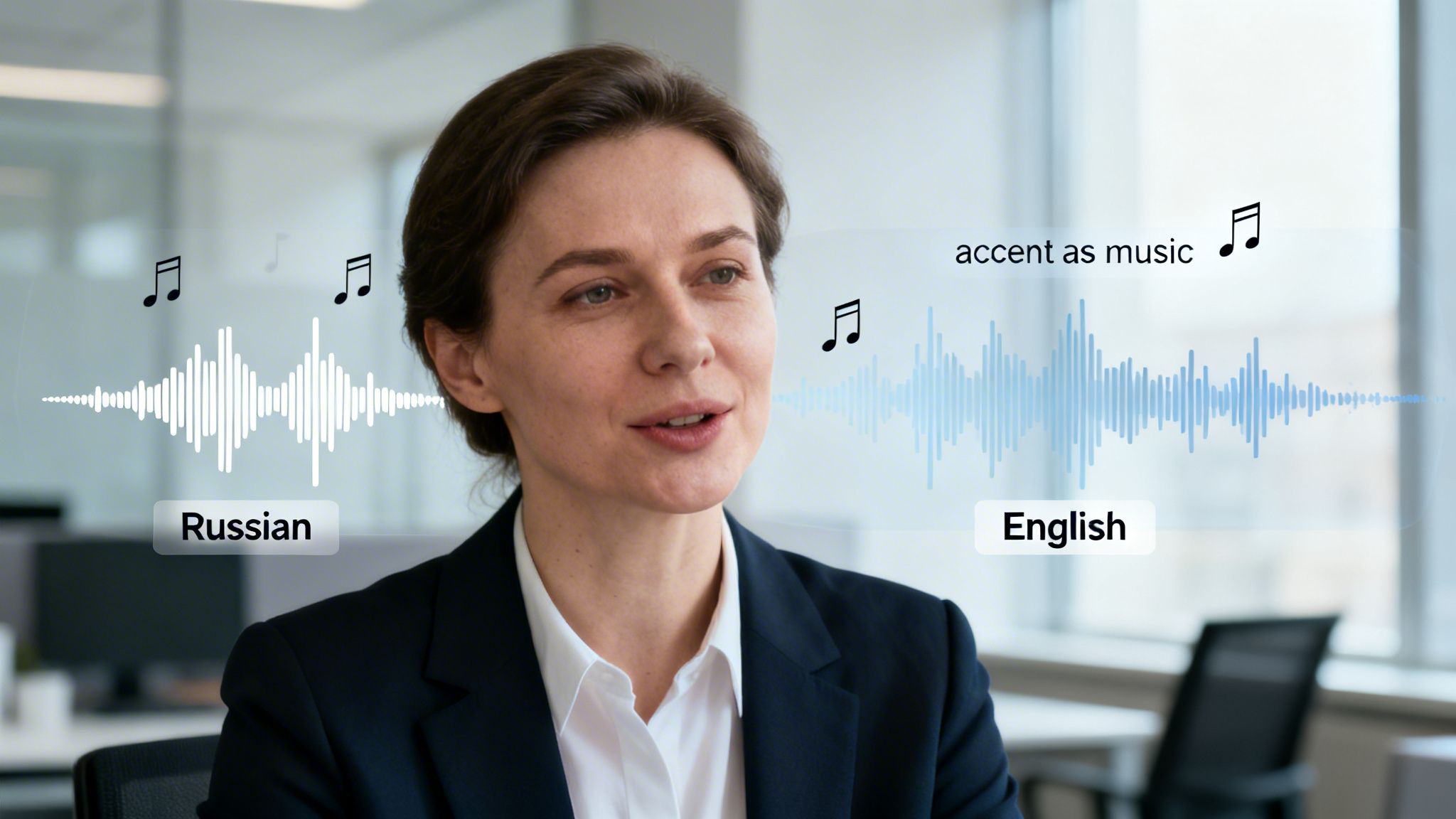
Many Russian speakers share a common frustration: you know the English words inside and out, but your message just doesn't seem to land with the clarity you intend. This isn't about making mistakes. It's about the underlying "music" of your native tongue influencing how you speak English.
Think about it this way: Russian and American English have fundamentally different rhythms and melodies. It’s like a classically trained pianist attempting to play jazz for the first time. You have all the right notes (your vocabulary) and you can play the keys (form sentences), but the unique timing, emphasis, and swing—the intonation and stress—are an entirely new skill set.
From Losing an Accent to Gaining Clarity
The goal shouldn't be to "lose" your Russian accent, because an accent is a core part of your identity and history. Instead, the focus should be on gaining clarity so you're always understood the first time. This small but powerful shift in perspective changes the objective from erasing a part of yourself to adding a new, valuable communication skill.
This journey starts by understanding exactly how Russian speech habits transfer into English. For example, your brain is wired to follow Russian language rules, which leads to a few key differences:
- Rhythm: Russian is what linguists call a syllable-timed language, where each syllable gets a roughly equal amount of time. American English, on the other hand, is stress-timed; certain words and syllables are stretched out while others are compressed, creating a completely different flow.
- Intonation: In Russian statements, the pitch range is often flatter and more consistent. To an American ear accustomed to more dynamic ups and downs, this can sometimes be misinterpreted as sounding less engaged or even blunt.
- Vowel Sounds: Russian has far fewer vowel sounds than English. This naturally leads to common substitutions that can completely change a word’s meaning, like the difference between ‘sit’ and ‘seat’ or ‘ship’ and ‘sheep’.
Understanding this foundational difference is the first step toward being clearly understood. It builds the confidence needed to lead professional conversations, ensuring your ideas—not your accent—are what people notice.
For more on this, you can read my guide on how to reduce native language interference in your English accent.
How Americans Hear a Russian Accent
Have you ever felt like you had to work twice as hard to be heard in a meeting, not because of your ideas, but because of your accent? It’s a common frustration. This isn't about your English skills; it’s about how an American listener’s brain processes speech that doesn’t quite fit the patterns it’s used to.
When someone from the U.S. hears a Russian accent, their brain is doing extra work. It's trying to decode sounds and rhythms that are different from the familiar template of American English. It’s a cognitive process, not a judgment. But that extra effort can sometimes get in the way of your message.
The "Eastern European" Label
This mental work often leads listeners to use broad, general labels. In fact, one study on accent perception found that American listeners were twice as likely to categorize a Russian accent as simply 'Eastern European or Slavic' rather than identifying it as specifically Russian.
From the listener's side, this is just a way to quickly categorize an unfamiliar pattern. But for you, it can have an unintended effect in a professional setting. Being lumped into a generic "other" category can create a subtle distance, especially when you’re trying to build trust with clients or lead a team.
Modifying specific, high-impact sounds isn't about erasing your identity. It's about removing communication friction so your message is received with the clarity and authority it deserves.
Why Intelligibility Matters
As a professional, your primary goal is to communicate with clarity and confidence. When certain features of a Russian accent make it tough for a listener to follow along, it can unintentionally chip away at your authority.
Think about it: if your listener is mentally struggling to tell the difference between "word" and "world," or "think" and "sink," their focus shifts. They're no longer fully absorbed in what you're saying, but rather how you're saying it.
This becomes especially critical when you're explaining complex data, presenting a new strategy, or leading a high-stakes discussion. By making a few strategic adjustments to your speech, you ensure your expertise takes center stage, free from any ambiguity. For a deeper dive into the specific sounds of American English, our guide on what an American accent sounds like offers a great starting point. The goal is to take control of the conversation, making sure your ideas are not just heard, but fully understood and respected.
The High-Impact Sounds: Where to Focus Your Practice
Okay, we've covered the 'why'—now let's get into the 'how.' This is your practical toolkit. Instead of getting lost in linguistic theory, we're going to zero in on the handful of pronunciation habits that cause the most confusion for Russian speakers. Mastering these few areas will give you the biggest, fastest boost in clarity.
This is all about closing the gap between what you mean to say and what your listener actually hears. It’s rarely about vocabulary or grammar; it's about the subtle, unconscious "rules" of sound you've carried over from Russian into English.
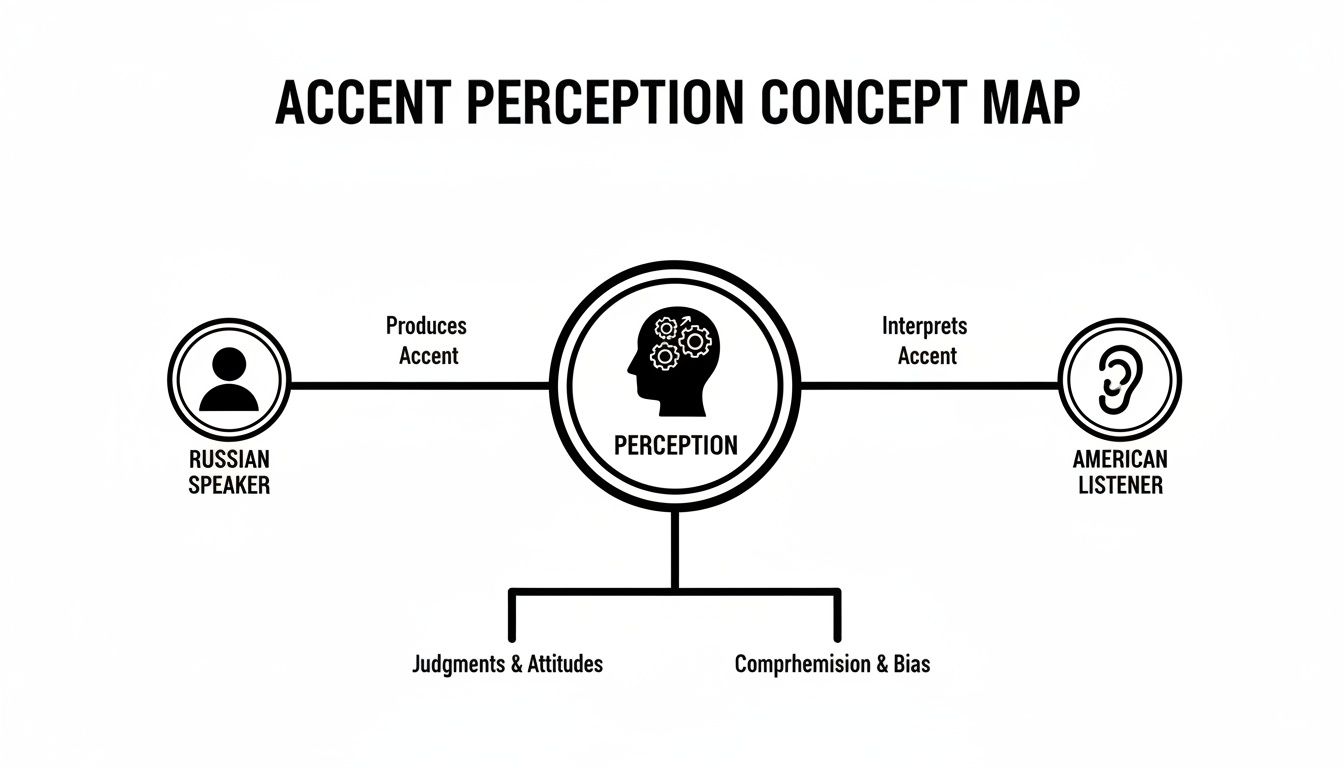
The good news is that with a little focused effort on the right things, you can bridge that perception gap much faster than you might think. Let's break down the most common challenges I see with my Russian-speaking clients.
To give you a clear roadmap, here’s a quick overview of the most critical pronunciation shifts. These are the changes that deliver the most significant improvement in clarity for the least amount of effort.
| High-Impact Pronunciation Changes for Russian Speakers |
| :— | :— | :— | :— |
| Common Challenge | Typical Russian-influenced Pronunciation | Target American English Sound | Example Words |
| Voiceless 'TH' | 'S' or 'T' sound | Soft 'th' | think, thank, through |
| Voiced 'TH' | 'Z' or 'D' sound | Vibrating 'th' | this, that, them |
| 'W' vs. 'V' | 'V'-like sound for both | Distinct 'W' and 'V' | west vs. vest, wine vs. vine |
| Short 'i' | 'ee' sound | Relaxed 'i' | sit, live, big |
| Final Consonants | Devoiced (e.g., 'b' becomes 'p') | Voiced | cab, bag, prize |
Focusing on just these few areas will resolve a huge percentage of the misunderstandings you might be experiencing. Now, let's dive into each one.
The 'TH' Sounds (Voiced and Voiceless)
This is probably the most recognizable feature of a Russian accent. Because the 'th' sounds don't exist in Russian, speakers naturally swap them for the closest sounds they know: 's' or 't' for the voiceless 'th' (like in think), and 'z' or 'd' for the voiced 'th' (as in the).
- Quick Diagnostic: Do you find yourself saying "I sink so" instead of "I think so"? Or "zis one" instead of "this one"? If so, this is a high-priority area for you.
- The Physical Fix: This is all about tongue placement. Gently place the tip of your tongue between your top and bottom teeth. Now, push air through. It’s a soft, continuous hiss of air, not a hard stop.
- Practice Words: think, thank, through, this, that, them
Since 'th' appears in some of the most common words in English (the, this, that, with), getting this one sound right makes a dramatic and immediate difference. For a much deeper dive, check out our guide on the voiced and voiceless TH sounds.
The 'W' vs. 'V' Mix-Up
Another classic challenge is the distinction between 'w' and 'v'. In Russian, the letter 'в' often lands somewhere between these two English sounds, which leads to words like west and vest sounding almost identical.
The difference is all about your lips and teeth. For 'v', your top teeth gently touch your bottom lip, creating friction as the air passes (think very). For 'w', your lips are rounded and pushed forward, with no teeth involved at all (think wow).
This might seem like a small detail, but in a professional setting, it's crucial. You don't want any confusion over whether you're talking about the company's "values" or "walleyes."
Mastering Key Vowel Distinctions
Here’s where a lot of subtle misunderstandings come from. Russian has 5 basic vowel sounds, while American English has over 15. Your brain has been trained to hear the world in 5 vowel categories, so it naturally tries to fit all those new English vowels into the old boxes.
Let's focus on two of the most problematic pairs:
- Short 'i' vs. Long 'ee' (as in 'sit' vs. 'seat'): The long 'ee' is a tense sound, like you’re smiling. The short 'i' is the opposite—it's short and relaxed. Accidentally asking someone to "take a sit" instead of "take a seat" during a meeting is a classic, slightly awkward example of this mix-up.
- 'a' as in 'cat' vs. 'u' as in 'cut': The 'a' sound in cat requires a wide-open jaw. The 'u' sound in cut is a short, neutral sound from the center of your mouth. Confusing 'cap' and 'cup' might be a small thing, but these little miscommunications add up.
You don't need to master all 15 vowels at once. Just focusing on these two pairs will clear up a surprising amount of confusion by retraining your mouth's muscle memory.
Final Consonant Devoicing
This is a deep-seated habit from Russian phonetics. In Russian, voiced consonants at the end of a word become voiceless. A 'b' sound becomes a 'p,' a 'd' becomes a 't,' and a 'g' becomes a 'k.' This habit is incredibly common when speaking English.
- The Challenge: A word like "cab" (which ends in a vibrating 'b' sound) gets pronounced "cap." "Card" sounds like "cart," and "bag" sounds like "back."
- The Impact: This can completely flip the meaning of what you're saying. Telling a client about the "big prize" is very different from telling them about the "big price."
To fix this, you need to consciously hold the vibration in your throat all the way to the end of the word. Try this: put your hand on your throat and say the word "buzz." Feel that vibration at the end? Now do the same for "cab," "bag," and "prize." You have to keep that motor running right to the finish line.
Mastering the Music of American English

Getting the vowels and consonants right is a huge step, but clear communication goes deeper than just individual sounds. If you've ever felt that your statements came across as flat or less engaging than you intended, the reason is almost always the rhythm and flow—what linguists call prosody, or the "music" of a language.
Russian is a syllable-timed language, which gives it a steady, even-paced rhythm. Each syllable gets a similar amount of time. Think of it like a metronome, with a consistent tick-tock-tick-tock.
American English, on the other hand, is a stress-timed language. It operates more like a dance, with certain important words stretched out and emphasized while others are quickly passed over. This creates a dynamic, up-and-down flow that’s absolutely fundamental to sounding natural and being understood easily. Without this "music," even grammatically perfect English can sound robotic and fail to make an impact.
The Power of Focus Words
In any American English sentence, one or two words carry the most weight. These are your focus words, and they’re the key to guiding your listener’s attention. By hitting these words with a slightly higher pitch and stretching them out, you’re essentially putting a spotlight on the most critical piece of information.
Because Russian is a state language in six countries and territories, many brilliant executives, engineers, and doctors from these regions now work in global English-speaking markets. Their prosodic habits—like stress and intonation—often differ from American norms, which can unintentionally affect how their authority and confidence are perceived.
Simply changing the focus word can completely transform a sentence's meaning. Take this simple request:
- "I need the report today." (This implies I'm the one who needs it, not someone else.)
- "I need the report today." (This highlights the report specifically, not the slides or the memo.)
- "I need the report today." (This stresses the urgency—it’s needed now, not tomorrow or next week.)
By consciously choosing your focus words, you gain incredible control over your message.
Think of intonation as a staircase. In American English statements, your pitch starts high on the main syllable of the focus word and then steps down, ending on a low, firm note. This falling intonation naturally conveys confidence and finality.
Putting It into Practice
Let’s see how this works in a couple of common professional scenarios. The goal is simple: find the focus word, raise your pitch on it, and then let your voice fall.
Scenario 1: Delegating a Task
- Flat Intonation: "Please finish this analysis by Friday." (Sounds like a suggestion, maybe even a bit weak.)
- Dynamic Intonation: "Please finish this analysis by FRI-day." (Your voice peaks on "FRI" and falls through "-day," adding a friendly but clear sense of authority.)
Scenario 2: Asking for an Update
- Flat Intonation: "What is the status of the project." (Can sound demanding or impatient.)
- Dynamic Intonation: "What is the STA-tus of the project?" (This typically uses a rising-falling intonation on the focus word, which signals genuine curiosity.)
Practicing these musical patterns will not only make your speech more engaging but also ensure your meaning lands exactly as you intended. If you're ready to dive deeper, our guide on how to master American English intonation with examples is packed with more detailed exercises.
Your Path to Clearer Communication
Knowing what to change is one thing; putting it into practice is where the real transformation happens. Now that you have a clear picture of the key sound and rhythm patterns that create a Russian accent, it’s time to map out your plan. Modifying your accent isn't a quick fix. It’s a process of consistent, focused practice that builds new habits over time.
It’s also important to be realistic. The goal isn’t to sound like you were born in Chicago overnight—and frankly, that’s not necessary. The real objective is steady, noticeable progress that makes you easier to understand and boosts your confidence in every conversation.
Realistic Timelines for Progress
So, what should you expect as you get started? Progress tends to happen in stages, and each one feels a little different.
- In 2-4 Weeks: You can make a real, noticeable difference on 1-2 high-impact sounds. If you focus daily on mastering the tricky 'th' sound or nailing the 'w' vs. 'v' distinction, you’ll start building new muscle memory. You'll even begin to hear the change in your own speech.
- In 8-12 Weeks: This is where things really start to click. With steady work, you’ll feel much more comfortable with several key consonants and begin to internalize the rhythm of American English. Colleagues might start commenting on your clarity in meetings, and you’ll feel more in command during presentations.
- In 6+ Months: At this stage, your new speech habits start becoming automatic. You'll find yourself naturally stressing the right words in a sentence and using American intonation without overthinking it. Your speech will sound more dynamic and flow much more naturally to native listeners.
How to Self-Diagnose and Prioritize
To practice effectively, you need to know where to put your energy. A simple recording is your best friend here. Just grab your phone, read a short text aloud, and then listen back with an honest ear.
Ask yourself these questions:
- In words like this or that, am I using a 'z' sound instead of the 'th'?
- Do my words west and vest sound identical?
- When I say cab, does it sound more like cap to a native listener?
By finding the one or two patterns that are causing the most confusion for your listeners, you can focus your practice time where it will make the biggest difference. Don't try to fix everything at once. Start with the changes that will give you the most clarity, the fastest.
As you work on your communication skills, remember that your professional image extends to your online presence, too. Taking some time for optimizing your LinkedIn profile for career success is a great way to ensure your digital first impression is as strong as your verbal one.
Every step toward more confident communication begins with a clear plan. If you're thinking about a more guided path, it might be helpful to explore the benefits of working with an online accent coach.
Frequently Asked Questions About Russian Accents
As you start exploring accent modification, it's natural to have a few questions. In my years of coaching, I've found that many Russian-speaking professionals share the same concerns. Let's tackle some of the most common ones head-on.
How Long Does It Take to Reduce a Russian Accent?
This is probably the most common question I get. While it's different for everyone, most professionals start to see real, noticeable improvements in their clarity within 12 weeks of focused, consistent practice.
The goal isn't to sound perfect overnight. It's about making steady progress on the highest-impact sounds and rhythm patterns. Often, the quickest wins come from mastering just a handful of sounds, like the 'th' or the 'w'. With a bit of practice, these new habits start to feel much more natural.
Is It Possible to Completely Lose My Accent?
Let's reframe that question. A much more powerful and achievable goal is to speak with total clarity and confidence, ensuring you're always understood. Trying to completely erase your accent is not only incredibly difficult but, for most professionals, it’s simply not necessary.
Your accent is part of your story, part of your identity. Our goal isn't to take that away. It's to soften the specific speech patterns that can get in the way of clear communication, so your ideas and expertise are what people remember.
Think of it as sharpening a tool in your communication toolkit, not replacing a part of who you are. The focus is always on being clearly and consistently understood.
Why Does My Accent Matter in a Professional Setting?
Your accent only becomes a factor when it creates an unintentional communication gap. For the roughly 975,000 Russian speakers in the United States—many concentrated in major business hubs like New York—speaking clearly is a huge professional asset.
If listeners have to strain to understand your pronunciation or rhythm, their mental energy shifts away from your actual message. By refining your speech clarity, you make sure your expertise is what shines through. In a competitive environment, that can make all the difference. You can find more data on the global distribution of Russian speakers on Babbel.
What Is the Difference Between Accent Modification and Speech Therapy?
This is a really important distinction to understand. Speech therapy is a clinical practice that diagnoses and treats communication disorders, like a stutter, a lisp, or speech difficulties caused by a medical issue. It's a form of medical treatment provided by a licensed speech-language pathologist.
Accent modification, on the other hand, is a form of coaching. It’s for non-native speakers who are already fluent in English but want to fine-tune their pronunciation and intonation to be more easily understood. It’s a skill-building process, much like getting a coach for a sport or a musical instrument—it’s not a medical treatment. We're simply enhancing the skills you already have.
For learners who aren't looking for one-on-one coaching but still want to improve their accent and clarity, Intonetic now offers two self-paced programs as a monthly subscription called Intonetic Accent Studio. The plans are priced at just $7 per month and $27 per month, with the main difference being that the $27/month program includes personalized feedback on your progress.
Feel free to explore the Intonetic Accent Studio programs and see if this flexible approach is the right fit for your journey.