
Mastering the Pronunciation of V A Professional’s Guide
The key to a perfect English ‘v’ sound is a simple but very specific physical action: gently rest your top teeth on your bottom lip and then create a buzzing sound from your throat.
It’s a voiced sound, which is just a technical way of saying your vocal cords need to vibrate. If you do it right, you’ll feel a distinct hum in your throat. This one physical detail is often the final piece of the puzzle for professionals aiming for crystal-clear English.
Why the ‘V’ Sound Trips Up So Many Professionals
Let’s be blunt: the ‘v’ sound can be a major roadblock to clear communication, especially for non-native English speakers. It feels like it should be easy, yet it’s one of the most common sounds that can weaken an otherwise powerful message in meetings, presentations, and high-stakes negotiations.
The problem isn’t about intelligence or language ability; it’s purely about muscle memory.
Many languages simply don’t have this sound—the voiced labiodental fricative, as linguists call it. So, when speakers encounter it in English, their brains naturally swap it for a sound that is familiar from their native language. That’s where the most common errors come from.
Common Pronunciation Substitutions
I see two main substitutions pop up constantly in my coaching sessions:
- The ‘W’ Sound: This is when “very” comes out sounding like “wery.” It happens because the lips are rounded and never make contact with the top teeth.
- The ‘B’ Sound: This is when “very” sounds more like “berry.” This error occurs when both lips press together, stopping the airflow completely for a moment, instead of letting a continuous, vibrating stream of air escape.
These substitutions are classic examples of native language interference, a common hurdle when learning any new sound system. For a more detailed look at this phenomenon, you can check out our guide on how to reduce your native language interference in English accent.
The goal is never to erase your accent, but to build new, precise habits for the sounds that are absolutely critical for being understood.
The core of mastering the ‘v’ is shifting from a lip-to-lip sound (like /b/ or /w/) to a teeth-on-lip sound. It’s a small physical adjustment that requires conscious practice before it can become second nature.
For many of my clients, a quick check in the mirror is all it takes to see what’s going wrong. Below is a quick-reference table to help you self-diagnose and fix the most common issues with the ‘v’ sound.
Common ‘V’ Sound Substitutions and How to Fix Them
| If You’re Saying This | What Might Be Happening | The Correct ‘V’ Articulation |
|---|---|---|
| “wery” instead of “very” | Your lips are rounded and pushing forward. No contact between teeth and lip. | Gently rest your top teeth on your bottom lip. Ensure your lips don’t round. |
| “berry” instead of “very” | Your lips are pressing together firmly, stopping the air completely before releasing it. | Keep your lips apart. Only the top teeth and bottom lip should touch, allowing air to flow continuously. |
| A silent or weak ‘f’ sound | You’re making the right mouth shape (teeth on lip), but you haven’t “turned on” your voice. | Keep the teeth-on-lip position and add a buzzing vibration from your vocal cords. Feel for the hum in your throat. |
Once you can feel the difference between these articulations, you’re on the right track. It’s all about building that new muscle memory.
The Global Business Case for Clarity
This isn’t just an academic exercise in phonetics. In today’s interconnected world, clear pronunciation is a vital tool for career advancement. The English ‘v’ sound often represents a critical intelligibility barrier for professionals whose native languages don’t include it.
With over 1.1 billion people speaking English at a level useful for business and 85% of employees agreeing it’s the language of international commerce, mastering these nuanced sounds is no longer optional—it’s a competitive advantage. Framing your pronunciation practice as a professional development goal can provide some powerful motivation to stick with it.
Feeling the Buzz: The Mechanics of a Perfect /v/
Mastering the /v/ sound is less about theory and more about feeling. You can read all the diagrams you want, but real progress happens when you tune into the physical sensations in your mouth and throat. Think of it like learning an instrument—you have to feel the vibration to know you’re hitting the right note.
The main thing you’re looking for is a gentle, steady buzz. This vibration should pop up in two places: right on your lower lip where your top teeth are resting, and deep in your throat. That hum is the sound of your vocal cords working, and it’s the single biggest difference between the voiced /v/ and its quiet twin, the unvoiced /f/.
The Voicing Diagnostic Test
Here’s a simple but incredibly effective test to feel this difference for yourself.
Gently place your fingertips on your Adam’s apple (your voice box). First, make a long, continuous /f/ sound, like you’re starting the word “fan.”
- fff…fff…fff…
Feel anything? You shouldn’t. There’s no vibration there at all. Now, keep your fingers in the exact same spot and switch to the /v/ sound.
- vvv…vvv…vvv…
There it is. You should immediately feel a distinct buzzing under your fingertips. That’s your vocal cords kicking into gear. This little test makes the whole concept of “voicing” crystal clear. If you don’t feel that hum, your /v/ is going to come out sounding like an /f/, which is how “vine” accidentally becomes “fine.”
Key Takeaway: That vibration isn’t just a side effect; it’s what defines the /v/ sound. No buzz, no /v/. Make this “throat buzz test” a regular part of your practice until you can feel it without even thinking about it.
This visual breaks down the process of spotting and fixing a common error, like swapping a ‘W’ for a ‘V’.
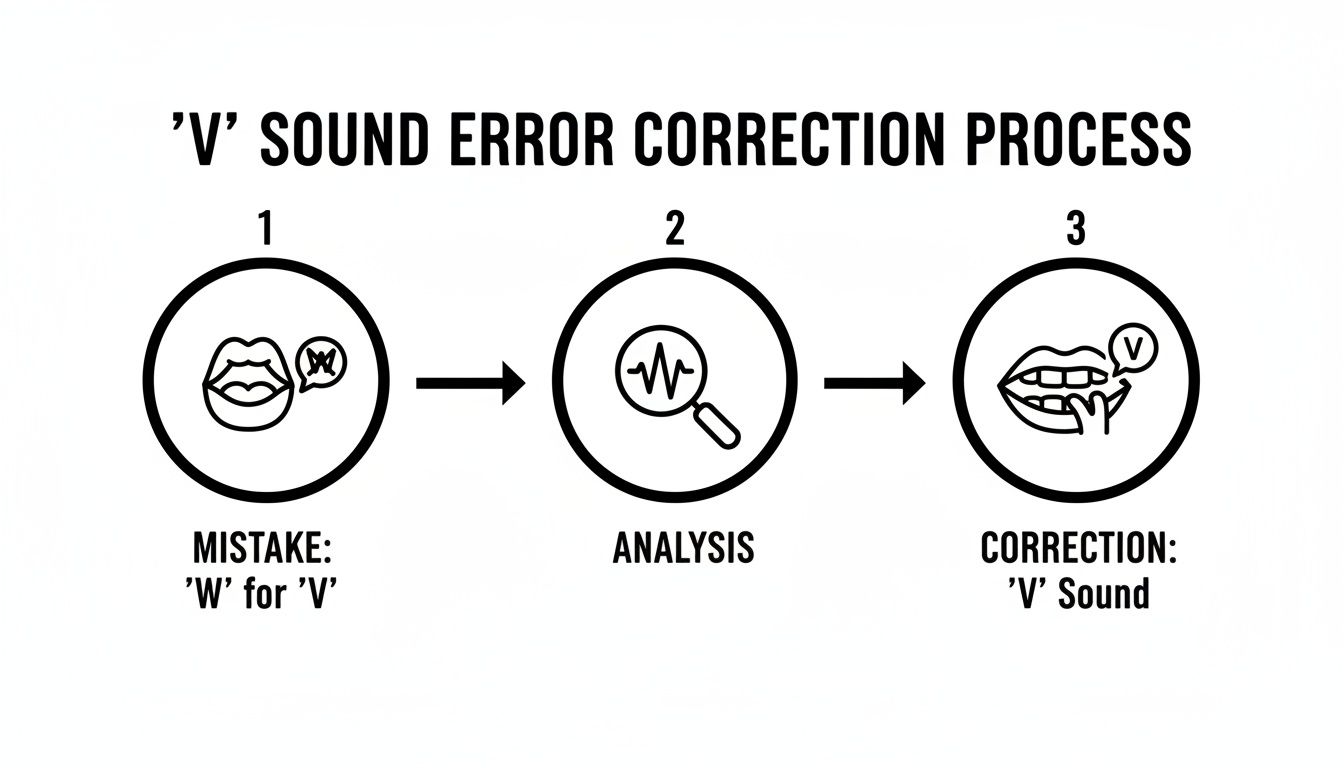
It’s all about moving from an incorrect mouth shape (like rounded lips for ‘W’) to consciously analyzing the problem, and then executing the correct teeth-on-lip placement for the ‘V’.
Building Your Physical Foundation
Beyond the buzz, your mouth’s posture is what gives the sound its unique quality. The good news? Your tongue isn’t really involved here. It can just chill out in a neutral position, which really simplifies things. The visual side of speech is fascinating; if you’re curious about how technology maps these movements, you can see how lip sync application technology matches mouth shapes to audio.
All the action for the /v/ sound happens at two key points:
- Teeth on Lip: Gently rest your top front teeth on the soft, inner part of your bottom lip. You shouldn’t be biting down hard—just light enough that air can still squeeze through.
- Airflow: Push a steady stream of air out from your lungs, forcing it through that tiny gap you’ve just created between your teeth and lip.
Mastering English consonant sounds is all about building this kind of specific muscle memory. To get a bigger picture, you can check out our guide on how to master English consonant sounds. By really nailing these physical mechanics, you’ll build a reliable foundation for a perfect /v/ every single time.
From Single Sounds to Core Vocabulary
Alright, once you can reliably produce that buzzing /v/ sound on its own, it’s time to start building some serious muscle memory. The real goal here is making the correct pronunciation of v completely automatic, so you don’t have to think about it in the middle of a conversation. This stage is all about smart, high-repetition drills that move the sound from a mental exercise into your everyday vocabulary.

We’ll kick things off with one of the most powerful tools in pronunciation training: minimal pairs. These are word pairs that are identical except for one single sound, which forces your brain and mouth to lock onto that tiny but crucial difference.
Sharpening Your Ear with Minimal Pairs
Think of minimal pair drills as a high-intensity workout for your mouth and ears. They create such a stark contrast that any mistake becomes glaringly obvious. For the /v/ sound, we’ll often pit it against its unvoiced twin /f/ and the all-too-common substitute, /b/.
Practice saying these pairs out loud. At first, really overdo the /v/ sound—make that vibration on your lower lip impossible to ignore.
- fan / van: “The fan was next to the delivery van.”
- few / view: “From our view, only a few options are viable.”
- fine / vine: “The fine wine comes from a very old vine.”
- best / vest: “He wore his best vest to the event.”
- boat / vote: “We took a boat to go cast a vote.”
Here’s a pro tip: record yourself saying these pairs and listen back. Can you clearly hear the difference? If you can’t, it’s a safe bet your listeners can’t either. This simple diagnostic check is absolutely essential for self-correction.
The point of minimal pairs isn’t just to say the words correctly. It’s to train your ear to instantly recognize the difference between the target sound and the error sound. This auditory feedback loop is what accelerates your progress.
Building Word Lists for Professional Contexts
After you’ve sharpened your perception with minimal pairs, the next logical step is to get comfortable with individual words. To make this practice count, let’s focus on vocabulary you actually use in your professional life. We can break this down by targeting the sound in different spots within a word.
Initial Position (V at the beginning)
This is usually the easiest place to start. You can set up your mouth for the sound before the word even begins.
- Value
- Version
- Validate
- Very
- Virtual
- Vision
Medial Position (V in the middle)
Here, the challenge is transitioning smoothly from the sound before it.
- Investment
- Available
- Reviewing
- Develop
- Innovation
- Evidence
Final Position (V at the end)
Ending a word with a voiced consonant like /v/ can be tricky. A lot of speakers accidentally devoice it, making a word like “improve” sound like “improof.” Make sure you hold that vibration right to the very end.
- Improve
- Achieve
- Involve
- Receive
- Resolve
- Give
The key is weaving these words into your daily routine. For more ideas on how to do this, check out our guide on how to practice English pronunciation with common daily phrases. The strategy is simple: pick five to ten words from these lists and say them out loud, multiple times a day. This high-repetition work is what forges the new neural pathways that make the correct pronunciation of v a natural, effortless part of your professional speech.
Using the V Sound Naturally in Conversation
Making the jump from isolated word drills to fluent, real-world speech is where the real work begins in mastering the pronunciation of v.
It’s one thing to say “value” perfectly when you’re focused on it. It’s another thing entirely to nail it in a fast-paced client meeting. This is where we bridge that gap, turning conscious effort into unconscious competence.
The goal here is to automate the sound so it becomes a seamless, effortless part of your professional communication. We’ll get there by practicing with language that mirrors real-world scenarios, training your brain and mouth to work together under pressure.
From the Practice Room to the Boardroom
To make the sound stick, your practice has to reflect the language you actually use day-to-day. Generic phrases just won’t cut it. You need to focus on sentences you could pull directly from a business email or a slide deck.
Try integrating these professionally-focused sentences into your daily drills:
- “We’ve reviewed the available data and believe it provides valuable insights.”
- “My personal view is that this new version will drive significant growth.”
- “Could you verify the invoice I received yesterday?”
- “Our objective is to improve customer retention over the next quarter.”
Recording yourself saying these sentences and then listening back is absolutely vital. Does your /v/ sound strong and consistent? Or does it weaken and revert to a /w/ or /b/ when you’re managing the cognitive load of a full sentence? This self-analysis is how you diagnose lingering issues before they show up in a high-stakes conversation.
The Growing Demand for Vocal Precision
This level of detail in pronunciation is becoming more important than ever. The digital English-learning market hit $10.39 billion in 2024 and is projected to climb to $12.30 billion in 2025.
This isn’t just a random statistic; it shows a major shift where basic fluency is no longer the benchmark. Precision and clarity are now competitive advantages. You can read more about these English proficiency insights to understand the trend. For professionals, this market growth highlights a genuine business demand for specialized coaching that targets these exact issues.
Expert Tip: Before an important meeting, identify three to five key words with the /v/ sound that you expect to use. Practice them in isolation, then in the sentences you’ll likely say them in. This little “vocal warm-up” primes your muscle memory for success when it counts.
Challenging Your Articulation with Tongue Twisters
Once full sentences start feeling more comfortable, the final test is maintaining that clarity at speed. Tongue twisters are a fantastic tool for this. They force your articulators to move quickly and accurately, reinforcing the correct placement for the pronunciation of v even when you’re talking fast.
Start slowly. The goal is to maintain that buzzing vibration, then gradually increase your pace.
- “Vivian believes very vicious wolves are valuable.”
- “A very vivid vest evolved into a lovely overcoat.”
- “Seven veterans viewed the eleven marvelous vases.”
These drills help your mouth navigate the tricky transitions between sounds, especially when moving into or out of that /v/ position. Understanding these movements is a core part of mastering natural, flowing speech. For a deeper dive, check out our guide on connected speech sound changes in American English.
By combining professional context sentences with speed-focused tongue twisters, you build a powerful practice routine. This approach moves you beyond just the mechanics and into the realm of natural, automatic, and confident communication, ensuring your voice is every bit as clear and impactful as your ideas.
Building a Daily Practice That Actually Works
Lasting improvement in your pronunciation of /v/ comes from consistency, not cramming. The goal here is to build a new muscle memory habit through short, focused bursts of effort. You’d be amazed at what a sustainable 10-minute daily routine can do—it fits into even the most packed professional schedule and creates far better results than a single, lengthy session once a week.
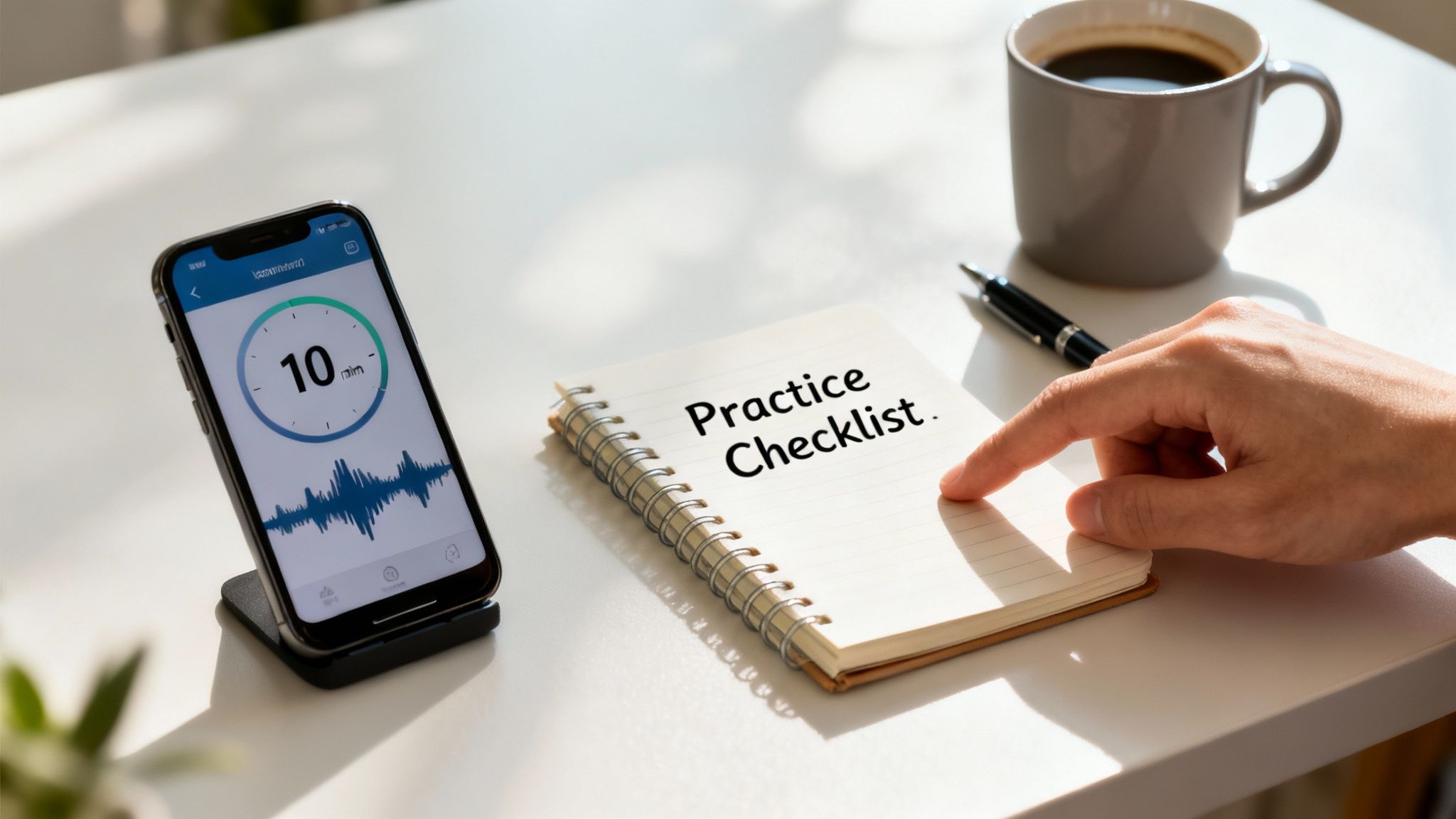
Think of this as your roadmap. We’re not just practicing sounds; we’re building a new habit that delivers tangible results in your professional communication by training your mouth, ear, and brain all at once.
Your 10-Minute Daily Workout
I like to call this a quick, high-intensity workout for your speech. Follow this structure every day for a few weeks, and I guarantee you’ll notice a significant improvement in your control and confidence with the /v/ sound.
- Minutes 1-2: Sound Isolation & Warm-Up
Start by simply making the sound. Get your top teeth on your bottom lip and create that buzzing vibration. Hold a continuous “vvv…” for about 15 seconds, rest, and then repeat it four times. This is all about reactivating the muscle memory and physical sensations you need. - Minutes 3-5: Minimal Pair Drills
Next, grab five minimal pairs like “fan/van” or “best/vest.” Say each pair out loud three times, really focusing on exaggerating the vibration of the /v/. This sharpens your ear and helps you feel the clear distinction between the target sound and any common errors. - Minutes 6-8: Sentence Repetition
Now, select two or three professional sentences from the previous section. Say each sentence slowly and deliberately five times. Pay close attention to how the /v/ feels at the beginning, middle, and end of words within a natural conversational flow. - Minutes 9-10: Record & Review
This is the most critical part. Use the voice memo app on your phone to record yourself saying the sentences from the previous step. Listen back immediately. Is the vibration consistent? Is the sound clear and not muffled? This self-monitoring is the single most powerful tool for improvement.
Becoming your own pronunciation coach is absolutely essential. Recording yourself removes all the guesswork and gives you objective data on your progress. Trust me, what you think you’re saying and what you’re actually saying can often be two very different things.
Integrating Practice into Your Day
A formal 10-minute session is ideal, but the real magic happens when you sneak in practice throughout your day. This micro-learning approach reinforces the new habits without ever feeling like a chore.
Consider these opportunities:
- During your commute: If you’re driving alone, listen to audio drills of /v/ words and repeat them out loud.
- While making coffee: Before your first sip, say five key /v/ words from your industry—like “value,” “review,” or “investment.”
- Before a meeting: Do a quick 30-second warm-up. Just hold that “vvv…” sound to prime your articulators and get them ready.
Consistency always beats intensity. By making these small exercises a non-negotiable part of your daily routine, you are methodically rebuilding the muscle memory needed for a perfect pronunciation of v, ensuring it becomes an automatic and natural part of your professional speech.
Common Questions About the V Sound
Even with the best drills, questions always pop up when you’re working to master a new sound. Here are a few of the most common ones I hear from professionals, along with some quick, practical answers to keep you on track.
How Long Does It Take to Fix This Sound?
This is always the first question, and the honest-to-goodness answer is: it depends. The timeline really hinges on your native language and—most importantly—how consistently you practice.
With focused daily work of just 10-15 minutes, most people feel a real difference in a few weeks. But to make the sound truly automatic in spontaneous speech? You should probably plan for about two to three months of consistent effort. The goal isn’t just knowing how to make the sound; it’s about building new muscle memory through high-repetition drills so you don’t even have to think about it.
My Native Language Lacks a V Sound. Where Should I Start?
If the /v/ sound is completely new territory for you, the single most important thing you can do is master the sound in isolation. Forget about words for a moment.
Zero in on the two core mechanics:
- The contact point: Your top teeth gently resting on your lower lip.
- Voicing: That buzzing vibration you feel in your throat.
Just practice making that “vvv…” sound over and over until it feels natural and consistent. This builds the non-negotiable foundation you’ll need before adding the complexity of words and sentences.
Don’t rush into sentences if you can’t nail the sound by itself. A shaky foundation will always lead to mistakes under pressure. Solidify the core mechanics first, and the rest will follow much more easily.
Is It Okay to Just Use a W Sound Instead?
While listeners can often figure out what you mean from context, substituting ‘w’ for ‘v’ (like saying “wery” instead of “very”) can really affect your professional clarity. It’s a common accent marker that, while small, can subtly undermine your authority and make your message less direct.
Getting the /v/ sound right is a high-impact change that instantly makes your speech sound clearer, more standard, and more confident. For a deeper dive into how easily sounds like these can be confused, you can explore the power of using minimal pairs in English to train your ear and correct these subtle but crucial differences.
I Forget the Sound During Meetings. How Do I Fix This?
This is a classic problem. It means you’ve learned the sound, but it hasn’t become automatic yet. The fix is to consciously bridge that gap between practice time and real-world application.
Start by deliberately using ‘v’ words in low-stakes situations, like when you’re ordering coffee or just chatting with a friend. Before an important meeting, identify a few key ‘v’ words you know you’ll use—think “value,” “review,” “provide”—and say them a few times. This simple act of priming helps move the correct pronunciation from conscious effort to automatic habit, especially when the pressure is on.
Ready to build the clarity and confidence you need for high-stakes conversations? The team at Intonetic offers personalized, one-on-one accent coaching designed for busy professionals. Book your free assessment today and receive a starter guide to begin your journey.