Top 10 Most Mispronounced Words for Professionals in 2026

In high-stakes professional settings, how you speak can be as impactful as what you say. It’s not about erasing an accent; it’s about ensuring your ideas land with clarity and authority. Simple, common errors in pronunciation can create a subtle drag on your credibility, forcing listeners to work harder to understand you and distracting them from your core message. This isn’t a grammar test, it’s about the science of sound and perception. Mastering these details is crucial for cultivating a clear tone of voice that reinforces your professional presence and impact.
This guide moves beyond generic advice to dissect some of the most mispronounced words that frequently appear in boardrooms, client meetings, and technical discussions. We will provide not just the correct pronunciation using the International Phonetic Alphabet (IPA) and simple respelling, but also practical drills, industry-specific examples, and an understanding of why these words are so tricky. By mastering these specific phonemes and stress patterns, you’re not just learning words. You’re building a framework for clearer, more confident communication that commands attention and respect, ensuring your expertise is always the focus.
1. Often – /ˈɔːf.ən/ vs /ˈɑːf.ən/
The word “often” is a prime example of how historical spelling can create modern pronunciation puzzles, making it one of the most mispronounced words in English. The core confusion stems from the letter ‘t’. Historically, this ‘t’ was silent, and for centuries, the standard pronunciation has been AW-fin (/ˈɔːf.ən/ or /ˈɑːf.ən/). However, a trend of “spelling pronunciation,” where people pronounce a word as it’s spelled, has led to the rise of the AWF-ten variant.
While pronouncing the ‘t’ is now common and widely accepted in casual speech, the silent ‘t’ version remains the traditional and often preferred standard in formal and professional contexts. For non-native speakers aiming for clarity and polish, mastering the silent ‘t’ can subtly enhance their credibility. Mispronouncing such a high-frequency word might distract listeners in a presentation or negotiation.
How to Get It Right
To train your pronunciation, focus on making the ‘t’ disappear completely. Think of it like the ‘t’ in “soften” or “listen.”
- Practice Phrase: Repeat the sentence, “I often find we soften our stance,” linking the silent ‘t’ sound in both words. This builds muscle memory for the pattern.
- Focus on the Vowel: Say “awe” then immediately add “-fin.” The goal is a smooth transition from the vowel to the ‘f’ sound without any ‘t’ interruption.
- Record and Review: Use your phone to record yourself saying, “How often do you update the software?” Listen back specifically for any hint of a ‘t’ sound and re-record until it vanishes.
Understanding the phonetic symbols for these sounds can provide an even clearer roadmap. If you’re unfamiliar with these symbols, you can learn more about using the International Phonetic Alphabet (IPA) for pronunciation to accelerate your progress.
2. Worcestershire – /ˈwʊ.stər.ʃər/ or /ˈwʊ.stər.ʃaɪər/
The word “Worcestershire” is a classic entry on any list of the most mispronounced words, notorious for a spelling that seems to have little connection to its sound. This name, representing both a county in England and a tangy sauce, trips up even native speakers. The pronunciation is roughly WOO-ster-sher (/ˈwʊ.stər.ʃər/) or WOO-ster-shire (/ˈwʊ.stər.ʃaɪər/). The main error is attempting to pronounce every syllable as written, which leads to jumbled results like “wor-cest-er-shi-er.”
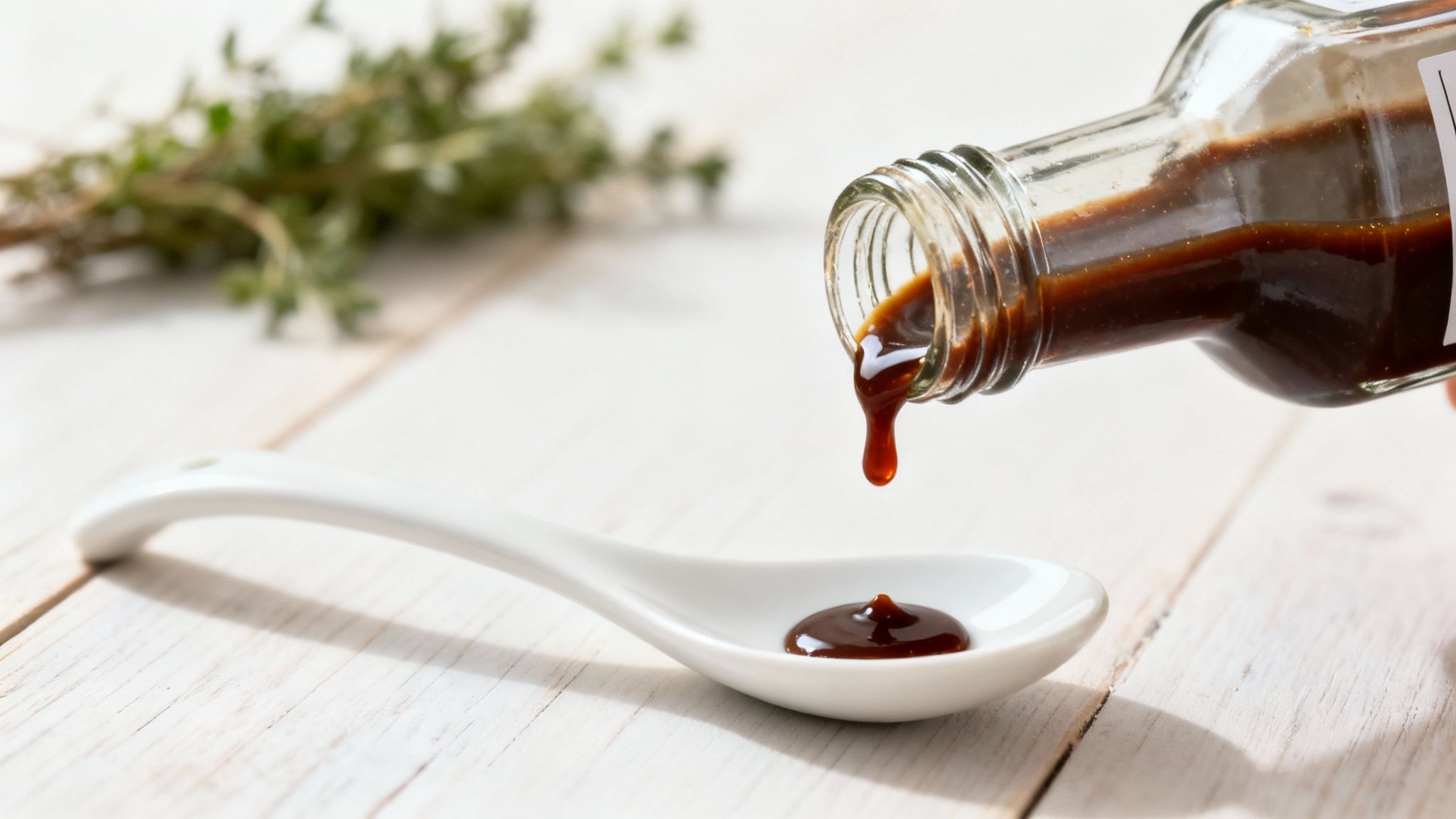
In a professional setting, such as a restaurant manager greeting clients (“Our signature dish uses Worcestershire sauce”) or a sales executive discussing product lines (“The Worcestershire product line shows strong Q3 growth”), confidently saying this word projects poise. Getting it wrong can be a momentary distraction that undermines your authority. The key is to ignore the spelling and learn the sound as a complete unit.
How to Get It Right
The most effective strategy is to stop trying to decode the word phonetically and instead memorize it as a single sound-chunk.
- Break It Down: Think of it in three simple parts: WOO + ster + sher. Say them slowly at first, then blend them together until they flow smoothly. Forget the “rce” and “shi” letters entirely.
- Contextual Practice: Repeat the phrase, “Please pass the Worcestershire sauce,” focusing on a natural, conversational rhythm. This helps embed the correct pronunciation into your everyday speech patterns.
- Listen and Mimic: Use a resource like Forvo or YouTube to listen to native speakers pronounce the word at least five times. Close your eyes and focus only on the sound, then try to replicate it exactly.
Mastering the distinct sounds that make up English words is crucial for clarity. You can learn more about the 44 sounds in English to build a stronger foundation for tackling difficult words like this one.
3. Nuclear – /ˈnuː.kli.ər/ vs /ˈnuː.kjə.lər/
The word “nuclear” consistently ranks among the most mispronounced words, often tangled by a process called metathesis, where sounds are swapped. The confusion centers on the “-cle” and “-ar” ending. The correct pronunciation is a clean, three-syllable NOO-klee-ur (/ˈnuː.kli.ər/), not the common but incorrect four-syllable NOO-kyoo-lur (/ˈnuː.kjə.lər/). This error often inserts an extra ‘y’ sound, disrupting the word’s flow.

This mispronunciation is particularly noticeable in professional settings, such as a tech lead discussing “nuclear options for data center power” or a C-level executive presenting on “nuclear energy.” Getting it right projects precision and attention to detail. For non-native speakers, mastering this tricky word demonstrates a high level of English proficiency, preventing a minor slip from distracting from a major point during a high-stakes conversation or presentation.
How to Get It Right
To correct this habit, focus on distinctly separating the syllables before blending them. Isolate the “klee-ur” sound.
- Practice Phrase: Say the phrase “It’s clear we need a nuclear option.” Link the correct “clear” sound directly into the final two syllables of “nuclear” to build the right mouth movement.
- Syllable Breakdown: Break it down slowly into three parts: “NOO – KLEE – UR.” Say it five times, gradually increasing your speed until the three syllables flow together smoothly without adding an extra sound.
- Record and Review: Use your phone to record yourself saying, “Our nuclear medicine division is expanding.” Listen back carefully. Can you hear a “kyoo” sound? If so, re-record, focusing on the clean “klee” transition.
Mastering the International Phonetic Alphabet (IPA) can further refine your pronunciation of challenging words like this. You can learn how to leverage the IPA for clear American English pronunciation to ensure you are always understood.
4. Epitome – /ɪˈpɪt.ə.mi/ vs /ˈɛp.ə.toʊm/
The word “epitome” often trips people up due to its deceptive spelling, making it one of the most mispronounced words for professionals. The common error is pronouncing it as EP-uh-tome (/ˈɛp.ə.toʊm/), treating the last syllable like “home” or “dome.” The correct pronunciation is uh-PIT-uh-mee (/ɪˈpɪt.ə.mi/), with four distinct syllables and the stress placed firmly on the second one.
For executives and professionals, using this word correctly is crucial when describing a perfect example of a concept, such as “the epitome of innovation.” A mispronunciation can undermine the speaker’s perceived expertise and distract from an otherwise powerful message, especially in high-stakes contexts like a product launch or a keynote address. Mastering this word adds a layer of polish and authority to your vocabulary.
How to Get It Right
The key to pronouncing “epitome” correctly is mastering the four-syllable structure and the second-syllable stress.
- Mark the Stress: Practice by exaggerating the stressed syllable: say “uh-PIT-uh-mee” loudly and clearly. Comparing it to words with a similar rhythm, like “academy” (uh-KAD-uh-mee), can help lock in the pattern. You can learn more about how syllable stress impacts clarity and meaning.
- Practice with Context: Repeat phrases where the word appears naturally. For example, “This product is the epitome of user-centered design” or “Our team represents the epitome of professionalism.”
- Slow and Speed Up: Record yourself saying “uh – pit – uh – mee” slowly, ensuring each syllable is clear. Then, gradually increase your speed to a natural, conversational pace while maintaining the correct pronunciation and stress.
5. Schedule – /ˈskedʒ.uːl/ (American) vs /ˈʃedʒ.uːl/ (British)
The word “schedule” is a transatlantic pronunciation minefield, securing its place among the most mispronounced words for professionals. The key difference lies in the initial sound: American English uses a hard ‘sk’ sound, resulting in SKEJ-ul (/ˈskedʒ.uːl/), while British English opts for a soft ‘sh’ sound, yielding SHED-ul (/ˈʃedʒ.uːl/). Non-native speakers often stumble by adding an extra syllable, like ‘SKED-yool,’ or blending the sounds incorrectly.
As this word is fundamental to business operations like setting meetings, managing projects, and planning timelines, mispronouncing it can create a moment of confusion. In a high-stakes client call or a team standup, a non-standard pronunciation might require a listener to mentally pause and process, momentarily disrupting the flow of communication. Choosing and mastering one standard pronunciation, typically based on your primary audience, projects confidence and clarity.
How to Get It Right
To master the American pronunciation, focus on a crisp, two-syllable delivery with a ‘k’ sound. Think of it as “sked” followed immediately by “jule.”
- Practice Phrase: Repeat, “Can you schedule a check-in on the project schedule?” to reinforce the correct American sound in a common professional context.
- Syllable Focus: Break it down. Say “SKEJ” with a short ‘e’ sound, then add “-ul.” The goal is to avoid drawing out the end into a ‘yool’ sound. It’s a quick, efficient word.
- Record and Review: Record yourself saying, “Let’s check the schedule for next week’s appointments.” Play it back and compare it to a native speaker’s version, listening for the hard ‘sk’ and the concise two-syllable structure.
Understanding the nuances between regional accents can be a powerful tool for any professional. To deepen your knowledge, you can explore what an American accent sounds like and how it differs from other English variants.
6. Colleague – /ˈkɑː.liːɡ/ (American) vs /ˈkɒl.iːɡ/ (British)
As a cornerstone of professional communication, “colleague” is a word where correct pronunciation is vital for credibility, yet it’s frequently one of the most mispronounced words. The primary error involves adding an extra syllable, making it sound like “KOL-league,” or placing the stress incorrectly on the second syllable (“kuh-LEEG”). Both versions can sound unnatural and distract from your message in professional settings.
The correct pronunciation has two distinct syllables with stress on the first: KAH-leeg (/ˈkɑː.liːɡ/) in American English and KOL-eeg (/ˈkɒl.iːɡ/) in British English. In a fast-paced business meeting or a client call, mispronouncing this word can subtly undermine your authority. For professionals in any field, from tech to healthcare, mastering this simple word ensures your language is as polished as your expertise.
How to Get It Right
Focus on stressing the first syllable and ensuring a clean two-syllable sound. The silent “ue” at the end often causes confusion; practice saying the word phonetically without it.
- Practice Phrase: Repeat, “My colleague and I will lead the meeting.” This phrase is common in business and helps you practice the word in a natural context.
- Isolate the Stress: Say KAH loudly, then add a short, crisp “-leeg.” The goal is a front-loaded sound, making the first syllable the most prominent part of the word.
- Record and Review: Record yourself saying, “Let me check with a colleague in that department.” Listen to the playback to ensure you are not adding a third syllable or stressing the “leeg” part of the word.
7. Comfortable – /ˈkʌm.fər.tə.bəl/ or /ˈkʌm.fɔɾ.tə.bəl/
The word “comfortable” is a notorious stumbling block due to its misleading spelling, making it one of the most mispronounced words for both native and non-native speakers. The common mistake is dropping syllables, leading to rushed pronunciations like “KUMF-ter-bul” or “KUM-for-bul.” The correct pronunciation has four distinct syllables: KUM-fer-tuh-bul (/ˈkʌm.fər.tə.bəl/) or, with a quick flap sound, KUM-fort-uh-bul (/ˈkʌm.fɔɾ.tə.bəl/).

This mispronunciation often stems from a phenomenon called “syllable elision,” where unstressed syllables get deleted in rapid speech. However, in professional settings, such as a doctor asking if a patient is comfortable or a manager discussing a work environment, articulating all four syllables projects clarity and precision. Pronouncing it correctly ensures your message is not only understood but also delivered with a polished, authoritative cadence.
How to Get It Right
The key is to consciously break the word down and articulate each of the four syllables, avoiding the urge to rush them together.
- Syllable Breakdown: Start by slowly saying each part aloud: KUM – fer – tuh – bul. Exaggerate the separation between them at first to build the correct rhythm and muscle memory.
- Focus on the Schwa: Pay close attention to the second syllable. It’s a soft “fer” sound, not a hard “fort.” Think of the sound in “differ.” Practice saying “I’m comfor-” and then add “-table.”
- Record and Review: Use your phone to record yourself saying professional phrases like, “We want to make sure you’re comfortable with this timeline.” Listen back and compare your version to a native speaker’s pronunciation, ensuring you can hear all four distinct syllables.
8. Pronunciation – /prəˌnʌn.siˈeɪ.ʃən/
Ironically, the very word that describes how we say words is itself one of the most mispronounced words in the English language. The confusion often comes from its verb form, “pronounce,” which has a distinct “noun” sound. This leads many speakers to incorrectly say “pro-NOUN-see-ay-shun.” The correct American English pronunciation is pruh-NUN-see-AY-shun (/prəˌnʌn.siˈeɪ.ʃən/), with the second syllable sounding like “nun,” not “noun.”
For professionals aiming to enhance their verbal communication, mispronouncing this specific word can inadvertently undermine their credibility, especially when discussing their efforts to improve their speech. Getting it right demonstrates a high level of attention to detail and a sophisticated command of English. Whether you’re telling a colleague, “My pronunciation has improved significantly,” or a manager is noting, “Your pronunciation is excellent,” using the correct form reinforces your professional polish and commitment to clear communication.
How to Get It Right
Breaking the word into its five distinct syllables is the key to mastering it. Focus on separating the sound from the verb “pronounce.”
- Syllable Breakdown: Practice saying it slowly: pruh – NUN – see – AY – shun. Notice the stress falls on the fourth syllable, “AY.”
- Focus on the First Syllable: The initial sound is a soft “pruh” (a schwa sound), not a hard “pro.” Think of the sound in “propose.”
- Record and Compare: Record yourself saying, “Let’s work on your pronunciation of technical terms.” Play it back and compare it to a native speaker’s version. Listen carefully for the “nun” sound in the second syllable.
Mastering this word is a foundational step as you improve your overall English speaking skills, building confidence for every other word you tackle.
9. February – /ˈfɛb.ru.ɛr.i/ or /ˈfɛb.rə.wɛr.i/ (American)
The shortest month of the year, “February,” frequently causes pronunciation trouble, making it one of the most mispronounced words in professional settings. The difficulty lies in its two ‘r’ sounds, with the first one often being dropped. Many speakers simplify it to “FEB-yoo-air-ee,” but the correct American pronunciations are FEB-roo-air-ee (/ˈfɛb.ru.ɛr.i/) or, more commonly, FEB-ruh-wer-ee (/ˈfɛb.rə.wɛr.i/).
This word appears constantly in business for scheduling meetings, discussing fiscal quarters, and setting project timelines. Saying “We’ll launch in Feb-yoo-ary” can sound informal and may subtly undermine a speaker’s precision, especially in high-stakes conversations like a product roadmap discussion or financial planning meeting. Mastering the standard pronunciation demonstrates attention to detail and enhances professional credibility.
How to Get It Right
The key is to acknowledge and articulate both ‘r’ sounds clearly. Breaking the word into its component syllables is the most effective training method.
- Practice Phrase: Repeat the sentence, “Our February review is truly crucial.” This forces you to articulate the challenging “brew” and “roo” sounds in close succession.
- Syllable Breakdown: Break the word down and say it slowly: FEB-ruh-wer-ee. Focus on making a distinct ‘r’ sound in the second syllable (
ruh) and again in the third (wer). - Record and Review: Record yourself saying, “The project deadline is February 15th.” Listen back to ensure you aren’t dropping the first ‘r’ or morphing the word into “Feb-yoo-ary.” Compare your recording to a native speaker’s pronunciation.
10. Subtle – /ˈsʌt.əl/ vs /ˈsuːt.əl/ (common mispronunciation)
The word “subtle” is a classic trap in English pronunciation, placing it firmly on the list of most mispronounced words due to its silent ‘b’. The correct pronunciation is SUH-tul (/ˈsʌt.əl/), with two distinct syllables and no ‘b’ sound whatsoever. Common mistakes include pronouncing the ‘b’ to say “SUB-tul,” or using an incorrect vowel sound like “SOO-tul.” This often happens because speakers try to sound out the word based on its spelling.
In a professional setting, correctly pronouncing “subtle” is key when discussing nuanced strategies, diplomatic communication, or delicate changes in data. For instance, a manager might discuss the “subtle shift in team dynamics” or a data scientist might point out a “subtle trend in the analytics.” Mispronouncing it can momentarily break your flow and distract from the sophisticated point you are making, potentially undermining your credibility on a complex topic.
How to Get It Right
To master this word, your main goal is to completely ignore the ‘b’ and focus on the two simple syllables.
- Practice Phrase: Say the sentence, “It’s a subtle but vital shuttle service.” The rhyming connection between “subtle” and “shuttle” helps reinforce the correct “uh-ul” sound at the end.
- Syllable Break: Break it down clearly. First, say “suh” (like the start of “sun”). Then, add “tul” (like “turtle” without the ‘r’). Combine them smoothly: “SUH-tul.”
- Record and Review: Record yourself saying, “The manager’s feedback was subtle yet effective.” Listen closely to ensure the ‘b’ is completely absent. The transition from the ‘u’ vowel sound to the ‘t’ should be direct and clean.
Understanding the phonetic transcription /ˈsʌt.əl/ provides a precise guide. The ʌ symbol represents the “uh” sound, and the absence of a b symbol is the most important clue. Familiarizing yourself with these symbols is a powerful tool for accelerating your pronunciation accuracy.
Top 10 Mispronounced Words — Pronunciation Comparison
| Term | 🔄 Complexity | ⚡ Resources / Effort | ⭐ Expected impact | 📊 Ideal use cases | 💡 Quick tip |
|---|---|---|---|---|---|
| Often (/ˈɔːf.ən/ vs /ˈɑːf.ən/) | 🔄🔄 (silent 't', simple pattern) | ⚡ (minutes/day; low-tech drills) | ⭐⭐⭐ (high ROI for fluency) | Meetings, presentations, status updates (executives, tech, healthcare) | Repeat "I often find" to lock rhythm |
| Worcestershire (/ˈwʊ.stər.ʃər/) | 🔄🔄🔄 (spelling vs pronunciation; regional variants) | ⚡⚡⚡ (listen + memorization; chunking) | ⭐⭐ (halo effect in client-facing roles) | Food service, hospitality, sales, product mentions | Chunk as "WOO-ster-sher" — ignore spelling |
| Nuclear (/ˈnuː.kli.ər/ vs /ˈnuː.kjə.lər/) | 🔄🔄🔄 (habitual mispronunciation; syllable reduction) | ⚡⚡ (focused drills over weeks) | ⭐⭐⭐ (high credibility in technical fields) | Healthcare, energy, defense, infrastructure talks | Slow: NU-KLI-ER, then increase natural speed |
| Epitome (/ɪˈpɪt.ə.mi/) | 🔄🔄 (stress on 2nd syllable) | ⚡⚡ (stress drills; sentence practice) | ⭐⭐ (valuable in marketing/executive messaging) | Presentations, branding, executive summaries | Mark stress: uh‑PIT‑uh‑mee; practice in phrases |
| Schedule (/ˈskedʒ.uːl/ vs /ˈʃedʒ.uːl/) | 🔄🔄 (transatlantic variation) | ⚡ (daily contextual practice) | ⭐⭐⭐⭐ (very high ROI; ubiquitous word) | All industries — meetings, calendars, project planning | Choose dialect: American SKEJ‑ul or British SHED‑ul |
| Colleague (/ˈkɑː.liːɡ/ vs /ˈkɒl.iːɡ/) | 🔄🔄 (silent 'ue', stress placement) | ⚡ (low effort; frequent use) | ⭐⭐⭐ (improves workplace fluency) | Team meetings, introductions, emails (all roles) | Two syllables: KAH‑leeg / KOL‑eeg — forget spelling |
| Comfortable (/ˈkʌm.fər.tə.bəl/) | 🔄🔄🔄 (schwa/reduction; variable syllable count) | ⚡⚡ (practice schwa and reductions) | ⭐⭐⭐ (improves naturalness and empathy) | Healthcare, customer service, HR, interpersonal speech | Exaggerate KUM‑fer‑tuh‑bul, then compress naturally |
| Pronunciation (/prəˌnʌn.siˈeɪ.ʃən/) | 🔄🔄🔄 (five syllables; schwa + stress pattern) | ⚡⚡⚡ (explicit coaching recommended) | ⭐⭐ (meta credibility; useful in coaching) | Education, coaching, professional development | Break: pruh‑NUN‑see‑AY‑shun; focus on schwa in first syllable |
| February (/ˈfɛb.ru.ɛr.i/) | 🔄🔄 (two 'r' sounds; syllable count) | ⚡⚡ (targeted practice around dates) | ⭐⭐ (seasonal but important in scheduling) | Scheduling, fiscal planning, roadmaps | Emphasize FEB; practice two 'r' sounds separately |
| Subtle (/ˈsʌt.əl/) | 🔄🔄 (silent 'b'; two syllables) | ⚡ (brief focused practice) | ⭐⭐ (polish for diplomatic language) | Leadership, coaching, HR, executive messaging | Drop the 'b': SUH‑tul; practice in context |
Beyond Words: Turn Pronunciation Practice Into Professional Power
Navigating the nuances of English pronunciation can feel like a daunting task, especially when even common words like "often," "colleague," and "schedule" present hidden challenges. As we've explored, the journey to clear and confident speech isn't just about memorizing a list of the most mispronounced words. It's about understanding the underlying patterns that cause these errors in the first place.
Many of the words on our list share common phonetic traps: silent letters ("subtle"), unstressed schwa sounds ("comfortable"), or tricky consonant clusters ("Worcestershire"). Recognizing these patterns is the first step toward moving from reactive correction to proactive mastery. Instead of treating each word as a separate battle, you can begin to see the systemic nature of English phonetics. This shift in perspective is what transforms practice from a chore into a powerful professional tool.
From Memorization to System Mastery
True progress comes from building a system, not just a vocabulary list. The goal is to develop an intuitive sense for the rhythm, stress, and intonation of American English. Think of it this way: memorizing words is like learning a few phrases in a new language, while understanding the phonetic system is like learning the grammar that allows you to construct infinite new sentences with confidence. This systemic approach has a ripple effect, improving not just a handful of problem words, but hundreds of them simultaneously.
Mastering your speech is a critical asset in high-stakes professional environments. When you communicate clearly, your ideas land with greater impact, your authority is reinforced, and you build stronger connections with colleagues and clients. This is especially true in settings where your voice is your primary instrument. For instance, creating a compelling interview requires more than just good answers; review these impactful essential podcast interview tips to see how vocal delivery is key for a flawless show.
Your Actionable Next Steps to Clarity
Lasting improvement requires a focused, personalized strategy. Here are your next steps to turn the insights from this article into tangible results:
- Identify Your Patterns: Review the words from this list that you found most challenging. Do they share common issues, like the "schwa" sound or specific consonant blends? Recognizing your personal high-frequency error patterns is the most efficient way to focus your efforts.
- Practice with Purpose: Don't just drill words in isolation. Use the practice phrases and tongue twisters from this article to integrate correct pronunciations into natural speech flow. Record yourself and compare it to the audio examples to self-correct.
- Seek Expert Feedback: The fastest way to accelerate your progress is to get targeted feedback from a professional. A trained ear can pinpoint subtle issues that you may not notice on your own and provide a roadmap tailored to your unique speech patterns.
By adopting a strategic approach, you elevate pronunciation from a simple matter of correctness to a cornerstone of your professional presence. Clear, confident speech ensures you are understood the first time, every time, allowing your expertise to shine through without distraction.
Ready to move beyond correcting the most mispronounced words and build a truly powerful communication system? Intonetic specializes in helping professionals pinpoint their highest-priority areas for improvement to achieve lasting clarity. Take our free, no-obligation assessment to receive a personalized analysis and a PDF starter guide on your journey to more authoritative speech.