Learn American English Accent for Professional Clarity

If you’re looking to learn the American English accent, the secret isn’t just drilling individual words. Far from it. The real key is mastering the core rhythm, intonation, and pivotal sounds of the language. This strategy helps you build clarity and confidence fast, which is way more effective than trying to completely erase your native accent.
Let’s be clear: the goal is intelligibility, not perfection.
Your Roadmap to a Clearer American Accent
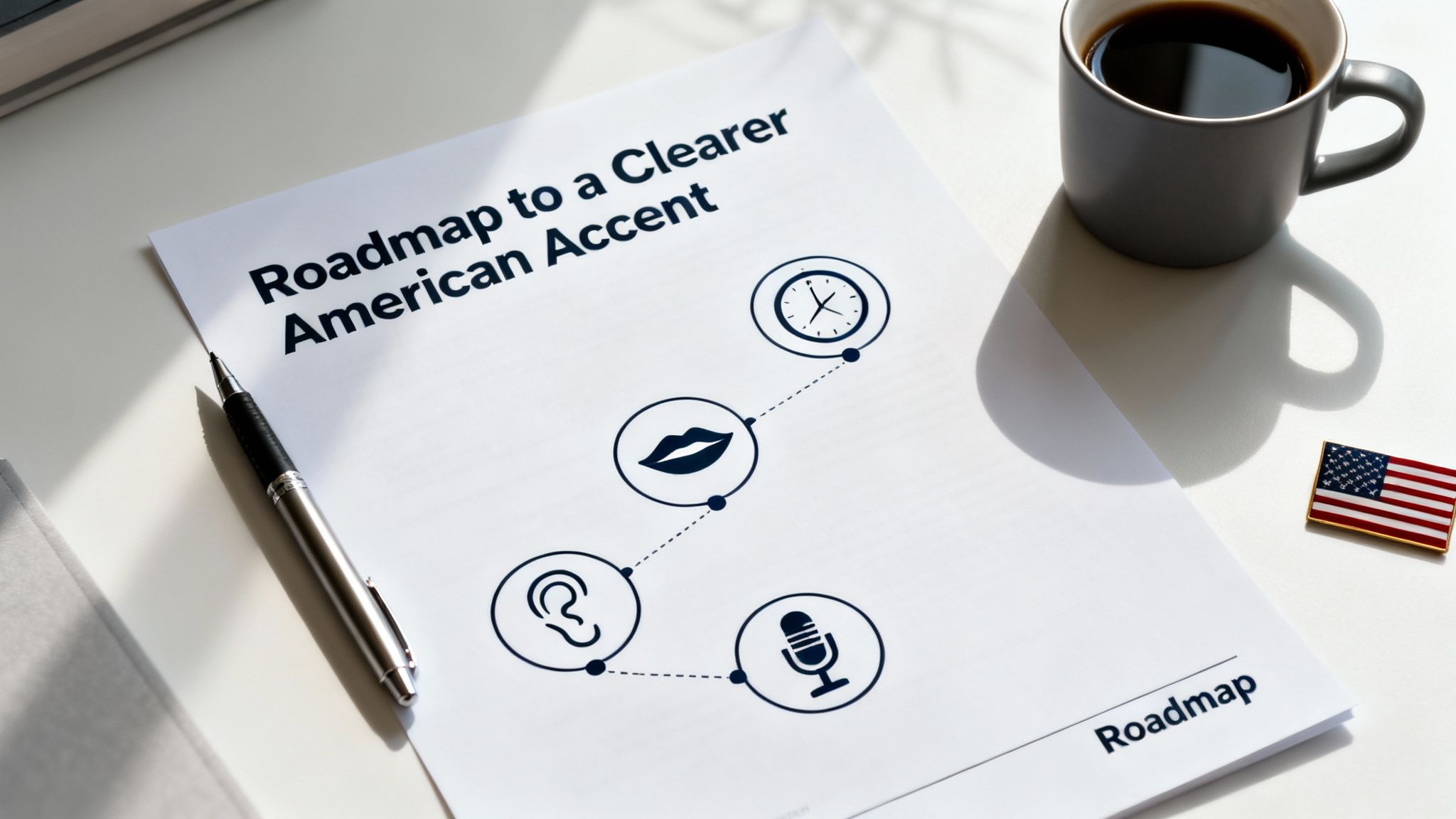
Welcome to a practical, no-fluff roadmap for developing a clearer American accent, built for ambitious professionals like you. This isn’t about hiding your identity; it’s about sharpening your communication so you’re understood the first time, every time.
Forget those tedious drills that go nowhere. We’re going to move beyond simple pronunciation and dive into the very music of American speech—its unique rhythm, intonation, and stress patterns. You’ll learn how to pinpoint your specific challenges, target high-impact sounds for the biggest gains, and build a practice routine that actually fits into your life.
Why Clarity Matters More Than Perfection
For professionals, the stakes are high. Clear communication is the foundation of influence, leadership, and getting ahead. Think about it: the U.S. workforce includes over 23 million non-native English speakers—a massive demographic driving innovation.
Yet, accent-related hurdles can quietly slow down collaboration and even affect promotion rates. Some studies show that non-native professionals with clearer accents get 15-20% more callbacks for job interviews and are often seen as more leader-like by their peers.
This points to a crucial truth: it’s not about sounding “perfectly American.” It’s about making sure your ideas land without friction. When people have to strain to understand you, opportunities can slip away, and frustration builds on both sides.
The Four Pillars of Accent Clarity
To truly learn the American English accent, you need a balanced approach. It’s like building a house; you can’t just focus on the walls and ignore the foundation. A smart plan needs to address the four core components of intelligible speech. If you want to dive deeper into the standard model, check out our guide on the General American Accent.
These pillars are the bedrock of clear, confident communication.
The Four Pillars of Accent Clarity
This table breaks down the essential components of learning a clear American accent, moving beyond just pronunciation to include the nuances that create intelligible and confident speech.
| Pillar | What It Is | Why It Matters for Professionals |
|---|---|---|
| Pronunciation | The accurate production of individual sounds (vowels and consonants). | This is the foundation. Mispronouncing key sounds can change the meaning of your words entirely. |
| Intonation | The rise and fall of your voice—the “melody” of your speech. | Intonation conveys confidence, signals questions vs. statements, and keeps your audience engaged. |
| Stress | Emphasizing the right syllables in words and the right words in sentences. | Correct stress is the #1 factor in making your speech sound natural and rhythmic to an American ear. |
| Rhythm & Pacing | The flow and timing of your speech, including how words connect smoothly. | A natural rhythm makes you easier to follow and helps you sound more fluent and authoritative. |
By focusing on these four pillars, you’re not just learning sounds—you’re building a complete system for improvement. This is how you transform your communication and unlock new levels of professional influence.
Starting Your Journey with an Accent Assessment
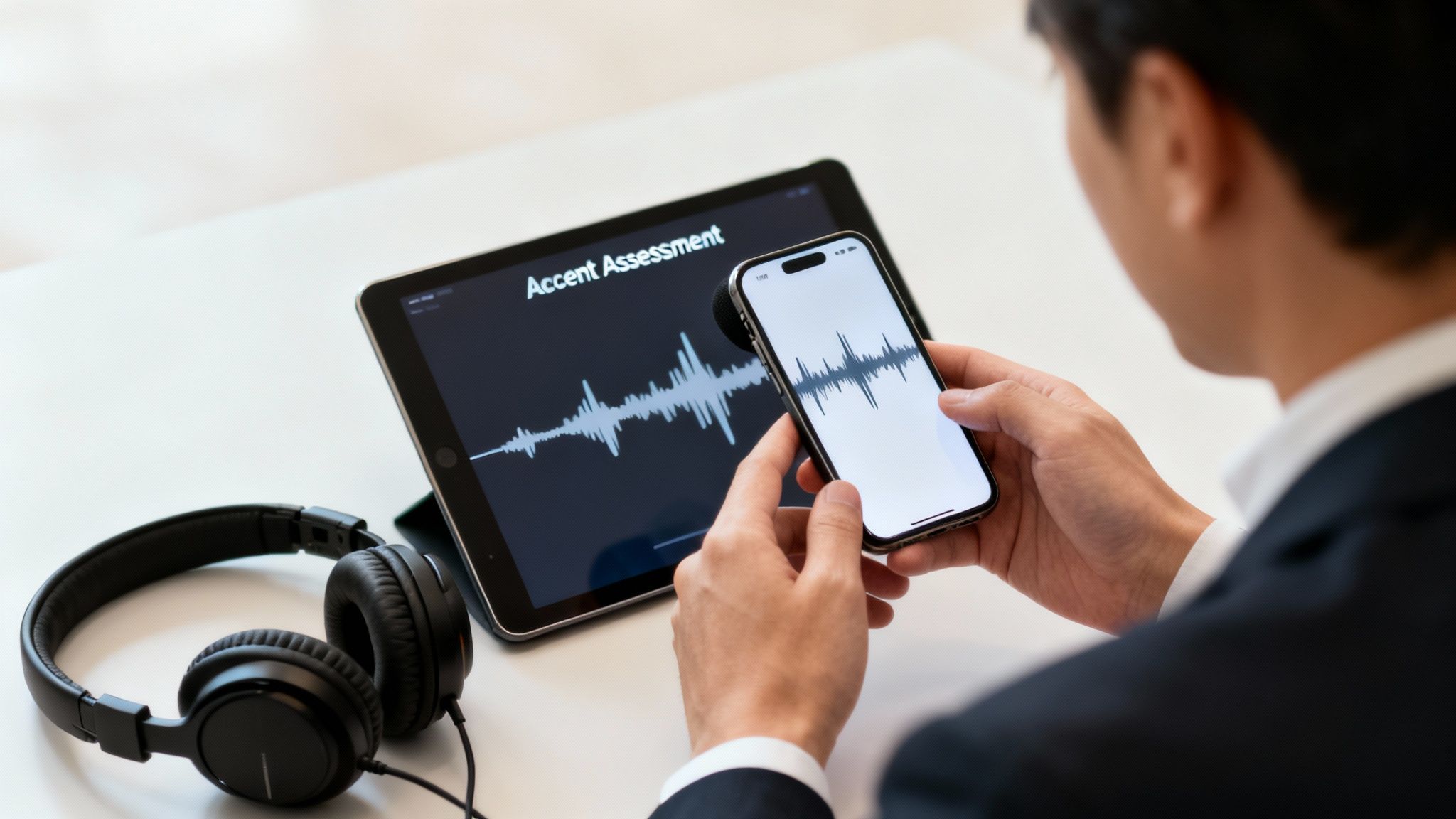
Before you can build new speech habits, you need a clear picture of your current ones. Trying to learn the American English accent without an initial assessment is a bit like driving in a new city without a map. You might get somewhere eventually, but you’ll waste a lot of time and energy on wrong turns.
An assessment gives you a crucial baseline. It’s not about finding every tiny mistake; it’s about strategically identifying the specific speech patterns that create the biggest roadblocks to clear communication.
How to Do a Quick Self-Assessment
You can get started on this right now with a tool you already have: your smartphone. The goal here is to capture a natural sample of your speech so you can listen back with an objective ear.
- Find a Text: Grab a paragraph of about 150-200 words. A news article or a professional email works perfectly. Just try to avoid anything you’ve memorized.
- Record Yourself: Read the text out loud at your normal, conversational pace. Don’t “perform” or try to put on a different voice. We want an authentic snapshot.
- Listen Back with a Critical Ear: This is where the magic happens. Play the recording and listen for patterns, not just one-off errors. Do certain vowel sounds always sound a bit off? Do you find yourself struggling with the same consonant blends over and over?
The biggest mistake I see learners make is getting hung up on single word errors. It’s far more effective to spot systemic patterns—like a habit of dropping the ‘th’ sound or using flat intonation. Correcting one pattern can instantly fix hundreds of words.
Identifying Your Priority Sounds
As you review your recording, listen for the sounds that have the biggest impact on how easily a native speaker can understand you. In my experience, not all sounds are created equal when it comes to clarity.
For most non-native speakers, a few key areas consistently cause trouble. Tackling these first will give you the most bang for your buck, delivering noticeable improvement in a short amount of time.
- The American ‘R’: How does your ‘r’ sound at the end of words like car or further? This is one of the most distinct hallmarks of a General American accent.
- The ‘Th’ Sounds: The voiced sound in ‘the’ and the unvoiced sound in ‘think’ are notoriously tricky. Swapping them for a ‘d’ or ‘z’ sound is a common flag for a non-native accent.
- Vowel Clarity: Listen to minimal pairs in your speech. Can you hear a clear difference when you say ship and sheep? Or sit and seat? The specific quality and length of American vowels are absolutely critical for meaning.
- The “Dark L”: American English has a unique “dark L” sound that you hear in words like full or call. It’s produced further back in the mouth and can feel like a brand-new muscle movement to learn.
Your native language is the biggest clue to which sounds will be your personal hurdles. A native Spanish speaker, for instance, might need to focus on distinguishing the ‘v’ and ‘b’ sounds, whereas a native Mandarin speaker will likely get more value from prioritizing final consonants.
The Power of a Professional Blueprint
While a self-assessment is a fantastic starting point, a professional evaluation offers a level of detail that’s tough to achieve on your own. An experienced accent coach is trained to hear the subtle nuances you might miss and can trace them back to the muscle memory of your first language.
This allows them to create a personalized blueprint that zeros in on your specific high-impact areas, saving you months of unfocused effort. This roadmap doesn’t just list sounds; it explains why they’re challenging for you and gives you a structured plan to master them. To get a better idea of what this entails, you can see what’s included in a professional accent reduction assessment and how it creates a personalized starting point.
Whether you start by yourself or with a coach, this initial diagnostic step is non-negotiable. It turns a vague goal like “sounding better” into a concrete, actionable plan for clear and confident communication.
Building Your Weekly Practice Blueprint
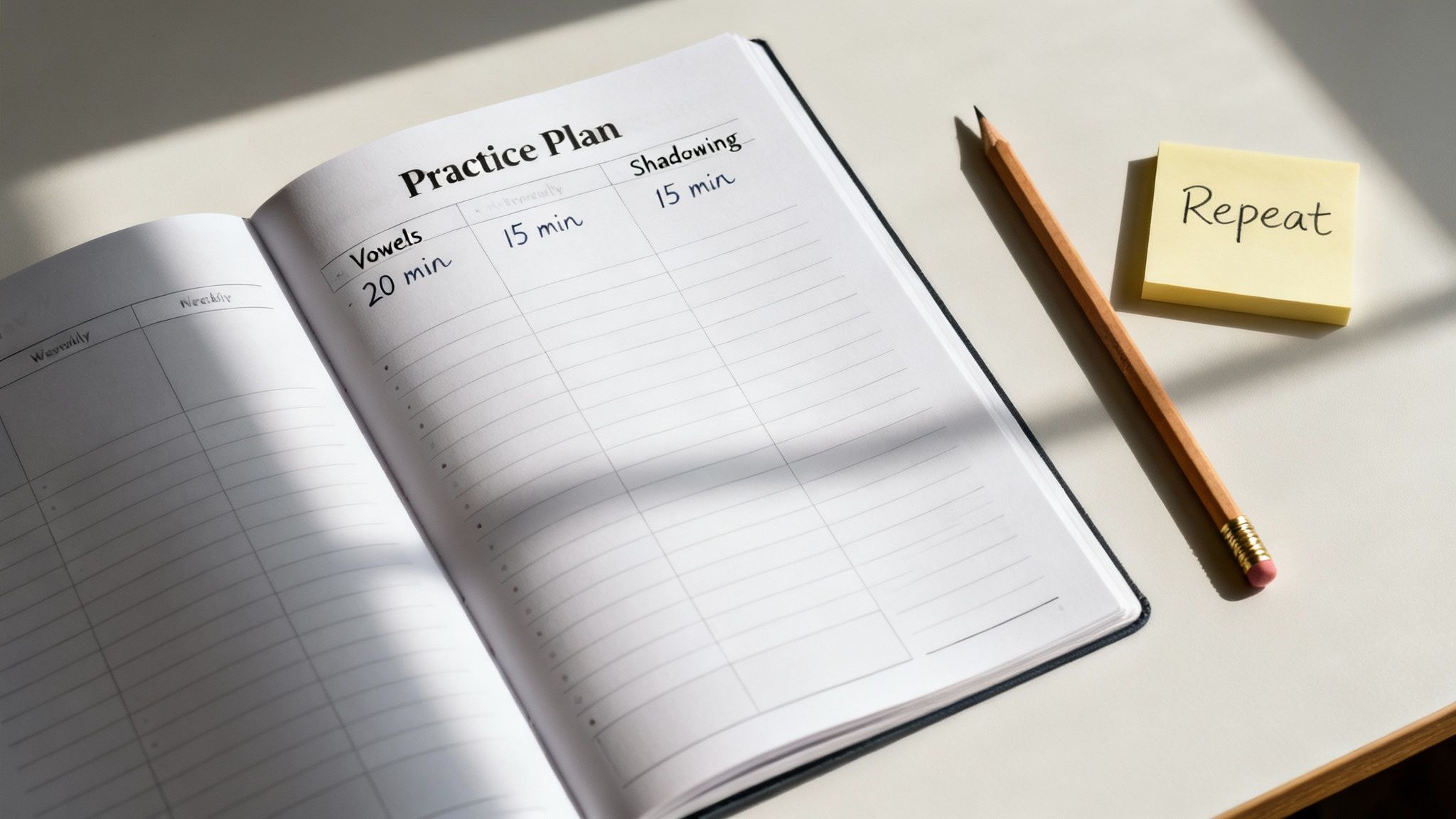
Knowing what to practice is one thing. Actually doing it consistently is where the real change happens. This is where we move from theory to action with a structured, repeatable plan—a blueprint that forges new muscle memory for speech.
I’m not talking about finding hours in your already-packed schedule. The secret is making 15-20 minutes of focused effort count, day in and day out. A solid blueprint balances targeted drills with real-world application, making sure you aren’t just practicing sounds in a vacuum but are actually integrating them into how you speak at work.
The goal here is simple: build a routine you can actually stick to, even on your busiest days.
Designing Your Core Practice Sessions
The foundation of your week should be built on high-repetition drills that zero in on those priority sounds we identified earlier. This is deliberate, focused work that overwrites old habits. Think of it like a musician running through scales before playing a song; these drills are the scales for your speech.
A fantastic way to structure this is by using minimal pairs. These are just pairs of words that differ by a single sound, like ‘ship’ and ‘sheep’ or ‘cat’ and ‘cot’. Drilling them back-to-back trains your ear and your mouth to lock onto those subtle but critical differences.
Another powerful tool is a targeted word list. Pull together a list of just 10-15 words that use one of your priority sounds in different spots—at the beginning, in the middle, and at the end. Repeating this short list daily builds the specific muscle control you need for that sound.
The secret to rapid improvement isn’t complexity; it’s repetition. A simple drill repeated 50 times is far more effective than 50 different exercises done once. You are literally rewiring the neural pathways between your brain and your mouth.
Of course, a crucial part of your blueprint is recording yourself. This self-feedback loop is the only way to get an objective look at your progress. Learning how to record videos effectively can make a huge difference, allowing you to both see and hear where you’re improving and what still needs work.
Integrating Intonation and Stress Practice
Beyond individual sounds, your plan has to include the “music” of American English. I’ve seen clients with near-perfect pronunciation who still sound unnatural because their rhythm and intonation are off. Set aside specific time to practice these patterns—they’re often a bigger key to clarity than getting every single vowel sound right.
For intonation, start with two primary patterns:
- Falling Intonation for Statements: Grab a business article and read sentences aloud, consciously letting your pitch fall at the very end. This is a subtle cue that signals confidence and finality in American English.
- Rising Intonation for Yes/No Questions: Practice asking simple questions like, “Are you joining the meeting?” making sure your pitch goes up at the end. It’s a hallmark of the American conversational style.
For word stress, pick five multi-syllable words from your industry each week (think: pro-fes-sion-al, de-vel-op-ment, in-no-va-tion). Say them out loud, really exaggerating the stressed syllable. This practice helps you internalize the natural rhythm of the language.
For many professionals I work with, these patterns feel completely unnatural at first. There’s a reason for that. Research consistently shows that our ability to acquire a native-like accent drops sharply after age 12. This is precisely why a structured, drill-based approach is so critical for non-native executives and tech leads. It’s about methodically building new muscle memory for sounds, intonation, and rhythm.
A Sample Weekly Accent Practice Plan
To pull this all together, here’s a sample weekly schedule. It’s structured but flexible enough to fit a real-world professional’s life. The key is to distribute different types of practice throughout the week to keep things engaging and effective. You can find more ideas for staying on track in our guide on how to practice English pronunciation daily for rapid progress.
This plan makes sure you hit all four pillars of clarity—pronunciation, intonation, stress, and rhythm—without ever feeling overwhelmed.
Sample Weekly Accent Practice Plan
A structured yet flexible weekly schedule for professionals to build consistent accent practice habits.
| Day | Focus Area (15-20 Minutes) | Example Activity |
|---|---|---|
| Monday | Vowel Sounds | Drill minimal pairs like sit/seat and pull/pool. Record yourself and compare to a native speaker’s audio. |
| Tuesday | Consonant Sounds | Focus on a priority consonant (e.g., American ‘R’). Practice a word list: car, report, further. |
| Wednesday | Intonation Patterns | Read a short news article aloud, focusing on falling intonation for statements and rising for questions. |
| Thursday | Word & Sentence Stress | Shadow a 2-minute clip from a TED Talk in your field, mimicking the speaker’s rhythm and emphasis. |
| Friday | Real-World Application | Choose a work email and read it aloud as if you were presenting it in a meeting. Record yourself for review. |
| Weekend | Review & Listening | Listen to your recordings from the week. Passively listen to an American podcast during your commute. |
This blueprint gives you a clear path forward. By dedicating these small, consistent blocks of time, you turn the abstract goal to learn the American English accent into a series of achievable daily actions. From my experience, this methodical approach is the fastest way to build the clarity and confidence you need to thrive in a professional American environment.
Mastering Intonation for Professional Impact

Perfect pronunciation is only half the battle when you want to learn the American English accent. If individual sounds are the bricks, then intonation, stress, and rhythm are the architectural blueprints that give your speech structure and meaning. It’s the “music” of the language, and it’s what truly conveys confidence, authority, and clarity.
In a professional setting, getting this musicality right is non-negotiable. It’s what makes your message persuasive and trustworthy, not just understood. Without it, even perfectly formed words can fall flat, sound uncertain, or simply fail to connect with your listeners in that high-stakes meeting.
The Power of Pitch and Intonation
Intonation is just the rise and fall of your voice’s pitch as you speak. In American English, it’s a surprisingly powerful tool that can completely flip the meaning of a sentence. A tiny shift in pitch can turn a confident statement into a hesitant question, even when the words don’t change at all.
Let’s take a simple phrase: “We’re launching the project on Friday.”
- Falling Intonation: If your pitch drops on the last word (“Fri-day↘”), it comes across as a firm, decisive statement. You’re informing your team, period.
- Rising Intonation: But if your pitch goes up at the end (“Fri-day↗”), it suddenly sounds like you’re asking for confirmation. This can project uncertainty, whether you mean to or not.
In professional communication, consistently using falling intonation for your statements is a subtle but powerful way to signal authority. It tells your audience that you are sure of what you’re saying, which builds instant trust and credibility.
Finding the Rhythm with Sentence Stress
Another key piece of the puzzle is sentence stress. This is what creates that characteristic rhythm of American English. Native speakers don’t give every single word the same weight. Instead, they instinctively punch the content words—the nouns, main verbs, adjectives, and adverbs that carry the real meaning.
At the same time, they tend to de-emphasize or almost “swallow” the function words—those little grammatical glue words like articles, prepositions, and auxiliary verbs. This constant dance between stressed and unstressed words creates a natural, rhythmic flow that’s easy for a native listener to process.
Consider this example: “I need to send the re-port to the cli-ent by five.”
The bolded words and syllables get the emphasis, while the others are spoken more quickly and softly. Mastering this pattern is one of the fastest ways to sound more natural and less robotic. When you get this right, you make it so much easier for colleagues to follow your train of thought without having to work at it.
Practical Exercises for Musicality
You can’t just think your way into a new rhythm; you have to feel it in your speech muscles. Integrating these patterns requires conscious practice until they become second nature.
A highly effective technique for this is shadowing. It’s simple: you listen to a short audio clip of a native speaker and try to mimic them in real time, like an echo. The trick is not to just copy the words—focus on replicating their exact pitch, rhythm, and stress patterns.
Here’s a simple routine to get you started:
- Select a Source: Find a 1-2 minute clip from a podcast, interview, or presentation in your professional field. This keeps the vocabulary relevant to your work.
- Listen First: Just play the clip once to get a feel for the speaker’s overall cadence and flow.
- Shadow and Record: Now, play it again, but this time, speak along with it. Make sure to record yourself doing this.
- Compare and Refine: Listen to your recording and compare it to the original. Where did your intonation differ? Did you stress the same words they did?
This exercise does double duty: it trains your ear to hear the subtle music of the language and builds the muscle memory needed to reproduce it. If you’re looking for more guidance, you can find a deeper dive with practical examples in our complete guide on how to master American English intonation. Committing to this kind of practice will transform not just how you sound, but how your professional contributions are perceived.
Tracking Progress and Overcoming Common Pitfalls
Learning a new accent isn’t an overnight fix; it’s a journey of consistent, focused effort. As you start refining your American English accent, it’s crucial to have a smart way to track your progress and a game plan for the inevitable challenges. This is what keeps you motivated and ensures your practice time is actually paying off.
Think of it like tending a garden. You don’t just plant a seed and expect a full harvest the next morning. You nurture it, check its growth, and adjust your care along the way. Your accent is no different. It’s the small, consistent actions that lead to big results over time.
Setting Realistic Milestones
One of the biggest hurdles I see clients face is unrealistic expectations. You won’t sound like a CNN anchor after one week, but you can absolutely make noticeable gains in a surprisingly short time.
With focused, consistent practice on your priority sounds and intonation, many professionals feel a real boost in their confidence and clarity within just 8 to 12 weekly sessions. This isn’t about hitting some imaginary “perfect” standard. It’s about making your speech smoother and reducing the effort it takes for others to understand you.
To see this progress for yourself, I always recommend a simple weekly voice check-in:
- Record a Baseline: Before you do anything else, record yourself reading a short, standard paragraph. This is your “before” picture.
- Record Weekly: Every week, at the same time, read that exact same paragraph and record it.
- Compare and Contrast: Listen to your newest recording right after your baseline. Then listen to last week’s. You’ll start to hear the subtle yet powerful shifts in your pronunciation and rhythm.
This kind of objective feedback is invaluable. We are often our own harshest critics and might not feel the progress we’re making day-to-day. But the recordings don’t lie. They provide concrete proof that your hard work is paying off. For a deeper dive into this, check out our guide on how to track your accent coaching progress.
Navigating Common Roadblocks
Every single person learning a new skill hits a plateau or feels discouraged at some point. It’s totally normal. The trick is to see these common pitfalls coming and know how to navigate them so you don’t lose momentum.
Let’s be clear about why this matters. With over 247.7 million Americans speaking English at home, it’s the language of business in the world’s largest economy. In fact, studies show that listeners rate speakers with clearer American accents as up to 28% more trustworthy in professional settings. That’s a direct link between intelligibility and perceived competence.
Here are the four biggest roadblocks I see and how to get around them:
1. The Perfection Trap
Chasing a “perfect” accent is the fastest way to burn out. The goal should always be clear communication, not erasing your native accent entirely.
- The Fix: Focus on progress, not perfection. Celebrate the small wins, like nailing a tricky sound you’ve been working on or getting feedback that you were easy to understand in a meeting.
2. Forgetting the Music of English
So many learners get hyper-focused on individual vowel and consonant sounds. They’re important, sure, but they often neglect intonation and sentence stress—the “music” of the language—which is arguably more critical for sounding natural.
- The Fix: Dedicate at least one practice session a week just to intonation and rhythm. Shadow native speakers from podcasts or presentations, mimicking their melodic patterns.
3. Inconsistent Practice
Cramming for two hours one day and then skipping a week is way less effective than practicing for 15 minutes every single day. Your brain and your speech muscles need consistent repetition to build new habits.
- The Fix: Anchor your practice to a habit you already have, like during your morning coffee or on your commute. Make it a non-negotiable part of your schedule.
The goal isn’t to find more time; it’s to make the time you have more focused. A short, deliberate practice session every day is what rewires your muscle memory for lasting change.
4. Fear of Making Mistakes
The fear of sounding “wrong” can be paralyzing. It makes you clam up in real-world situations, which is the exact opposite of what you need. Using your new skills is the only way to truly make them your own.
- The Fix: Reframe mistakes as learning opportunities. Find a trusted colleague or friend to practice with—someone who can give you supportive, low-stakes feedback. Every conversation becomes a chance to get better.
Your Top Questions About Learning an American Accent
When you start thinking about improving your accent, a lot of questions pop up. It’s a big step for your career, so it’s smart to get a clear picture of the process, how long it takes, and what you can realistically expect. Let’s tackle some of the most common questions I hear from professionals just like you.
These answers come from years of coaching people from all over the world, in every industry imaginable. Think of it as a straight-to-the-point guide on what this journey really looks like.
How Long Does It Realistically Take to Improve My American Accent?
This is the big one, and the honest answer is: it depends. Your starting point, native language, and how consistently you practice are the biggest factors. But there’s a huge myth that it takes years to see any real progress, and that’s just not true with a focused plan.
Most professionals start feeling a noticeable boost in confidence and even get positive feedback from colleagues within just 8 to 12 weekly sessions. This initial phase is all about locking in the fundamentals and mastering the sounds that give you the biggest “bang for your buck” in terms of clarity.
Lasting change, where the new habits become completely automatic and you don’t have to think about them? That develops over a slightly longer haul, usually a full 12-week program paired with daily practice. It’s not about the sheer number of hours, but the quality and focus of those hours.
Will I Lose My Original Accent and Cultural Identity?
This is a really important concern, and I want to be crystal clear: the goal is clarity, not erasure. Absolutely not. Good accent coaching is about adding a powerful new communication tool to your professional toolkit, not taking anything away from who you are.
Think of it like becoming “bilingual” in accents. You learn how to switch into a clearer American accent for a high-stakes client presentation or a team meeting, where it gives you a distinct advantage. Your unique voice and cultural background are assets. We’re just making sure your message always lands perfectly, without any friction.
Can I Just Learn an American Accent on My Own with Apps?
Language apps can be pretty good for drilling a specific sound in isolation, but they miss two huge pieces of the puzzle: personalized feedback and a structured roadmap. An app can’t tell you why you’re mispronouncing a word, or more importantly, which handful of sounds you should focus on to make the biggest immediate improvement in your overall clarity.
A classic mistake with self-study is accidentally practicing the wrong way, which just digs the incorrect muscle memory in deeper. A structured coaching program is different. You get:
- An expert ear to pinpoint your subtle, specific challenges.
- A personalized plan that tackles the highest-impact issues first.
- The accountability you need to make sure you’re practicing the right way, every day.
These things are what really move the needle, especially for mastering the rhythm and intonation of American English—something most apps just can’t teach effectively.
Is It Too Late for Me to Change My Accent as an Adult?
It’s never, ever too late. While kids seem to soak up accents like sponges, adults have their own superpower: the ability to learn analytically and deliberately. A structured accent program is built entirely around this advantage.
You can consciously learn the mechanics—exactly where to put your tongue, how to shape your lips, and how to move your jaw. Then, through targeted, high-repetition drills, you build new muscle memory. Your brain is more than capable of creating and automating these new habits. It’s a different process than how you learned as a child, but it’s incredibly effective.
Ready to stop wondering and start seeing real improvement? At Intonetic, we give you a clear, step-by-step path to hit your communication goals. Book your free, no-obligation assessment today and get a personalized PDF starter guide to kick off your journey to a clearer American accent.