
Craft a Powerful Introduction in a Presentation
An effective introduction in a presentation is far more than a simple "hello." It's your one chance to grab the room's attention, establish your authority, and set the tone for everything that follows—all in the first handful of seconds.
Get it right, and you create a "halo effect" that makes your audience receptive and engaged. Get it wrong, and you're stuck climbing out of a "credibility deficit" for the rest of your presentation. It’s nearly impossible to recover from a weak start.
Why Your Opening Seconds Define Your Entire Presentation

The moment you stand up to speak, before you’ve even clicked to your first slide, your audience is already forming an opinion of you. In a high-stakes business environment, that judgment happens instantly. Those first 30 to 60 seconds aren't just a warm-up; they are the main event for establishing your presence.
A powerful opening generates what psychologists call a "halo effect." When you begin with confidence and clarity, your audience instinctively labels you as credible, authoritative, and worth their time. This positive bias makes them far more likely to trust your data, accept your recommendations, and buy into your vision.
On the other hand, a weak start creates an immediate "credibility deficit." If you're fumbling with notes, mumbling an apology, or launching into a confusing message, you've already lost them. You’ll spend the rest of your time just trying to win back their attention.
The Psychology of First Impressions in Business
In the corporate world, especially with senior leaders, time is the most valuable asset. Executives are trained to make quick assessments, and a strong, concise introduction signals that you respect their time and are there to deliver real value.
I once coached a finance director who had to pitch a high-risk, high-reward investment to a skeptical board. Instead of diving into dense financial charts, he opened with a provocative question about a major opportunity the company had missed five years earlier. The room went silent.
That simple hook immediately captured their attention and reframed his entire presentation. He wasn't just making another proposal; he was offering a solution to a past failure.
This kind of opening completely shifts the dynamic in the room.
- It establishes your authority. You’re not just a presenter; you’re a strategic leader guiding the conversation.
- It creates intrigue. The audience leans in, genuinely curious to hear what you have to say.
- It frames the problem. A strong hook ensures everyone is on the same page about why your topic matters right now.
The Halo Effect vs. The Credibility Deficit
This isn't just a gut feeling; it's backed by data. Research consistently shows that up to 65% of an audience forms their opinion of a speaker within the first 30 seconds.
Your introduction literally sets the tone for your credibility. Nail it, and you're seen as a leader. Falter, and you'll be fighting off doubts for the rest of your talk.
A strong opening doesn’t just introduce your topic; it introduces your authority. It’s the single highest-return investment you can make in your professional influence, especially when navigating cross-cultural communication where first impressions carry immense weight.
I’ve seen tech leads secure project funding with a powerful, one-minute opening that perfectly articulated a market gap. I’ve also watched brilliant professionals with incredible ideas lose their audience because their introduction in a presentation was unfocused, diluting their message before they even got started.
If you feel like your message isn't landing, the problem often lies in those first few moments. It's why it's so helpful to master how to speak English more clearly on video calls and presentations. Perfecting your opening isn’t about being a performer; it’s about making sure your ideas get the attention they deserve.
The Blueprint for a Compelling Introduction

We’ve all seen it happen. A brilliant professional with a critical message steps up to present, says "Hi, my name is…" and immediately loses half the room. Your first 90 seconds are the most valuable real estate in your entire presentation, and a weak opening is a massive, unforced error.
Instead of just hoping for a good start, you can build one. I teach my clients a simple, repeatable four-part framework that turns a flat opening into a compelling one. It's designed to grab attention, establish your credibility, and get your audience to lean in, all before you even get to your first slide.
Let's break down this structure.
The Four Pillars of an Executive Introduction
These four elements are the secret to an introduction that commands respect and holds attention from the very first word.
- The Hook: Your opening move. It’s designed to cut through the noise and give your audience a reason to stop checking their email and listen.
- Your Positioning: This is where you quickly and subtly establish why you're the right person to speak on this topic. It’s about perspective, not just your title.
- The WIIFM (What’s In It For Me): Here, you pivot to the audience. You have to clearly state the direct value they will get from investing their time with you.
- The Roadmap: A quick, benefit-focused preview of where you’re going. It’s not a boring agenda; it’s a clear path to the value you just promised.
When you nail this sequence, you shift the dynamic from a passive audience to engaged participants, all within that crucial first minute and a half.
To make this crystal clear, here’s how these pillars come together in practice for different professional roles.
Introduction Blueprint Breakdown
| Pillar | Objective | Example for a Tech Lead | Example for a Finance Director |
|---|---|---|---|
| Hook | Grab immediate attention | "Last quarter, 65% of our support tickets came from a single feature we all thought was stable. What if our biggest perceived strength is actually our biggest blind spot?" | "For the past two quarters, we’ve been celebrating record revenue. But after digging into our cash flow, I’ve found a looming risk that could erase those gains in the next six months." |
| Positioning | Establish credibility and perspective | "As the person who architected the initial build and has been monitoring its performance data daily, I’ve traced the problem back to its source." | "Having spent the last three months stress-testing our financial models against market headwinds, I've seen this exact pattern before." |
| WIIFM | State the direct audience benefit | "Over the next 15 minutes, I’m going to show you not only what’s causing this but a two-part fix that will cut our ticket volume in half and free up significant dev resources." | "My goal today is to give you the one key insight you need to protect our margins and make a more informed Q4 budget decision next week." |
| Roadmap | Outline the path forward | "To get there, we’ll first look at the core issue, then I’ll walk you through the proposed solution, and we’ll finish with the immediate next steps." | "We’ll start by reviewing the data, then I’ll outline the risk, and we'll conclude with a clear action plan." |
As you can see, this framework provides a powerful and flexible structure that moves far beyond a simple "Hello, my name is…"
Pillar 1: The Hook
Your hook is your best chance to jolt a busy executive out of their day-to-day haze. A weak opening is an invitation for them to multitask. Your hook must be sharp, relevant, and impossible to ignore.
Try opening with a provocative question that challenges a core assumption in your field. A tech lead could ask, "What if our biggest competitive advantage is also our biggest blind spot?" This immediately creates intrigue and makes people want to know the answer.
A surprising statistic is another fantastic tool. "Last quarter, 65% of our support tickets came from a feature we thought was our most stable. Today, we'll talk about why that happened and how we fix it." A statement like that grounds your talk in a real, urgent problem.
Finally, never underestimate the power of a short, relevant anecdote. A quick story about a customer success—or failure—can humanize your topic and make it instantly relatable. Your only goal here is to make them look up from their phones.
Pillar 2: Your Positioning
Once you have their attention, you need to quickly show them why you are the right person to lead this conversation. This isn't the time to recite your CV. It’s about framing your unique perspective and experience in the context of the problem at hand.
Your positioning statement should be concise and connect your authority directly to the topic you just introduced with your hook.
An effective positioning statement answers the silent question in the room: "Why should we trust you on this?" It's not about your job title; it’s about your unique insight.
For instance, instead of saying, "I'm the Director of Finance," you could say, "Having spent the last three months analyzing our cash flow against market headwinds, I've identified a critical risk we need to address." The second version positions you as a proactive expert, not just someone filling a role. This subtle shift makes a world of difference in how your message is received.
Pillar 3: The WIIFM (What’s In It For Me)
Your audience, especially at the senior level, is constantly running a mental ROI calculation on their time. The "What's In It For Me" (WIIFM) is where you make that value crystal clear. You have to translate your presentation's subject into a direct, tangible benefit for them.
This means you have to step into their shoes. What are their goals? What pressures are they under? Frame your presentation as a solution to one of their problems or a clear path to one of their objectives.
- Weak WIIFM: "Today, I'm going to review the Q3 performance data."
- Strong WIIFM: "In the next 20 minutes, you will see the three key trends from Q3 that will directly inform our Q4 budget allocation for maximum impact."
A strong WIIFM promises a concrete outcome and answers their unspoken question: "Why should I care?" Without it, your introduction lacks purpose, and your audience will tune out. Mastering this is especially crucial for non-native speakers, and our guide on how to improve English pronunciation for public speaking offers extra tips for delivering your WIIFM with clarity and impact.
Pillar 4: The Roadmap
Finally, the roadmap gives your audience a simple preview of what's coming. This is not a boring agenda slide filled with bland bullet points. You should frame it as a logical journey toward the benefit you promised in your WIIFM.
My advice? Keep it to three key points. The human brain loves the number three; it's easy to process and remember.
For example: "To get there, we’ll first unpack the problem we're seeing, then I’ll walk you through the solution I'm proposing, and we'll finish by outlining the immediate next steps."
This structure provides a mental map, making your presentation feel organized and easy to follow. It signals that you respect their time and have a well-thought-out plan, cementing your credibility before you even dive into your first main idea.
Crafting Your Opening Hook and Positioning Yourself
Now that we’ve laid out the framework for a strong introduction, let’s get practical. The first 60 seconds are where you either win your audience or lose them. It all comes down to mastering two things: your opening hook and how you position yourself.
These two pieces work in tandem to snap a distracted audience to attention and immediately establish your credibility. This isn't just theory; it's about having the right phrases ready to go when the stakes are high.
Your hook is your first, best chance to make a room full of busy people look up from their phones. It needs to be sharp enough to cut through their mental to-do lists and give them a compelling reason to listen to you, right now.
I often remind my clients to think about the power of effective storytelling techniques here. A great opening line, framed as a story or a bold statement, can instantly turn passive listeners into active participants.
A Gallery of Opening Hooks for Different Scenarios
The perfect hook isn't one-size-fits-all. It changes based on who you're talking to and what you need to achieve. A skeptical leadership team needs a different opener than an excited project team. Here are a few battle-tested scripts I’ve developed with international professionals for different situations.
For a Product Launch or New Initiative:
- The Provocative Question: "What if our single biggest operational bottleneck could become our greatest competitive advantage by the end of this quarter?"
- The Surprising Statistic: "Last year, our competitors collectively spent an estimated $10 million addressing a problem that our new platform solves out of the box."
For a Quarterly Review or Performance Update:
- The 'Look Back to Look Forward' Hook: "Six months ago, we set a target that many thought was impossible. Today, I'm going to walk you through not just how we hit it, but what that means for our ambitions in Q4."
- The Problem-First Hook: "While our top-line numbers look strong, a single metric buried in our churn data tells a different, more urgent story. We need to talk about it."
For a Strategic Pivot or Change Proposal:
- The Bold Declaration: "The strategy that got us here will not get us where we need to go. In the next 15 minutes, I'm proposing a fundamental shift in our approach."
- The Anecdotal Hook: "I spoke with three of our top clients last week. They all asked me the same tough question, and our inability to answer it is costing us market share."
These examples go way beyond a generic "Good morning." They immediately frame the conversation around high-stakes problems, opportunities, or value.
The Nuances of Positioning Yourself with Authority
Once you’ve hooked them, you have a brief window to answer their unspoken question: "Why should I listen to you on this topic?" This is your positioning statement. It's not about reciting your resume; it's about connecting your unique experience directly to the problem at hand.
This is a moment where I see many non-native English speakers pull back and lose a bit of their natural confidence. The key is to project expertise without sounding arrogant. You want to ground your authority in the work you've done.
A powerful positioning statement isn’t about boasting. It’s about building a bridge of trust between your experience and the audience’s need for a credible guide.
Just look at the difference between these two approaches:
- Weak Positioning: "I'm the Project Manager for this initiative."
- Strong Positioning: "After leading the cross-functional team that analyzed this problem for the last six months, I've identified the three critical factors we must address."
The second version doesn’t rely on a title. It establishes authority through action and insight, which is far more compelling.
Phrasing for Credibility and Confidence
Here are a few phrases I coach my clients to use. They are designed to project quiet confidence and ground your credibility in recent, relevant experience.
- "Having spent the last quarter analyzing the performance data…"
- "From my conversations with key stakeholders in the EMEA region…"
- "As the person who architected the original framework, I have a unique perspective on…"
- "My team and I have been on the front lines of this issue, and our findings point to…"
Notice a pattern? These phrases tie your authority to specific actions—analysis, conversations, and hands-on work. It’s much more powerful than just stating your job. Of course, your delivery matters just as much as the words; for anyone looking to make their words land with more impact, learning how to enunciate better can be a game-changer.
By pairing a sharp hook with a concise positioning statement, you create an unbreakable start to your introduction in a presentation. You’ve earned their attention and established your right to lead the conversation—all before you even get to your first slide.
Delivering Your Introduction with Executive Presence

Even a perfectly written introduction will fall flat if your delivery doesn't have authority. Your words are only half the story. Executive presence isn't some vague, abstract quality reserved for the C-suite; it’s a set of intentional verbal and non-verbal behaviors that signal leadership, credibility, and control from the moment you stand up.
When you step onto that stage or into that boardroom, your physical presence and vocal tone are the very first pieces of information your audience gets. This is where we bridge the gap between your content and your performance, making sure your voice and body project the confidence your message deserves.
Mastering Vocal Authority in Your Opening
Your voice is your most powerful tool for conveying authority. I’ve seen it countless times: a brilliant professional with a powerful opening statement who undermines it all with a hesitant, quiet, or monotonous tone. It makes you seem uncertain. In contrast, a controlled, resonant voice commands attention and builds immediate trust.
To truly deliver your introduction with presence, honing your executive communication skills is non-negotiable. Let's start by focusing on three vocal elements I work on with my clients.
- Strategic Pauses: The silence before you deliver your hook or after a key statement is golden. It creates tension and signals importance. Instead of rushing, take a deliberate two-second pause to command the room's focus. It will feel much longer to you than it does to them, I promise.
- Pitch Variation: A monotone voice sounds disengaged and bored. By varying your pitch—especially dropping your intonation at the end of a sentence—you sound more definitive and confident. Practice your opening line with a downward inflection to avoid sounding like you're asking a question.
- Voice Projection: This isn't about shouting. It’s about breathing from your diaphragm to create a fuller, richer sound that carries across the room with ease. A strong, projected voice signals self-assurance and control.
The Fundamentals of Executive Body Language
Your body language either reinforces your words or completely contradicts them. In those crucial opening moments, your audience is scrutinizing your posture, gestures, and eye contact to decide if you’re credible.
Start with a grounded, open stance. Stand with your feet about shoulder-width apart, distributing your weight evenly. This "power stance" makes you look—and feel—more stable and confident, and it helps eliminate nervous swaying or shifting.
Your body language should be an extension of your message, not a distraction from it. Purposeful movement conveys authority; nervous fidgeting signals discomfort.
Once your stance is solid, you can layer on other non-verbal cues to enhance your introduction.
Gestures and Eye Contact
Your hand gestures should be deliberate and aligned with what you're saying. Keep them within the "strike zone"—the area between your shoulders and your waist. Use open-palm gestures to signal transparency and precise movements to emphasize the key points in your hook or roadmap.
Making deliberate eye contact is just as critical. Don't just scan the room. Connect with individual decision-makers for three to five seconds at a time. This creates a powerful sense of personal connection and shows you are confident enough to engage directly.
Aligning Your Words, Voice, and Body
True executive presence clicks into place when your words, voice, and body language are all in perfect sync. A mismatch—like making a bold claim in a quiet voice or looking at the floor while stating your purpose—creates an instant credibility gap.
The only way to achieve this alignment is through focused rehearsal. Try these drills:
- Record and Review: Film yourself delivering your introduction. First, watch it back with the sound off to analyze your body language. Then, listen with your eyes closed to focus solely on your vocal delivery.
- Stance and Breathe: Before you even think about speaking, plant your feet firmly. Take a deep diaphragmatic breath and hold it for a count of three. This simple action calms your nerves and prepares you for powerful voice projection.
- Gesture Rehearsal: Practice your opening line while using one specific, intentional gesture to emphasize your hook. This helps train your body to move with purpose, not out of nervousness.
By consciously practicing these elements, you ensure your physical presence amplifies the power of your opening words. To see exactly where you stand and get a personalized analysis, you can get a free Executive Communication Assessment.
Even the most polished professionals can inadvertently torpedo their own credibility with a few subtle missteps in their introduction. These might feel like minor slip-ups, but in a high-stakes presentation, they can instantly chip away at your authority and make your audience second-guess your expertise.
I like to think of them as tiny "credibility leaks." One won't sink your presentation, but a few in a row can leave you scrambling to regain control. Based on years of coaching international leaders, these are the most common blunders I see that sabotage an otherwise powerful introduction in a presentation.
The Apologetic Opening
This one is probably the most damaging mistake you can make, and it's painfully common. It sounds something like this:
- "Sorry, I'm a bit nervous today…"
- "I didn't have a lot of time to put this together, but…"
- "I hope this all makes sense…"
Starting with an apology immediately frames you as unprepared or, worse, not confident in your own message. If you’re already apologizing for your content, why should the audience bother investing their time and attention?
The Confident Alternative:
Never apologize. Instead, project complete ownership. Stand tall, take a deliberate breath, and launch directly into your powerful opening hook. If you're feeling nervous, channel that energy into a more focused, passionate delivery. Don't announce your insecurity to the room.
Your audience has no idea you're nervous unless you tell them. Starting with an apology is like pointing out a tiny crack in a wall that they would have never noticed otherwise. Own your moment.
Your audience wants you to be the expert in the room. Don't give them any reason to doubt you from the very first sentence.
The False Start
A "false start" is any fumbling, tech check, or verbal tic that happens before you actually begin speaking. It’s that awkward moment of shuffling around before the main event, and it completely erodes the crisp, professional image you want to project.
I see this constantly in coaching sessions. It often manifests as:
- "Can everyone hear me okay?"
- "Is this microphone working?"
- "Okay, um, let me just… one second…"
- "Right, so…"
These little phrases signal that you aren't fully in command. You're essentially asking the audience for permission to start, which is a subtle but very real giveaway of authority. It's a verbal crutch that you can, and should, eliminate. For more on breaking these kinds of filler habits, our article on commonly mispronounced words and verbal tics offers some great strategies.
The Confident Alternative:
Act as if everything is already perfect. Test your microphone and clicker before you're introduced. When it’s your time, walk confidently to the stage, plant your feet, make eye contact, and let a moment of silence hang in the air. That pause commands attention. Then, deliver your opening line. A clean start is a powerful start.
Using Weak or Hedging Language
Weak language is like a slow leak in your authority. It’s made up of words and phrases that hedge, qualify, and soften your statements until you sound more like a hesitant guest than a confident guide.
Here’s a quick comparison of what to avoid and what to use instead:
| Weak Language (Avoid) | Strong Language (Use) |
|---|---|
| "I just wanted to say…" | "My key message today is…" |
| "I think maybe we could…" | "I recommend we…" |
| "This is kind of important." | "This is critical because…" |
| "Hopefully, you'll see…" | "You will see…" |
Hedging is often a deeply ingrained habit, sometimes developed to avoid sounding too direct or aggressive, especially in multicultural business environments. In a leadership context, however, it comes across as a lack of conviction.
The Confident Alternative:
Be direct. Be declarative. State your ideas and recommendations with conviction. Go on a mission to scrub filler words like "just," "sort of," and "kind of" from your professional vocabulary, especially in your opening minutes. The most respected leaders communicate with clarity and certainty, and it all starts with the words they choose. By sidestepping these common mistakes, you ensure your introduction is clean, impactful, and authoritative from the very first word.
Your Final Rehearsal Checklist for a Flawless Opening
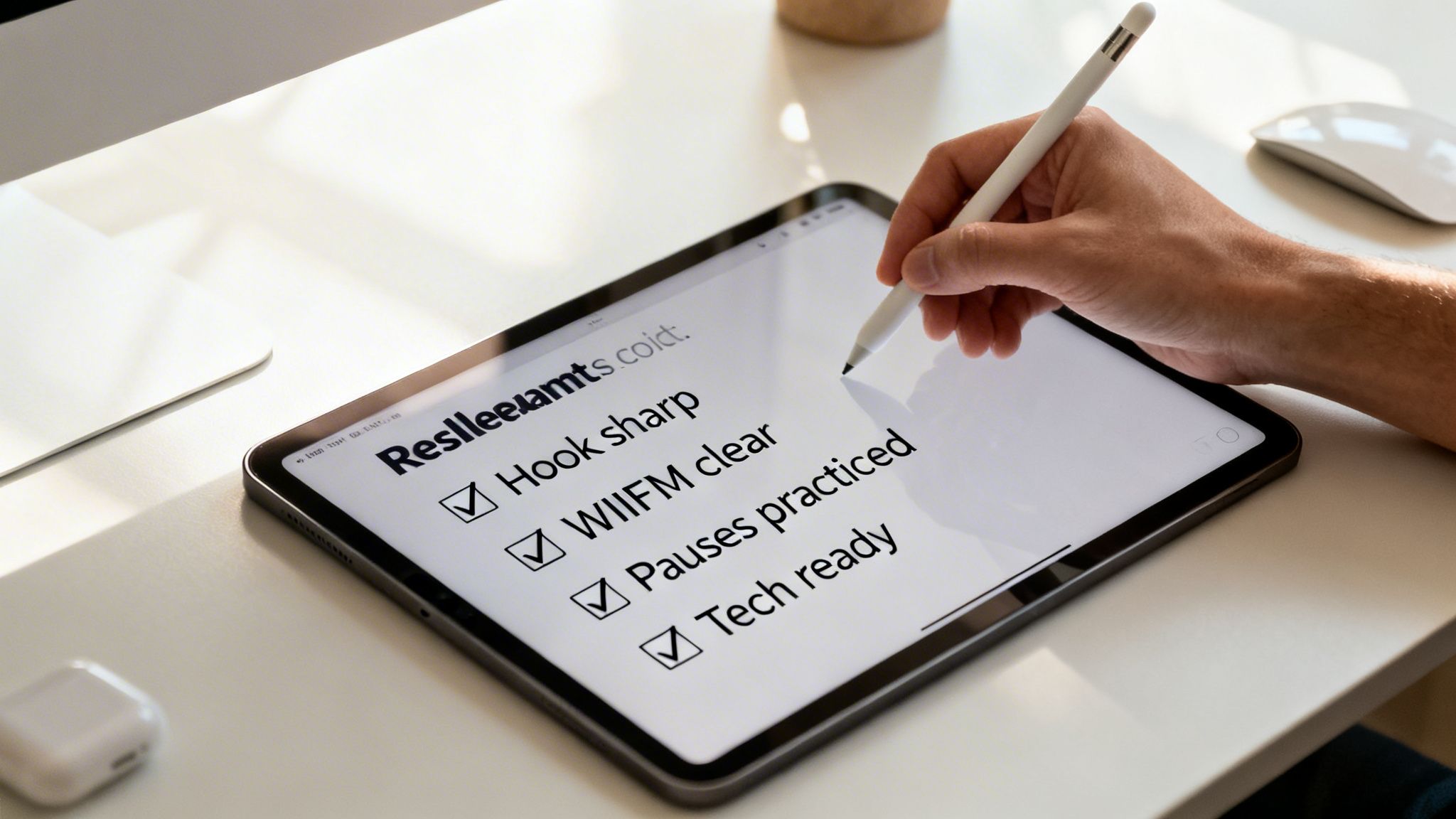
True confidence isn’t something you just hope for on presentation day; it’s earned through smart, focused preparation. A powerful introduction in a presentation looks effortless to the audience for one reason: you’ve put in the work behind the scenes. This checklist is your final run-through to internalize your opening, so you can walk in and deliver it with both authority and ease.
Think of this as your pre-flight check before you take the stage. It’s about more than just memorizing words. This is how you make sure your message, your delivery, and your tech are all perfectly aligned to land that critical first impression.
Content Readiness
Before you even think about your delivery, let’s make sure the message itself is sharp. Is your introduction actually built for your audience? Run through these points to be sure.
- Is my hook sharp and compelling? Does it jolt the audience to attention with a surprising fact, a challenging question, or a bold claim?
- Is my positioning clear and authoritative? Have I made it obvious why I'm the one to talk about this? This isn't about listing credentials; it's about framing my unique perspective.
- Is the WIIFM (What's In It For Me) impossible to miss? Can every person in the room immediately see the value they will get from tuning in?
- Is my roadmap a simple, three-point journey? Does it lay out a clear path to that value without getting lost in the weeds?
The point of rehearsing your content isn't to sound like a robot. It's to know your key points so well that you can talk about them with complete conversational confidence. You want to internalize the message, not just memorize a script.
Delivery and Presence
Once the content is locked in, your focus shifts to how you deliver it. This is where you build presence. Your body language and voice need to reinforce the authority in your words, not undermine it.
- Have I practiced my strategic pauses? I always tell my clients to rehearse the silence. A well-placed pause right before your hook or after a key statement is a powerful tool for commanding the room.
- Is my opening stance grounded? Practice standing with your feet shoulder-width apart. This simple physical shift eliminates nervous swaying and makes you look (and feel) more stable and confident.
- Are my gestures purposeful? Don't just wave your hands around. Pick one or two key moments in your intro where a deliberate gesture can drive a point home, and practice it.
- Do I have a plan for eye contact? Know who the key decision-makers are. Make a mental note to connect with them directly during your opening moments. It matters.
Logistical Polish
Finally, don’t let a clumsy start derail you before you've even said a word. A simple tech glitch can throw off your entire rhythm. Make sure your tools and environment are ready to go.
- Is my technology pre-tested? Get in the room early. Check your microphone, your clicker, and the display connection. Awkward fumbling with cables kills your credibility.
- Is the opening slide ready? Your first slide should be clean, professional, and cued up. You want to start with a single, confident click.
A checklist like this gives you a solid blueprint for a killer opening. It provides the exact tools you need to build and refine an introduction that truly connects.
While this guide provides the blueprint, personalized feedback is the fastest path to mastery. At Intonetic, we believe true authority comes from closing the specific gaps in your communication style. That’s why we invite you to book a complimentary and confidential Executive Communication Assessment to pinpoint where you can make the most impactful improvements.
For those ready for a deeper commitment, The Gravitas Method is a 12-week one-on-one executive presence coaching program for international professionals who want to communicate with more authority and influence at senior levels. The program is priced at $8,200 paid in full or $9,000 across three installments. Coached by Nikola, it covers vocal authority, strategic framing, executive body language, and high-stakes communication.