
intonation vs inflection: Clear Differences & Practical Tips
Here’s the simplest way to think about the difference between intonation and inflection: Intonation is the melody of your speech that shows your attitude across a whole sentence. Think of how your pitch rises when you ask a question. Inflection, on the other hand, is a small change to a word’s form that signals its grammatical job, like adding ‘-ed’ to talk about the past.
Unpacking the Core Concepts of Spoken Language
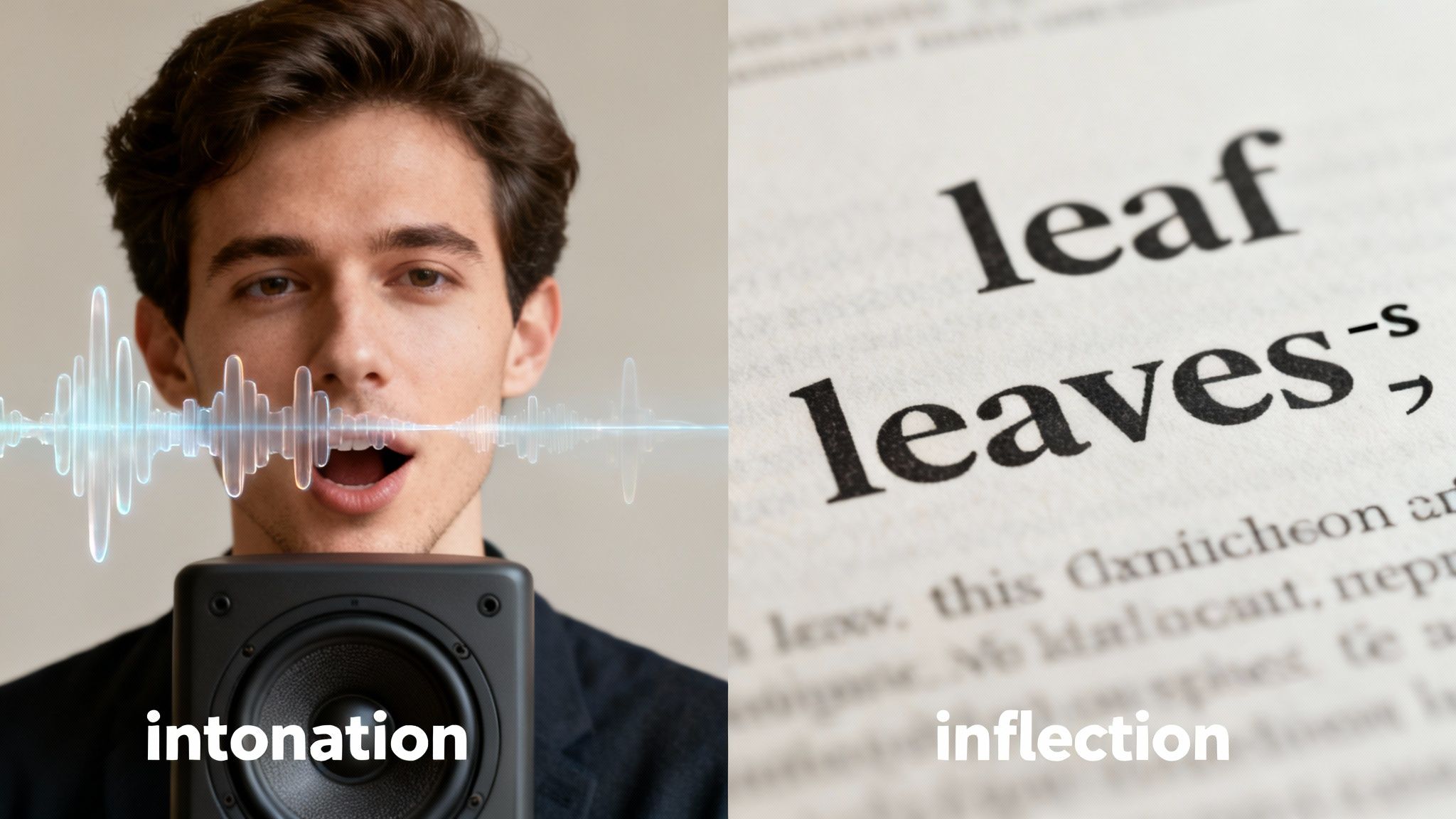
Even though both involve sound, they operate on totally different levels. Intonation shapes the meaning of entire phrases, while inflection tweaks individual words to make them fit grammatically. I like to tell my clients to think of intonation as the emotional color of their speech, while inflection is its structural grammar.
Mastering both is non-negotiable for anyone who wants to sound clear and natural in English. In fact, some studies estimate that 40-60% of meaning in a conversation comes from prosodic features like intonation. That’s a huge chunk of your message that has nothing to do with the words themselves.
Intonation vs Inflection At a Glance
To really nail down the difference, it helps to see them side-by-side.
The table below breaks down the key characteristics of each. Think of it as a high-level summary that gets right to the point, showing how they differ in scope, function, and what happens when you get them wrong. For a deeper dive, you can also explore our detailed guide on how to recognize and produce American English stress and intonation.
| Feature | Intonation | Inflection |
|---|---|---|
| Scope | Applies to phrases, clauses, or entire sentences | Applies to single words (nouns, verbs, adjectives) |
| Primary Function | Conveys attitude, emotion, and pragmatic meaning | Indicates grammatical function (tense, number, case) |
| Mechanism | Changes in pitch, rhythm, and stress across speech | Changes to a word’s form (e.g., adding suffixes) |
| Example | Rising pitch on “You’re done?” to ask a question | Adding ‘-s’ to “dog” to create the plural “dogs” |
| Impact of Error | Miscommunication of intent or emotion (e.g., sounding rude) | Grammatical incorrectness (e.g., “He walk to school”) |
Getting this fundamental distinction right is the first step. With this foundation in place, we can now dig into the specific mechanics of how each one works in the real world.
Comparing How Intonation and Inflection Work
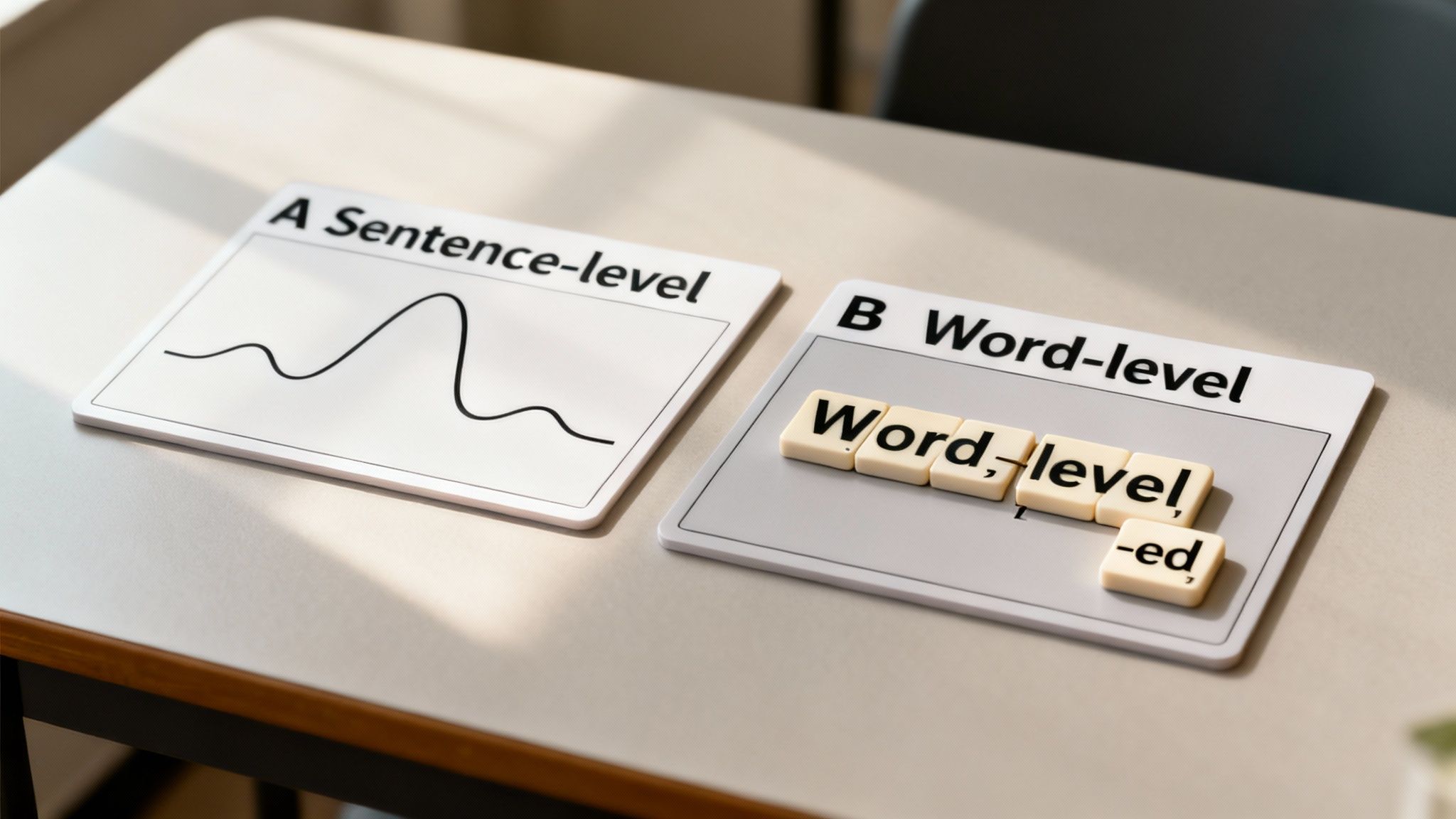
To really get the difference between intonation and inflection, we have to look at how they operate on the ground. While both are about tweaking sound to change meaning, they play on completely different fields with entirely different rulebooks. One paints with a broad brush across entire sentences, while the other chisels fine details onto individual words.
Here’s a practical way to think about it: intonation is like the musical score of a film scene. It doesn’t change the words in the script, but it completely dictates how we interpret the action—is this a moment of suspense, romance, or comedy? Inflection, on the other hand, is like changing an actor’s costume. It alters their specific role, turning one “king” into several “kings.”
Scope and Domain
The most crucial difference is their scope. Intonation is a sentence-level (or phrase-level) game. It’s what linguists call a suprasegmental feature, which is a fancy way of saying it’s a layer of melody draped over a whole string of words.
Inflection, by contrast, happens strictly at the word level. It’s a grammatical tool that alters a single word’s form to make it fit correctly within the sentence structure.
This table breaks down that fundamental difference:
| Criterion | Intonation (Sentence-Level) | Inflection (Word-Level) |
|---|---|---|
| Domain | Stretches across a whole thought (e.g., “She found the keys.”) | Modifies one word at a time (e.g., “key” becomes “keys”) |
| Tool | Uses pitch, stress, and rhythm to create a melodic contour. | Uses affixes (like prefixes/suffixes) or internal vowel changes. |
| Example | A rising pitch on “She found the keys?” turns it into a question. | Adding “-s” to “keys” changes it from singular to plural. |
Linguistic Function
This difference in scope leads directly to their different jobs in the language. Intonation primarily serves a pragmatic function. It’s all about the speaker’s intent, their attitude, and the social context of the conversation. It’s how we signal sarcasm, excitement, doubt, or that we’re finished speaking.
Inflection, however, has a purely grammatical job. Its function is to make sure words agree with each other, keeping the sentence structurally sound according to the rules of English. It’s about correctness, not emotion.
Key Takeaway: Intonation is about how you mean what you say—it adds the human layer of emotional context. Inflection is about what you are saying, making sure the grammar is correct and unambiguous.
For example, saying “That’s great” with a falling pitch sounds genuine. But say those exact same words with a slow, rising-then-falling pitch, and it drips with sarcasm. The words haven’t changed, but the intonation flipped the pragmatic meaning on its head. This is completely different from changing “walk” to “walked,” which is a mandatory grammatical shift needed to talk about the past.
Understanding how this melody shapes meaning is just as critical as knowing where to put the emphasis. If you want to dig deeper into that, our guide on syllable stress vs sentence stress breaks it down. This kind of nuanced understanding is the key to unlocking truly natural-sounding speech.
Hearing the Difference in Everyday Conversations
This is where the theory behind intonation vs. inflection stops and the practical side begins—the moment we actually open our mouths to speak. In our daily conversations, these two tools are constantly at work, usually without us even noticing. One shapes the emotional and social meaning of our words, while the other makes sure our sentences are grammatically correct.
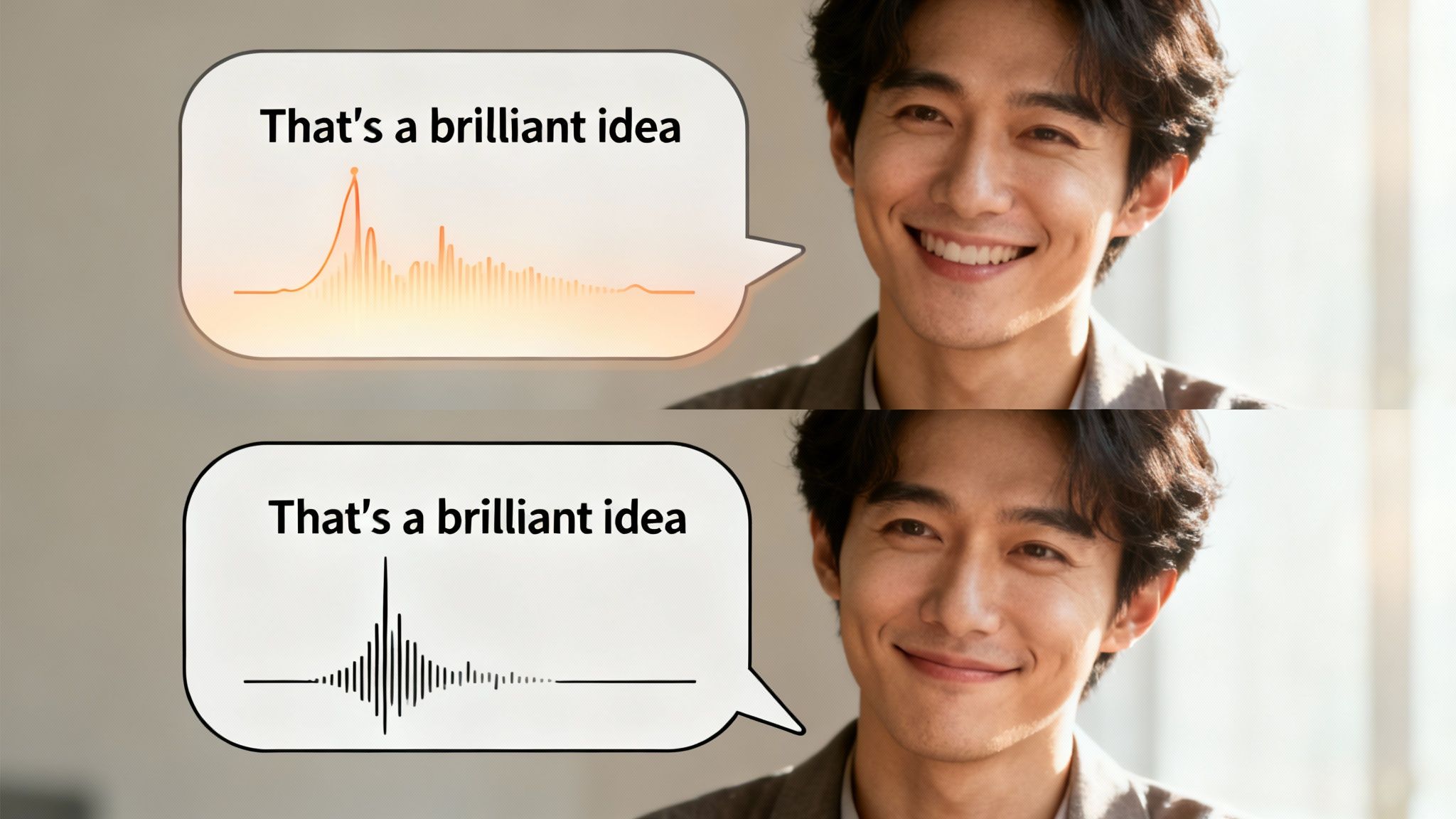
Let’s break down how this works in the real world. Imagine a colleague pitches a new project idea. Your response, “That’s a brilliant idea,” can mean two completely different things, and it all comes down to your intonation.
Intonation: The Emotional Thermometer
The words themselves are positive, but it’s the melody of your voice that tells the real story.
Think about these two ways of saying the exact same phrase:
- Sincere Enthusiasm: You say it with a high, falling pitch on the word “brilliant.” Your vocal energy rises and then falls decisively. This melody tells your colleague you’re genuinely excited and on board with the idea.
- Biting Sarcasm: Now, imagine saying it slowly, drawing out the words with a wavering, up-and-down pitch. The same words now signal the exact opposite—that you think the idea is terrible. Your tone is doing all the work.
This power to flip the meaning of a sentence on its head belongs entirely to intonation. It’s the emotional layer you place over your words, telling the listener how to feel about what you’ve said. The grammar hasn’t changed, the words are identical, but the message is completely different.
Key Differentiator: Intonation is what gives our speech emotional context—it’s how we convey nuance, sincerity, and sarcasm. It colors a sentence’s meaning without touching its grammatical structure. Inflection, on the other hand, is all about that structure.
Inflection: The Grammatical Blueprint
Unlike the fluid, mood-driven nature of intonation, inflection is all about rules. It’s rigid. It doesn’t care if you’re happy or sarcastic; it only cares that your grammar is correct.
Let’s look at an example that relies on inflection. Take the verb “walk.” The difference between “I walk to the office” and “I walked to the office” has nothing to do with attitude. That little -ed suffix is an inflection, and it makes a mandatory grammatical change, shifting the sentence from the present tense to the past.
There’s no room for interpretation here. You either walked in the past, or you walk in the present. The inflection provides the sentence’s structural integrity, making sure the listener understands the timeline. If you leave it out and say, “I walk to the office yesterday,” you’ve made a clear grammatical mistake.
This gets to the heart of the difference. In day-to-day speech, intonation is your tool for expressing how you feel about what you’re saying. Inflection is the tool for building the sentence correctly so it makes sense in the first place. Linguistic analysis shows just how consistent these patterns are; for instance, 85-90% of English speakers instinctively use a rising intonation for a yes-or-no question.
For anyone looking to make their speech clearer and more impactful, zeroing in on these conversational nuances is essential. Our guide on how to master American English intonation with examples breaks down even more practical steps you can take.
The Hurdles for Non-Native English Speakers
If English isn’t your first language, navigating the nuances of intonation versus inflection can feel like learning two different skills at once. They both play a huge role in fluency, but they affect your communication in completely different ways. Getting one right without the other often leaves a noticeable gap in your proficiency, impacting everything from basic clarity to social connection.
Inflection errors are usually the first thing learners tackle. These are straightforward grammatical mistakes—like saying “he walk” instead of “he walks”—that can trip up a listener and make your meaning unclear. Because these mistakes break clear-cut rules, they’re often easier to spot and fix with structured practice and a bit of memorization.
Intonation, on the other hand, is a much trickier beast. An awkward intonation pattern won’t make your sentence grammatically wrong, but it can completely flip its social and emotional meaning. Get the pitch contour wrong, and a sincere compliment can land like sarcasm or a polite question can sound like a demand.
Your Native Language Is Calling the Shots
A speaker’s mother tongue has a massive influence on how they hear and produce the melody of English. Someone coming from a tonal language like Mandarin or Vietnamese might instinctively try to apply word-level pitch rules to English, which can sound stilted and unnatural to a native ear.
On the flip side, speakers of languages with flatter intonation, like Russian, often have to work hard to create the wide, dynamic pitch ranges that are so common in American English.
This linguistic background doesn’t just affect how you speak; it creates a perceptual barrier, changing how you hear. Cross-linguistic research shows just how tuned-in native speakers are to these melodic cues. For instance, around 65% of native English speakers can accurately pinpoint emotions based on pitch patterns alone. In one study, Korean learners of English showed a different sensitivity, with only 40-45% making the same connection between intonation and emotional meaning.
Here’s a common pitfall I see all the time: learners focus so intensely on perfect grammar (inflection) that the emotional delivery (intonation) gets completely ignored. The result is speech that’s technically flawless but feels robotic or disconnected, which can really get in the way of building rapport in professional and social settings.
To truly understand how this plays out in real life, you have to listen for how things are said, not just what is said. This is also a critical piece of the puzzle for tech, especially when it comes to creating English translation with sound, where natural intonation is everything.
Ultimately, you need both skills, but they serve different masters. Inflection makes sure your message is grammatically solid and easy to follow. Intonation ensures your message is received with the right feeling and intent. For most learners, the journey involves working on both, and it almost always starts with learning how to train your ear to recognize English sounds accurately.
Practical Exercises to Sharpen Your Speech
Knowing the difference between intonation and inflection is one thing, but actually applying that knowledge is where you’ll see real progress. This is the part where theory meets practice, requiring specific exercises that build muscle memory for both the musical flow of your speech and the grammatical precision of your words.
Think of this section as your personal toolkit. We’ll break down how to sharpen each skill independently so you can build confidence and clarity, one exercise at a time.
Exercises for Better Intonation
Mastering intonation is all about learning to control the musicality of your voice to signal the right emotion and intent. These exercises are designed to train your ear through listening and imitation, helping you internalize the natural pitch patterns of English.
- Shadow Podcasts and Speeches: Find a short audio clip from a speaker you admire—a segment from a podcast or a TED Talk is perfect. Listen to just one sentence, hit pause, and immediately repeat it. Your goal is to mimic the speaker’s exact pitch, rhythm, and stress. This exercise is fantastic for training your ear and mouth to finally work in sync.
- Contrastive Stress Drills: Take a simple sentence and watch how its meaning completely changes just by stressing a different word. Let’s use, “I didn’t say she stole the money.”
- I didn’t say she stole the money. (Someone else did.)
- I didn’t say she stole the money. (A flat-out denial.)
- I didn’t say she stole the money. (But I might have implied it.)
- I didn’t say she stole the money. (It was someone else.)
- Record and Analyze: This one is a game-changer. Use the voice memo app on your phone and record yourself reading a few sentences or just answering a simple question. Now, listen back with a critical ear. Does your pitch rise when you ask a question? Does it fall firmly at the end of a statement? Comparing your own speech to a native speaker’s is one of the fastest ways to spot where you can improve.
Listening back to your own voice might feel a little strange at first, but it is the single most effective tool for self-correction. It closes the gap between what you think you sound like and what you actually sound like, which is always the first step toward meaningful change.
Exercises for Accurate Inflection
Unlike intonation, which is about melody, improving inflection is all about drilling down on grammatical rules until they’re second nature. These exercises are built to make correct word endings feel automatic and effortless.
- Verb Conjugation Drills: Go old school with flashcards or use an app to drill common verb tenses. The key is to practice saying sentences aloud with different subjects to really master that third-person singular “-s” (e.g., “I walk,” “she walks,” “they walk”). Repetition is what makes this rule stick.
- Plural and Possessive Practice: Grab a book or a news article and read through one paragraph. With a highlighter, mark every plural noun (ending in -s) and every possessive noun (ending in ‘s). Then, read that paragraph out loud, slightly exaggerating the “s” or “z” sound on each word you marked. This builds the physical habit of pronouncing these critical grammatical markers.
- Sentence Building Games: Turn practice into a creative challenge. Give yourself a subject, a verb, and an object (like “the cat,” “chase,” “the mouse”) and see how many grammatically correct sentences you can build in different tenses. “The cat chases the mouse.” “The cat chased the mouse.” “The cats are chasing the mice.” It’s far more engaging than just rote memorization.
For a more structured way to improve your overall verbal communication, including the subtle use of your voice, you might want to look into social skills training for adults. When you combine targeted drills like these with broader communication strategies, you start building a powerful foundation for clear, confident speech.
Which Skill Should You Prioritize?
So, where do you start? Intonation or inflection? The honest answer is that it really depends on where you are in your communication journey. There’s no single right answer, just the right answer for you, right now.
For learners just getting started or those focused on building a solid foundation, inflection is your best bet. Think of it as the bedrock of your speech. Mastering grammatical markers like the past tense “-ed” or plural “-s” makes sure your sentences are structurally sound and fundamentally understandable. This is about preventing basic mix-ups and getting your core message across accurately.
But if you’re an intermediate or advanced speaker, and your goal is to sound more natural and build stronger connections, that’s where intonation becomes the game-changer. Good intonation is what separates a speaker who is simply understood from one who is truly engaging. It’s what helps you sound confident and approachable, build rapport, and avoid coming across as robotic or unintentionally rude. It’s the key to being perceived as a fluent, nuanced speaker.
To make it a bit clearer, think about which path aligns with your immediate goals. Are you aiming for grammatical accuracy, or are you trying to sound more natural?
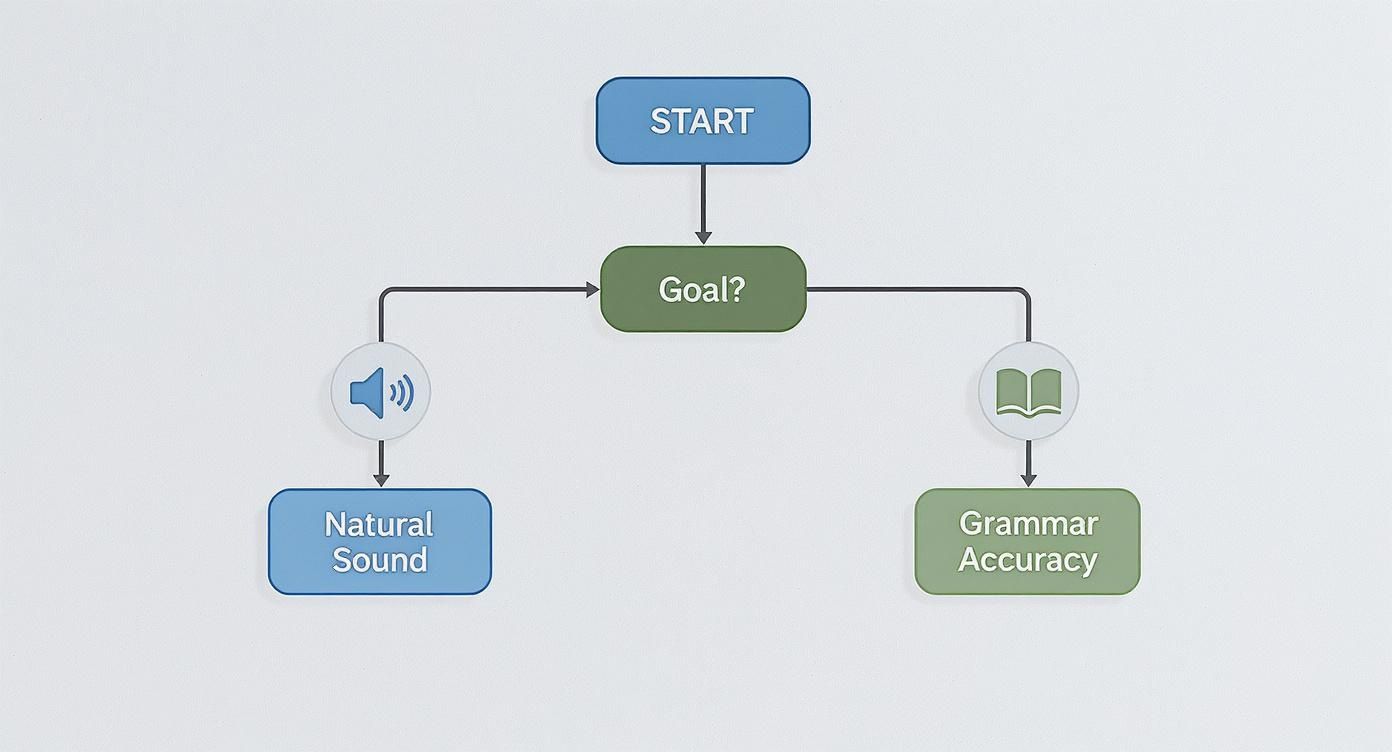
Ultimately, it boils down to this: inflection helps you get understood, while intonation helps you get heard. Both are absolutely vital for complete mastery, but focusing your energy on the right skill at the right time is how you’ll make the fastest progress toward clear, confident speech.
Got Questions? We’ve Got Answers
Even after breaking things down, a few common questions always seem to pop up when people are trying to get a handle on intonation versus inflection. Let’s tackle them head-on to clear up any lingering confusion.
Is Inflection a Type of Intonation?
Nope, they’re completely different tools in your communication toolkit. Think of it this way: inflection is a grammatical tweak to a single word’s structure (like adding ‘-s’ to make a noun plural). Intonation, on the other hand, is the musical melody of pitch and rhythm that stretches across a whole sentence to show your attitude or purpose.
They operate on totally different levels—one is about word construction, the other is about sentence melody.
Which Is More Important for Sounding Fluent?
This really comes down to what you’re aiming for. If your goal is just grammatical correctness and being understood at a basic level, then mastering inflection is non-negotiable. Getting it wrong is a clear-cut mistake.
But if you want to sound natural, connect with people, and get your subtle meaning across, that’s where intonation makes a much bigger splash. It’s what transforms correct sentences into genuinely fluent and engaging speech.
When it comes to intonation vs. inflection, just remember this: Inflection makes you grammatically correct. Intonation is what makes you sound human. One builds the car, the other drives it.
Can a Sentence Be Grammatically Correct but Have the Wrong Intonation?
Absolutely. In fact, this is one of the most common hurdles for non-native speakers.
You could say, “It was a pleasure to meet you,” with every word and inflection perfectly in place. But if you say it with a flat, robotic tone or a rising pitch at the end, that polite sentiment can instantly sound insincere, sarcastic, or even like a question. The words say one thing, but the music of your voice tells a completely different story.
Ready to stop guessing and start getting practical, personalized feedback on how you sound? The head accent expert behind Intonetic is here to help you master both intonation and inflection, so you can finally communicate with total clarity and confidence. Book your free assessment today.