
Mastering Intonation in Speech for Confident Communication
Intonation is the music of your voice. It’s the natural rise and fall of your pitch that breathes life into your words, turning a flat statement into an engaging question or a powerful declaration. Think of it this way: the words are the lyrics, but intonation is the melody that tells people how to feel about them.
Why Intonation Is Your Professional Superpower

Imagine your words are the script for a movie. They lay out the plot, but without the right delivery, the message falls flat. Intonation is the director, guiding your audience’s attention, telling them what’s important, and signaling when a new idea is about to begin. It’s the difference between a message that’s just heard and one that’s truly understood, felt, and remembered.
In any professional setting, this vocal music isn’t just a nice-to-have—it’s a powerful tool of influence. Whether you’re leading a team meeting, presenting to a client, or in a high-stakes negotiation, the way your voice rises and falls can signal confidence, build trust, and command the room. A flat, monotonous delivery can accidentally project boredom or a lack of conviction, even when your ideas are brilliant.
The Melody of Meaning
The study of intonation is part of a broader linguistic field called prosody, which covers all the rhythmic and tonal aspects of speech, including stress, timing, and rhythm. In short, prosody is what makes speech sound human. Without it, even perfectly pronounced words can feel robotic, disconnected, and difficult to follow.
Effective intonation ensures your message lands with the intended impact. It clarifies ambiguity, conveys emotional subtext, and guides the listener’s interpretation, making it a cornerstone of influential communication.
Mastering the intonation in speech used in American English allows you to navigate professional conversations with much greater precision. It’s a skill that directly shapes how others perceive your authority and credibility. To really elevate your professional impact, it’s worth exploring how intonation is a key component of effective executive communication skills training.
The Four Core Functions of Intonation
Intonation isn’t just one thing; it’s a multi-tool that accomplishes several crucial jobs at once. Understanding these functions is the first step toward using your voice with greater intention and purpose.
Here’s a quick breakdown of what intonation is doing behind the scenes every time you speak.
| Function | What It Does | Professional Example |
|---|---|---|
| Signals Sentence Type | Distinguishes statements from questions. | A falling pitch on “The project is due Friday.” (Statement) vs. a rising pitch on “The project is due Friday?” (Question). |
| Highlights Key Information | Uses pitch changes to emphasize the most important word. | “I need that report” (Me, not someone else) vs. “I need that report” (The report, not the slides). |
| Expresses Emotion | Conveys your attitude—sincerity, skepticism, excitement. | A warm, downward tone for “That’s a great idea” (Sincere) vs. a sharp, rising tone for “That’s a great idea?” (Skeptical). |
| Organizes Your Thoughts | Acts as vocal punctuation to separate ideas. | A slight pause and pitch drop signals the end of one point before you introduce the next, making complex information easier to digest. |
By getting a handle on these functions, you’re not just learning to speak differently—you’re learning to lead the conversation.
Ultimately, working on your intonation isn’t about erasing your unique vocal identity. It’s about adding a powerful tool to your communication toolkit, one that helps you build confidence while improving pronunciation and ensures you are always understood the first time.
The Unseen Rhythm of Human Speech
Ever notice how natural, flowing speech just seems to have its own internal beat? It’s not your imagination. That musical quality you hear—what we call intonation in speech—isn’t just a cultural quirk learned over time. It’s rooted in a deep, biological cadence that connects all of us. Think of it as the universal heartbeat of communication.
This underlying rhythm is built on something linguists call intonation units. The easiest way to think of them is as short, natural phrases or “thought groups” we instinctively use to package our ideas. Each unit is a small burst of information, spoken as a single, coherent musical phrase before we pause, take a breath, or shift our pitch for the next thought.
This pattern isn’t random at all. Our brains are hardwired to process information in these bite-sized chunks. So when we speak, we aren’t just stringing words together; we’re delivering neatly organized packets of meaning, each with its own melodic contour. It’s this cognitive process that makes our speech so much easier for others to follow.
The Global Pulse of Conversation
For a long time, experts thought this rhythmic quality was unique to each language. But recent discoveries have painted a much more interconnected picture of human communication. It turns out this “heartbeat” of speech is remarkably consistent across the entire globe.
A groundbreaking study revealed that human speech operates on a universal biological rhythm, with intonation units popping up at a steady rate of about one every 1.6 seconds. This wasn’t a small sample, either—the conclusion came from analyzing over 650 recordings from 48 different languages, representing every continent and 27 language families.
This finding suggests that the rhythm of intonation is a fundamental aspect of human cognition, not just a feature of a specific language. It’s a shared foundation for how we all structure and deliver information.
Understanding this universal cadence is a game-changer for non-native speakers. It means that mastering intonation isn’t about memorizing arbitrary rules you have to force. It’s about aligning your speech with a natural, cognitive rhythm that your listeners are already hardwired to expect. Tapping into this rhythm is a huge part of sounding more fluent and authoritative.
Aligning With the Natural Flow
When you learn to group your words into these natural intonation units, your speech instantly sounds more organized and confident. Instead of a long, monotonous stream of words, you create a dynamic, engaging delivery that holds your listener’s attention.
Each intonation unit works like a musical measure, giving your speech a predictable and pleasant structure. This structure helps you:
- Improve Clarity: By pausing between thought groups, you give your listener time to process each idea before moving on to the next one.
- Convey Confidence: A controlled, rhythmic delivery signals that you are in command of your material and your message.
- Sound More Natural: Aligning with this universal pulse makes your speech feel less rehearsed and more authentic.
This rhythmic aspect of speech is foundational to clear communication. To go deeper, check out our guide on how rhythm and timing in American English are the secret to natural-sounding speech. By focusing on this core element, you are learning a skill that transcends language barriers and connects you more deeply with your audience on an instinctual level.
Decoding Common American English Intonation Patterns
Now that we have a feel for the universal rhythm behind all speech, we can zoom in on the specific “melodies” used in American English. The best way to think about these intonation patterns is like musical phrases that native speakers use intuitively to add precise layers of meaning to their words.
Learning them is a bit like learning the most common chord progressions in a song. Once you know them, you can communicate with far greater nuance and authority.
This is where subtle pitch changes, known as inflection, come together to create the overall intonation pattern of a sentence. While the two terms are closely related, you can dive deeper into the specific differences in our detailed guide on intonation vs. inflection. For now, let’s stick with the big-picture melodies that drive clear professional communication.
The diagram below shows how these patterns fit into the bigger picture of speech, starting from the universal human level and narrowing down to the individual intonation units that carry these specific melodies.
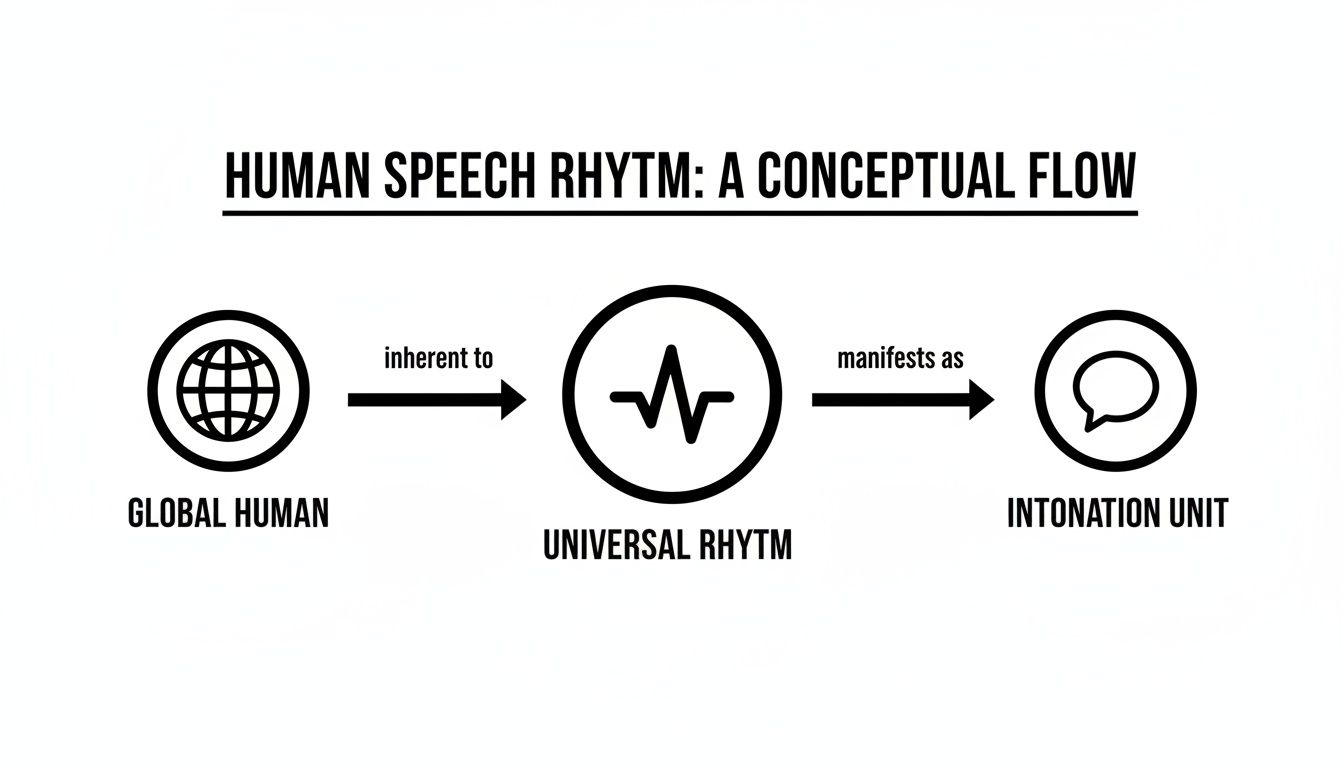
This just reminds us that these patterns aren’t random. They’re the final, culturally-specific layer built on the universal foundation of human speech rhythm.
The Falling Tone for Statements
By far the most common and foundational pattern in American English is the falling tone. You might also hear it called the 2-3-1 pattern. Your pitch starts at a normal level (let’s call it level 2), rises on the most important word (level 3), and then drops decisively at the end of the sentence (level 1).
This pattern screams finality, certainty, and completion. It’s how you tell your listener, “This is a fact,” or “A decision has been made.” Getting this right is absolutely critical for sounding authoritative and confident.
- Business Scenario: You are delivering a final project update in a team meeting.
- Example Sentence: “The project is DONE.”
- Pitch Movement: Your voice starts mid-range on “The project is,” rises sharply on the stressed word “DONE,” and then falls to a low pitch.
A flat or rising pitch at the end of a statement can make you sound hesitant, like you’re second-guessing yourself or asking for approval. The falling tone completely removes that ambiguity and projects confidence.
The Rising Tone for Yes or No Questions
When you need a straight “yes” or “no” answer, you’ll want to use the rising tone. Your voice will end on a higher pitch than where it started. This upward lift is a nearly universal signal for inquiry, inviting the other person to confirm or deny something.
This pattern is essential for gathering information clearly. It makes your questions direct and easy to process, which helps prevent miscommunication in fast-paced professional settings.
- Business Scenario: You need to confirm a deadline with a colleague.
- Example Sentence: “Are you finished with the rePORT?”
- Pitch Movement: Your voice starts at a normal level and rises steadily, peaking on the final stressed syllable of “rePORT.”
The Fall-Rise Tone for Lists and Uncertainty
The fall-rise tone is a more complex but incredibly useful pattern in intonation in speech. It involves a distinct dip and then a rise in pitch on a key word. This melody does two main things: it signals that a list is still ongoing, or it can imply a contrast or a bit of uncertainty.
When you’re listing items, you use a slight fall-rise on each one until you get to the end. The very last item gets the definitive falling tone to signal that the list is complete. This acts like vocal punctuation, telling your listener to keep paying attention.
- Business Scenario: You’re presenting a few options to a client.
- Example Sentence: “We can offer a basic plan (fall-rise), a premium plan (fall-rise), or a custom plan (falling).”
- Pitch Movement: The pitch dips and rises on “basic” and “premium,” then falls conclusively on “custom” to mark the end of the list.
Mastering this pattern is a powerful way to structure your speech and guide your listener’s expectations with real precision.
Why Intonation Is a Hurdle for Non-Native Speakers
For many professionals learning English, mastering the language can feel like a marathon. You spend years perfecting grammar, building an impressive vocabulary, and honing your writing skills. Yet, when it comes time to speak, something feels… off. You know you have the right words, but your message doesn’t land with the impact you intended.
If this sounds familiar, the missing piece isn’t your vocabulary or your verb tenses. It’s almost certainly intonation—the vocal melody that native speakers use without a second thought, but that often has to be learned consciously.
This gap exists because most traditional language classes focus on the what of English (the words and rules) instead of the how (the delivery and musicality). The curriculum hammers home discrete sounds and sentence structure, leaving the overarching rhythm and pitch patterns as a frustrating afterthought.
This leaves many non-native speakers to figure out the complex system of English intonation all on their own. The result is often something called native language interference, where the musical patterns of your first language get unintentionally mapped onto English. For a deeper dive, check out our guide on how to reduce your native language interference in English accent.
The Classroom Gap
This isn’t just a hunch; it’s a well-documented blind spot in language instruction. In one striking study, the vast majority of English as a Foreign Language (EFL) teachers admitted they don’t actively teach intonation patterns in the classroom. This is a huge deal for the millions of professionals who need to communicate effectively but get almost no structured guidance on one of its most critical components. You can read the full research about these instructional findings.
Because of this lack of formal training, you might have a perfect command of English grammar but still use a pitch pattern that sounds beautiful in your native tongue but comes across as unnatural or confusing in English.
How Unintended Intonation Affects Perception
When your intonation doesn’t match what a native English listener expects, a disconnect forms between your words and their perceived meaning. This can chip away at both your clarity and your professional authority in subtle but significant ways.
Here are a few common habits and how they can be misinterpreted:
- Flat Intonation: Speaking with a steady, monotonous pitch is one of the most common pitfalls. Even if your words are crystal clear, a flat delivery can accidentally signal disinterest, a lack of confidence, or even boredom—no matter how passionate you actually are.
- Rising Pitch on Statements: In American English, a firm, falling pitch signals a statement of fact. But if you end a statement with a rising pitch, it can make you sound hesitant or like you’re asking for approval, which can undermine your authority.
- Incorrect Word Stress: Placing emphasis on the wrong word can completely change the meaning of a sentence. For instance, “I didn’t say he stole the money” implies someone else said it. But, “I didn’t say he stole the money” implies he got it some other way.
Misaligned intonation sends signals you don’t intend to send. It’s not about getting the words wrong; it’s about the music of your speech accidentally telling a different story than your lyrics.
Bridging the Communication Divide
The good news? These are just learned habits, not permanent traits. And like any habit, they can be reshaped with focused practice.
The first step is simply recognizing that intonation is a skill, just like grammar. It requires awareness, targeted exercises, and consistent work to build new muscle memory.
Since this skill is so often overlooked in conventional learning, targeted coaching becomes a game-changer for professionals who need to speak with clarity and influence. By identifying your specific intonation habits and practicing proven patterns, you can finally close the gap between what you mean to say and what your audience truly hears. This is how you ensure your expertise and confidence shine through in every single conversation.
Practical Drills to Master Your Intonation

Knowing the theory behind intonation is one thing, but making it part of your natural speech requires practice. Real improvement comes from building new muscle memory. Just like an athlete trains for a sport, you need to train your vocal cords, tongue, and breathing to create these new musical patterns without even thinking about it.
The key is consistent, high-repetition practice that takes these concepts out of your head and puts them into your body. These drills are designed to do just that. They break down the skills so you can focus on one thing at a time, making them second nature. Spending just a few minutes on these each day will make a huge difference in your clarity, confidence, and vocal authority.
Drill 1: Contrastive Stress for Emphasis
One of the most powerful tools in intonation in speech is the ability to shift a sentence’s entire meaning just by emphasizing a different word. Contrastive stress drills train you to control that emphasis consciously, making your speech far more precise and dynamic.
The exercise is straightforward: take one sentence and repeat it, moving the stress to a different word each time. As you say each version, really think about how the meaning and subtext change.
Let’s try it with the sentence: “I didn’t say she stole the money.”
- “I didn’t say she stole the money.” (Meaning: Someone else said it, not me.)
- “I didn’t say she stole the money.” (Meaning: I’m flat-out denying I said it.)
- “I didn’t say she stole the money.” (Meaning: I may have hinted at it, but I never said those words.)
- “I didn’t say she stole the money.” (Meaning: I said someone else took it.)
- “I didn’t say she stole the money.” (Meaning: Maybe she just borrowed it, but she didn’t steal it.)
- “I didn’t say she stole the money.” (Meaning: She stole something, but it wasn’t the money.)
Practicing this drill gives you the vocal agility to highlight key information instantly, making sure your listener never misses your point.
Drill 2: Pitch Contouring for Melody
This drill is all about getting a feel for the fundamental rising and falling tones of American English. The goal is to connect with the physical sensation of your pitch moving up and down so the patterns start to feel natural.
First, just hum. Seriously. Humming strips away the distraction of words and lets you focus completely on the pitch.
- Falling Tone Practice: Hum a single note, then let it glide smoothly downward, almost like a sigh of relief. Do this 10 times. Now, attach that feeling to simple statements: “It’s DONE.” “Let’s GO.” Feel that same downward slide on the stressed word.
- Rising Tone Practice: Hum a note again, but this time, let it glide upward, as if you’re asking a gentle question. Do this 10 times. Now, apply it to yes/no questions: “Is that oKAY?” “Are you REA-dy?”
This exercise forges a direct link between the physical feeling of a pitch change and what it communicates. By isolating the melody first, you make it much easier for your vocal muscles to remember the pattern when you bring the words back in.
Drill 3: Shadowing for Rhythm and Flow
Shadowing is an incredible technique for internalizing the sound of a language. You simply listen to a native speaker and repeat what they say in real-time, doing your best to mimic their intonation, rhythm, and stress. Think of it as tracing a drawing—you’re tracing their vocal melody with your own voice.
It’s so effective because it forces you to stop focusing on individual words and start listening for the music of the language. This is how you absorb the natural cadence and flow of American English.
To start, find a short audio clip—maybe 5-15 seconds from a podcast, an audiobook, or a speech. At first, don’t worry about perfect pronunciation. Your only goal is to match the speaker’s musicality. As this gets easier, you can learn more about how to use the shadowing technique to improve your accent fast and make it a regular part of your routine.
How Intonetic Builds Confident Intonation
Understanding the theory behind intonation is a great first step, but real mastery doesn’t come from practicing drills in a vacuum. True confidence is built with a structured, guided approach that connects those concepts to the real world. This is where the Intonetic Method comes in—we bridge that crucial gap between knowledge and application.
We don’t just practice sounds. We treat intonation in speech, stress, and rhythm as a single, interconnected system. When these skills work together, they build vocal authority and create trust with your listener. This isn’t about erasing your unique voice; it’s about making sure your message lands with crystal-clear intent, every single time.
A Personalized Path to Clarity
Your journey starts with a personalized evaluation. We dig deep to pinpoint the specific intonation patterns that will make the biggest and fastest impact on your professional clarity. Instead of a generic plan, we identify your highest-priority habits and create a focused blueprint just for you.
A structured, expert-guided program provides the focused instruction often missing from traditional language learning, helping you achieve measurable results in professional settings. This targeted feedback is essential for building new muscle memory correctly.
From there, our program is built on three core pillars designed to create lasting, automatic change:
- One-on-One Coaching: You get real-time, expert feedback in live sessions. Your coach is your guide, helping you hear and feel the subtle pitch shifts, correcting mistakes before they become ingrained habits, and explaining the “why” behind each pattern.
- Tailored Practice Blueprints: We create customized practice plans with on-the-go audio drills. These aren’t just random exercises; they’re high-repetition drills designed to fit into a busy schedule and build new speaking habits efficiently.
- Integrated Skill Building: We don’t isolate intonation. We focus on how it works hand-in-hand with word stress and sentence rhythm. This holistic approach ensures you develop a natural, confident, and influential speaking style that feels completely authentic to you.
Building Authority and Trust
Ultimately, the Intonetic program is designed to give you the practical tools to command attention and project confidence in any professional interaction. We don’t just teach you the patterns; we help you apply them in high-stakes meetings, presentations, and negotiations.
When you master the musicality of American English, you ensure your expertise isn’t just heard—it’s felt. You learn how to guide your listener’s attention, project an unshakable sense of confidence, and build the kind of trust that is absolutely essential for leadership and influence.
Your Top Questions About Intonation Answered
Even after understanding the mechanics, it’s natural to have questions about the journey of mastering intonation. Here are some of the most common ones I hear from professionals just like you.
How Long Does This Actually Take?
Everyone’s timeline is different, but progress is directly tied to consistent, focused practice. Most of my clients report a noticeable boost in their confidence and clarity within just 8–12 dedicated coaching sessions.
But for those new intonation patterns to become second nature, you’re generally looking at a full 12-week program. This gives your brain and your muscles enough time to build new habits that stick. The secret isn’t just listening—it’s high-repetition practice of the right drills.
Is the Goal to Erase My Accent?
Absolutely not. Let’s be clear: the goal of intonation coaching is to make you a more effective communicator, not to erase your identity. Your accent is part of who you are.
Mastering the musical patterns of American English is about ensuring your message lands exactly as you intend it to. It gives you more authority and confidence, all while you keep the unique qualities of your own voice. You’re not trying to sound like someone else; you’re trying to sound like the clearest, most impactful version of yourself.
Intonation coaching is an additive process. You gain new skills for clarity and influence without losing the vocal identity that makes you who you are.
Can I Just Use an App, or Do I Really Need a Coach?
Language apps can be a fantastic way to get started. They’re great for building initial awareness and getting some basic practice with common patterns. But intonation is incredibly nuanced, and that’s where technology hits a wall.
An expert coach offers something an app simply can’t: personalized, human feedback. A coach can hear the subtle errors that software misses, explain why a certain pattern isn’t working for your specific speech habits, and design drills that target your biggest challenges. That expert guidance is what turns practice into real, lasting improvement you can actually use in your next meeting or presentation.
Ready to stop guessing and start speaking with confidence? Intonetic provides the expert coaching and personalized blueprint you need to master your intonation. Start your journey to clearer, more influential communication by booking your free assessment at Intonetic.