
How to Talk Confidently in Any Professional Setting
Speaking with real confidence has almost nothing to do with faking it. The game is won or lost in your head long before you ever open your mouth, and it all comes down to preparation and mindset.
The goal is to move from a place of self-doubt to one of genuine self-belief. We do this by actively reframing those nagging negative thoughts, learning how to structure our ideas, and building a simple pre-performance routine that creates unshakable composure.
Build Your Mental Foundation for Confident Speech

True confidence is an inside job. How you deliver your message—your authority, your clarity, the very sound of your voice—is a direct reflection of your internal state. Before we even get into the mechanics of pronunciation or vocal tone, we have to build a solid psychological foundation.
This means getting to the root causes of hesitation: the fear of being judged, crippling self-doubt, and that all-too-common performance anxiety.
Many non-native English professionals I work with worry that their accent or a minor mistake will cause a misunderstanding, which makes them speak tentatively. This fear isn’t just in your head; it has real-world consequences. A workplace communication survey found that 28% of employees worldwide point to poor communication as the main reason they miss deadlines.
Often, this boils down to unclear speech patterns—like shaky intonation or rhythm—that are common when you’re feeling hesitant. This isn’t a small problem; businesses can lose millions from these inefficiencies. It just goes to show how a lack of confident delivery can slowly erode productivity and trust.
Reframe Your Inner Critic
Let’s be honest. The biggest obstacle to confident speech is usually that negative monologue running on a loop in your head. Thoughts like, “What if they can’t understand me?” or “I’m going to sound foolish” are absolute confidence killers.
The first step isn’t to fight these thoughts, but to simply acknowledge them without letting them drive the car.
Instead of trying to crush them, just reframe them. For instance, the thought “My accent is a problem” can be shifted to “My accent is part of my identity, and my message is what really matters.” This subtle change neuters the power of self-doubt. You’re not ignoring your concerns; you’re just choosing a more empowering perspective. You can learn more about this in our guide on https://intonetic.com/how-to-build-confidence-while-improving-pronunciation/.
“Confidence comes not from always being right but from not fearing to be wrong.” – Peter T. McIntyre
This mindset shift is everything. It frees you up to focus on the value and expertise you bring to the table, rather than on perceived imperfections in your speech.
Structure Your Thoughts for Clarity
Uncertainty is the fuel for anxiety. When you’re not entirely sure what you want to say or how you want to say it, your delivery will naturally sound hesitant and weak.
The fix is to structure your thoughts before you speak. This applies to everything from a formal presentation to a quick update in a team meeting.
Try this dead-simple framework:
- The Point: What’s the one thing you need them to know? Start there.
- The Reason: Why is this important? Give some context or data.
- The Example: Share a quick story or a concrete example to make it real.
- The Point (Again): Circle back and restate your main idea to lock it in.
This structure puts an end to rambling and makes your message logical and incredibly easy for others to follow. When you know your key points inside and out, you have a mental roadmap, which allows you to speak with true conviction.
Develop a Pre-Performance Routine
Ever wonder why athletes have pre-game rituals? It’s not superstition. These routines center the mind and prime the body for peak performance. You can—and should—apply the exact same principle to any high-stakes communication.
A consistent pre-performance routine helps you transition from a state of anxiety to one of focused, positive energy. A crucial part of this is knowing your audience. Understanding What is audience analysis? allows you to tailor your message and connect on a deeper level, which instantly reduces uncertainty and gives you a sense of control.
Your routine doesn’t need to be complex. It could be as simple as finding a quiet corner for five minutes to do some deep breathing, quickly review your key talking points, and visualize a successful outcome. The goal is to create a predictable ritual that signals to your brain: “It’s time to perform with poise and authority.” This small habit can make a world of difference.
Master the Mechanics of a Powerful Voice

Once your mental game is strong, it’s time to work on the physical delivery. How you say something is often far more powerful than the words you choose. Your voice is an instrument, and mastering its mechanics—pronunciation, intonation, and rhythm—is what signals credibility and authority to everyone in the room.
Many professionals I work with feel completely overwhelmed by the 44 distinct sounds, or phonemes, in American English. There’s a common belief that to sound confident, you have to achieve perfect, native-like pronunciation on every single sound. Frankly, this is a myth. It’s also a surefire path to frustration.
The reality? Not all sounds are created equal. A much smarter strategy is to identify and master the 10–12 highest-impact phonemes that have the biggest effect on your clarity. Focusing your energy here creates faster, more noticeable results in how easily people understand you.
Prioritize Your Pronunciation Practice
Instead of trying to boil the ocean, get laser-focused. For most professionals, the sounds that create the most confusion are often subtle but critical vowel and consonant distinctions.
Think about the difference between the short “i” sound (as in “ship”) and the long “ee” sound (as in “sheep”). One small slip can change the entire meaning of a sentence and cause your listener to stumble. Likewise, mastering the “th” sound—which doesn’t even exist in many languages—can instantly boost your overall clarity and reduce the mental effort your audience needs to understand you.
Here are a few phonemes that give you the biggest bang for your buck in practice:
- The “th” sounds (voiced and unvoiced): As in “the” and “think.”
- The “r” sound: A classic challenge that can really impact how clear you sound.
- Key vowel distinctions: Such as the /æ/ in “cat” versus the /ɛ/ in “bet.”
When you zero in on these critical sounds, you build a foundation of clear speech that lets your confidence shine, instead of getting bogged down trying to perfect everything at once.
A powerful voice isn’t about having a perfect accent; it’s about having a clear and controlled delivery that makes your message impossible to ignore. It’s the difference between being heard and being understood.
Use Intonation to Command Attention
Ever listened to someone drone on in a flat, monotone voice? It’s not just boring; it’s unconvincing. Intonation, the rise and fall of your pitch, is the music of your speech. It’s what injects emotion, flags important information, and keeps your audience locked in.
A common trap for professionals trying to sound serious is to adopt a low, flat pitch. This often backfires, making you sound bored or, worse, uncertain. Confident speakers, on the other hand, use pitch variation like a tool.
Take a look at how you end your sentences. A rising intonation at the end of a statement can make it sound like a question, completely undermining your authority.
- Uncertain: “We should move forward with this project?” (pitch goes up)
- Confident: “We should move forward with this project.” (pitch goes down)
That subtle shift from an upward to a downward inflection instantly turns a tentative suggestion into a decisive command. A great way to practice this is to record yourself saying a few key phrases from an upcoming meeting. Listen back only for the pitch at the end. Are you making statements or asking for permission?
Master Rhythm and Pausing for Impact
The final piece of the puzzle is rhythm—the dance between stressed words and strategic silence. Rhythm controls the flow of your speech and tells your listener exactly what to focus on. In English, we don’t treat every word the same; we punch the important “content” words.
For example, in the sentence, “We need to focus on the key deliverables,” the bolded words get more emphasis. This creates a natural cadence that guides the listener’s ear. Speaking with a flat, even rhythm forces your audience to work overtime just to figure out what your main point is.
Pausing is your secret weapon. A well-placed pause can:
- Build suspense right before you drop a key insight.
- Add weight to a point you just made, giving it a moment to sink in.
- Give you a second to breathe and gather your thoughts.
Confident speakers aren’t afraid of silence. They wield it.
Of course, all these mechanics are powered by your breath. It’s the engine behind a strong, controlled voice. If you want to go deeper, our guide on how to use breathing exercises for better English speech is a great next step.
Let’s quickly recap the core components that make up a confident and authoritative voice.
The Three Pillars of Vocal Mechanics
| Vocal Pillar | What It Is | Impact on Confidence |
|---|---|---|
| Pronunciation | The clarity and accuracy of individual sounds (phonemes). | Clear pronunciation removes distractions, allowing listeners to focus on your message, not your accent. |
| Intonation | The rise and fall of pitch in your voice (the "music" of speech). | Varied intonation conveys emotion and emphasis, making you sound engaged, certain, and authoritative. |
| Rhythm | The pattern of stressed words and strategic pauses. | A strong rhythm guides the listener's attention and controls the pace, signaling poise and control. |
By mastering these three pillars—pronunciation, intonation, and rhythm—you're not just tweaking your accent. You're learning how to command your voice with purpose and authority.
Choosing Words That Project Authority and Clarity
Beyond how you sound, what you say forms the bedrock of a confident message. Professionals who command a room know that language isn't just for conveying information—it's a strategic tool for building credibility, steering conversations, and leaving no room for doubt. It all starts with a simple but profound shift: moving from passive to active language.
Hesitant, wishy-washy phrasing can kill your authority before your idea even has a chance to land. Phrases like "I sort of think…" or "This is just my opinion, but…" immediately signal a lack of conviction. You're essentially asking for permission to have a viewpoint, which is the exact opposite of projecting confidence.
The fix? Be direct. Own your contributions. Swap out those tentative lead-ins for strong, active statements.
Ditch Hesitant Language for Active Statements
Making this one change is probably the fastest way to sound more decisive. This isn't about being aggressive or arrogant; it's about being clear and unambiguous. Your goal is to frame your ideas as well-thought-out facts, professional recommendations, or clear next steps.
Here’s a quick before-and-after look at passive versus active phrasing:
| Instead of This (Passive & Hesitant) | Try This (Active & Authoritative) |
|---|---|
| "I guess we could try the new software." | "My recommendation is to implement the new software." |
| "I was just wondering if maybe we should…" | "The next step should be…" |
| "This might be a silly idea, but…" | "Here's the plan I've developed…" |
| "Sorry to interrupt, but I kind of feel…" | "To add to that point, I see it this way…" |
See the difference? This is more than a cosmetic tweak. Active language repositions you from a sideline observer to a key player who is driving the conversation forward. It proves you’ve thought things through and are ready to stand behind your ideas.
The words you use frame reality for your listeners. Choosing direct, active language doesn’t change your idea, but it fundamentally changes how that idea is perceived. It’s the difference between hoping for influence and claiming it.
Tailor Your Vocabulary to Your Audience
Truly confident communication is never one-size-fits-all. It’s about adapting your vocabulary and level of detail to the people right in front of you. This shows both expertise and emotional intelligence, which only reinforces your authority.
Think about it in two common scenarios:
- Speaking with Peers and Experts: In this circle, using precise, industry-specific jargon is not only okay—it’s expected. It acts as a shortcut, showing you have a deep grasp of the subject and belong in the conversation. It proves you’re fluent in the language of your field.
- Speaking with Stakeholders or Non-Experts: Here, your goal is clarity, not complexity. Your real power comes from distilling a complicated topic into simple, understandable terms. Ditch the jargon. Instead, use analogies, simple language, and focus on the “so what”—the bottom-line impact for them.
Being able to switch between these modes proves you’ve mastered your subject. You know it so well you can explain it to anyone, and that is a true hallmark of a confident professional.
Use Signposting to Guide the Conversation
Have you ever listened to someone who is incredibly easy to follow, even when the topic is complex? They’re likely using a technique called signposting. It’s the simple act of using words and phrases to give your listeners a roadmap of where you’re going. It shows you’re in control of the narrative and are thoughtfully guiding your audience from one point to the next.
Effective signposting makes your message digestible and paints you as a clear, organized thinker.
Here are a few powerful signposting phrases you can start using today:
- To introduce a point: “The first thing we need to consider is…”
- To add another idea: “Another key factor here is…”
- To contrast or pivot: “On the other hand, it’s important to remember that…”
- To drive home a conclusion: “Ultimately, what this all means is…”
- To summarize and close: “So, to wrap this up, the main takeaways are…”
Weaving these phrases into your speech creates a logical flow that makes you sound prepared, articulate, and completely in command of your message.
Your Blueprint for Consistent Practice and Improvement
Confidence isn’t something you’re born with; it’s a skill you build through smart, consistent practice. All the theory in the world is a great start, but the real change happens when you start weaving these new speech habits into the fabric of your daily professional life.
This blueprint is designed to give you a tangible framework to move from that conscious, clunky effort to a place of unconscious, natural competence over the next 4 to 12 weeks.
The key is to start small with “micro-drills”—quick, targeted exercises you can do anywhere, anytime. We’re not talking about long, grueling sessions. Think short bursts of focused effort that build muscle memory for your voice and delivery.
Weeks 1-4: Foundational Habits
The first month is all about laying a solid foundation and making these new skills a conscious part of your routine. The goal here isn’t perfection. It’s consistency.
- Daily Vocal Warm-up (5 mins): Before your first call or meeting of the day, spend just five minutes doing simple vocal exercises. This could be humming, doing lip trills (like a horse), or running through a few tongue twisters to wake up your articulators.
- Active Language Swap: Each day, pick one meeting or email where you will consciously swap a passive phrase for an active one. Instead of saying, “I think we could maybe try…”, go with “My recommendation is to…”
- End-of-Day Reflection (2 mins): Take two minutes to jot down one communication win and one area for improvement. Did you use a downward intonation to make a strong point? Did you catch yourself using filler words? That awareness is the first step to real change.
Weeks 5-8: Integration and Application
Now that you’ve got the basics down, it’s time to apply these skills in more challenging, real-world scenarios. This phase is all about moving these techniques from your head into your natural way of speaking.
This timeline shows how authoritative language has evolved over the years, shifting from hesitant phrasing to more active and, eventually, connective language.
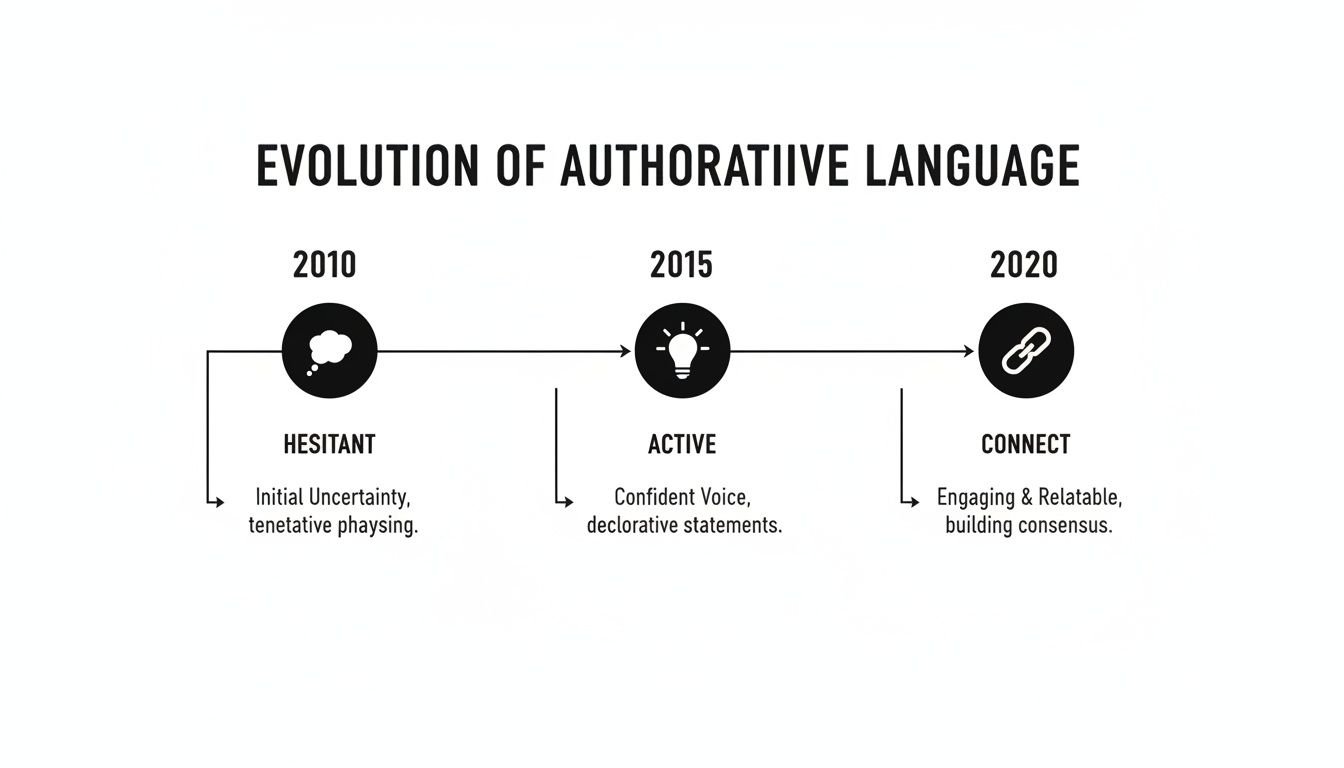
This visual journey highlights why it’s not just about being direct, but also about building bridges with your language for maximum impact.
Your focus for this period is integration. Here are a couple of drills:
- Meeting Intro Rehearsal: Before an important meeting, record yourself saying your opening line two or three times. Listen back. What’s your vocal tone? Your pacing? Your clarity? This simple drill primes you to start strong.
- “Pause Power” Practice: In one conversation each day, make a point to use a strategic pause before answering a question or making a key point. Feel the power of that silence. It gives you a moment to think and adds real weight to your words.
The impact of clear, confident speech can’t be overstated. A PwC study flagged that 41% of leaders struggle to gather information quickly due to miscommunications, which can stall deals and projects. This is often where this kind of training makes a tangible difference.
Weeks 9-12: Automation and Refinement
This final phase is all about making confident speech your default setting. The drills become less about learning new things and more about refining your delivery under pressure until it becomes second nature. If you’re looking for more ways to level up, check out our guide on how to improve your English speaking skills.
- High-Stakes Simulation: Practice delivering a tough piece of feedback or a complex idea to a trusted colleague. Ask for specific feedback on your delivery—not just the content.
- Impromptu Speaking Drill: Once a week, pick a random work-related topic and speak on it for 60 seconds without any prep. This builds mental agility and confidence in your ability to think on your feet.
Accountability Checkpoint: At the end of each week, rate your confidence on a scale of 1-10 in a specific situation (e.g., team stand-up, client call). Tracking this simple metric over 12 weeks will reveal your progress and keep you motivated.
A key part of consistent improvement involves actively refining your verbal delivery. For more focused strategies on improving verbal communication skills, especially in high-stakes situations, it’s worth exploring additional actionable steps.
Think of this blueprint as a flexible guide, not a rigid set of rules. The goal is to build a sustainable practice that turns conscious effort into an unconscious skill, allowing your expertise to finally shine through, clearly and authoritatively.
Navigating Common Confidence Blockers in Real Time
No matter how much you prepare, the real world has a knack for throwing curveballs. A sudden interruption, a challenging question, or a simple mental blank can send your confidence into a nosedive. The goal isn’t to pretend these moments won’t happen; it’s to build an emergency toolkit so you can handle them with grace.
Think of these strategies as your real-time troubleshooting guide. When you know how to navigate these common blockers, you not only save yourself in the moment but also project a level of poise that actually reinforces your authority.
When You Lose Your Train of Thought
It happens to the best of us. You’re right in the middle of a crucial point, and suddenly… nothing. Your mind is a blank slate. The silence feels like it’s stretching for an eternity, and you can feel the panic creeping in.
The absolute worst thing you can do is visibly flounder. Instead, own the moment.
- Take a deliberate pause. Stop, take a slow, deep breath, and maybe take a sip of water. To your audience, this looks intentional—a moment for emphasis. For you, it’s a few precious seconds to regroup.
- Use a bridging phrase. Saying something like, “Let me rephrase that for clarity,” or “The most important part of this is…” gives your brain a moment to catch up without breaking the flow.
- Recap your last point. Briefly summarizing what you just said—”So, as I was mentioning about the Q3 data…”—can often be the trigger your memory needs to get back on track.
When You’re Interrupted or Challenged
An unexpected question or pushback can feel like a direct assault on your authority. Your first instinct might be to get defensive, but this is a golden opportunity to demonstrate confident control of the conversation.
First, always acknowledge the interruption. Don’t just talk over it. A simple, “That’s an interesting point, thank you,” shows you’re actively listening and in command.
From there, you have two options: address it or park it.
To Address: “To quickly speak to that…” (then immediately steer back to your main point).
To Park: “That’s an important question. Let me finish this thought, and I’ll circle back to it right after.”
This approach validates the other person but keeps you from getting derailed. You look unflappable.
Managing Physical Signs of Nerves
Sometimes our bodies betray us. A racing heart, shaky hands, a voice that quivers—these physical signs of anxiety can completely shatter our perceived confidence. When you feel them coming on, you need an immediate grounding technique.
Try the 5-4-3-2-1 grounding method:
- Acknowledge 5 things you see around you.
- Acknowledge 4 things you can touch.
- Acknowledge 3 things you can hear.
- Acknowledge 2 things you can smell.
- Acknowledge 1 thing you can taste.
This simple sensory exercise yanks your brain out of its panic loop and forces it back into the present. You can even do a discreet version by just feeling your feet firm on the floor or noticing the texture of the table. For those who battle this often, exploring ways to overcome accent anxiety and speak fearlessly can offer more permanent strategies.
The impact of these skills is real. While 60% of internal communications pros don’t measure their efforts, the metrics for confident speech are clear. Employees led by transparent communicators report satisfaction levels 12 times higher, and businesses with strong communication tools see 3.5 times better results. You can find more data on the tangible benefits of confident communication at Worldcom Group.
Receiving Feedback Without Losing Momentum
Constructive feedback is a gift, but when it’s delivered poorly or at a bad time, it can feel like a punch to the gut. If someone offers feedback on your communication, your response is everything.
Resist the urge to get defensive. Instead, shift into a mode of genuine curiosity. Thank the person for their input and ask clarifying questions like, “That’s helpful. Can you give me a specific example of when you noticed that?”
This move transforms a potentially negative interaction into a productive learning opportunity. It shows you’re secure enough to be open to improvement—which is the ultimate sign of confidence.
For learners who want to improve their accent and clarity without committing to one-on-one coaching, Intonetic now offers 2 self-paced programs as a monthly subscription called Intonetic Accent Studio, priced at $7 per month and $27 per month. The difference is that the $27 per month program gets you personalized feedback on your progress. You can find out more about these American accent training programs on our site.
Frequently Asked Questions About Confident Speaking
When you start digging into this work, a few questions always pop up. Professionals I work with often ask about the timeline for improvement, the “right” way to practice, and how to balance learning new techniques without losing their authentic voice. It’s natural to have these questions.
Let’s clear up some of the most common ones I hear so you have the clarity you need to move forward.
How Long Does It Take to See Real Improvement?
This is always the first question, and the honest answer is: it depends entirely on your consistency. While there’s no magic number, most professionals feel small but meaningful wins within the first 4 weeks of dedicated practice.
Here’s a realistic breakdown of what that journey often looks like:
- Weeks 1-4: This is the awareness phase. You’ll start catching yourself using filler words or noticing when your pitch goes flat. You’re building the foundation for change.
- Weeks 5-8: Things start to click. You’ll find yourself naturally integrating new habits. A strategic pause might feel less rehearsed, or your intonation will start to shift on its own in real conversations.
- Weeks 9-12 and beyond: With steady practice, these skills become your new normal. You’ll spend less mental energy thinking about how you’re speaking and more time focused completely on your message.
The key isn’t how much time has passed, but how often you’re putting in the reps. A few focused minutes every day will always beat a long, infrequent practice session.
Will I Lose My Accent or My Identity?
This is a huge—and completely valid—concern. Let me be very clear: the goal here is clarity, not erasure.
Improving your pronunciation of certain English sounds or mastering American intonation isn’t about stripping away your cultural identity. It’s about making sure your brilliant ideas land with the full impact they deserve, the first time you say them.
Think of it this way: a world-class musician learns to play with incredible precision. They don’t lose their unique musical style; they just gain more control and nuance. Your accent is part of your story. We’re just fine-tuning the elements that directly impact listener comprehension, so your authentic voice and expertise can be heard without any communication static.
“True confidence isn’t about changing who you are. It’s about removing the obstacles that prevent others from seeing the expert you’ve always been.”
Is It Better to Practice Alone or With Others?
You need both. A mix of solo and interactive practice is where the real progress happens. Each one builds a different kind of muscle.
| Practice Method | Benefits |
|---|---|
| Solo Practice | This is your lab. It’s a safe, no-pressure space to get awkward with new vocal techniques, drill key phrases, and build muscle memory without feeling self-conscious. |
| Practice with Others | This is the real world. It tests your skills under pressure, forces you to adapt to interruptions, and gives you instant feedback on how your message is actually landing. |
My advice? Build the foundational skills on your own first. Once a technique feels somewhat comfortable, intentionally try it out in low-stakes chats with colleagues you trust. Then, you can start bringing it into those higher-stakes meetings. For a deeper look at common questions, feel free to explore our Frequently Asked Questions page.