How to Speak with an American Accent A Practical Guide

Learning how to speak with an American accent is less about erasing your identity and more about mastering its core sounds, rhythm, and intonation so you can be understood effortlessly. It starts with a smart self-assessment to find your highest-priority areas, ensuring you spend time on what will actually make a difference in your clarity.
Build Your Personalized Accent Roadmap
Before you practice a single sound, you need to know where you're going. Trying to change everything at once is a surefire way to get frustrated and burn out.
Instead, a focused, strategic plan makes sure every minute you spend practicing gives you the biggest possible boost in clarity and confidence. This isn't about ditching your background; it's about building a solid bridge for clearer communication.
The very first step is a simple but critical self-assessment. The goal here is to pinpoint the exact sounds and speech patterns creating the biggest gap between your current accent and a standard American one. You're basically becoming a detective of your own speech.
Recording and Analyzing Your Voice
First things first, you need a baseline recording. Your phone's voice memo app is perfect for this. Just find a quiet spot to avoid any distracting background noise.
Don't overthink what you're going to say—the point is to capture your natural, everyday speaking voice.
Here are a few ideas to get you talking:
- Read a short paragraph from a news article or a book.
- Describe your day, starting from the moment you woke up.
- Explain your job or talk about a hobby you're really into.
Once you have a recording that’s a few minutes long, it’s time to play it back. But don't listen as you. Try to listen as an objective, curious observer. Can you spot any moments where your pronunciation might be a bit fuzzy, or where the rhythm feels off compared to native speakers you hear on TV or at work?
Identifying Your Priority Sounds
As you listen, jot down any words or sounds that jump out. Are there specific vowels or consonants that consistently trip you up? For many non-native speakers, a handful of sounds cause the most trouble.
The most effective accent training focuses on the 20% of issues that cause 80% of the communication breakdowns. It's far better to master a few high-impact sounds than to be mediocre at all of them.
Here are some of the usual suspects to listen for:
- The American 'R': This sound is often one of the biggest giveaways. Does your 'r' sound rolled or tapped, rather than the tight, retroflex 'r' you hear in American English words like "car" or "river"?
- The 'TH' Sounds: Many languages don't have the voiced 'th' (as in "this") or the unvoiced 'th' (as in "think"), which leads to common substitutions like 'd', 'z', 's', or 't'.
- Vowel Distinctions: Pay close attention to vowel pairs that are close but distinct, like the sounds in "ship" versus "sheep" or "sit" versus "seat." Even tiny shifts in tongue position or vowel length can change a word's meaning entirely.
After going through your recording, you should have a short, concrete list of 3-5 sounds or patterns to tackle first. This is your personalized roadmap.
Setting this foundation is essential. This targeted approach transforms a vague goal like "improve my accent" into a series of clear, achievable steps. You can learn more about how to set micro-goals to stay on track with your accent journey.
Mastering the Core Sounds of American English
Now that you have a roadmap, it's time to get your hands dirty. Think of this as your pronunciation gym, where we'll build the muscle memory you need to produce core American English sounds on command, accurately and consistently. This is where we move from theory to actual physical practice.
The goal isn't just knowing how a sound is made; it's making its production completely automatic. This only happens with short, focused, high-repetition drills. Honestly, trying to cram in an hour once a week is far less effective than practicing for just ten minutes every single day. Consistency is what builds new habits that actually stick.
This whole process is a simple, repeating cycle: you record your voice, analyze what you hear, and then plan your next practice session based on that feedback.
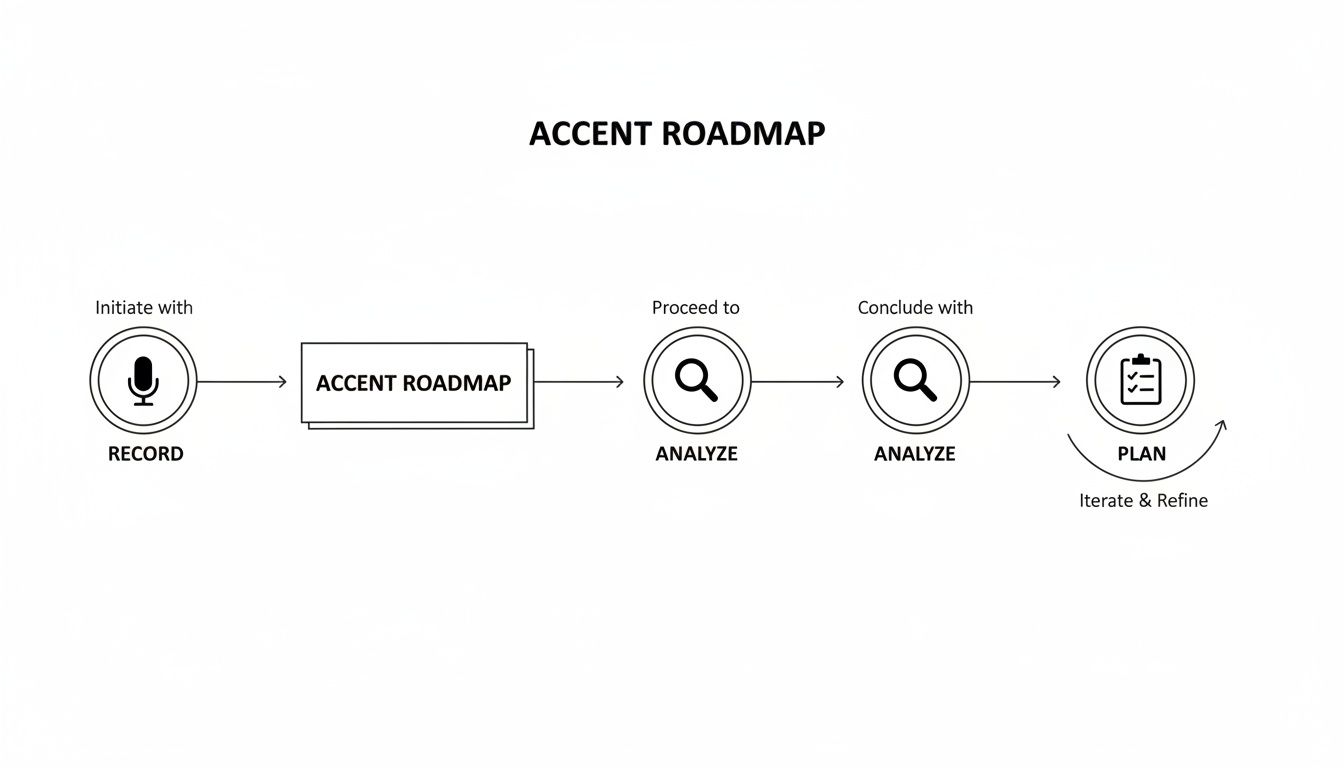
This loop reinforces a key idea: improving your accent is about constant action and refinement, not some one-and-done fix.
Deconstructing the American R
For a huge number of learners, the American 'R' is the single biggest hurdle. It’s nothing like the tapped or rolled 'R' found in so many other languages. The American version is a retroflex sound, which is just a fancy way of saying your tongue tip curls back. It’s all about creating tension in the back of your tongue.
Here's a little trick: imagine your tongue is shaped like a spoon. For the 'R' sound, you need to pull the sides of that "spoon" up until they touch your upper back molars. The very tip of your tongue should then pull back and curl up slightly, but—and this is critical—it should not touch the roof of your mouth.
Let’s try it with a common word: car.
- First, just say "cah," letting your jaw drop and your tongue lie flat on the floor of your mouth.
- Now, without closing your mouth, slowly pull your tongue back into that retroflex 'R' position.
- You should physically hear the sound morph from "ah" into "ar." You’ll probably notice your lips rounding just a bit, too.
Practice that transition very slowly: cah-rrrr. Pay close attention to the physical sensation of your tongue tensing and pulling back.
Tackling the Tricky TH Sounds
American English has two 'TH' sounds, and since they don't exist in many languages, learners often substitute them with 'd', 't', 's', or 'z'. Getting this right comes down to precise tongue placement.
- Unvoiced 'TH' (as in "think," "three," "path"): This is a soft, airy sound. Just place the very tip of your tongue gently between your front teeth and blow. That's it. You shouldn't feel any vibration in your vocal cords.
- Voiced 'TH' (as in "this," "that," "breathe"): The tongue placement is exactly the same. The only difference is that this time, you "turn on" your voice by activating your vocal cords. You should feel a slight buzzing vibration on your tongue and in your throat.
A fantastic way to practice this is with minimal pairs—words that are identical except for that one sound. This really trains both your ear and your mouth to notice the subtle difference.
Minimal Pair Drill: Repeat these pairs out loud, really exaggerating the 'TH' sound at first. Record yourself to make sure you're getting it right.
- think / sink
- three / tree
- path / pass
- then / den
- breathe / breed
Distinguishing Critical Vowel Pairs
It's easy to overlook them, but subtle vowel differences can completely change the meaning of a word. One of the most common mix-ups I see is the distinction between the long 'ee' sound (as in sheep) and the short 'i' sound (as in ship).
The difference is all about tongue tension and position.
- Long 'ee' (sheep, seat, leave): For this sound, your tongue is high and pushed far forward in your mouth. The muscles in your tongue feel tense, and your lips naturally spread into a slight smile.
- Short 'i' (ship, sit, live): Here, your tongue is a bit lower and much more relaxed. Your lips are also relaxed, not spread wide.
To really feel the difference, say "eeeee" and just hold it. Notice that tension. Now, relax your tongue and jaw just a little bit, and the sound will naturally soften to "ih." If you find you're struggling to nail all 44 sounds in English, checking out a detailed guide can really help clarify the mechanics for each vowel and consonant.
To help you get started, here is a quick reference table for some other common sound challenges many of my clients face.
Common American English Sound Challenges and Fixes
This table is a practical cheat sheet for spotting common pronunciation hurdles and applying specific techniques to get the sound right.
| Challenging Sound | Common Mistake | How to Fix It (Tongue/Lip Placement) |
|---|---|---|
| The 'L' Sound | Making a "dark L" in all positions. | For a "light L" (like in light), the tip of your tongue must firmly touch the alveolar ridge right behind your top front teeth. |
| The 'A' as in cat | Pronouncing it too much like "ah" or "eh." | Drop your jaw significantly. Your tongue should be low and flat, and the corners of your mouth pull back slightly. |
| The 'W' vs. 'V' | Interchanging the two sounds (wine vs. vine). | For a 'W', your lips must be rounded and tight. For a 'V', your top teeth gently touch your bottom lip. |
Remember, building a native-sounding American accent is a marathon, not a sprint. Focus on mastering just one or two of these priority sounds at a time with consistent, deliberate practice.
Finding the Music in American English
Have you ever nailed the pronunciation of individual words, but your speech still feels a little… off? I see this all the time. The real secret to sounding natural in American English often has less to do with the sounds themselves and more to do with the music of the language.
This musical quality, what experts call prosody, is built on three pillars: rhythm, stress, and intonation.
Getting a handle on this trio is what will take your speech from a flat, sometimes robotic delivery to a dynamic, engaging style that sounds genuinely American. It’s the key difference between just saying words and truly conveying meaning, emotion, and confidence.

We absorb the music of our native language from a very young age. It’s deeply ingrained. Research on immigrants to the U.S. has even pinpointed a critical window for accent acquisition, showing that the ability to gain a native-like accent tends to drop off around age 15. It just goes to show how fundamental these patterns are.
The Pulse of American Rhythm
Unlike many languages that are syllable-timed (where every syllable gets about the same amount of time), American English is stress-timed. This is a game-changing concept to grasp.
It means the time between stressed syllables stays relatively consistent, no matter how many unstressed syllables you have to cram in between them.
This is exactly why native speakers often sound like they’re “swallowing” or rushing through certain words. It's not lazy—it’s the natural rhythm. They instinctively emphasize the important "content words" (like nouns, main verbs, and adjectives) and glide right over the "function words" (like articles, prepositions, and helping verbs).
Take this sentence:
I need to go to the store to buy some bread.
A native speaker doesn't give each word equal weight. The beat falls on NEED, GO, STORE, and BREAD. All the other little words—I, to, to, the, to, buy, some—get squeezed in to fit that rhythm. If you want to dive deeper, you can learn more about the rhythm and timing in American English.
Word Stress: The Key to Being Understood
Once you get the feel for the overall rhythm, the next layer is word stress. Placing the stress on the wrong syllable is one of the quickest ways to confuse a listener. It can even change a word’s meaning entirely.
Think about these pairs:
- RE-cord (the noun, like a vinyl record) vs. re-CORD (the verb, to record your voice)
- PRO-ject (the noun, like a work project) vs. pro-JECT (the verb, to project an image)
The spelling is identical, but where you put the stress completely changes the word. When you learn new vocabulary, don't just learn the spelling—learn where the stress goes. A stressed syllable is usually a bit longer, louder, and higher in pitch.
Here’s a great drill: Grab a paragraph from a news article. Go through it and underline the one stressed syllable in every multi-syllable word. Then, read it out loud, really exaggerating the stressed syllables to make them pop. This builds crucial muscle memory.
Intonation: Painting Pictures with Your Pitch
Intonation is the melody of your speech—the rise and fall of your voice's pitch. It's how we signal our emotions and intentions without having to say them directly. The exact same sentence can be a statement, a question, or an expression of disbelief, all based on its pitch contour.
In American English, a few predictable patterns cover most situations.
- Falling Intonation: This is your default for statements, commands, and "wh-" questions (who, what, when, etc.). Your pitch starts a little higher and drops on the last important word. For instance, "She works in marketing." (The pitch falls on 'marketing').
- Rising Intonation: You’ll use this for yes/no questions and to show surprise or doubt. Your pitch goes up at the end. For example, "Are you coming?" (The pitch rises on 'coming').
Let’s apply this to a real-world scenario. You're in a meeting and need to confirm a deadline.
- You state it as a fact: "The deadline is Friday." (Falling pitch)
- You ask for confirmation: "The deadline is Friday?" (Rising pitch)
The only thing that changed was the music, but it completely altered the meaning. Mastering these pitch patterns makes your speech more nuanced, makes your intentions crystal clear, and helps you build authority in any professional setting.
Weaving Accent Practice Into Your Daily Life

Real, lasting change in your accent comes from daily consistency, not from cramming on the weekend. The secret to learning how to speak with an American accent is finding ways to weave small, focused exercises into the rhythm of your existing day.
You don't need to block out a huge chunk of time. In fact, that's often counterproductive. This is all about building new muscle memory, and your mouth and brain respond far better to frequency than to intensity. A focused 15-minute session every single day builds sustainable habits and will get you much further than a marathon session once a week.
Designing Your Daily 15-Minute Session
A powerful daily practice session should feel short, focused, and just varied enough to keep things interesting. The goal here is to touch on the core components of your accent roadmap without it ever feeling like a chore. Think of it as a quick, high-impact workout for your speech.
Here’s a simple structure I've seen work time and time again:
- Minutes 1-3 (Warm-up): Get physical. Gently massage your jaw and neck muscles. Do a few simple tongue stretches, like touching the tip of your tongue to the spot behind your top teeth, then sweeping it back. This just releases the tension that gets in the way of clear sounds.
- Minutes 4-9 (Focused Drills): This is where you do the heavy lifting. Pick just one or two of your priority sounds and hit them with minimal pair exercises (like ship/sheep or then/den). Critically, record yourself saying them and listen back immediately. The instant feedback is what trains your ear.
- Minutes 10-15 (Application): Time to bridge the gap from isolated sounds to real speech. Grab a news article or a book and read a paragraph out loud. Your focus here isn't just on getting the words right, but on applying your target sound and feeling the natural rhythm of American English.
This structure ensures you're building both precision at the sound level and fluency in connected speech. You can dive deeper into this with our guide on how to practice English pronunciation daily for rapid progress.
Activating Your Dead Time
One of the most powerful things you can do is activate your "dead time." This is all the time you spend on autopilot—your commute, washing dishes, folding laundry, you name it. Instead of letting that time evaporate, turn it into a mobile practice lab.
The most successful accent learners I’ve worked with are the ones who immerse themselves in the sounds of the language, even when they aren't actively drilling. This passive listening builds an intuitive sense of what just "sounds right."
Load up your phone with audio. Listen to podcasts hosted by American speakers, play audiobooks, or find pronunciation apps with audio drills. The key is to shadow what you hear. Repeat phrases right after the speaker, trying to mimic their exact intonation and rhythm. You don't have to be perfect. The simple act of imitation is incredibly powerful for retraining your muscles.
A Sample Weekly Practice Blueprint
Consistency happens when you have a plan. A simple weekly structure stops you from just practicing random things and makes sure you're covering all your bases.
| Day | Focus Area | 15-Minute Activity Example |
|---|---|---|
| Mon & Thu | Priority Sounds | Minimal pair drills for the American 'R' and 'TH'. |
| Tue & Fri | Rhythm & Intonation | Shadowing a podcast, really exaggerating the stressed words. |
| Wednesday | Application & Review | Record yourself reading a short speech and critique it. |
| Saturday | Real-World Use | Have a conversation with someone and focus on speaking clearly. |
| Sunday | Rest & Listen | Passive listening—just enjoy American TV shows or movies. |
This kind of routine pays off. While it can take years for some learners to acquire a new accent, one study showed that 16.7 percent of participants achieved noticeable proficiency in just one year through this kind of dedicated practice. These small, daily actions really do build into significant, life-changing skills.
Tracking Your Progress and Breaking Through Plateaus
Consistent practice is the engine that drives your accent journey, but how do you actually know if you’re getting anywhere? Tracking your progress isn’t just for a motivational boost; it’s a strategic tool. It tells you what’s working, what isn’t, and when it’s time to switch things up.
Without it, you’re flying blind. You miss the small victories that stack up into major breakthroughs, making it easy to get discouraged.
The most powerful tool you have for this is your own voice. The simple act of recording yourself on a regular schedule provides undeniable, objective proof of your improvement. You can’t always trust your own perception—what feels strange in your mouth might sound perfectly natural to a listener.
To get the most out of this, you need a clean recording. Your smartphone is all you really need. If you're using an iPhone, this guide to audio recording with iPhone for clear sound has some great tips.
Creating a System for Self-Assessment
Don't just hit record whenever you feel like it. A random approach won't help. You need a structured system that allows for a direct, apples-to-apples comparison over time.
- Pick your benchmark text. Find a short paragraph, just 3-4 sentences long, that contains some of your target sounds. This is your new standard.
- Schedule your recordings. Set a recurring reminder to record yourself reading that same passage every two weeks. Consistency is everything here.
- Listen and compare. After a month, pull up your first recording and your latest one. Listen to them back-to-back. The changes, even the subtle ones, will jump out at you.
This simple process turns the vague feeling of "Am I getting better?" into concrete evidence. You’ll hear the evolution in specific sounds, notice a shift in your rhythm, and maybe even catch a more natural intonation. It's the most reliable way to stay motivated, especially when you feel like you've hit a wall.
Overcoming the Inevitable Plateau
Every single learner hits a plateau. It’s that frustrating point where you're putting in the work but feel like you’ve stopped making progress. This is a completely normal part of learning, not a sign that you’re failing.
Often, it just means your brain and muscles are busy consolidating all the new skills you've been practicing before they can make the next big leap.
When you feel stuck, pushing harder on the same exercises is rarely the answer. It’s time to change your approach.
- Shift your focus. Have you been drilling the 'R' sound into the ground? Give it a rest. Switch over to working on intonation or word stress for a week. When you come back to the 'R' sound with fresh ears, you'll be surprised at what you notice.
- Go back to the beginning. Revisit your initial self-assessment. Are you still working on the high-impact sounds you first identified, or have you gotten sidetracked? Refocusing on your original priorities can reignite your momentum.
- Ask for specific feedback. Don't just ask a native-speaking friend, "How does my accent sound?" That's too broad. Get specific. Ask something like, "When I say the word 'world,' does my 'R' sound clear or muddy?"
A plateau isn't a wall; it's more like a rest stop on a long hike. It’s your brain’s way of saying it needs a moment to organize all the new information it has absorbed. Don't fight it—work with it by shaking up your routine.
For a deeper dive into navigating these periods, our article on understanding plateaus and surges in accent reduction progress offers some valuable insights. And, of course, if self-correction just isn't cutting it anymore, an accent coach can provide that expert guidance to help you smash through stubborn challenges and get back on track.
Have Questions About Learning an American Accent?
As you start working on your accent, you're going to have questions. That’s a good sign—it means you're paying attention and getting serious about the process. Let's tackle some of the most common ones I hear from clients to clear things up and keep you focused on what really moves the needle.
How Long Until I Notice a Real Difference?
This is always the first question, and the honest answer is: it really depends on your starting point and, more importantly, your consistency. But to give you a ballpark, many learners feel a significant shift in their clarity and confidence within 8 to 12 weeks of focused, daily practice.
"Noticing a difference" happens in stages:
- Early Wins (Weeks 1-4): You’ll likely start nailing one or two of your high-priority sounds. Maybe it's finally getting that American 'R' to click or producing a clean 'TH' sound without thinking too hard.
- Growing Clarity (Weeks 5-12): This is when other people start to notice. A colleague might mention you're easier to understand, or you'll get through a whole phone call without having to repeat yourself.
- Making It Automatic (Months 3-6+): The new pronunciation habits start becoming second nature. You're not consciously thinking about every single sound anymore; it just flows more naturally.
The real key here is consistent, deliberate practice. A focused 15-minute session every single day will do more for you than a two-hour cram session on a Sunday afternoon.
Can I Completely Lose My Native Accent?
The goal shouldn't be to "lose" your accent but to "gain" clarity. Your accent is part of your story and your identity. Trying to erase it completely is incredibly difficult, and for most adults, it's not a practical or even necessary goal.
A much healthier and more effective way to think about it is accent modification. We focus on softening the specific speech patterns from your native language that get in the way of being understood clearly in American English. You can sound incredibly clear, confident, and professional while still having subtle traces of your linguistic background.
Your voice is unique. The aim isn't to sound like a generic American newscaster. The real win is making sure your message lands the first time, every time, without your accent being a distraction.
Is It Harder to Learn an American Accent as an Adult?
In short, yes, it’s a bit more challenging for adults than it is for kids. Research shows our brains are more flexible with language sounds when we're young. After a certain age, our native sound system gets "locked in," making it harder to pick up new sounds with perfect native-like proficiency.
But that's far from the whole story. As an adult, you have a massive advantage: conscious, analytical learning. You can understand the mechanics of how your tongue, lips, and jaw create sounds in a way a child never could. With the right strategy, adults can make incredible progress.
History backs this up. Non-native speakers have always shown a strong ability to gain proficiency. For instance, census data reveals that English fluency rates among immigrants to the US have actually climbed from 86% in the early 20th century to over 91% in recent decades. You can find out more about how immigrants have historically learned English in America.
What Are the Best Resources for Daily Practice?
Building a small toolkit of reliable resources is crucial for keeping your practice from getting stale. I always recommend a mix of active and passive tools for the best results.
- For Sound Drills: An IPA chart app with audio is great for targeting specific sounds. You can also find fantastic YouTube channels dedicated to breaking down individual phonemes.
- For Rhythm and Intonation: The shadowing technique is your best friend here. Use American podcasts, audiobooks, or TED Talks to mimic the natural flow of speech. It’s one of the most powerful things you can do.
- For Feedback: Look no further than your smartphone. The voice memo app is a non-negotiable tool. Recording yourself regularly is the only way to get objective feedback and track your actual progress.
Ultimately, the "best" resource is the one you’ll actually use. Find tools that fit your routine and learning style, and you’ll be far more likely to stick with them long enough to see real change.
At Intonetic, we build your personalized roadmap to clearer communication. Our 12-week coaching program combines expert guidance with practical, on-the-go drills to help you master the core sounds and rhythm of American English, so you can speak with confidence and authority in every professional conversation. Book your free assessment and get a starter guide at https://intonetic.com.