How to Speak with an American Accent — Our Guide
Mastering an American accent is less about a complete overhaul and more about smart, targeted adjustments. The most effective way I’ve seen professionals make real progress is by first recording and analyzing their own speech. This simple step helps you pinpoint your unique challenges, allowing you to systematically practice high-impact sounds, stress patterns, and word linking until they feel natural.
Your American Accent Starting Point
Before you can fine-tune your accent, you need an honest snapshot of where you’re starting. Simply aiming for an “American accent” is too vague—it’s like trying to navigate without a map. The real key is to identify the exact elements of your speech that differ from your target. This diagnostic step turns a fuzzy goal into a clear, actionable plan.
For busy professionals, this isn’t about getting lost in endless analysis. Think of it as a focused, initial check-up to make sure your practice time is spent on what actually matters. Trying to fix everything at once is a surefire way to get frustrated and burn out. Instead, we’ll build a targeted roadmap.
Recording Your Baseline Speech
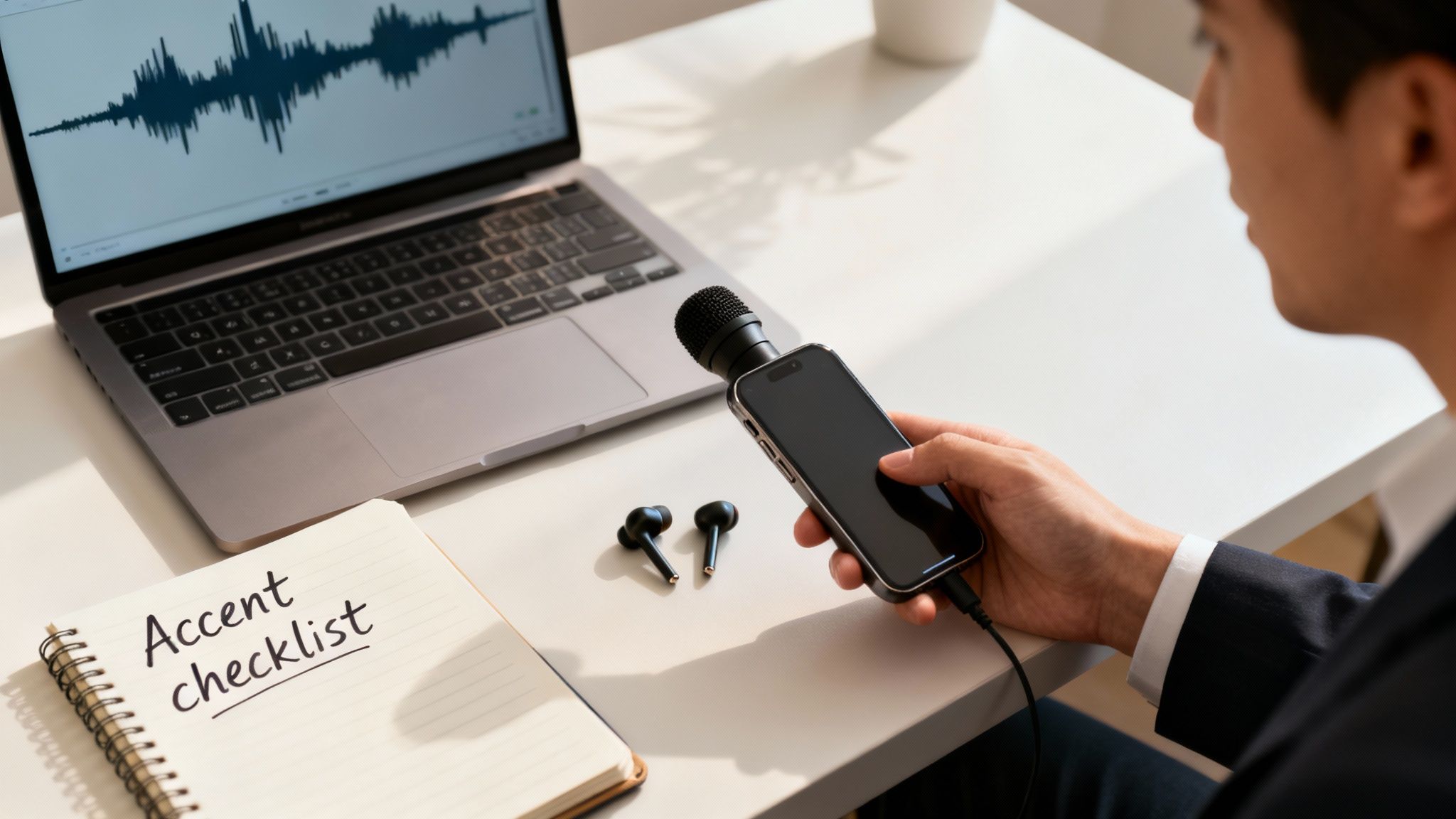
First things first, let’s create a raw sample of your current speech. You don’t need any fancy equipment for this; the voice memo app on your smartphone is perfect. The idea is to capture your natural speaking voice, not a rehearsed performance.
Find a quiet spot and record yourself talking for about 2-3 minutes. Here are a few ideas:
- Read a paragraph from a news article or a book.
- Describe your workday or talk about a recent project you managed.
- Answer a common question out loud, like “Tell me about yourself.”
Save this recording! It’s your “before” photo—a crucial benchmark you’ll come back to again and again. It gives you objective proof of your starting point, moving beyond just a feeling that you “have an accent.”
Analyzing Your Own Voice
Now, it’s time to listen back to your recording with a critical but kind ear. Don’t judge yourself; your goal here is to gather data. As you listen, jot down notes on a few key areas that are fundamental to sounding clear and natural in American English.
Look for patterns. Do you consistently struggle with the ‘R’ sound? Do your sentences sound a bit flat, where an American speaker’s would rise and fall with more variation? This is where a quick self-check can be incredibly revealing.
To help you get started, use this table. Record yourself reading a short passage, then listen back and make notes on what you hear.
Quick Self-Assessment Checklist for an American Accent
Use this table to record a short speech sample and identify areas for improvement in your pronunciation and speech patterns.
| Pronunciation Area | What to Listen For | My Current Habit (Notes) |
|---|---|---|
| Vowel Sounds | Are vowels clear and distinct (e.g., seat vs. sit, pool vs. pull)? | |
| Consonant Sounds | Are sounds like R, L, TH (as in think), and V clear? | |
| Word Stress | Is the right syllable emphasized (e.g., pro-JECT vs. PRO-ject)? | |
| Sentence Rhythm | Does my speech have a natural flow, or is it choppy/monotone? | |
| Linking Words | Do I connect words smoothly (e.g., “an apple” sounds like “anapple”)? |
After you’ve done this, you’ll have a much clearer idea of what to tackle first. For a more structured approach, a formal accent reduction assessment can provide a detailed breakdown of your specific pronunciation habits.
Key Takeaway: The goal of self-evaluation isn’t perfection; it’s identification. By isolating 3-5 specific sounds or patterns to work on first, you create manageable goals that lead to noticeable improvements in your professional communication.
Research shows there’s a critical window for acquiring a native-like accent, which tends to close around age 12 to 15. But don’t let that discourage you. While the age of arrival is a strong predictor, studies also reveal that many late learners achieve remarkable clarity with focused effort. This proves that significant progress is absolutely possible at any stage of life, and this initial diagnostic step is what makes that targeted practice so effective.
Mastering the Core Sounds of American English

Alright, you’ve done your self-assessment and now have a personalized map of your accent. This is where the real work begins. We’re going to target the specific sounds—the phonemes—that give American English its distinct character.
Instead of trying to fix everything at once (a recipe for frustration), we’ll focus on the highest-impact sounds that will give you the biggest bang for your buck in terms of clarity.
Think of it like an athlete running drills. This is all about targeted repetition to build new muscle memory in your mouth, making these new sounds feel natural over time. This approach gets you faster, more noticeable results than a scattered effort.
Tackling the American ‘R’ Sound
One of the most defining features of a General American accent is its rhoticity. That’s a fancy way of saying the ‘R’ sound is fully pronounced wherever you see it in a word. In many other English accents, the ‘r’ in a word like car gets softened or dropped. Not in American English.
Here’s the key: to make this sound correctly, the tip of your tongue shouldn’t touch the roof of your mouth. It actually pulls back and curls up slightly.
Drill for the Rhotic ‘R’:
- Initial ‘R’: Start with ‘R’ at the beginning of words. Really feel your tongue pulling back: run, right, red, really, report.
- Medial ‘R’: Now practice with ‘R’ in the middle: around, very, direct, sorry, parent.
- Final ‘R’: Finally, work on that defining final ‘R’: car, far, more, sure, over.
String them together into sentences to get a real-world feel: “Her report was very clear on the more important numbers.” Consistency is what we’re aiming for here.
Mastering the Flap ‘T’ Transformation
Another huge tell for a native American accent is the flap ‘T’ (or tapped ‘T’). This happens when a ‘t’ is sandwiched between two vowel sounds. Instead of a sharp, crisp ‘T’, it softens into a sound that’s very close to a light ‘D’.
It’s one of those subtle things that makes a massive difference. For instance, you’ll almost always hear a native speaker say “wadder” instead of “waTer.” “Little” becomes “liddle,” and “meeting” can sound a lot like “meeding.”
Actionable Tip: Start listening for the flap ‘T’ in movies, podcasts, and conversations. You’ll hear it everywhere—in words like city, beautiful, later, getting, and better. Just recognizing it is the first step toward producing it yourself.
To practice, say these phrases aloud and consciously soften that ‘T’:
- “A little bit of water” (a liddle bidda wadder)
- “Get a better editor” (gedda bedder edider)
This small shift makes your speech flow so much more naturally. It’s one of those tiny changes that has a surprisingly big impact.
Differentiating Tricky Vowel Pairs
Vowels can be tough because tiny shifts in your jaw and tongue create entirely different words. One of the most common mix-ups I see with my clients is the difference between the long “EE” sound and the short “I” sound.
Getting this wrong can completely change your meaning. You don’t want to tell a colleague you’ll “fill” the sheet when you mean you will “feel” the sheet.
Vowel Sound Comparison: ‘seat’ vs. ‘sit’
| Sound | Word Example | Mouth Position | Practice Phrase |
|---|---|---|---|
| Long EE | seat, leave, feel |
Your lips are spread wide, almost in a smile. Your tongue is high and forward. | Please leave these sheets on the seat. |
| Short I | sit, live, fill |
Your mouth is much more relaxed. Your jaw drops a bit, and your lips are neutral. | I will sit here and fill this in a bit. |
A great way to check yourself is to record your voice saying these phrases and listen back. For a deeper dive into all 44 English phonemes, you can check out our clear guide to vowels, consonants, and diphthongs. That’s a fantastic resource for understanding the full inventory of sounds you’ll eventually want to master.
By isolating and drilling these core sounds—the rhotic ‘R’, the flap ‘T’, and key vowels—you’re building a rock-solid foundation. Remember, this isn’t about erasing your identity. It’s about adding a powerful communication tool to your professional toolkit. Consistent, focused practice is the only way to get there.
Finding the Music in American English

Alright, you’ve started hammering out the individual sounds. That’s a great foundation. But now it’s time to zoom out and see the bigger picture. An American accent isn’t just a list of correct phonemes; it has a distinct melody.
This “music” comes from a unique combination of rhythm, stress, and intonation. Getting a feel for this cadence is what separates technically correct speech from speech that is genuinely clear and engaging. It’s the difference between just saying words and truly conveying meaning, whether you’re leading a team huddle or closing a major deal.
The Pulse of American English Rhythm
Here’s a concept that will fundamentally change how you approach your pronunciation: American English is a stress-timed language. This is a huge deal.
If your native language is syllable-timed, you might be used to giving each syllable a roughly equal beat, like a metronome. American English doesn’t work that way. Instead, we give more time and emphasis to the important words and basically rush through the less critical ones.
This creates a flowing, almost wave-like rhythm. The content words—nouns, main verbs, adjectives, adverbs—are the big, important beats that carry meaning. They get stretched out and stressed. The function words—articles, prepositions, conjunctions—are the little grammatical glue holding it all together, and they get reduced and spoken quickly.
That’s why “I need to go to the store to buy some milk” sounds natural, while a flat, evenly spaced “I-need-to-go-to-the-store-to-buy-some-milk” sounds robotic. The bolded words are the rhythmic anchors. You can dive deeper into this in our guide on rhythm and timing in American English.
Key Takeaway: Stop giving every word equal weight. Your new job is to identify the key content words in a sentence and give them the emphasis they deserve. Let the smaller grammatical words fade into the background. This single shift is the secret to sounding less stiff and more fluent.
Placing Stress Correctly in Sentences
Knowing which words to stress is half the battle. The other half is knowing how to stress them. In American English, a stressed syllable isn’t just louder. It’s also higher in pitch and held for just a fraction of a second longer.
Let’s use a real-world example you might hear in any office:
“We need to FINish the rePORT by FRIday.”
Listen for three things happening on those stressed syllables:
- Volume: They are slightly louder than their neighbors.
- Pitch: Your voice goes up on “FIN,” “PORT,” and “FRI.”
- Length: You linger on these syllables just a tiny bit longer.
This is something you have to practice. Record yourself saying a few simple sentences and play them back. Do you hear those subtle shifts in pitch and length, or does your speech sound flat? A monotonous delivery is a real killer in a professional setting—it can make you sound disinterested or unconfident, even when you’re not.
Using Intonation to Convey Meaning
Intonation is simply the rise and fall of your voice’s pitch across an entire sentence. It’s the secret sauce that adds emotion, context, and grammatical meaning. The exact same words can mean completely different things depending on the intonation pattern you use.
Two of the most fundamental patterns you need to master are falling and rising intonation.
- Falling Intonation: Your pitch drops on the final stressed word. This is your go-to for making statements, giving commands, and asking “wh-” questions (who, what, where, etc.). It signals confidence and finality.
- Example: “The presentation is at three.” (Your voice falls on “three.”)
- Rising Intonation: Your pitch goes up at the end of the sentence. This is typically for yes/no questions and can also convey surprise or uncertainty.
- Example: “Is the presentation at three?” (Your voice rises on “three.”)
Getting these patterns right is non-negotiable for being understood correctly. If you deliver a statement with rising intonation, your listener will probably think you’re asking a question, which can create unnecessary confusion.
Putting It All Together in Practice
The absolute best way to make this musicality second nature is through active listening and mimicry, a technique known as shadowing. This is where you turn your media consumption into a powerful practice tool.
Don’t just take my word for it. One study found that media exposure was a major factor for EFL learners acquiring a new accent. A whopping 46.7% of students credited movies for helping them pick up a General American accent, and another 26.2% said songs were the key.
For a busy professional, this means making your listening time more active. Instead of just passively consuming a podcast or news report, try this exercise:
- Grab a short audio clip. Find a 30-second snippet from a business podcast, a TED Talk, or a scene from a movie with clear dialogue.
- Listen for the beat. Play the clip and tap your finger on your desk every time you hear a stressed word. Just focus on feeling the rhythm.
- Shadow the speaker. Now, play the clip again and try to talk along with them. Your goal isn’t perfect pronunciation yet—it’s to match their rhythm, stress patterns, and intonation as closely as you can.
By doing these drills consistently, you’ll start to internalize the natural music of the American accent. Your speech will become more dynamic, far more engaging, and, most importantly, crystal clear to your audience.
Building a Consistent Accent Training Routine
Mastering the individual sounds and the overall “music” of the American accent is one thing. Making them an automatic, natural part of your everyday speech? That requires something far more important: consistency.
Real progress isn’t born from occasional, marathon practice sessions. It’s built brick-by-brick through small, repeatable actions that fit seamlessly into the life you already have.
For a busy professional, finding an extra hour in the day often feels impossible. That’s why we’re going to ditch the vague advice to “practice more.” Instead, let’s build a practical, sustainable blueprint that turns accent training from a chore into a powerful and effective habit.
The Power of Micro-Drills
The secret to a sustainable routine is the micro-drill. These are quick, hyper-focused exercises that last just 2-5 minutes each. Instead of feeling overwhelmed by a long list of sounds you need to work on, you just isolate one single element for a brief, intense burst of practice.
This approach lets you take advantage of the small pockets of time that already exist in your day. Your morning coffee break, your commute, or even the two minutes you spend waiting for a Zoom meeting to start can all become productive training moments.
Examples of Effective Micro-Drills:
- The Commute ‘R’ Drill: While driving or on the train, just repeat a list of ‘R’ words out loud: report, career, farther, order, return.
- The Coffee Break Flap ‘T’: As you wait for the coffee to brew, practice phrases with the flap ‘T’ sound: a little bit of water, it’s a matter of time, get a better idea.
- The Intonation Mirror: Before hopping on a call, look into a mirror (or your phone camera) and practice one sentence with falling intonation: “We need to finalize the budget.”
These quick hits prevent burnout and keep your goals feeling manageable. Over time, these small efforts compound into significant, lasting changes in your muscle memory and speech patterns.
Structuring Your Active and Passive Practice
A truly balanced routine involves both active, focused work and passive immersion. Think of it this way: active practice builds the skills, while passive immersion helps your brain internalize the natural flow and rhythm of the language without you even trying. To get this right, it helps to understand the proven strategies for developing a training curriculum which can help structure your plan.
Here’s how you can weave both into your week:
- Daily Active Practice (15-20 minutes): Block out a small slot each day for focused drills. This could be shadowing a short audio clip, drilling a specific vowel sound, or practicing word stress patterns.
- Daily Passive Immersion: Just fill the background noise of your life with American English. Listen to American podcasts, audiobooks, or news broadcasts during your commute or while you’re making dinner. Your brain will soak up the patterns even when you’re not paying close attention.
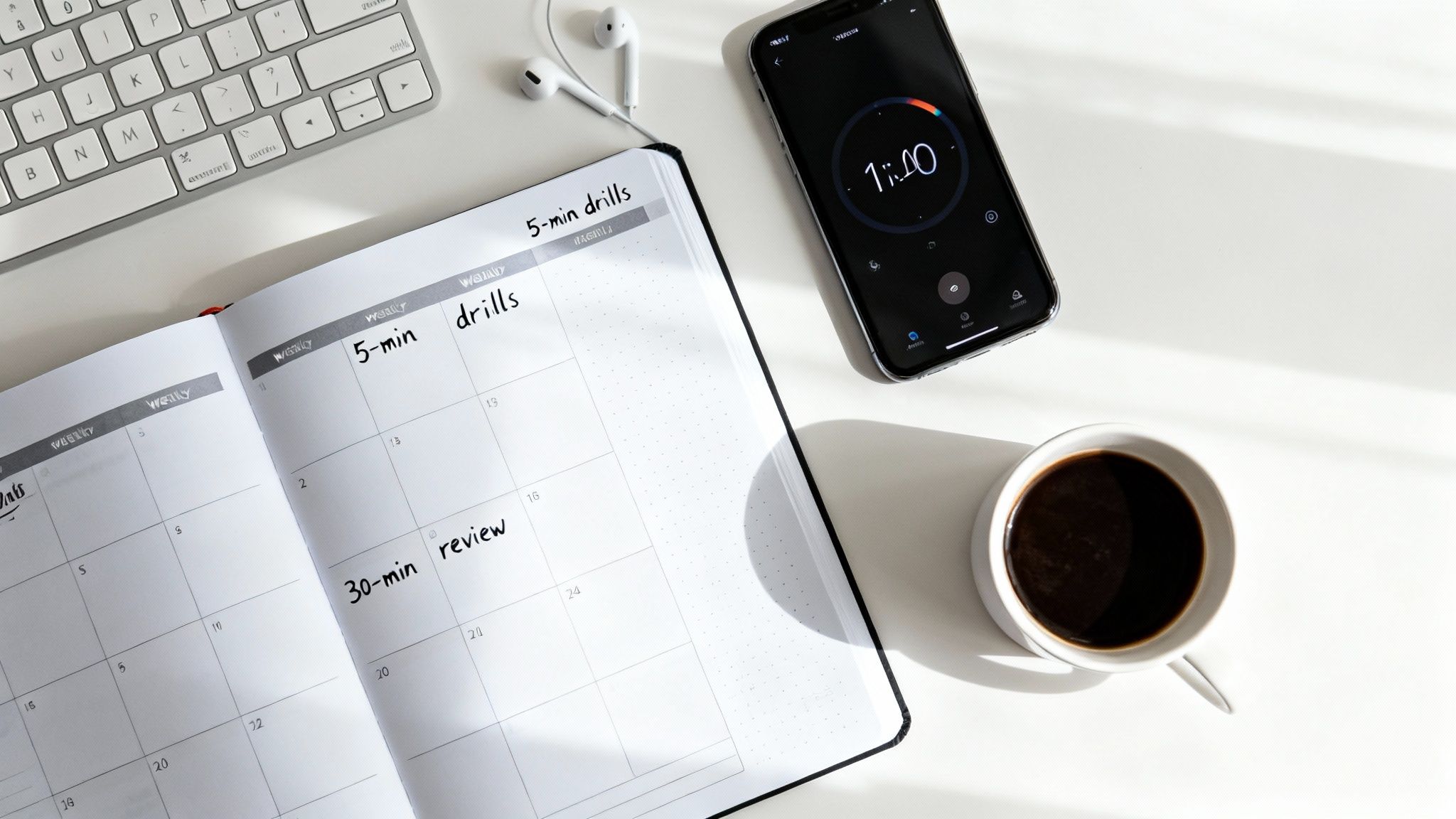
Weekly Check-In: Set aside 30 minutes once a week—maybe Sunday evening—to review your progress. Record yourself reading a short paragraph and compare it to last week’s recording. This accountability step is absolutely vital for tracking your progress and staying motivated.
Sample Weekly Schedule for Professionals
A structured plan takes the guesswork out of what you should be practicing each day. This sample schedule offers a balanced approach, mixing pronunciation drills with the more musical elements of speech. For some foundational advice, our article on how you can improve your English speaking skills is a great place to start.
Here’s a look at what a balanced week of training can look like for a professional.
Sample Weekly Accent Training Schedule for Professionals
A balanced weekly plan integrating focused drills and immersive learning to build and maintain an American accent.
| Day | Focus Area (15-20 mins) | Immersion Activity (Passive) |
|---|---|---|
| Mon | Rhotic ‘R’ sound drills | Listen to a business podcast |
| Tue | Shadowing a 1-min TED Talk clip | Watch an American TV series |
| Wed | Vowel pair practice (e.g., ‘sit’ vs. ‘seat’) | Listen to an American news broadcast |
| Thu | Sentence stress and intonation patterns | Listen to an American audiobook |
| Fri | Flap ‘T’ and word linking practice | Fun Friday: American pop music |
| Sat | Review challenging words from the week | Watch an American movie |
| Sun | 30-Min Review: Record, listen, and plan next week | Relaxed listening of choice |
This routine is designed to be flexible. If you miss a day, don’t sweat it—just pick up where you left off. The goal isn’t perfection; it’s consistent, forward momentum that will gradually and permanently transform how you speak.
Common Pitfalls to Avoid on Your Accent Journey
Embarking on an accent journey is exciting, but it’s surprisingly easy to get sidetracked by a few common mistakes. These are the little habits that can stall your progress, no matter how hard you practice.
Understanding these pitfalls from the start helps you sidestep a ton of frustration. It ensures your hard work actually translates into clear, natural-sounding speech. I’ve seen countless dedicated learners get stuck, not because they lacked commitment, but because they were accidentally reinforcing the wrong habits.
Pitfall 1: Over-Enunciating Every Single Word
One of the most frequent errors I see is over-enunciating. In an effort to be crystal clear, many professionals pronounce each word distinctly, almost like reading items from a list. The problem is, that’s just not how American English flows. Native speakers naturally link words together, creating a smooth, connected sound.
Think about it. A native speaker doesn’t say “What – are – you – up – to?” They blend it into something that sounds a lot more like “Whaddayaupto?” This isn’t sloppy speech; it’s a core feature called connected speech, and it’s essential for sounding natural.
Pitfall 2: Misplacing Word and Sentence Stress
Another major hurdle is getting the stress wrong. This happens on two levels: within a single word and across an entire sentence.
Placing emphasis on the wrong syllable can make a word completely unrecognizable. The classic example is the difference between “RE-cord” (the noun, as in a vinyl record) and “re-CORD” (the verb, as in to record a video). One small shift, completely different meaning.
This exact same principle applies to full sentences. American English is a “stress-timed” language, which means we emphasize key content words (like nouns and main verbs) while rushing through or “reducing” the function words (like prepositions and articles). Stressing the wrong words in a sentence can completely change your meaning or just make your speech sound robotic and unnatural.
Quick Practice Tip:
Put on a short news clip. But instead of listening for the words, listen for the beat.
- Which words are louder, longer, and higher in pitch?
- Which words seem to get rushed or almost swallowed?
- Try repeating a sentence, but only mimic the rhythm and stress you hear.
This little exercise starts retraining your ear to hear the music of the language, not just the individual notes. For a much deeper dive into this and other common issues, check out our complete guide covering 10 critical accent reduction mistakes that might be holding you back.
Key Insight: Clear American speech isn’t about the perfect, isolated pronunciation of every single sound. It’s about creating the right rhythm and flow by stressing the important words and linking the rest together smoothly.
Pitfall 3: Falling Back on Native Intonation
Finally, it’s incredibly common for learners to unconsciously apply the intonation patterns of their native language to English. For example, your first language might use a very flat tone to make a statement, or maybe a consistently rising tone for every question.
American English, however, uses a dynamic mix of rising and falling intonation to signal different meanings, emotions, and intentions.
A simple statement like “We’re meeting on Friday” should have a falling pitch at the end to sound confident and final. If you use a rising pitch, it will instantly sound like a question (“We’re meeting on Friday?”), which could create confusion for your listener.
As you work on your accent, remember that a polished delivery also means minimizing distractions. A great way to do this is to explore strategies to remove filler words from your speech. By actively steering clear of these common traps, your practice will become more focused and deliver much better results, much faster.
Your Questions About Learning an American Accent, Answered
As you get started, you’re bound to have questions. It’s only natural. Professionals I work with often ask about how long it takes, how effective the training really is, and what “success” actually looks like. I want to tackle those head-on to give you a clear, realistic picture of the journey ahead.
First, know that you’re on a well-trodden path. The U.S. has a long history of people adapting to new ways of speaking. In fact, between 1980 and 2010, an incredible 91.2% of immigrants reported speaking English—a huge jump from 86% in the early 20th century. This shows just how much modern resources and immersion can speed up the process. Fine-tuning your accent is the next logical step to really excel professionally. If you’re interested in the data, you can dig deeper into immigrant language trends in this immigration research policy brief.
Let’s get into the specifics of what this means for you.
How Long Does It Take to Get an American Accent?
This is the big one, and the honest answer is: it depends. There’s no magic timeline. Your progress is tied to your native language, how much time you put in, and—most importantly—your consistency.
But I can give you some realistic milestones. With steady, daily practice of about 15-20 minutes, most professionals feel a real boost in confidence and see noticeable improvements in their clarity within 8-12 weeks. This first phase is all about building the foundational muscle memory for new sounds and rhythms.
Getting to a highly proficient, natural-sounding accent is a longer game, often taking a year or more of focused work. But the immediate goal isn’t to sound like a completely different person overnight. It’s about making steady, measurable progress that makes your day-to-day communication easier and more effective, week by week.
Can I Completely Lose My Original Accent?
The goal here isn’t to erase your identity; it’s to enhance your clarity. Think of it less as replacing your accent and more as adding a new tool to your communication toolkit. Many people become experts at “code-switching”—they use a clearer, more American-sounding accent in professional settings and then relax into their native accent with family and friends.
Key Insight: Your accent is part of your story. The objective is to make sure it never becomes a barrier that stops you from being understood, respected, and heard for your great ideas in high-stakes professional moments. We’re aiming for clarity, not elimination.
This approach puts you in control, letting you adapt your speech to fit the situation. It’s about being understood the first time, every time, without feeling like you’ve had to give up a piece of yourself.
What Are the Best Tools for Practicing?
Beyond a structured program, a few simple tools can make a huge difference in your progress. Weaving these into your daily routine makes practice feel less like a chore and more like a natural habit, even when you’re swamped with work.
Here are a few essentials that professionals I’ve worked with find incredibly effective:
- A Smartphone Voice Recorder: This is your single most powerful tool. No question. Use it to record yourself, listen back for specific sounds, and actually hear your improvement over time. It’s your personal feedback loop.
- Speech-to-Text Apps: Tools like Google Docs voice typing or Otter.ai are fantastic for a quick pronunciation check. If the app consistently misunderstands a certain word you’re saying, that’s a flashing sign that you need to work on it.
- Podcasts and Audiobooks: This is your secret weapon for passive immersion. Listening to native speakers helps you internalize the rhythm, intonation, and flow of American English while you’re commuting, at the gym, or just doing chores. Stick to speakers with clear, standard accents, like news broadcasters or popular non-fiction narrators.
When you combine these tools with the focused drills from your program, you create a powerful practice routine that builds both conscious skill and a subconscious feel for the sounds of American English.
Ready to stop wondering and start improving? The Intonetic 12-week coaching program gives you a personalized roadmap, one-on-one expert guidance, and a proven system to achieve clear, confident communication. Book your free assessment today and see what’s possible.