How to Speak Professionally: Master Confident, Clear Communication
If you want to speak with authority, you have to get laser-focused on three core elements of clear communication: the specific sounds you produce, the rhythm and melody of your speech, and the language you choose.
Getting these three areas right is the fastest path to projecting confidence and ensuring your message isn't just heard, but fully understood and respected. It’s about moving beyond basic grammar and truly influencing the room.
Your Foundation for Confident Professional Communication
Speaking with authority isn't about erasing your accent or swallowing a dictionary. From my experience coaching hundreds of professionals, I can tell you it’s about building a solid foundation that lets your ideas shine through with absolute clarity.
Many non-native English speakers get stuck trying to perfect every single sound, but that's a slow, frustrating road. A much smarter strategy is to concentrate on the three pillars that listeners actually notice.
I call this framework the 'Clarity Triangle.' It simplifies the entire process by channeling your energy into what truly matters in a professional setting. Instead of feeling overwhelmed, you can build your skills methodically, which leads to much faster, more noticeable improvements in how you come across in meetings, presentations, and client calls.
The Clarity Triangle
These three components don’t work in isolation; they support each other to create a powerful, professional speaking style. Let's quickly break down what each one means for you.
- Sound: This is all about the precise articulation of consonants and vowels. Even small inaccuracies can cause momentary confusion, forcing your listener to work harder to keep up with you. Clear sounds are the bedrock of being understood.
- Rhythm: This is the music of your speech—the pattern of stressed and unstressed syllables that gives American English its signature flow. A natural rhythm makes you much easier to listen to and is one of the biggest signals of confidence.
- Language: This covers your vocabulary and phrasing. When you choose precise, authoritative words over vague or hesitant language, you instantly boost your professional presence and credibility. It’s the difference between sounding like an expert and sounding like you're second-guessing yourself.
Focusing on these three pillars gives you a reliable system for continuous improvement. The goal isn’t to become a different person; it’s about giving your unique professional voice the clarity and power it deserves.
Building on this foundation is key. Once you have a handle on these components, you can dig deeper into practical strategies for how to improve verbal communication skills and truly own the room in any professional setting.
To help visualize this, here’s a simple breakdown of how these pillars work together.
The Clarity Triangle: Your Core Components for Professional Speech
This table summarizes the three pillars for improving professional speaking skills, showing how each contributes to your overall clarity and confidence.
| Pillar | Focus Area | Impact on Professional Communication |
|---|---|---|
| Sound | Clear articulation of consonants and vowels. | Prevents misunderstanding and ensures your message is easily received without listener fatigue. |
| Rhythm | The natural flow, stress, and intonation of speech. | Makes you sound more confident, natural, and engaging, holding your audience's attention. |
| Language | Precise vocabulary and professional phrasing. | Builds credibility and authority, ensuring your ideas are perceived as valuable and well-considered. |
By mastering these three areas, you're not just learning to speak better English—you're learning to communicate with impact.
The goal is clear, authoritative communication that enhances, rather than erases, your unique professional voice. Think of this as your roadmap to not just being understood, but truly influencing your audience.
We also have a great article on how to build confidence while improving pronunciation that you might find helpful.
Pinpoint Your High-Impact Speech Patterns
Before you start any exercises, you need to play detective with your own speech. The goal here isn't to find every single tiny mistake—that's a fast track to feeling overwhelmed. A much smarter approach is to find the handful of patterns that, once fixed, will give you the biggest boost in clarity.
Forget trying to master all 44 sounds of English in one go. I’ve seen it time and time again with my clients: the real secret is focusing on the 10-12 highest-impact areas. This is what professional coaches do. It’s a targeted method that makes sure every minute you spend practicing is spent on what actually matters for professional communication.
To get started, you need some objective data. It’s almost impossible to hear your own speech patterns accurately in real-time. Recording yourself is the single most powerful diagnostic tool you have at your disposal.
Create Your Diagnostic Recording
You don’t need any fancy equipment for this; your smartphone will do just fine. The important part is to capture yourself speaking in a realistic professional scenario. Pick one of these:
- A mock presentation intro: Record yourself introducing a topic you know well for about one minute.
- A client introduction: Pretend you’re on a first call and introduce yourself and your company.
- A common meeting update: Briefly explain your progress on a current project.
Once that’s done, listen back with a critical but constructive ear. Don't judge yourself. Just observe. You're listening for recurring patterns in your pronunciation, rhythm, and even your word choice. This process helps you see how your speech flows through the core components of sound, rhythm, and language.
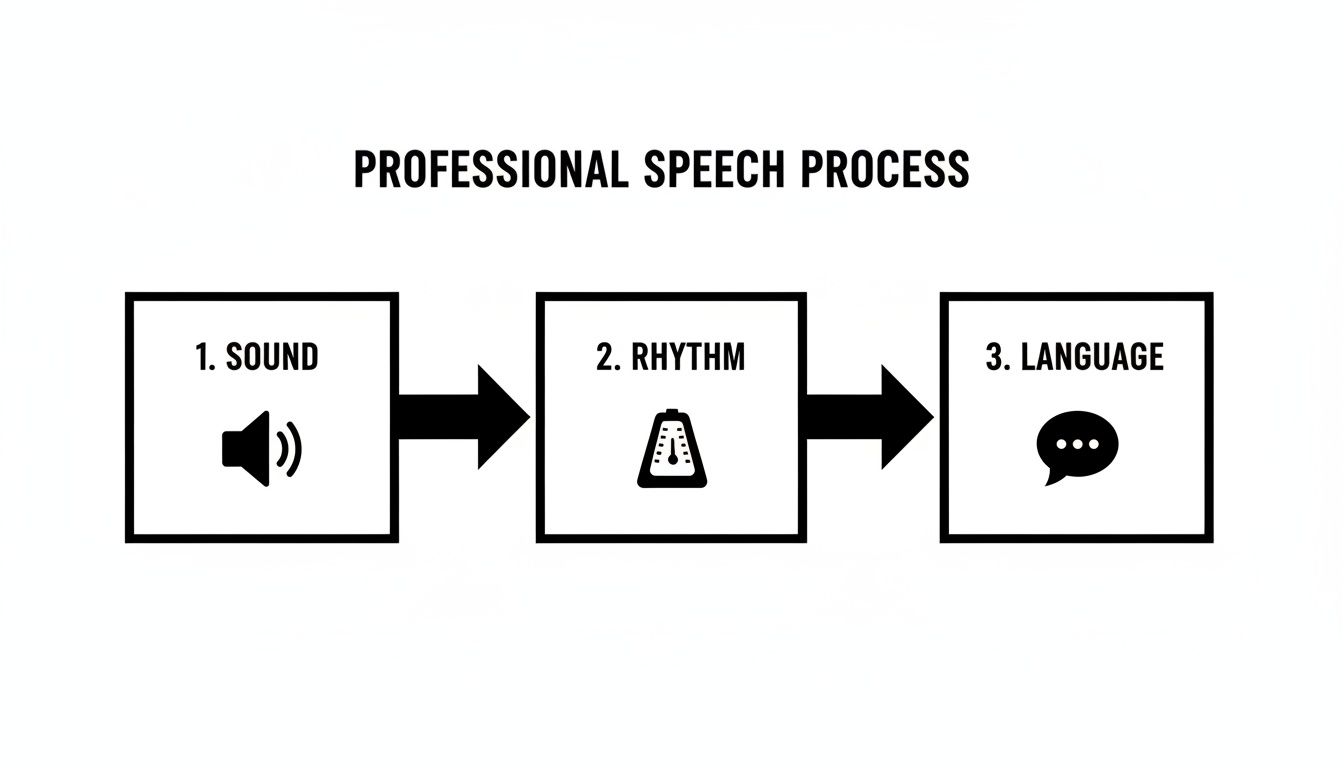
This simple flow chart really captures it. Mastering professional speech isn't just about one thing; it’s a holistic process where clear sounds are carried by a confident rhythm and backed up by precise language.
What to Listen For
As you analyze your recording, be specific. You’re not aiming for perfection. You're looking for recurring habits that might be getting in the way of your message.
Sound & Pronunciation:
- Are there specific consonant sounds you tend to drop, like the 't' at the end of "project" or the 's' on plurals?
- Do certain vowel sounds trip you up? Think about the classic difference between "ship" and "sheep," or "sit" and "seat."
- Do you notice any patterns, like swapping 'v' and 'w' sounds?
Rhythm & Intonation:
- Does your speech sound a bit choppy or flat? A monotone delivery can make even the most exciting ideas fall flat.
- Are you stressing key words to guide your listener's attention, or is every word getting the same amount of emphasis? You can learn more about how to use stressed and unstressed syllables to create a more natural rhythm.
- Does your pitch go up at the end of statements, making them sound like questions? This is a really common habit that can unintentionally undermine your authority.
This self-assessment is so important because effective verbal communication is now the single most sought-after skill by employers. In today's global business world, a staggering 54% of global recruiters rank it highest. This shows just how much learning to speak professionally can directly impact your career, especially if you're a non-native English speaker in a competitive field.
By pinpointing your specific high-impact areas, you move from generic practice to a surgical, results-driven approach. You stop wasting time on things that don’t matter and start building the habits that get you heard and respected.
This diagnostic step isn't about being hard on yourself. It's about gathering the intelligence you need to build a smart, targeted improvement plan—one that will help you get your point across clearly, the first time, every time.
Master the Music of American English
Once you've started to get a handle on your specific pronunciation challenges, it's time to zoom out. We need to shift from focusing on individual sounds to seeing the bigger picture: the melody of your speech.
Think of it this way: if clear sounds are the individual notes, then rhythm, stress, and intonation are the music that turns those notes into a compelling song. In my experience, how you say something is often more powerful than what you say. Mastering this "music" is the real secret to sounding confident and authoritative.
American English is a stress-timed language. This just means that we emphasize certain words in a sentence, while others are spoken more quickly and with less force. It's what creates the natural, rhythmic flow that native speakers are subconsciously listening for. When that rhythm isn't there, speech can sound flat, robotic, or just difficult to follow—even if every single word is pronounced perfectly.
Getting this melodic quality right is a game-changer for anyone learning how to speak professionally. It’s what turns a hesitant statement into a decisive one and makes sure your most important points land with the impact they deserve.
The Power of Sentence Stress
Sentence stress is the engine that drives professional communication. It’s how you guide your listener's attention to the most critical information you're sharing. By punching key words—typically nouns, verbs, adjectives, and adverbs—you make your message instantly clearer and far more dynamic.
Take this simple update you might give in a team meeting:
- Without stress: "I finished the report this morning and sent it to the client."
- With stress: "I finished the report this morning and sent it to the client."
The second version immediately screams completion and action. The emphasis on "finished," "morning," "sent," and "client" tells your team the most vital parts of the message without you needing to add a single extra word. This is an incredibly powerful tool when you're presenting data or making a business case.
Key Takeaway: Think of stressed words as the peaks of your sentences; they carry the core meaning. The unstressed words are the valleys that connect those peaks smoothly. Mastering this up-and-down rhythm is fundamental to sounding natural and engaging.
Developing this skill isn't just some technical exercise; it's a strategic move that directly impacts your career. Communication consistently ranks as the top skill employers look for, with 70% of employers prioritizing it above all else. This isn't surprising when you see that 51% of global employers say it's vital for business performance. Oral skills are especially critical, with over 80% of business students calling them 'very important' after they enter the workforce.
Harnessing Intonation for Authority
Intonation is simply the rise and fall of your voice's pitch, and it's what injects emotional and grammatical meaning into your words. The right intonation can signal confidence, curiosity, or finality. One of the most common traps for non-native speakers is using a rising intonation at the end of a statement, which instantly makes a definitive point sound like a tentative question.
Falling Intonation (The Voice of Authority):
This should be your default for making statements, giving instructions, and answering questions. A downward slide in pitch at the end of a sentence signals that you're confident and that you've finished your thought.
- Example: "We need to finalize the budget by Friday." (Your pitch should drop on "Friday.")
Rising Intonation (The Voice of Inquiry):
This is mainly for yes/no questions or to show surprise or uncertainty. If you use it on a statement, you risk undermining your own credibility.
- Example: "We need to finalize the budget by Friday?" (That rising pitch makes it sound like you're asking for permission or are totally unsure.)
By consciously using a falling tone for your key statements, you project an image of decisiveness and control. You can dive deeper into how this works in our guide on rhythm and timing in American English.
Practical Drills to Find Your Rhythm
Theory is one thing, but building muscle memory is what really counts. Here are two simple drills you can start today to help internalize the music of American English.
- The "Key Word" Drill: Grab a sentence from a recent work email or report. First, identify the key content words (the main nouns, verbs, and adjectives). Now, read the sentence out loud, tapping your finger on the desk for each of those stressed words. Really exaggerate the stress at first to get a feel for the rhythm.
- The "Listen and Echo" Drill: Find a short audio or video clip of a professional speaker you admire—a TED Talk is perfect for this. Listen to just one sentence at a time, paying close attention to the speaker's melody. Pause the video and immediately repeat the sentence, trying to mimic their exact rhythm and intonation.
Consistent practice with these patterns will gradually shift you away from a word-by-word delivery and toward the persuasive, natural cadence of a respected professional. It’s the final piece of the puzzle in learning how to speak professionally with genuine impact.
Choosing Words That Convey Authority
While the music of your speech—your rhythm and intonation—is what signals confidence, the words you choose are what actually build your credibility. The right vocabulary can instantly elevate your professional presence, making you sound as strategic and insightful as you truly are.
This isn't about memorizing a list of complicated words to sound smart. It’s about being intentional with your language to project authority and clarity in every interaction, whether you're in a high-stakes negotiation, a team meeting, or a client presentation.

From Hesitant to Authoritative Phrasing
One of the fastest ways to undermine your own authority is by using weak, qualifying language. Phrases like "I think," "I feel," or "maybe we could" immediately create an impression of uncertainty. Swapping these out for more direct, data-driven alternatives is a simple but incredibly powerful shift.
Just look at the difference here:
- Hesitant: "I think we should probably focus on the Asian market next quarter."
- Authoritative: "My analysis indicates the Asian market presents the most significant growth opportunity next quarter."
See how the second statement isn't just stronger? It implies you’ve done your homework. It frames your suggestion as a strategic conclusion backed by evidence, not just a passing thought.
Pro Tip: Whenever possible, frame your contributions around data, analysis, or observation. This shifts the focus from your personal opinion to objective facts, which naturally carries more weight in a professional setting.
Language for Navigating Difficult Conversations
Knowing how to speak professionally is never more critical than during those tough conversations. You need language that lets you be firm and clear while still maintaining a respectful, collaborative tone.
Here are a few common scenarios and some powerful phrases you can use:
Politely Disagreeing:
- Instead of: "I don't think that's right."
- Try: "I see it a bit differently. From my perspective…" or "That's a valid point, but have we considered…"
Summarizing Complex Ideas:
- Instead of: "So, basically…"
- Try: "To distill this down, the key takeaways are…" or "In essence, the core issue is…"
Delegating Tasks Effectively:
- Instead of: "Can you get this done?"
- Try: "I’d like you to take the lead on this. The priority is to [achieve a specific outcome] by [deadline]."
These phrases don't just sound more professional; they actively shape the conversation and guide it toward a productive outcome. They show you're in control and have thought things through.
Avoiding Common Language Traps
As a non-native English speaker, certain language habits can creep in that unintentionally create confusion or water down your professional image. Just being aware of these common traps is the first step to avoiding them.
Here are two big ones to watch out for:
- Overusing Idioms: Idioms can make speech more colorful, but they are often culturally specific and don't always land well. A phrase like "let's hit a home run on this project" might be perfectly clear in an American office but could easily confuse a global team. When in doubt, always go for direct, universally understood language.
- Diminishing Your Own Ideas: Stop using phrases like "This is just an idea, but…" or "I'm not an expert, but…" They immediately discount whatever you're about to say. Cut them out. Present your ideas with conviction, even if you’re inviting discussion. State your point clearly, then ask, "What are your thoughts on this approach?"
Mastering this level of communication is a critical step in positioning yourself as an expert. After all, professional speaking is about building influence and credibility. If you're ready to take that to the next level, learn how to become a thought leader and build real influence through your communication. Your words are a direct reflection of your thinking, so make every single one of them count.
Build a Sustainable Practice Routine That Works
Knowing what to practice is only half the battle. Real, lasting improvement in your professional speaking comes from consistent, deliberate practice that actually fits into your life—not from cramming the night before a big presentation. The key is to build a realistic blueprint that integrates this work into your existing schedule.
This means finding moments you already have and putting them to work. Your daily commute, for example, is a perfect slot for high-repetition drills. Instead of just zoning out to a podcast, you could be running through targeted sound work, repeating key phrases, or practicing intonation patterns with an audio exercise.

Weave Practice into Your Workflow
The most effective practice doesn’t feel like another chore. It feels like a natural part of your professional preparation. It’s all about being strategic and turning everyday work activities into chances to level up your speech.
Here are a few ways I've seen clients do this successfully:
- Meeting Prep as Practice: Before a team meeting, don't just skim your notes. Actually read your key talking points out loud several times. This simple shift transforms a basic prep task into a focused rehearsal for clarity and delivery.
- Weekly Voice Check-ins: Carve out just five minutes once a week. Record yourself giving a quick summary of a project update. This creates a consistent feedback loop, letting you track your progress and spot recurring habits without a huge time commitment.
- AI-Powered Sound Work: Modern tools are a game-changer. There are plenty of apps that give you instant feedback on your pronunciation of specific sounds. What used to require a coach can now be a quick, targeted solo drill.
When you integrate practice this way, it becomes immediately relevant to your job. The vocabulary you're drilling is the same vocabulary you’ll use on your next client call, making the transfer of skills seamless and impactful. We cover more of these methods in our detailed guide on how to improve your English speaking skills.
Customize Drills for Your Industry
Generic practice materials will only get you so far. To truly sound like an authority in your field, you have to practice with the language you use every single day. Whether you're in finance, tech, or healthcare, customizing your drills is non-negotiable.
Start by creating your own high-repetition lists using industry-specific terms.
| Industry | Sample Drill Phrases |
|---|---|
| Finance | "Quarterly earnings report," "strategic asset allocation," "risk mitigation framework." |
| Tech | "Scalable cloud architecture," "agile development sprint," "API integration." |
| Healthcare | "Differential diagnosis," "evidence-based practice," "patient-centered care." |
Repeating these phrases builds the muscle memory for the specific sound combinations and rhythms that signal credibility in your profession. It’s how you ensure you can talk about your expertise with total fluency and confidence.
The cost of miscommunication is staggering. It’s not just frustrating; poor communication kills productivity, with the average worker wasting 3.2 hours per week trying to understand unclear messages. In diverse teams, where 62% of corporate employees work with colleagues from three or more cultures, clarity isn’t just nice to have—it’s essential. The data is clear: better communication skills could boost overall team productivity by as much as 30%.
The goal is to make practice so seamless that it becomes an automatic part of your professional life. This isn’t about adding more to your plate; it’s about making your existing efforts work harder for your speech development.
For professionals who want to improve their accent and clarity without committing to one-on-one coaching, Intonetic now offers 2 self-paced programs as a monthly subscription called Intonetic Accent Studio, priced at $7 per month and $27 per month. The difference is that the $27 per month program includes personalized feedback on your progress. These programs are designed for learners who want to improve their accent and clarity on their own schedule. You can learn more about these flexible American accent training programs on our website. It’s a structured yet independent path to building that sustainable routine.
Got Questions About Your Professional Speaking Journey?
Even with the best game plan, working on how you speak professionally can bring up a lot of questions. It’s totally normal. In fact, knowing you’re not the only one wrestling with these challenges is a huge part of staying motivated. This is where we tackle the most common questions I hear from professionals just like you.
My goal here is to give you clear, practical answers that cut through the noise. Think of this as your go-to spot for overcoming those common roadblocks and keeping your momentum strong.
How Long Until I Actually Hear a Difference?
This is, without a doubt, the number one question I get asked. The honest answer is: it varies, but probably not as much as you think. Most professionals tell me they feel a real shift in their confidence and clarity within 8 to 12 weeks of consistent, focused practice. We’re not talking hours a day, either—even 15-20 minutes daily makes a huge impact.
The first things you’ll likely notice are improvements in your rhythm and intonation. These “musical” aspects of English tend to click into place faster than the super-precise muscle movements for tricky sounds. For those changes to become second nature, where you don’t even have to think about them, you’re typically looking at 3 to 6 months of steady work.
The real secret? Steady, targeted practice beats long, infrequent cram sessions every single time. Consistency is what builds the new muscle memory you need to speak clearly and confidently without conscious effort.
What Should I Focus on First for the Biggest Impact?
If you want the biggest bang for your buck right out of the gate, zero in on rhythm and intonation. While it’s tempting to obsess over a tricky vowel sound, mastering the overall flow and “music” of American English will make you sound more natural and authoritative much, much faster.
American English is a stress-timed language, which is just a fancy way of saying its musicality is key. Nailing a few core elements will give you immediate results:
- Sentence Stress: Learn to punch the important words in your sentences (usually the nouns, verbs, and adjectives). This one change instantly makes you easier to follow and sound more dynamic.
- Falling Intonation: End your statements with a confident, downward tone. It’s a subtle shift, but it signals finality and authority, completely changing how your ideas land in a meeting.
Building this melodic foundation first makes all your later work on individual sounds that much more effective.
How Do I Stop Sounding So Nervous?
First off, getting nervous is completely normal, especially when the stakes are high. The key isn’t to eliminate nerves but to manage them so they don’t hijack your delivery. Confidence isn’t just a feeling; it’s a skill you build with preparation and technique.
My go-to strategy involves a few simple steps. First, prepare your key talking points. Never, ever try to “wing it” when you’re under pressure. Knowing exactly what you want to say frees up your brain to focus on how you’re saying it.
Second, right before you speak, take one slow, deep breath. It’s a cliché for a reason—it works. This simple action calms your nervous system and slows your heart rate.
Third, make a conscious choice to speak a little slower than your normal pace. When we get nervous, our speech speeds up, which can make us sound uncertain and is harder for others to follow. Slowing down projects control and calm.
And finally, shift your mental focus away from your accent and onto the value of your message. When you truly believe in what you’re sharing and are focused on helping your audience, that conviction naturally bleeds into your voice. For more tips on this, check out some of the other frequently asked questions about accent training.
Is the Goal to Completely Lose My Accent?
Absolutely not. Let’s get this straight right now: the goal is clarity, not conformity. Your accent is a part of who you are, your history, and your identity. The purpose of this work is never to erase that.
Instead, we focus on modifying only the specific, targeted elements of your speech that might be getting in the way of your message being understood effortlessly. Think of it as accent modification for clarity, not “accent reduction.”
You can be an incredibly clear, powerful, and respected speaker while still retaining the unique character of your voice. The whole point is to make sure your brilliant ideas are heard and understood the first time, every time, without changing who you are.
For a structured and self-paced way to improve, explore our Intonetic American Accent Training programs.