How to Speak Confidently and Clearly in Any Situation

Speaking with real confidence isn't about "faking it till you make it." It's a physical skill, built from the ground up on breath control and vocal projection. If you want to make an immediate, noticeable change in how you sound, mastering two core exercises is the most powerful first step you can take.
We'll focus on Diaphragmatic Breathing to stop a shaky voice and Vocal Projection Drills to make sure you're always heard. Get these right, and you'll build an unshakable presence in any professional setting.
Build Your Foundation for Confident Speech
Let's clear up a common myth right away: true speaking confidence is a skill you build, not a talent you're born with. Far too many professionals, especially non-native speakers, get stuck believing they just aren't "natural" speakers.
That belief is what holds people back. In reality, the confidence you hear in others is the audible result of physical control. It all starts with your breath—the engine that powers your voice.
Imagine you're in a critical meeting, presenting an update. Your ideas are solid, but your voice comes out quiet or shaky. Your point gets lost in the delivery. This isn't a failure of intellect; it's a breakdown in the physical mechanics of speech. By mastering the fundamentals, you gain immediate control over how you sound and, just as importantly, how you feel.

The Power of Breath and Projection
Your journey to speaking confidently really begins with two pillars: solid breath support and effective vocal projection. They're completely interconnected. You simply can't have powerful projection without a steady, deep supply of air.
Here's what that means in practice:
- Diaphragmatic Breathing: Often called "belly breathing," this is the secret to a stable, grounded voice. It's about engaging your diaphragm muscle to manage your airflow, which prevents the shallow chest breathing that makes your voice sound weak or tremble when you're anxious.
- Vocal Projection: This is not about shouting. It's about using that controlled breath to carry your voice to the back of the room without straining. Proper projection makes you sound authoritative and ensures your message lands clearly.
Your First Steps to Vocal Confidence
To get started, let's focus on a couple of simple, repeatable exercises designed to build muscle memory. Remember, consistency beats intensity every time. A few dedicated minutes each day will do far more for you than one long session per week.
Here are the two foundational techniques I start all my clients with.
| Technique | Core Benefit | Quick-Start Exercise |
|---|---|---|
| Diaphragmatic Breathing | Calms nerves and eliminates a shaky, weak voice by providing a stable air supply. | Lie on your back with one hand on your chest and one on your stomach. Breathe in slowly through your nose, focusing on making your stomach rise while your chest stays still. Exhale slowly through your mouth. Repeat for 2 minutes. |
| Vocal Projection Drills | Ensures your voice is heard clearly and sounds authoritative without straining. | Stand tall and take a deep diaphragmatic breath. On the exhale, produce a sustained "ahhh" sound, aiming to make it smooth and even. Imagine sending the sound to a point across the room. Practice at different volumes. |
These drills train the physical systems that support your voice, giving you a reliable foundation to build on.
“The audience is on your side; they want you to do well in your presentation. Remember the talks you’ve attended… You would have regarded the speaker as just a person talking, with no reason to be nervous. You’re in their position now.”
This shift in perspective is incredibly helpful. While many workplace communication stats focus on nonverbal cues, for non-native speakers, mastering the audible elements—intonation, stress, and rhythm—is the absolute key to being understood and projecting authority.
Leaders aiming to refine their delivery even further often turn to executive communication skills training for advanced strategies. But the work starts right here, with your physical delivery. For more guidance, check out our guide on how to build confidence while improving pronunciation: https://intonetic.com/how-to-build-confidence-while-improving-pronunciation/
Achieve Crystal-Clear Articulation
Once you’ve got a solid, steady stream of air powering your voice, the next piece of the puzzle is shaping that air into clear, crisp sounds. This is articulation—the physical work your tongue, lips, and jaw do to form words. For many of my clients, mastering articulation is the single biggest leap they make toward being understood easily and consistently.
Let’s be honest: being understood is non-negotiable if you want to speak with real confidence. If you’re constantly second-guessing whether people are catching your words, your focus splits. Instead of thinking about your message, you’re worrying about your delivery, and that’s a quick way to kill your confidence. The goal here isn’t to erase your accent but to refine it, making sure every word you say lands exactly as you intend it to.

A Smarter Way to Tackle Pronunciation
The idea of mastering all 44 sounds of American English can feel completely overwhelming. But here’s the good news: you don’t have to. A far more effective strategy is to pinpoint the small handful of sounds that create the biggest communication gaps for speakers from your specific language background.
This is all about focusing on high-impact phonemes—those specific sounds that, when mispronounced, are most likely to cause confusion. In my experience, most learners can see a dramatic boost in their overall clarity by focusing on just 10-12 of these priority sounds. It’s about working smarter, not harder.
Figuring Out Your Priority Sounds
So, how do you know which sounds are your priority sounds? A good starting point is to notice which words people tend to ask you to repeat. Some common culprits for non-native speakers include:
- The “TH” sounds: Both the voiced /ð/ in “this” and the unvoiced /θ/ in “think” are rare in many languages and require very specific tongue placement.
- Vowel distinctions: Telling the difference between short and long vowels—like the sounds in “ship” vs. “sheep” or “sit” vs. “seat”—is absolutely critical for meaning.
- The American “R”: This sound is a real workout for the tongue and is formed very differently from the “R” in most other languages. Getting it right can make a huge difference.
- Consonants like “L” and “W”: Depending on your native language, these can also be tricky and lead to misunderstandings.
By channeling your energy into the few sounds that will give you the biggest bang for your buck, you build momentum and, just as importantly, you build confidence.
Practical Drills for Sharper Speech
Once you have a few target sounds, you need to build new muscle memory through targeted exercises. The secret is consistent, focused repetition. Here are a couple of powerful techniques to get you started.
1. Minimal Pair Drills
Minimal pairs are two words that are identical except for one single sound, like “ship” and “sheep.” Practicing these pairs is like weightlifting for your mouth and ears—it trains you to hear the subtle differences and teaches your mouth how to produce them on command.
- Example Drill (for “i” vs. “ee”): Say “ship… sheep” out loud. Really pay attention to what your mouth and tongue are doing for each word. Then, record yourself and listen back. Can you clearly hear the difference?
2. Targeted Tongue Twisters
Tongue twisters aren’t just for kids; they are high-repetition workouts. The key is to use twisters that specifically feature your priority sounds, not just random ones.
- Example Drill (for the “TH” sound): Try this one: “They thankfully think this thing through.” Start slowly, really exaggerating the tongue movement for every “th” sound. As it gets easier, you can start picking up the pace.
By isolating and drilling these specific mechanics of speech, you’re not just improving pronunciation; you’re building a reliable system for clear communication. This reliability is the bedrock of genuine speaking confidence.
If you’re looking for a more structured way to build clarity at your own pace, our Intonetic Accent Studio programs are designed for exactly that. They’re perfect if you want to improve your accent without the scheduling commitment of one-on-one coaching. You can learn more about how to enunciate better and apply these techniques in a guided format.
We offer two straightforward monthly subscription options:
- Intonetic Accent Studio ($7/month): This gives you full access to all our self-paced programs—ideal for independent learners.
- Intonetic Accent Studio+ ($27/month): You get everything in the base plan, plus personalized feedback from an expert coach to make sure you’re on the right track.
Having this kind of framework can provide the structure and accountability you need to turn your practice into consistently clear and confident speech.
Master the Music of American English

Speaking confidently is about so much more than just getting the words right. It’s about making them land with genuine impact. This is where we go beyond the mechanics of pronunciation and tap into the real ‘music’ of American English—its unique intonation, stress, and rhythm.
Think of it this way: articulation gives your words clarity, but musicality gives them meaning and emotion. It’s the critical difference between a speaker who is merely understood and one who is truly influential.
Mastering these melodic patterns is how you project authority, invite collaboration, and guide your listener’s attention exactly where you want it.
Using Intonation to Shape Meaning
Intonation is the rise and fall of your voice’s pitch when you speak, and honestly, it’s one of the most powerful tools in your communication kit. A slight change in pitch can completely flip the meaning of a sentence in American English.
For example, a falling intonation at the end of a statement signals finality and authority. It sounds like a decision has been made. A rising intonation, on the other hand, often signals a question or invites others to weigh in, creating a much more collaborative feel.
- Falling Intonation (Authority): “We need to finalize this report by Friday.↓” The downward pitch here isn’t a suggestion; it’s a clear directive.
- Rising Intonation (Collaboration): “What if we finalized this report by Friday?↑” That little upward tick at the end turns it into an idea, seeking agreement.
The Strategic Power of Word Stress
In any given sentence, some words carry more weight than others. Word stress is the art of emphasizing those key words to make sure the most critical information stands out. I’ve seen this skill make or break high-stakes negotiations and presentations.
By strategically stressing different words, you can change the entire focus of a sentence without altering a single word. It’s how you control the narrative and ensure your main point is impossible to miss.
Take this simple sentence and see how the meaning shifts completely based on what you stress:
- “I didn’t say he stole the money.” (Someone else said it, not me.)
- “I didn’t say he stole the money.” (I might have implied it, but I didn’t say it.)
- “I didn’t say he stole the money.” (It was someone else, not him.)
- “I didn’t say he stole the money.” (He stole something else entirely.)
This subtle shift is a cornerstone of confident, persuasive speech.
The ability to modulate your voice through intonation and stress isn’t just a “nice-to-have” skill. In my experience, it directly influences how people perceive your competence and leadership potential in the workplace.
Imagine stepping into a high-stakes meeting, your ideas solid but your voice faltering because you’re worried about your accent. It’s a scenario I’ve seen far too many talented professionals face. The link between how you speak and how you succeed is real. One analysis even showed that countries with higher English proficiency tend to have stronger economic growth, which just underscores the value of clear communication.
Develop the Mindset of a Confident Speaker
You can practice every vocal technique in the book, drill every sound, and perfect your breathing, but the biggest battle is often the one fought between your ears. Technical skill gives you control, but a resilient mindset is what lets you actually use that control when the pressure is on.
For many professionals I work with, especially non-native speakers, the final barriers to true confidence aren’t technical. They’re psychological hurdles like fear of judgment or deep-seated anxiety about their accent.
The good news? Your mindset is a skill you can train, just like your voice. It all starts with a simple realization: confidence isn’t the absence of fear. It’s the ability to perform effectively right alongside it.
Reframe Nervousness as Excitement
Think about it. A racing heart, butterflies in your stomach, faster breathing—are you anxious or are you excited? The physical symptoms are nearly identical. Your brain just slaps a label on them based on the story you tell it.
When you catch yourself thinking, “I’m so nervous,” you’re feeding a narrative of fear and threat. It’s a self-fulfilling prophecy.
Instead, you have to consciously reframe it. The next time you feel those pre-presentation jitters, tell yourself out loud, “I’m excited to share my ideas.” This isn’t just fluffy positive thinking; it’s a proven psychological trick. This simple language shift can nudge your brain into interpreting that adrenaline rush as readiness and enthusiasm, not panic.
The energy is the same. You’re just changing the story.
Address Impostor Syndrome Head-On
For non-native speakers, impostor syndrome often latches onto their accent. It whispers that nagging, corrosive thought: “They won’t take me seriously because of how I sound.” This self-doubt can be paralyzing, causing you to hesitate or soften your delivery right when you need to be most assertive.
To truly speak with conviction, you have to tackle these internal barriers. For a deeper dive, there are some great strategies for overcoming imposter syndrome and building lasting confidence.
The key is to mentally separate your accent from your expertise. Your accent is a part of your story and your identity. Your knowledge, your insights, your experience—that’s the value you bring to the room. Remind yourself that you were hired for your skills and unique perspective, not for a particular sound. For more practical advice on this, check out our guide on how to overcome accent anxiety and speak fearlessly.
Use Visualization and Pre-Performance Routines
Top athletes and performers don’t just stumble onto the field or the stage. They have specific routines that get them into a peak state. You can, and should, do the same before any important meeting or presentation. This isn’t about complex rituals; it’s about creating a quick, powerful moment of calm and focus.
Confidence comes from embracing discomfort—not avoiding it. Every great public speaker has felt nervous at some point. It’s not about eliminating that feeling but learning how to move through it.
Your pre-performance routine can be incredibly simple and take just a few minutes:
- Two Minutes of Grounding: Find a quiet space (even a bathroom stall works). Stand tall, plant your feet firmly, and take five slow, deep diaphragmatic breaths. Feel your feet on the floor. This is a powerful way to calm your nervous system.
- Mental Rehearsal: Close your eyes and visualize the presentation going exactly as you want. Don’t just think about it; see it. See yourself speaking clearly, making your key points with impact, and feeling in command. Imagine the positive outcome—the nods of agreement, the successful Q&A.
This combination of physical grounding and mental preparation centers you. It helps you walk into the room feeling proactive and prepared, rather than anxious and reactive.
Put Your Skills Into Practice With Intonetic
Knowing how to speak confidently is one thing. Doing it consistently under pressure is another beast entirely. We’ve covered the core pillars—breathing, articulation, rhythm, and mindset. But turning theory into a reliable skill requires one thing above all else: consistent, focused practice.
Let’s be honest, theory alone doesn’t build confidence when you’re in a high-stakes meeting or giving a critical presentation. If you’re ready to move from understanding the concepts to truly owning them, the next logical step is a structured environment designed to build the right habits.
This is exactly why we created the Intonetic Accent Studio. It’s a self-paced, systematic path for professionals who want a proven framework without the scheduling headache of one-on-one coaching.
Choose Your Path to Confident Speech
We know that every professional has different needs and learning styles. That’s why we offer the Intonetic Accent Studio through two simple and flexible monthly subscription plans. Both are designed to help you sharpen your accent and clarity on your own time.
The core idea is to give you an accessible, effective way to apply everything we’ve talked about in this guide. You get the exercises, the structure, and the tools to turn your daily practice into real, measurable progress.
As we covered in the mindset section, building confidence starts with a simple mental process. The flowchart below is a quick reminder of that powerful three-step loop.
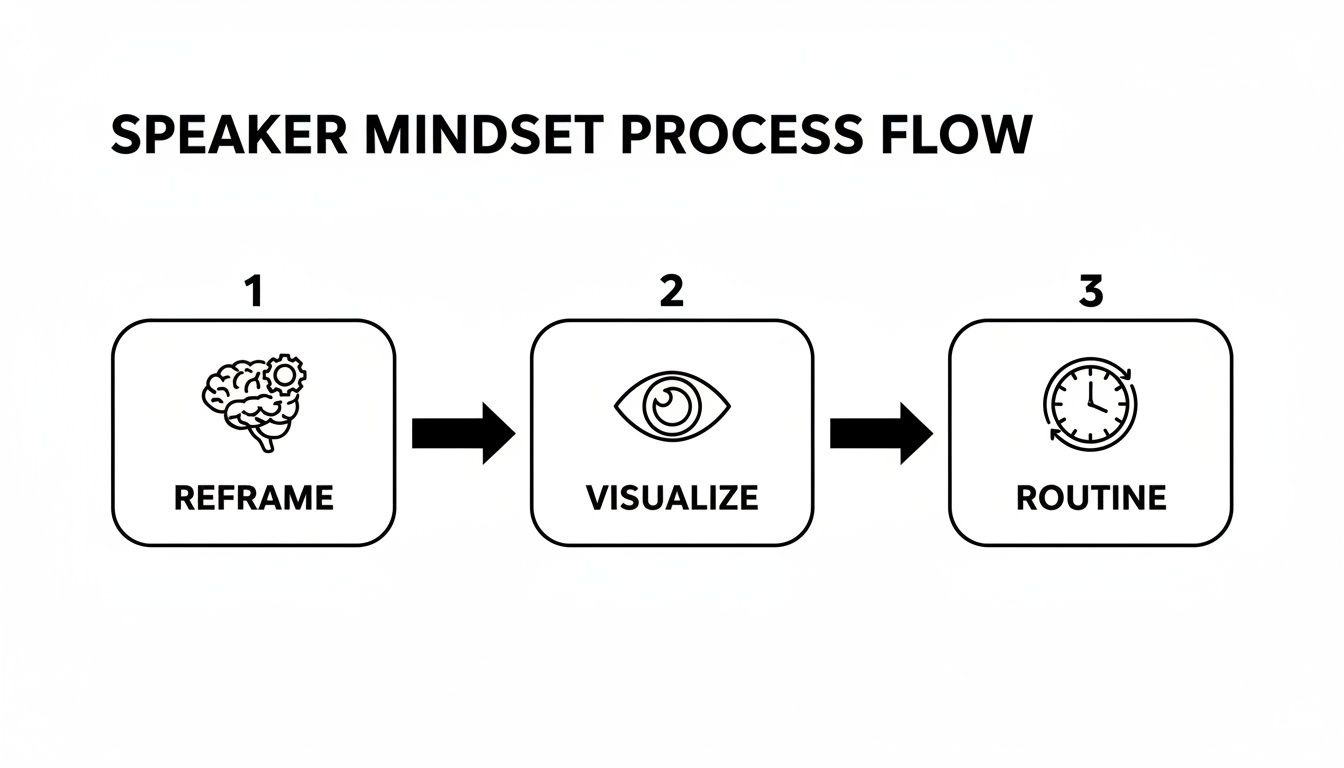
This cycle of reframing your thoughts, visualizing success, and locking in a routine is the bedrock of consistent performance. Our programs help you build that routine.
Choose Your Intonetic Accent Studio Plan
So, which program is the right fit for you? It really comes down to one simple question: do you prefer to work completely independently, or would you benefit from an expert eye on your progress?
To make it easy, here’s a direct comparison of the two options.
| Feature | Accent Studio ($7/month) | Accent Studio+ ($27/month) |
|---|---|---|
| Full Program Access | Yes, complete access to all self-paced programs. | Yes, complete access to all self-paced programs. |
| Learning Style | Perfect for independent, self-motivated learners. | Ideal for learners who want expert guidance and support. |
| Personalized Feedback | Not included. | Yes, receive feedback on your progress from a coach. |
| Best For | Building foundational skills with a structured curriculum. | Accelerating progress with targeted, expert input. |
Both paths lead to clearer, more confident communication. The “Plus” plan simply adds a personalized feedback loop that can be incredibly valuable for spotting subtle errors and making sure your practice is as effective as possible.
The most direct path to mastering confident speech is through focused, consistent application. A structured program removes the guesswork, allowing you to concentrate solely on building the right skills.
Why a Structured Program Makes All the Difference
While any practice is better than no practice, a dedicated program gives you a clear roadmap and a sense of accountability. It stops you from getting stuck on one tricky sound or accidentally ignoring a crucial area like intonation or rhythm.
The journey to speaking confidently is a marathon, not a sprint. Having a structured path ensures you’re always taking the most effective next step. It’s the difference between wandering in the right direction and following a clear, well-marked trail to your destination.
These programs are your most direct route to applying what you’ve learned in this guide, built for busy professionals who need flexibility but still demand a proven system for tangible results. If you’re curious, you can learn more about the top reasons to choose Intonetic for confident communication in our detailed breakdown.
Your Questions Answered: Speaking Confidently
Even with the best game plan, questions always pop up when you’re working on something as personal as your voice. That’s a good thing—it means you’re engaged in the process. I get asked these all the time, so let’s tackle the big ones head-on.
How Long Until I Actually Hear a Difference?
This is the number one question, and the answer isn’t about logging hours—it’s about consistency. While everyone’s journey is a bit different, most professionals I work with start feeling a real, tangible shift in their confidence and clarity within 8-12 weeks.
The key is focused, daily effort. Think of it like going to the gym. Short, consistent workouts build muscle memory far more effectively than one marathon session on a Saturday. That’s why targeted exercises for things like breathing and articulation are so powerful. They fast-track the process, helping you both hear and feel the improvement much sooner.
Will I Lose My Accent and Part of My Identity?
This is a huge, and completely valid, concern. Let me be clear: the answer is a firm no. Modern, effective speech coaching is about adding clarity, not erasing your identity. We’re not trying to change who you are; we’re giving you another powerful tool for your communication toolkit.
The goal here is simple: to be understood easily and accurately the first time you speak. That, in itself, is a massive confidence booster. Your unique voice, your background, your perspective—those are your strengths. We just help you deliver your message with more precision in an American English context.
I Have No Time. How Can I Possibly Practice?
I get it. Your schedule is already packed. The good news is that you don’t need to block out huge chunks of time to see significant progress. The most effective practice is woven right into your existing day. It’s about quality and consistency, not quantity.
Here are a few “micro-practice” habits my clients build:
- Before a call: Take two minutes for deep diaphragmatic breathing. It will ground your voice and calm your nerves.
- During your commute: Run through a few tongue twisters that target your specific priority sounds.
- While the coffee brews: Practice holding a steady “ahhh” sound. This is a simple but amazing exercise for breath control and projection.
Just 5-10 minutes of this kind of focused, daily work is far more impactful than trying to cram an hour in once a week. These small, consistent efforts are what build new, automatic speaking habits that last.
Ready to move from questions to a clear action plan? The Intonetic offers a structured path specifically for professionals who want a proven system to improve their accent and clarity.