How to Speak Clearly and Confidently – A Professional’s Guide

To speak with real clarity and confidence, you need to get a handle on three things: controlled breathing, sharp articulation, and dynamic intonation.This isn’t about erasing your accent. It’s about making sure your message lands with authority and is effortless for your audience to follow.
Why Speaking Clearly and Confidently Changes Everything

Ever present a brilliant idea, only to be met with blank stares? It’s a gut-wrenching feeling. You start to wonder if the problem is the idea itself, when really, your message just got lost in translation.
The good news is that speaking clearly is a skill you can build, not some innate talent you either have or you don’t. It all comes down to intelligibility—making it easy for people to grasp your ideas so they have the impact they deserve.
A common worry I hear from professionals is that focusing on speech means losing their identity or accent. That couldn’t be further from the truth. The goal here is clarity, not some cookie-cutter version of “perfection.”
When you’re easy to understand, your expertise is what shines through. This builds trust and credibility, especially in high-stakes situations. In fact, the real world impact of having an accent often has more to do with how easily you’re understood than the accent itself.
The Professional Cost of Miscommunication
When communication breaks down, it’s not just an annoyance—it has real-world consequences. A staggering 86% of employees and executives point to poor communication as the primary reason for workplace failures.
On the flip side, targeted training can make a world of difference. One workforce report found that 94% of participants felt significantly more confident using English at work after training, which allowed them to articulate their thoughts much more crisply.
The ability to articulate your thoughts clearly is directly tied to how your competence and leadership potential are perceived. When your delivery is as strong as your ideas, you remove any barriers to being heard and respected.
Your Path to Greater Vocal Authority
So, how do you actually start? The journey begins with understanding the physical pillars that support a powerful voice. It’s less about memorizing abstract rules and more about building new muscle memory that gives your speech strength and flexibility.
Simply recognizing the profound impact of knowing how to improve your public speaking is the first critical step toward unlocking your professional growth.
We’re going to zero in on the areas that deliver the biggest, most immediate results:
- Breath Support and Projection: You’ll learn to breathe from your diaphragm, giving your voice a steady, powerful foundation that eliminates strain.
- Targeted Sound Work: Instead of getting bogged down trying to perfect every single sound, we’ll focus on the specific phonemes that have the greatest impact on intelligibility in American English.
- Intonation and Rhythm: This is the “music” of English. Mastering it helps you convey meaning and authority, making your speech far more engaging and persuasive.
To give you a quick overview, here’s a snapshot of the foundational pillars we’ll be building throughout this guide.
Your Path to Clear and Confident Speech At a Glance
| Pillar | What It Is | Why It Matters for Confidence |
|---|---|---|
| Breath & Projection | Using your diaphragm to support your voice for steady, powerful sound. | Eliminates vocal strain and the fear of your voice cracking or trailing off. |
| Targeted Articulation | Focusing on high-impact American English sounds for maximum clarity. | You stop worrying if people can understand specific words and can focus on your message. |
| Intonation & Rhythm | Mastering the “music” of English—stress, pitch, and timing. | Your speech sounds more natural and authoritative, making you feel more in command. |
| Filler Word Reduction | Replacing “ums” and “ahs” with strategic pauses. | Pauses make you sound thoughtful and in control, not hesitant or unsure. |
| Strategic Vocabulary | Building and practicing industry-specific terminology. | Having the right words ready to go removes the anxiety of fumbling for terms. |
Each of these pillars works together to create a voice that is not only clear but also authentically confident. This guide provides a practical blueprint for making your delivery as compelling as your ideas.
Let’s get started.
Build Your Vocal Foundation from the Ground Up

Before you ever worry about specific sounds or fancy words, you have to get the engine of your voice running properly. Think of your breath as the fuel for your speech. Without a steady, controlled supply, your voice will sound weak, shaky, or just run out of gas mid-sentence.
It’s a classic sign of nervousness and instantly undermines your confidence.
So many professionals I work with are “chest breathers,” taking shallow little sips of air from high up in their chest. It’s an incredibly common habit, but it creates tension and puts a hard ceiling on your vocal power. The real key to unlocking a strong, steady voice lies in diaphragmatic breathing, or what some call belly breathing. This technique engages the diaphragm, that big muscle sitting at the base of your lungs, giving you masterful control over your airflow.
The immediate payoff here is a sense of calm control. When your nerves spike right before a big presentation, your breathing naturally gets fast and shallow. By consciously switching to deep belly breaths, you can literally slow your heart rate and center your focus. It’s a physical tool you can use to manage anxiety on the spot.
Master Diaphragmatic Breathing
The good news is you don’t need a special studio or any equipment. You can practice this right now, sitting at your desk.
Here’s how to get started:
- Get Grounded: Sit up straight in your chair, with both feet flat on the floor. Place one hand on your chest and the other on your stomach, just underneath your rib cage.
- Breathe In Deep: Slowly inhale through your nose for a count of four. Your whole focus should be on making the hand on your stomach rise, while the hand on your chest stays pretty still.
- Control the Release: Now, exhale slowly through your mouth for a count of six. As you do, gently pull your stomach muscles inward. You should feel the hand on your stomach fall as you release the air.
The goal is to make this your default way of breathing, especially when you’re speaking. A voice that’s properly supported feels effortless and sounds resonant. It allows you to speak with clarity and confidence without ever feeling like you’re straining.
Project Your Voice Without Yelling
Once you get comfortable with belly breathing, you can start using that controlled airflow to project your voice. Let me be clear: projection is not about being loud. It’s about carrying your voice efficiently so it fills the space and commands attention, whether you’re in a huge boardroom or just trying to sound present on a video call.
Try this simple exercise to find your natural projection. Take a deep diaphragmatic breath and, on the exhale, make a gentle “hummm” sound. You should feel a vibration in your lips, nose, and maybe even your upper chest. That’s your voice resonating.
Now, try saying a simple phrase like “Good morning, everyone” on your next exhale, aiming to recreate that exact same resonant feeling.
For a more structured path to building your vocal instrument, you might even consider professional voice lessons. This kind of work builds the crucial muscle memory for a consistently powerful voice.
To keep your tongue and lips nimble, it’s also a great idea to explore some daily vocal warm-ups and tongue twisters. These exercises are like a quick workout for your mouth, making it that much easier to speak with absolute clarity when it counts.
Focus on Sounds That Make the Biggest Impact
Trying to perfect every single sound in American English isn’t just exhausting—it’s one of the fastest ways to burn out. Here’s a little secret from my years of coaching: not all sounds are created equal when it comes to being understood.
You can get incredible results by applying an 80/20 approach. Focus your energy on the small handful of sounds that make the biggest difference in clarity. This is all about strategic practice, not perfection. Many professionals I’ve worked with find that mastering just 10–12 high-impact phonemes can dramatically improve how easily they’re understood. It’s a manageable goal that delivers noticeable results fast.
And in a professional context, that clarity is non-negotiable. Research shows an incredible 98% of large firms see English proficiency as vital, and it’s often a huge factor in hiring and promotions. When you nail these critical sounds, you don’t just speak more clearly—you speak with more authority.
The Most Common Sound Challenges
For most non-native speakers targeting clear American English, a few specific sounds consistently cause the most trouble. These are often the sounds that simply don’t exist in your native language, which means you have to build entirely new muscle memory in your mouth, tongue, and lips.
Here are the usual suspects:
- Vowel Contrasts (Long vs. Short): The tiny difference between the long /iː/ in “sheep” and the short /ɪ/ in “ship” can completely change the meaning of your sentence. It’s a subtle distinction, but a critical one.
- The American ‘R’: This sound is famously tricky. It’s not the rolled or tapped ‘R’ found in many other languages. The American ‘R’ requires a very specific tongue position, pulled back in the mouth without touching the top.
- ‘TH’ Sounds (Voiced and Voiceless): Getting the /θ/ in “think” and the /ð/ in “this” right requires placing the tip of your tongue between your teeth. For many speakers, this movement feels completely unnatural at first.
If you want a deeper dive into the mechanics, our guide on how to pronounce all 44 sounds in English breaks down each phoneme with detailed instructions.
Your Self-Assessment Checklist
Before you jump into drills, you need to know exactly where to focus your energy. A quick diagnostic is the best way to start. Just record yourself saying a few specific word pairs and sentences, then listen back with an honest ear. Are the sounds distinct? Are they clear?
Think of this as creating a targeted workout plan for your mouth. You wouldn’t go to the gym and randomly use every machine; you’d focus on exercises that get you closer to your goals. The same principle applies right here.
Use this checklist to pinpoint your personal priority sounds:
- Long ‘ee’ vs. Short ‘i’: Say aloud, “I need to reach that rich client.” When you listen back, can you hear a clear difference between “reach” and “rich”?
- American ‘R’: Now try this one: “Her career requires very clear reporting.” Does the ‘R’ sound strong and consistent? Or does it sound more like a ‘W’ or get lost completely?
- The ‘TH’ Sounds: Finally, say, “They think that‘s the thirty-third option.” Are the ‘TH’ sounds in “they/that” (voiced) and “think/thirty” (voiceless) crisp and easy to distinguish?
By isolating these specific sounds, you build a focused, high-impact practice plan. This is how you start speaking more clearly with less effort and build the kind of confidence that comes from knowing you’ll be understood the first time you speak.
Mastering the Music of American English

If getting individual sounds right is the foundation of clear speech, then intonation is the architecture that makes your message powerful. Speaking clearly is about so much more than just correct pronunciation. It’s about the melody, rhythm, and emphasis you weave into your words.
This “music” of the language is what turns a flat string of syllables into a dynamic, persuasive message. Without it, even perfectly formed words can fall flat, leaving your audience disengaged or, worse, confused. Mastering intonation is where you cross the bridge from being understood to being truly influential.
How Stress Changes Everything
In American English, where you place stress in a sentence can completely flip its meaning. This isn’t just a minor detail—it’s one of your most powerful tools for directing your listener’s attention exactly where you want it.
Take this simple sentence: “I didn’t steal your report.”
By shifting the emphasis, we can create four totally different meanings:
- “I didn’t steal your report.” (Implication: Someone else did.)
- “I didn’t steal your report.” (Implication: A firm denial of the action.)
- “I didn’t steal your report.” (Implication: I just borrowed it, or maybe I wrote it.)
- “I didn’t steal your report.” (Implication: I stole someone else’s.)
This is precisely why monotonous, flat speech can be so difficult to follow. When every word gets the same weight, your listener has to work overtime to figure out what’s important. Dynamic stress patterns do that heavy lifting for them, making you sound clear, organized, and confident.
Key takeaway: When you strategically emphasize key words, you’re essentially giving your listener a roadmap to your thoughts. It’s a simple shift that makes you sound more decisive and in control of your message.
The impact of how you deliver your message—flatly versus with dynamic energy—is stark. A monotonous delivery can inadvertently signal boredom or a lack of conviction, whereas a dynamic one communicates engagement and authority.
Monotonous vs Dynamic Delivery: The Impact of Intonation
| Vocal Trait | Monotonous Delivery (Low Impact) | Dynamic Delivery (High Impact) |
|---|---|---|
| Audience Perception | Sounds bored, uninterested, or unconfident. | Sounds engaging, passionate, and authoritative. |
| Message Clarity | Listeners struggle to identify key points. | Main ideas are highlighted and easy to follow. |
| Professional Image | Can be perceived as hesitant or unprepared. | Perceived as confident, prepared, and credible. |
| Engagement Level | Audience is likely to tune out. | Audience remains attentive and interested. |
Ultimately, leveraging intonation isn’t just about sounding better; it’s about ensuring your ideas land with the full force of your conviction.
Harnessing Pitch, Pauses, and Rhythm
Beyond stressing single words, the overall rise and fall of your pitch—your intonation—sends critical cues. In American English, a rising pitch at the end of a sentence usually signals a question. A falling pitch indicates a statement. If your statements consistently end on a high note, you might sound hesitant or like you’re seeking approval.
Another vital piece of the puzzle is what we call thought grouping. This is the art of using brief, strategic pauses to break longer sentences into digestible chunks. Instead of barreling through a complex idea, you give your listeners a moment to process each part. It not only makes you easier to understand but also makes you sound more fluent and in control.
If you’re looking to dive deeper into this, you can find some fantastic insights into the rhythm and timing in American English that will help you sound more natural.
When you start combining intentional word stress, thoughtful intonation, and well-placed pauses, you elevate your speech from merely intelligible to genuinely compelling. This is how you hold a room’s attention and convey your ideas with real power.
Polish Your Delivery and Own Your Expertise
Once you’ve built a stronger vocal foundation, it’s time to add that final polish. This is where we tackle the small habits that can unknowingly chip away at your credibility, even when your core message is brilliant.
One of the biggest culprits? Filler words.
We all use them. Those little “ums,” “ahs,” “you knows,” and “likes” are often just verbal placeholders our brains insert while searching for the next thought. But to an audience, they can make a speaker sound hesitant or unprepared. Learning to speak with confidence means swapping these habits for something far more powerful.
The best tool in your arsenal is the strategic pause. Instead of filling a quiet moment with an “um,” just… stop. Take a breath. A short, silent pause doesn’t feel nearly as long to your listeners as it does to you. In fact, it makes you sound thoughtful and in control, giving everyone a second to absorb what you just said.
Eliminate Filler Words for Good
You can’t fix a habit you don’t know you have. Most of us have no idea how often we rely on filler words until we’re forced to listen to ourselves.
Try this quick diagnostic exercise:
- Grab your phone and record yourself speaking for just one minute. Talk about a familiar topic, like your current project or a recent vacation.
- Now, listen back with a pen and paper. Every single time you hear a filler word, make a tally mark. The number might surprise you.
- Record yourself one more time, but now consciously try to replace every potential filler with a brief, silent pause.
This isn’t about hitting zero filler words overnight. The goal is to build awareness. Once you can hear the habit in real-time, you can start making the conscious choice to replace it with silence, which instantly boosts your perceived authority.
Master Your Industry Vocabulary
Now, let’s bring this newfound clarity to the language of your profession. Nothing signals expertise like delivering complex, industry-specific terms with complete ease.
If you stumble over a word like “pharmacokinetics” in a healthcare meeting or “container orchestration” in a tech presentation, it can create a tiny moment of doubt for your listener. You know your stuff, so let’s make sure it sounds like it.
Here’s a simple framework to master your professional jargon: Isolate, Practice, Integrate.
First, write down the 5-10 most critical terms in your field—the ones you use all the time. Next, practice saying them out loud, breaking them down syllable by syllable if you need to. Finally, create a few sentences using each term and practice delivering those sentences until they roll off the tongue.
This kind of targeted practice ensures that when a high-stakes conversation comes up, you project nothing but confidence in your domain knowledge.
This precision is more critical than ever. In today’s global workforce, 98.5% of employers across 38 countries evaluate English competency during the hiring process, often in high-pressure interviews where clarity is a make-or-break skill. Another report found that 92% of professionals worldwide see English as vital for their job security. Your ability to communicate specialized knowledge clearly isn’t just a soft skill; it’s a major career asset. You can dig deeper into these findings on the importance of English in the global workforce.
Your 12-Week Blueprint to Confident Speaking
Knowing the theory is one thing, but real transformation comes from consistent practice. This isn’t about cramming for a test; it’s about building new habits, day by day.
I’ve designed this structured 12-week plan to fit into a busy professional’s schedule. The secret isn’t intensity—it’s consistency. Just 15-20 minutes of focused work each day is enough to build the muscle memory you need for lasting change.
Think of it as a progressive workout for your voice. We’ll start with the fundamentals and then slowly layer on more advanced skills. This approach keeps things manageable and helps build momentum, ensuring each new skill has a solid foundation.
Weeks 1-6: Building Your Core Skills
The first half of our journey is all about mechanics. We’re going to dial in the essential elements of clear, confident speech, giving you the raw tools you’ll need before we start polishing your delivery.
- Weeks 1-2: Foundational Breath Control. Your only job for these two weeks is to master diaphragmatic breathing. Spend 10 minutes, twice a day, on the breathing exercises we covered earlier. The goal is to make deep, supported breathing your automatic response, especially when you’re feeling the pressure.
- Weeks 3-4: Priority Sound Drills. Keep up with your breathing work, but now let’s add 10 minutes of targeted sound practice. Pull out that self-assessment checklist you made and focus only on the high-impact phonemes that you personally struggle with. Don’t try to fix everything at once.
- Weeks 5-6: Mastering Intonation. Now we add the music. This is where you’ll dedicate your practice time to sentence stress and pitch modulation. A great exercise is to record yourself reading a short paragraph, really focusing on hitting the keywords with emphasis and using a clear falling pitch for statements.
Weeks 7-12: Polishing Your Professional Delivery
With a strong foundation in place, we shift gears to real-world application. This is where you’ll start to see a major boost in your confidence during actual professional situations. We’re moving from isolated drills to integrating everything into fluent, authoritative communication.
This timeline shows how we’ll tackle the key stages of speech polishing during these final weeks.
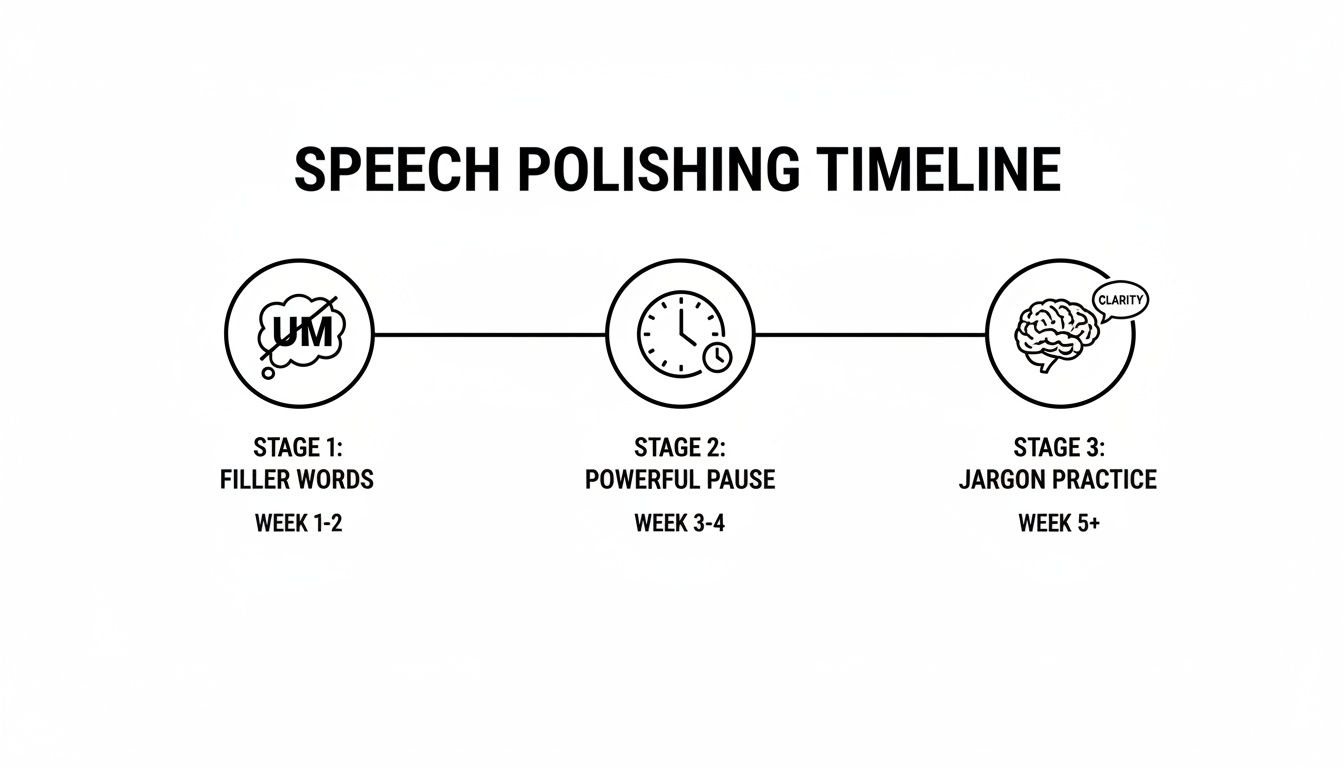
As you can see, mastering the pause and cutting out filler words are the stepping stones to confidently delivering specialized language.
- Weeks 7-8: Filler Word Reduction. Time to kill the “ums” and “ahs.” Make a conscious effort to replace them with powerful, deliberate pauses. Start by practicing this during your drills, then begin applying it in low-stakes conversations.
- Weeks 9-10: Industry Jargon Mastery. List your top 10 industry-specific terms—the ones you use every day. Your goal is to practice saying them until they roll off your tongue and feel completely natural.
- Weeks 11-12: Full Integration. Let’s bring it all together. The final step is to practice short, impromptu speeches on work-related topics. As you speak, consciously apply your breath control, clear articulation, and dynamic intonation.
Remember, the goal here is significant progress, not overnight perfection. If you want more perspective on what to expect, check out our guide on setting realistic goals for accent improvement in 3 months. Stick with this plan for 12 weeks, and I guarantee you’ll see noticeable, confidence-boosting results.