
How to Speak American English (how to speak american english)

Speaking clear American English isn’t about erasing your accent; it’s about making small, targeted tweaks that guarantee you’re always understood. The whole process kicks off with a quick self-assessment to find the 10-12 key sounds that will give you the biggest bang for your buck in your professional communication. When you zero in on these priorities, you create a much smarter, more efficient path to success.
Pinpointing Your American English Pronunciation Goals
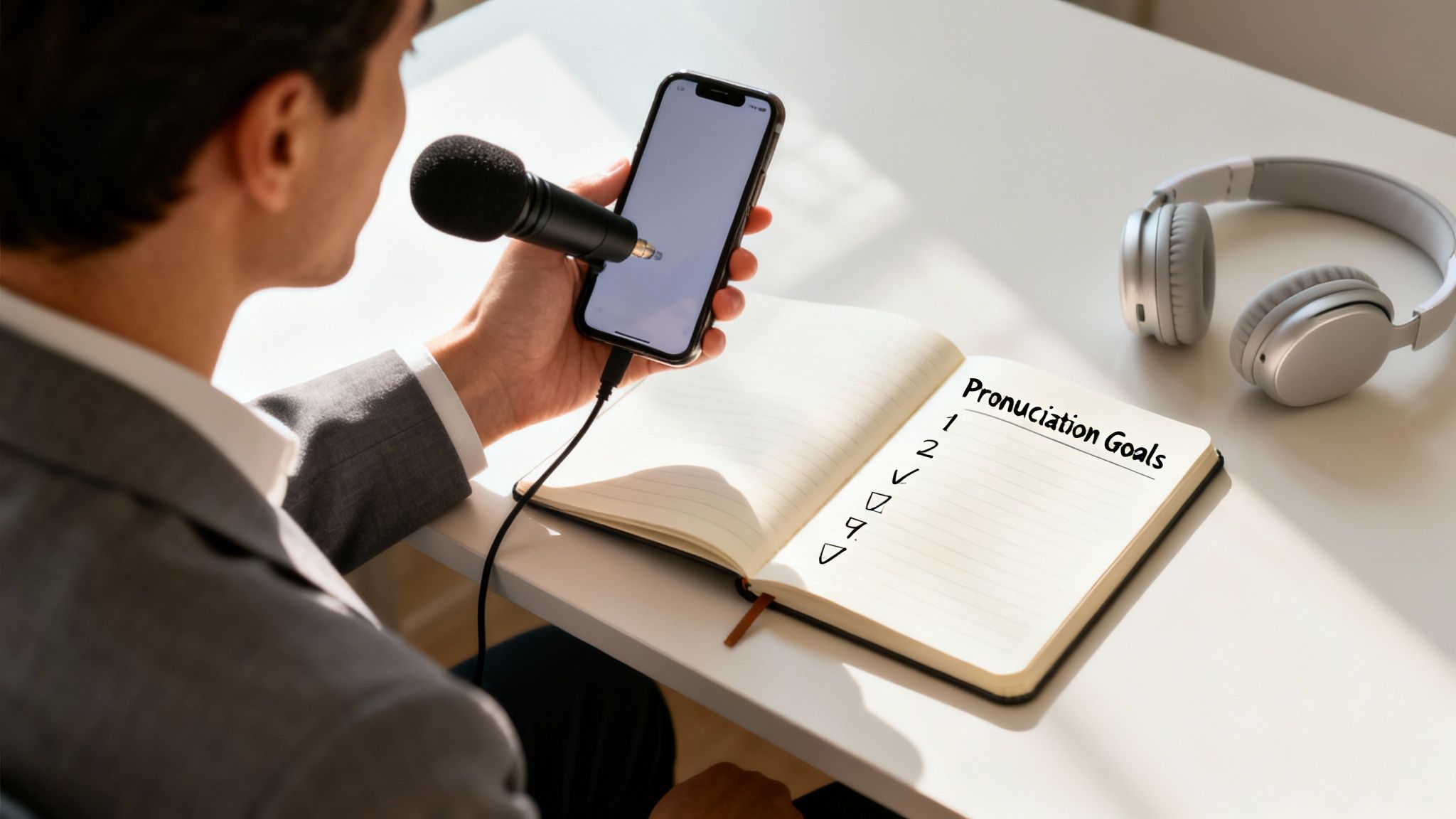
Before you jump into a sea of endless drills and tongue twisters, you need a clear starting point. A focused plan is so much more effective than trying to fix everything at once. The first real step is figuring out which specific parts of your speech are creating the biggest roadblocks to clear communication.
The goal here isn’t perfection or trying to sound like a native speaker. Your accent is part of your story. The real objective is intelligibility—making sure your colleagues, clients, and managers get your ideas the first time you share them. This strategic approach saves you a ton of time and builds your confidence way faster.
Creating Your Personal Pronunciation Baseline
To build a plan that actually works, you have to first get a handle on your unique challenges. The best way to do this? Become an objective listener of your own voice.
Just start by recording yourself. You don’t need any fancy gear; the voice memo app on your smartphone is perfect. Try a few different speaking tasks to get a complete picture of your speech:
- Read a paragraph aloud from a news article or a book. This shows how you handle prepared text.
- Describe your job or a recent project for about a minute. This reveals your natural, spontaneous speech patterns.
- Say a list of tricky words common in your industry. A software engineer, for instance, might say “architecture,” “repository,” and “implementation.”
This simple act of recording gives you the raw data you need to do a proper self-assessment.
Analyzing Your Speech for High-Impact Targets
Got your recordings? Great. Now, listen back with a critical ear. Don’t judge yourself—just listen like a detective searching for clues. Pay close attention to any spots where your speech might sound a bit fuzzy, unclear, or just different from the American English you hear in meetings or on podcasts.
I’ve seen it time and again with my clients: the biggest leaps in clarity come from mastering just a handful of high-frequency sounds and rhythm patterns. It’s all about working smarter, not harder, by focusing on what creates the most confusion for listeners.
As you listen, ask yourself these questions:
- Vowel Sounds: Are my vowels crisp and distinct? For example, can people clearly hear the difference between your “ship” and “sheep,” or “cot” and “caught”? Many non-native speakers tend to merge these sounds.
- Key Consonants: How am I handling challenging sounds like the American /r/ in “report,” the “th” in “think,” or the /l/ in “fully”?
- Rhythm and Stress: Am I stressing the right part of multi-syllable words (like re-PORT, not RE-port)? Does my overall sentence have a natural, rhythmic flow?
From this quick analysis, you’ll be able to pull together a shortlist of 10-12 sounds and patterns that represent your biggest opportunities for improvement. Setting realistic goals for accent improvement in 3 months begins with this foundational step of knowing exactly what to prioritize. This focused list becomes your personal curriculum, guiding every minute of your practice toward what truly matters.
Mastering the Core Sounds of American English

Once you’ve pinpointed your personal pronunciation targets, the real work can begin. Let’s get one thing straight: mastering how to speak American English isn’t about learning every single sound perfectly from day one. That’s a recipe for burnout.
Instead, the smart approach is to strategically focus on the core sounds that give you the biggest bang for your buck in terms of clarity. Some sounds simply carry more weight than others in making your speech intelligible. By prioritizing these high-value targets, you can make significant, noticeable progress—fast. This is all about building a strong phonetic foundation that supports clear, confident communication.
The Unmistakable American /r/ Sound
If there’s one consonant that practically screams “American English,” it’s the rhotic /r/. This is that hard, pronounced ‘r’ you hear in words like “work,” “career,” and “report.” For many non-native speakers, this sound is a major hurdle. But mastering it is absolutely non-negotiable for crystal-clear American English.
The American dialect has become the world’s most influential since the late 20th century, driving global business and media. Its distinct sound, especially the widespread rhotic /r/, creates specific challenges for professionals. Unlike non-rhotic British English where the /r/ often vanishes after a vowel (making ‘hard’ sound like /hɑːd/), General American English keeps this /r/ sound in nearly all positions. This makes it a critical sound to nail down.
So, how do you make it? The key is in your tongue. The body of your tongue pulls back and bunches up right in the middle of your mouth. The tip can either point slightly up or pull down, but it should never touch the roof of your mouth.
Here’s a simple drill to feel it out:
- Start by making a long “ee” sound, like in the word “see.”
- Hold that “ee” sound and slowly, deliberately, pull your tongue straight back into your mouth.
- You should feel the sides of your tongue press firmly against your upper back teeth as you transition into that perfect American /r/.
This little exercise helps build the muscle memory you need for a strong, consistent /r/ sound.
Crucial Vowel Distinctions
While consonants give your speech its structure, the vowels give American English its unique color and character. And let me tell you, tiny little differences in vowel sounds can completely change the meaning of a word. Getting these right is vital to being understood.
Two of the most common trip-ups I see with my clients are the “long ee” versus “short i” sounds, and the “short a” versus “short e” sounds. A slip-up here can lead to some pretty awkward misunderstandings in a professional setting.
“Sheet” vs. “Ship” (The /iː/ and /ɪ/ Sounds)
The difference here all comes down to tongue tension and position.
- /iː/ as in “sheet,” “leave,” “meet”: Your tongue is high and far forward. Your face muscles are tense, almost like you’re holding a tight smile. It’s a longer, more deliberate sound.
- /ɪ/ as in “ship,” “live,” “it”: Your tongue is a bit lower and much more relaxed. The sound is quick, short, and lax.
Practice Phrase: “I need to leave this sheet before I live on that ship.”
“Bat” vs. “Bet” (The /æ/ and /ɛ/ Sounds)
This distinction is all about how far you drop your jaw.
- /æ/ as in “bat,” “manager,” “plan”: Your jaw drops down quite a bit. Your tongue should be low and flat in your mouth. Think of the sound a sheep makes: “baaa.”
- /ɛ/ as in “bet,” “get,” “said”: Your jaw is much more relaxed and neutral. Your tongue is in a mid-high position, not nearly as low as the /æ/ sound.
Practice Phrase: “The manager will bet we can get a new plan.”
For a deeper exploration of all the phonemes in English, check out our guide on how to pronounce the 44 sounds in English. It’s a fantastic resource for understanding the mechanics behind each vowel and consonant.
Building Muscle Memory with Targeted Drills
Your mouth, jaw, and tongue are a complex system of muscles. Just like hitting the gym, you need high-repetition drills to build the strength and coordination for these new sounds. This is where tongue twisters come in. They are an incredible tool because they force you to move between difficult sound combinations quickly and accurately.
Here are a few of my favorites to get you started:
- For the /r/ sound: “Richard’s brother Robert ran around the rugged rocks.”
- For the /θ/ sound (voiceless “th”): “I thought a thought, but the thought I thought wasn’t the thought I thought I thought.”
- For the /s/ and /ʃ/ (“sh”) distinction: “She sells seashells by the seashore.”
The trick is to start slow. Say them deliberately, focusing on making each sound perfectly. As you get more comfortable, you can gradually pick up the pace. Remember, the goal isn’t just speed—it’s clarity at speed.
Understanding Common Sound Mergers
Here’s an insider tip: in American English, some distinct vowel sounds have actually merged together for millions of speakers. Knowing about these can help you sound more natural and, honestly, simplify your learning process a bit.
| Sound Merger | Description | Example Words |
|---|---|---|
| Cot-Caught Merger | The vowel sounds in “cot” (/ɑ/) and “caught” (/ɔ/) are pronounced exactly the same for many Americans. | cot / caught |
| Pin-Pen Merger | The vowel sounds in “pin” (/ɪ/) and “pen” (/ɛ/) sound identical, especially right before nasal sounds. | pin / pen |
| Mary-Marry-Merry Merger | All three of these words are often pronounced the same, with the vowel sound neutralizing before the /r/. | Mary / marry / merry |
You don’t need to force these mergers into your speech, but just being aware of them is a huge help for your listening comprehension. It also gives you permission to relax on certain vowel targets, especially if the merger is common in the part of the U.S. where you work or live.
By focusing your energy on these high-impact sounds, crucial vowel pairs, and targeted drills, you create a direct path to clearer speech. This is how you learn to speak American English effectively—by turning conscious, deliberate effort into automatic, intelligible pronunciation.
Learning the Music of American English
Mastering individual sounds is like learning the notes of a song—it’s crucial, but it’s only half the story. If you really want to know how to speak American English, you have to learn its music. This “music” is the blend of stress, rhythm, and intonation that gives the language its unique flow and melody.
Think of it this way: clear sounds make sure people understand your words, but getting the music right ensures they understand your meaning. Nailing this is what makes you sound not just clear, but also confident and authoritative in any professional setting.
The Power of Sentence Stress
In American English, not all words get equal billing. We naturally punch up certain words to signal what’s most important, a technique called sentence stress. It’s a surprisingly powerful tool for getting your point across.
Native speakers do this almost unconsciously, placing stress on content words—the heavy lifters that carry the real meaning. These are usually:
- Nouns (e.g., project, data, report)
- Main verbs (e.g., present, analyze, develop)
- Adjectives (e.g., efficient, critical, important)
- Adverbs (e.g., quickly, very, always)
At the same time, we tend to glide right over the function words—the grammatical glue like articles (a, an, the), prepositions (in, on, at), and pronouns (he, she, they). This contrast between the stressed and unstressed words is what creates that rhythmic, wave-like pattern you hear in natural American speech.
How a Single Stressed Word Changes Everything
The true impact of sentence stress hits home when you see how just shifting the emphasis can completely flip a sentence’s message. Picture this: you’re in a team meeting, and the topic of a product launch comes up.
Someone says to you, “So, you said we should launch the project.” You reply with: “I didn’t say we should launch the project.”
Now, watch what happens when we just move that stress around:
- “I didn’t say we should launch the project.” (Implication: Someone else said it, but it wasn’t me.)
- “I didn’t say we should launch the project.” (Implication: This is a direct denial. I’m correcting a false assumption.)
- “I didn’t say we should launch the project.” (Implication: Maybe another team should, but definitely not us.)
- “I didn’t say we should launch the project.” (Implication: I said we should delay it or rethink it, but launching is a bad idea.)
- “I didn’t say we should launch the project.” (Implication: We should launch something else—maybe the prototype—but not the whole thing.)
Each version sends a totally different subtext. Mastering this skill gives you precision and control, making sure your team understands not just your words, but your true intent.
Mastering the rhythm and timing of American English is a game-changer. It’s the secret ingredient that moves your speech from just being understood to being truly influential and natural-sounding.
Riding the Waves of Intonation
Intonation is simply the melody of your speech—the rise and fall of your voice’s pitch. Getting these patterns right is essential for sounding confident and making sure your questions don’t sound like statements, and vice-versa.
For professional communication, there are two core patterns you need to get down.
1. Falling Intonation (The 2-1 Pattern)
This is your bread and butter in American English. Your pitch starts neutral, pops up on the stressed syllable of the last important word, and then drops firmly. This pattern signals completion and authority.
- Use it for: Statements and WH-questions (who, what, where, etc.).
- Example statement: “We need to finish this report by Friday.➘”
- Example question: “What are the next steps?➘”
2. Rising Intonation (The 2-3 Pattern)
Here, your voice lifts at the end of the sentence. This signals a question, some uncertainty, or that you’re looking for confirmation.
- Use it for: Yes/No questions and checking for understanding.
- Example question: “Do you have the data?➚”
- Example checking: “So the deadline is Tuesday?➚”
Using falling intonation for statements makes you sound decisive and in command. But if you accidentally use a rising tone when making a statement, it can make you sound unsure of yourself, which can seriously undermine your authority in a meeting or presentation.
A great way to practice this is to record yourself saying the same sentences with both patterns. The difference will be obvious. Paying attention to the “music” is a critical part of learning how to speak American English effectively. You can learn more about how to master the beat of the language by exploring the rhythm and timing in American English. Focusing on these prosodic elements will elevate your communication skills dramatically.
Building a Daily Pronunciation Practice Routine
Knowing what to practice is half the battle. The other half—the part that actually gets you results—is turning that knowledge into a consistent habit.
Real, lasting change in your pronunciation doesn’t come from marathon cram sessions. It comes from consistency. This is where you build the muscle memory that makes clear American English feel less like a performance and more like second nature, even with a demanding professional schedule.
The good news? A powerful routine doesn’t require hours you don’t have. Short, focused bursts of daily practice are far more effective at rewiring your speech habits than a long session once a week.
The Power of the 15-Minute Daily Habit
Finding an extra hour in your day can feel like a fantasy. But almost everyone can find 15 minutes. That small, daily commitment is all it takes to build and strengthen the neural pathways for new speech habits. A consistent quarter-hour will always outperform a heroic two-hour session every other Sunday.
Here’s a simple, effective blueprint you can start using today. This structured plan helps build momentum by breaking down the core components of pronunciation into manageable chunks.
| Time Allotment | Activity | Focus Area | Example Task |
|---|---|---|---|
| 5 Minutes | Ear Training | Rhythm & Intonation | Listen to a 1-minute clip from a US news report or podcast. Shadow a single sentence, trying to match the speaker’s “music”—the rise and fall of their voice. |
| 5 Minutes | Targeted Drills | Phoneme Articulation | Work on one of your high-priority sounds. If it’s the American /r/, repeat words like “report,” “career,” and “further.” If it’s the /æ/ vowel, drill “analytics,” “plan,” and “strategy.” |
| 5 Minutes | Real-World Application | Practical Integration | Connect your drills to your job. Read a work email aloud, rehearse the first minute of an upcoming presentation, or practice industry-specific phrases you use every day. |
This daily investment is powerful because it keeps the new patterns fresh in your mind and muscles. If you want more ideas to mix things up, exploring different ways to practice English pronunciation daily can lead to rapid progress.
Designing Your Weekly Practice Structure
While daily drills are about building the foundation, your weekly structure is for zooming out, checking your progress, and making sure you’re still moving forward. It adds a couple of key components that prevent you from getting stuck in a rut.
Think of it this way: daily practice is the workout, and the weekly review is your check-in with the coach—even if that coach is you.
1. A Weekly Record-and-Review Session: Once a week, set aside a few extra minutes to record yourself. You could summarize a recent meeting or explain a complex concept from your field for two or three minutes. A day later, listen back with fresh ears. Compare it to last week’s recording. What’s better? What still needs work? This objective feedback is gold.
2. Introduce a New Concept: Dedicate one session a week to learning something new about connected speech. You can’t just work on the same sounds forever. One week, you might focus on linking sounds—how “an apple” naturally becomes “anapple” in conversation. The next, you could tackle reductions, understanding why native speakers say “gonna” instead of “going to.” This keeps your practice dynamic and your progress steady.
This is where you start layering skills like word stress, sentence rhythm, and intonation, which all work together to create the natural “music” of American English.
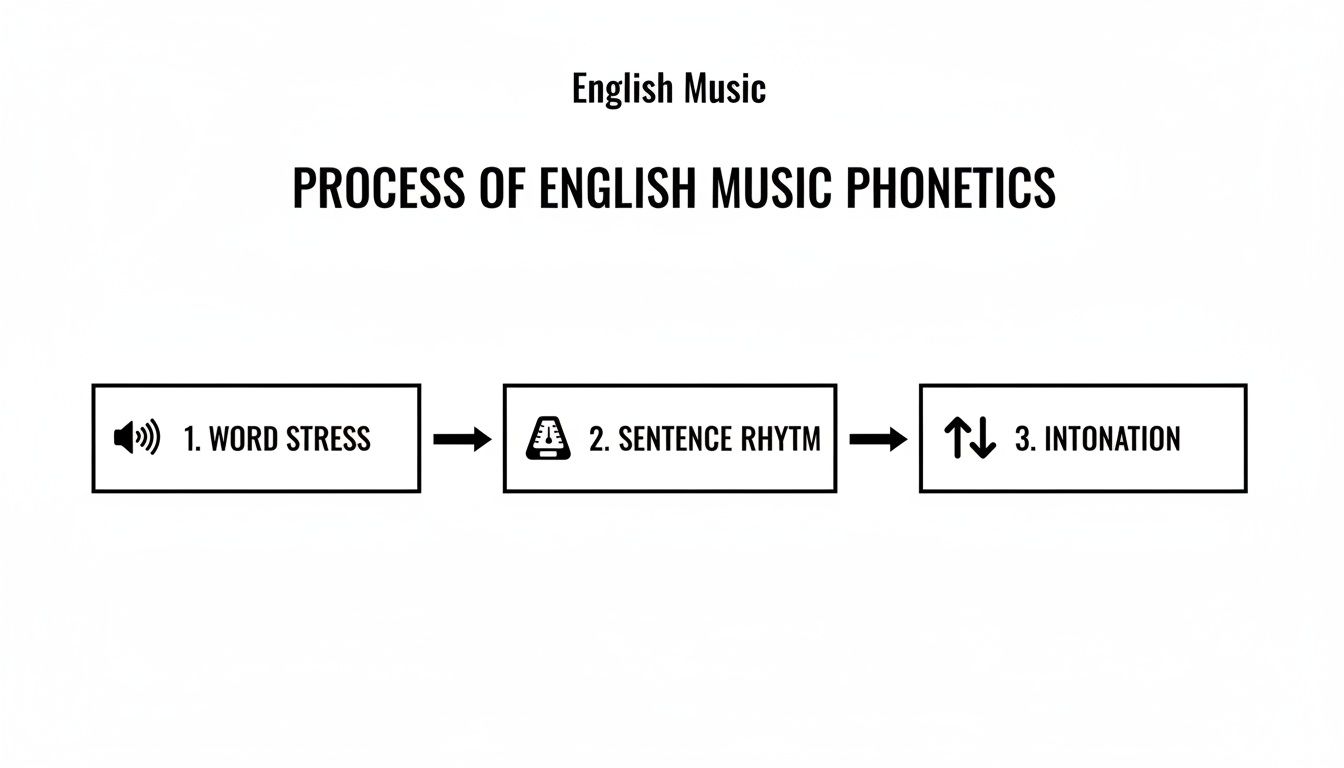
As the flowchart shows, mastering these elements in sequence is what allows you to build a confident, natural, and authentic speaking style.
Tips for Staying Motivated and Accountable
Let’s be honest: motivation comes and goes. The professionals who succeed are the ones who build systems to keep them going even when they don’t feel like practicing.
The secret to long-term success isn’t intensity; it’s consistency. A small, non-negotiable commitment every single day will always outperform sporadic, heroic efforts.
Here are a few tricks I’ve seen work time and time again with my clients:
- Schedule It Like a Meeting. Don’t just hope you’ll “find time.” Block off 15 minutes in your calendar and label it “Pronunciation Practice.” When you treat it like a real appointment, you’re far more likely to do it.
- Track Your Wins. Keep a simple log. Note the date, what you worked on, and one small thing that felt easier than before. Looking back at a list of your efforts is a huge psychological boost on days when progress feels slow.
- Find an Accountability Partner. Team up with a colleague or a friend who’s also working on a skill. You don’t need to practice together, but a quick weekly text—”Did you get your 5 sessions in?”—can make all the difference.
Building a practical routine isn’t about finding more time. It’s about making your existing time work smarter for you.
Applying Your Skills in Professional Scenarios

This is where the rubber meets the road. You’ve been drilling sounds and mastering tongue twisters, but the real test comes when you have to apply those skills in a high-stakes meeting or during a critical presentation. It’s one thing to get it right in private, but quite another to nail your articulation when the pressure is on.
The trick is to shift your focus from practicing sounds to practicing scenarios. When you rehearse with the actual vocabulary and phrases you use every day, you’re not just polishing your American English—you’re building the deep-seated confidence you need to communicate with clarity and authority.
Tailoring Your Practice to Your Industry
Let’s be honest, generic practice phrases are only going to take you so far. To make your skills stick, you need to get specific and focus on the language of your profession. This makes every minute of practice directly relevant and immediately useful.
Start building custom phrase lists for the situations you encounter all the time.
- For Tech Professionals: Think about explaining system architecture or a bug report. Phrases like, “We need to refactor the legacy codebase” or “The API endpoint returned a null value,” are packed with multi-syllable words that are perfect for practicing word stress.
- For Healthcare Providers: Rehearse how you’d explain a diagnosis or a treatment plan. A sentence like, “The preliminary results suggest a follow-up is necessary,” demands clear, calm intonation to build trust with a patient.
- For Sales Executives: Drill your value proposition until it’s second nature. Nailing the stress and rhythm in, “This solution drives revenue while reducing overhead,” can make your pitch dramatically more persuasive.
This kind of targeted practice builds a seamless bridge between your training and your actual performance.
Scripts for High-Stakes Conversations
Some moments at work just carry more weight. Leading a team meeting, presenting to leadership, or negotiating a contract—these are times when polished communication is non-negotiable. Preparing for these events with scripts helps you consciously apply your new pronunciation habits instead of falling back on old patterns when you’re under stress.
This is especially critical for executives and tech leads from non-native backgrounds. In hyper-competitive environments like Silicon Valley or on global sales teams, clear American English intonation and stress patterns can build trust and credibility in record time. In fact, some research suggests that non-natives with refined accents can close cross-border deals 20-30% more effectively. It’s a tangible advantage.
Here’s a quick script you can adapt for opening a project kickoff meeting:
“Good morning, everyone. Thanks for joining. The primary objective of today’s meeting is to align on the project scope and establish our key milestones for the first quarter. Let’s start with a quick review of the project brief.”
Practice reading this out loud, making sure to land on the stressed words (in bold). Use a falling intonation at the end of each statement to project confidence and control. You can find more strategies to improve your English pronunciation for work and career advancement.
Navigating Common Pitfalls Under Pressure
It’s completely normal for old habits to creep back in when you’re nervous or concentrating on a complex idea. The two most common culprits? Speaking way too fast and reverting to a flat, monotonous intonation.
Here’s how to catch and correct these issues in the moment:
- Conscious Pacing: If you feel your speech accelerating, just stop. Take a deliberate pause. A single, quiet breath before your next key sentence is all it takes to reset your rhythm and regain focus on your articulation.
- Strategic Stress: Before a big meeting, pick out the three most important words in your opening sentence. Seriously, write them down. Make a conscious plan to emphasize them. This one simple trick can instantly pull your delivery out of a monotone and make you sound more dynamic.
And since so much of our work happens online now, make sure your efforts aren’t wasted by poor audio. You can take a few simple steps to improve your audio quality online and ensure your message is always heard clearly. By anticipating these challenges and having a game plan, you can maintain your hard-earned clarity and composure, no matter the situation.
Have Questions About Learning American English? Let’s Talk.
If you’re starting this journey, you’ve probably got some questions. That’s completely normal. Most professionals I work with want to know about the process, the timeline, and what “improving” their American English really means. Let’s get into some of the most common ones to give you some clarity.
The whole point here is to sharpen your voice for maximum impact, not to erase it. Think of this as adding a powerful tool to your communication toolkit, not taking anything away from who you are.
Will Improving My Accent Make Me Lose My Identity?
Absolutely not. Let’s be clear: the goal of learning to speak American English more intelligibly isn’t to erase your accent. Your accent is a huge part of who you are. The real focus is on enhancing clarity and intelligibility.
We do this by tweaking specific pronunciation habits that might be causing communication breakdowns. You’re just refining your ability to be understood effortlessly in a professional American setting. It’s all about making sure your brilliant ideas land the first time, every time.
How Long Does It Take to Actually Notice a Difference?
This really varies from person to person, but the single biggest factor is consistency. With dedicated practice of just 15–20 minutes a day, most professionals tell me they feel a noticeable boost in confidence and clarity within the first 8 to 12 weeks.
Bigger, more automatic changes in your speech patterns naturally take a bit longer, typically building over three to six months. The secret is to stop trying to perfect everything at once. When you zero in on your specific high-impact sounds, your progress speeds up dramatically.
The biggest breakthroughs happen when you shift your mindset from “sounding perfect” to “being understood.” Clarity is the real goal, and it’s a much more achievable—and rewarding—target than perfection.
Can I Do This on My Own, or Do I Really Need a Coach?
You can absolutely make significant progress on your own. With so many great online resources available today, self-study is more possible than ever. If you follow a structured plan, record yourself, and stick to your drills, you’ll definitely see improvement.
However, a coach is an accelerator. A good coach provides the kind of personalized, expert feedback on pronunciation issues that are nearly impossible to hear in your own speech. They can pinpoint your priorities right away, build a plan that’s just for you, and—most importantly—stop you from accidentally practicing the wrong habits. It can save you a ton of time and frustration.
Should I Focus on Individual Sounds or the “Music” of the Language?
The honest answer? Both. They’re two sides of the same coin.
Mastering individual sounds—like the American /r/ or those tricky vowels—is the foundation. It ensures people understand you at the word level. Without that, sentences can fall apart.
But mastering the “music” of the language—the rhythm, stress, and intonation—is what makes you sound natural and fluent at the sentence level. This is often the final piece of the puzzle for advanced learners. The most effective path is a balanced approach that hits both. Of course, clear speech goes beyond just pronunciation; a solid grasp of the basics is key for building your sentences. You can master basic English grammar rules to make sure that foundation is strong.
Ready for some personalized feedback and a clear, actionable plan to get started? Intonetic offers a free initial assessment to pinpoint your exact pronunciation priorities. Book your no-obligation call today and get a PDF starter guide to kickstart your journey toward clearer, more confident communication. Learn more and book your assessment at Intonetic.