
A Guide on How to Pronounce TH in English Like a Native
If you struggle with the English ‘th’ sounds, you’re in good company. The simple truth is they’re tough because they are incredibly rare sounds on a global scale. Your mouth just isn’t trained to make them. Mastering the voiceless /θ/ (like in think) and the voiced /ð/ (like in this) is all about building new muscle memory, not a reflection of your language ability.
Why the TH Sound Is So Hard to Master
For a lot of English learners, the ‘th’ sound feels like the final boss in a video game—frustratingly hard to beat. This struggle isn’t your fault; it’s deeply rooted in linguistics and the unique mechanics of your native language. When learning a new language, your brain and mouth instinctively try to substitute unfamiliar sounds with the closest ones from your mother tongue.
This is a totally normal part of language acquisition. It’s the reason so many speakers accidentally say ‘fink’ instead of ‘think’ or ‘dis’ instead of ‘this’. Your brain is just taking a shortcut, replacing the new, complex ‘th’ movement with a more familiar ‘f’, ‘t’, ‘d’, or ‘s’ sound. Breaking this subconscious habit takes conscious effort and a clear understanding of what’s really going on.
A Rare Sound on a Global Scale
The heart of the issue is that the ‘th’ sounds are statistical outliers. In fact, these interdental fricatives—the technical term for sounds made with the tongue between the teeth—are incredibly uncommon across the world’s languages. This rarity is a huge reason why pronouncing ‘th’ in English is a widespread challenge for learners from nearly every linguistic background.
Data from the World Atlas of Language Structures reveals that out of 567 languages surveyed, only about 8% include these sounds in their phonetic inventory. That means for the vast majority of people, the specific tongue-and-teeth coordination required is completely new. A detailed acoustic study backed this up, finding the most common substitution for the voiceless /θ/ sound was [f] at a rate of 36.6%. You can find even more of these patterns in academic research.
The difficulty of the ‘th’ sound isn’t a personal challenge—it’s a global linguistic phenomenon. Realizing that you’re retraining your mouth to make a sound that over 90% of the world’s languages don’t use can shift your perspective from frustration to empowerment.
Before we go deeper, here’s a quick-glance table to help you see, feel, and hear the difference between the two ‘th’ sounds.
Voiceless /θ/ vs. Voiced /ð/ Quick Guide
| Feature | Voiceless /θ/ (think) | Voiced /ð/ (this) |
|---|---|---|
| Vocal Cord Vibration | No vibration (just air) | Vibration (buzzing feel) |
| Feel It | Place hand on throat, no buzz | Place hand on throat, feel a buzz |
| Sound Quality | Soft, airy, hissing sound | Deeper, buzzing, resonant sound |
| Common Words | think, thank, three, path, both | this, that, the, they, breathe |
Getting a feel for this physical difference is the first step. The voiceless /θ/ is pure air, while the voiced /ð/ adds that hum from your vocal cords.
The Role of Native Language Interference
Your first language creates a powerful phonetic blueprint in your brain. When you try to produce a sound that doesn’t exist in that blueprint, you run into what linguists call L1 interference. This is simply when the rules of your native language “interfere” with the rules of the language you’re learning.
This is why understanding your specific substitution pattern is so important for making real progress.
- Romance languages (Spanish, French, Italian): Speakers often substitute ‘th’ with a /t/ or /d/ sound.
- Germanic languages (German, Dutch): Learners might default to an /s/ or /z/.
- Slavic languages (Russian, Polish): Common substitutes include /s/, /z/, /f/, or /v/.
- Sino-Tibetan languages (Mandarin, Cantonese): Speakers might use an /f/ or /s/.
By identifying your default error, you can focus your practice where it counts. If you want to go deeper, check out our guide on how to reduce your native language interference in English accent. This awareness is the first step toward consciously overriding those old habits and building new, clearer pronunciation skills.
Mastering the Voiceless /θ/ Sound
Let’s dive into the first of the two ‘th’ sounds: the voiceless /θ/. This is the airy, hissing sound you hear in words like think, both, and math.
Unlike its voiced sibling, this sound is made with absolutely no vibration from your vocal cords. It’s purely a stream of air that you shape with your tongue and teeth. Getting this one right is a huge step toward clearer, more natural-sounding English.

The secret to the /θ/ sound lies in a gentle, precise tongue placement. So many of my clients initially press their tongue too hard or put it in the wrong spot, which is what turns “think” into “tink” or “fink.” Your goal here isn’t to block the air completely but to create a very narrow gap for it to escape through.
The Mechanics of the Sound
Okay, let’s break down the physical steps. I always recommend standing in front of a mirror for this part. Being able to see what your mouth and tongue are doing provides incredibly valuable feedback as you build new muscle memory.
- Start Relaxed: Let your mouth open slightly. Your jaw and lips should be completely relaxed, with no tension.
- Position Your Tongue: Gently place the very tip of your tongue either lightly between your top and bottom front teeth or just behind your top teeth. The key is “lightly.” It shouldn’t stick out far—just enough to be visible.
- Create the Air Stream: Now, push a steady, continuous stream of air out of your mouth, forcing it through that tiny gap between your tongue and teeth.
The feeling you’re aiming for is a soft, controlled hiss. Think of a tire with a slow leak. It should feel effortless, without any hard stops or popping sounds. If you hear a sharp ‘t’, you’re definitely pressing your tongue too hard. Ease up.
Practicing /θ/ in Different Word Positions
This sound can show up anywhere—at the beginning, middle, or end of a word. Practicing it in every position is the best way to solidify your control and make it automatic in real conversations.
At the Beginning of Words:
- think
- three
- thank
- thirsty
In the Middle of Words:
- nothing
- healthy
- worthy
- something
At the End of Words:
- bath
- earth
- math
- teeth
Say these words out loud, paying close attention to the physical sensation of making that /θ/ sound. Go ahead and record yourself, then listen back and compare it to a native speaker’s pronunciation. It might feel strange at first, but with a bit of repetition, these drills will make the movement feel completely second nature.
For a more advanced challenge, you can explore minimal pairs in English, the secret to training your ear and correcting pronunciation. This is a fantastic way to train your brain to hear and produce the difference between /θ/ and similar sounds like /s/ and /f/.
Turning Up the Volume: The Voiced /ð/ Sound
Now that you’ve got the hang of the airy, voiceless /θ/, it’s time to add some power and bring its sibling to life: the voiced /ð/ sound. This is that buzzing, resonant sound that you hear in some of the most fundamental words in English, like this, that, and mother.
The great news? You already know the mechanics. The placement of your mouth and tongue is exactly the same as for the /θ/ sound, with your tongue tip resting gently between or just behind your front teeth. The only new ingredient is vibration. By engaging your vocal cords, you transform that quiet hiss into a noticeable buzz.
Feel the Vibration
The single best way to know if you’re producing the /ð/ sound correctly is to feel it, not just hear it. This simple physical check is a game-changer for so many of my clients.
Gently place two fingers on the front of your throat, right over your voice box (what some call the Adam’s apple). Now, say the word “this.” As you form the “th” sound at the beginning, you should feel a distinct buzzing sensation right under your fingertips. That’s your vocal cords kicking into gear.
If you don’t feel that buzz, you’re probably still making the voiceless /θ/ sound. A great trick is to hum first (mmmm) to get your vocal cords vibrating, then smoothly transition into the /ð/ sound while keeping that vibration going.
This tactile feedback is your built-in confirmation tool. It helps you instantly tell the difference between /ð/ and other common substitutions like ‘d’ or ‘z’, which feel completely different to produce. Mastering this feeling is a huge step on your journey to master English consonant sounds for a better accent.
High-Frequency Practice Words
The /ð/ sound is everywhere in English, especially in function words—those small but essential words that glue our sentences together. Nailing their pronunciation will make your speech flow much more naturally.
Let’s get some practice with these common words:
- At the Beginning: the, this, that, they, them, then, there
- In the Middle: mother, brother, father, another, weather, together
- At the End: breathe, soothe, smoothe (Note: Ending a word with /ð/ is much less common)
Don’t underestimate this sound. Linguistic research has shown that the voiced /ð/ can be a major hurdle for learners. A 2022 study of high school students revealed it was tougher to master than its voiceless counterpart, with over a third of male participants getting a ‘poor’ rating on their pronunciation. Even native speaker usage can be tricky; one poll found that 16% of American English speakers use /ð/ at the end of “with,” a pattern more common in Southern British English. You can read more about these pronunciation challenges on aclanthology.org.
Building Your TH Muscle Memory With Drills
Knowing the mechanics of the ‘th’ sound is one thing, but making it a natural, automatic part of your speech is a whole different ball game. This is where consistent, targeted practice comes into play. The real goal is to build new muscle memory so your tongue and mouth can produce the /θ/ and /ð/ sounds without you even thinking about it.
It’s all about training your mouth and your ears at the same time. By repeatedly working through specific drills, you’re essentially rewiring the neural pathways that control your speech, making the ‘th’ sound just as effortless as any sound in your native language.
Sharpen Your Listening With Minimal Pairs
One of the most powerful ways to train your brain is with minimal pairs. These are pairs of words that are almost identical—the only difference is one single sound. Practicing them helps you fine-tune your ear to catch the subtle difference between the ‘th’ and the sounds you might be accidentally swapping in.
The following table lays out some common minimal pairs. Use these to practice distinguishing the ‘th’ sounds from their most frequent error substitutions.
| Minimal Pair Practice Drills for TH Sounds |
|---|
| Voiceless /θ/ vs. /s/ |
| think vs. sink |
| thing vs. sing |
| path vs. pass |
| Voiceless /θ/ vs. /f/ |
| three vs. free |
| thought vs. fought |
| oath vs. oaf |
| Voiced /ð/ vs. /d/ |
| they vs. day |
| then vs. den |
| breathe vs. breed |
Try saying these pairs out loud, really focusing on the distinct mouth positions for each sound. Recording yourself and listening back can be a game-changer; you’ll start to hear exactly where your pronunciation is solid and where it needs a bit more work.
Don’t just rush through the words. The power of minimal pairs comes from exaggeration. Over-articulate the ‘th’ sound, making sure you can feel the air flowing for /θ/ and the vibration for /ð/. This intentional practice is what builds lasting habits.
This process flow visualizes the three core actions for producing the voiced /ð/ sound.
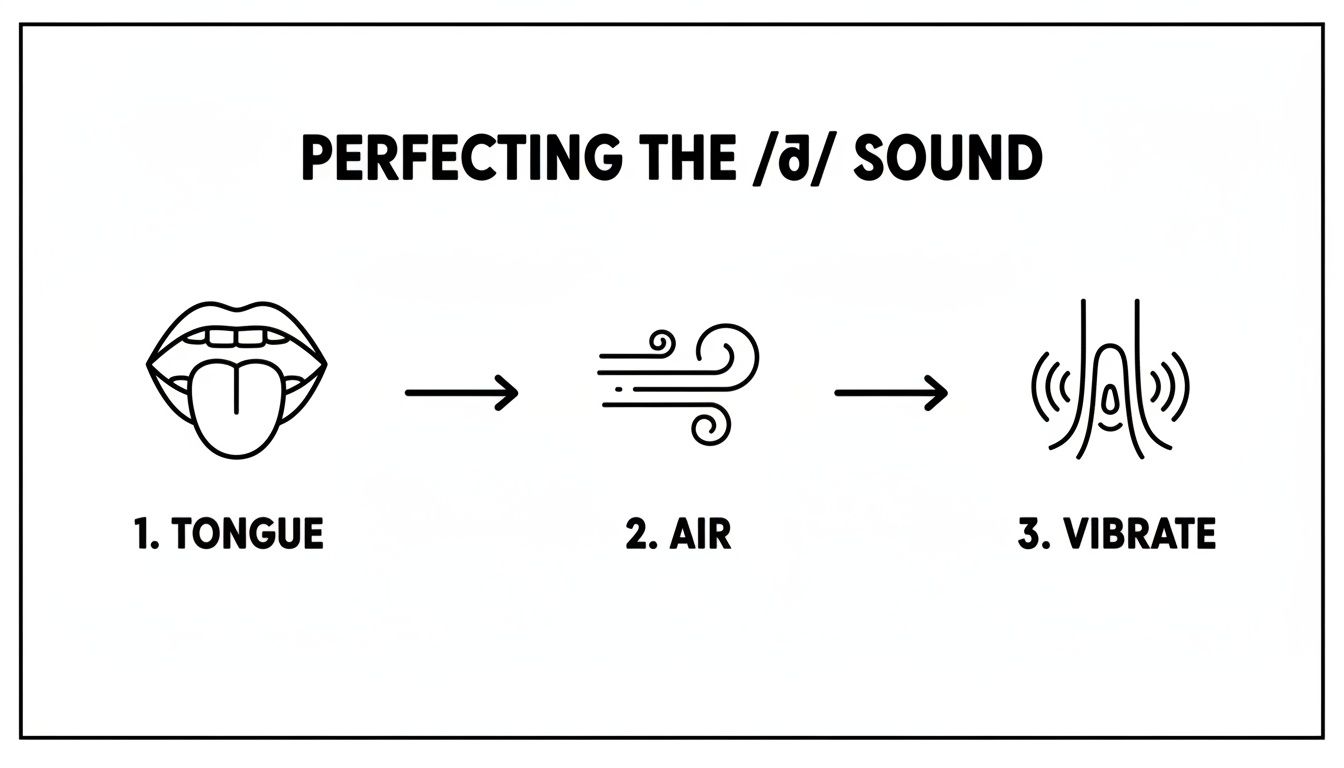
As you can see, mastering the sound is a sequence of precise physical actions—tongue placement, controlled airflow, and vocal cord vibration.
Integrate the Sound With Tongue Twisters
Once you feel more confident telling the sounds apart, it’s time to challenge your agility. Tongue twisters are fantastic for this because they force you to switch between ‘th’ and other sounds quickly, which is exactly what happens in real conversation.
Start slowly, then gradually pick up the pace as you get more comfortable. Remember, accuracy trumps speed here.
- “Three thousand thick feathers float through the air.” This one is packed with the voiceless /θ/ and forces you to differentiate it from the /f/ sound.
- “These things, those things, and the other things.” A perfect drill for practicing the voiced /ð/ in quick succession.
- “I thought a thought, but the thought I thought wasn’t the thought I thought I thought.” This classic is a true workout for the voiceless /θ/.
Tongue twisters aren’t just for kids; they are a serious form of vocal exercise. For more ideas on getting your mouth ready for speaking, check out our guide on vocal warm-ups and tongue twisters for clearer speech.
Put It All Together With Full Sentences
Finally, it’s time to take these sounds off the practice page and put them into real-world sentences. You can create your own sentences using the minimal pairs from earlier, or just practice with these examples. This is the step that bridges the gap between isolated drills and fluid conversation.
- I think I saw three healthy things over there.
- My father and mother went north together.
- Is that the path to the fourth theater?
Troubleshooting Common TH Pronunciation Mistakes
Even with the best instructions, old habits die hard. If you’ve been practicing and your ‘th’ sounds still aren’t quite landing, don’t get discouraged. This is a totally normal part of the process, and figuring out exactly what’s going wrong is the first real step to fixing it for good.
Let’s play detective and diagnose some of the most frequent slip-ups I see with my clients.

Often, the problem comes down to a tiny, almost unnoticeable error in pressure or placement. A small adjustment can be the lightbulb moment that turns a frustrating mispronunciation into a clear, crisp sound.
The “T” and “D” Substitution Error
Does “think” keep coming out as “tink”? Or does “that” sound more like “dat”? This is, without a doubt, the most common hurdle. It all stems from one simple action: your tongue is pressing way too hard.
When your tongue tip makes firm contact with the bumpy ridge behind your top teeth (that’s the alveolar ridge) and completely stops the air, you’re making a /t/ or /d/. To make a ‘th’, you need airflow.
- The Fix: Lighten up! Your tongue should barely kiss the back of your top teeth, allowing a continuous, gentle stream of air to flow over it. Think “hiss,” not “hit.” It’s about friction, not a hard stop.
The “S” and “Z” Substitution Error
If your “think” sounds more like a snake’s hiss (“sink”), the issue is that your tongue has retreated. It’s likely hovering just behind your teeth but not actually making contact. This placement creates that sharp, high-frequency friction of an /s/ or /z/.
- The Fix: Grab a mirror and watch your tongue. Gently guide the tip forward until it’s either peeking between your teeth or making the softest contact with the back of your top front teeth. That forward movement is the key.
Self-Correction is Key: The fastest way to improve is to become your own accent coach. Record yourself saying a few target words. Listen back, compare it to a native speaker’s recording, and try to diagnose your specific error. This active listening trains your ear and accelerates your progress tenfold.
The “F” and “V” Substitution Error
This one is a classic mix-up of articulators. The error happens when your tongue stays put inside your mouth and your bottom lip comes up to touch your top teeth. That’s the perfect placement for /f/ and /v/, but it completely sidesteps the tongue action needed for /θ/ and /ð/.
- The Fix: The mirror is your best friend here, too. Watch yourself say “three” or “they.” If you see that bottom lip rising to meet your teeth, you’ve caught the culprit. Consciously keep your lips relaxed and slightly apart, focusing on leading the movement with your tongue.
These are just a few common patterns, and many learners find they struggle with a combination of issues. If you’re looking for a more structured way to untangle these habits, you might find it helpful to explore resources that cover how to fix common English pronunciation mistakes easily.
Remember, troubleshooting is a skill in itself. By learning to identify and correct these small mechanical errors, you’re empowering yourself to refine your accent with real precision.
Your Top Questions About the TH Sound, Answered
Even after you’ve put in the work, some questions always seem to come up. It’s totally normal. Here are the answers to some of the most common things learners ask me when they’re wrestling with how to pronounce the English ‘th’.
Is It Ever Okay to Pronounce TH as F or D?
This is a great question. While you might hear some native English speakers in certain dialects make these substitutions (like saying “free” for “three”), it’s not the standard in professional or international circles.
If your goal is to be understood as clearly as possible, sticking to the standard /θ/ and /ð/ sounds is your best bet. In most business or academic settings, swapping these sounds can accidentally make you sound less proficient or, worse, cause genuine confusion. For maximum clarity, mastering the standard pronunciation is the way to go.
How Far Should My Tongue Really Stick Out?
I get this one all the time, and the answer is usually a relief: not very far at all! Many learners think they need to make a big, dramatic gesture with their tongue, but it’s actually much more subtle.
The tip of your tongue should just barely peek out between your front teeth. In fact, you can even make a perfect ‘th’ by placing the very tip of your tongue just behind your top front teeth.
The goal isn’t a visual performance. It’s about creating that tiny, controlled gap for the air to hiss through. Focus on the friction and airflow, not how far your tongue is sticking out.
How Long Will It Take to Master the TH Sound?
There’s no magic number, as it really depends on your native language and how consistently you practice. But the key isn’t logging hours—it’s about focused, daily effort.
Here’s a realistic timeline based on what I see with my clients:
- Initial Improvement: With just 10-15 minutes of targeted, daily drills on the mechanics and minimal pairs, most people notice a huge improvement in just a couple of weeks.
- Automatic Pronunciation: To get to the point where you don’t even have to think about it in a normal conversation? That usually takes a few months of consistent use and reinforcement.
Remember, consistency beats intensity every time. Short, frequent practice sessions are far better for building new muscle memory than one long, grueling session once a week. And when you’re creating instructional content to explain these kinds of nuances, learning how to add accurate captions to your instructional videos can make a world of difference for your learners’ comprehension.
At Intonetic, we build personalized plans to help you master challenging sounds and speak with clarity. If you’re ready to be understood the first time, every time, learn more about our accent coaching programs at https://intonetic.com.