
How to Pronounce S Clearly and Confidently
To make the English /s/ sound, you’ll want to bring the sides of your tongue up to touch your upper side teeth. This creates a narrow groove right down the middle. From there, you just gently push a continuous stream of air through that groove to create a clean hissing noise. The trick is to do this without letting your vocal cords vibrate.
This is the voiceless sound you hear in words like success, simple, and strategy.
Mastering the Mechanics of the English S Sound
Getting into the nitty-gritty of the /s/ sound shows you just how essential it is for clear, professional English. Even a tiny error in how you make this sound can completely change a word’s meaning, which can chip away at your credibility in a meeting or presentation. Understanding the physical mechanics is the first real step toward building the muscle memory you need to say it clearly every single time.
This is especially true if you're a non-native speaker. Often, the biggest pronunciation hurdles come from the habits of your native language, where the /s/ sound might not exist at all or is made in a totally different way.
The Core Components of the S Sound
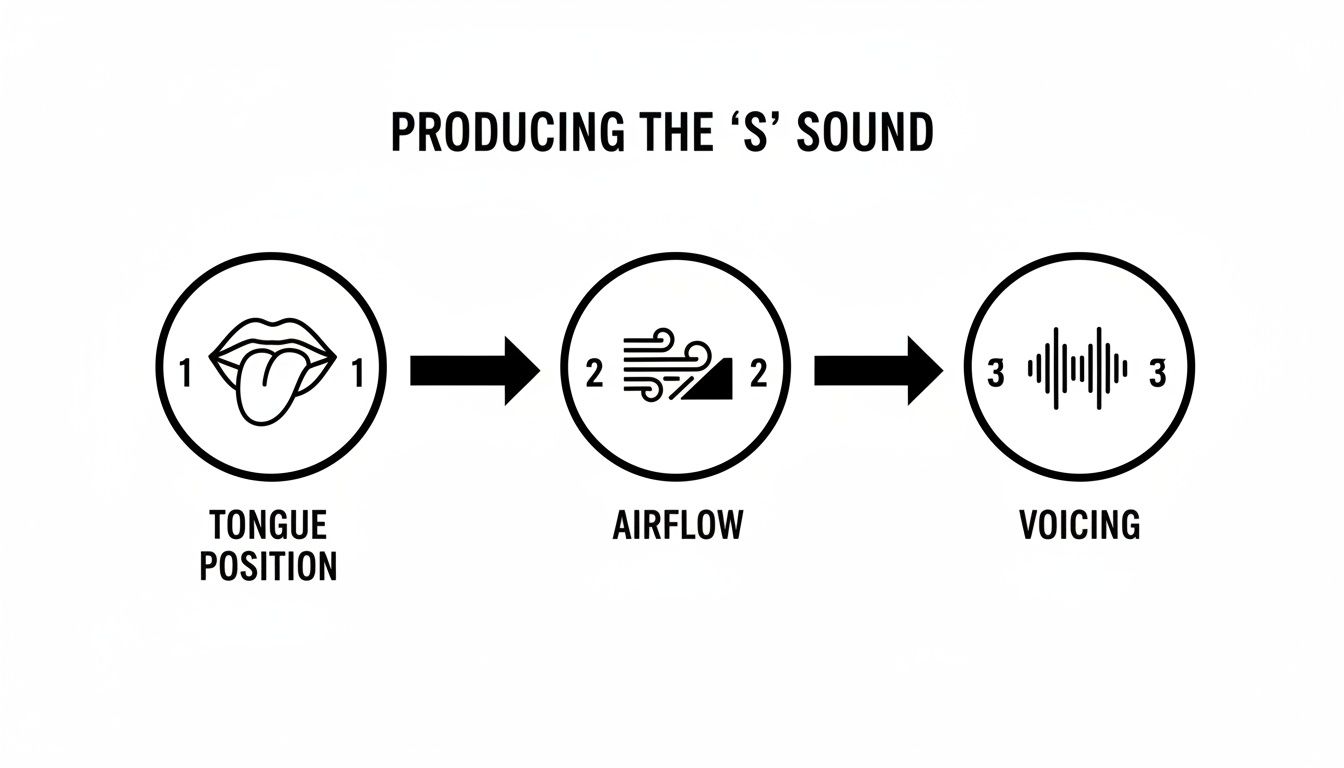
A perfect /s/ sound comes down to coordinating three things: your tongue position, your airflow, and whether or not you're using your voice. Get these right, and you’ll sound crisp and be understood the first time.
- Tongue Position: Your tongue is the star player here. It has to be in just the right spot to form that narrow channel for the air.
- Airflow: The sound itself is nothing more than a steady, controlled stream of air. If you push too much or too little, the sound can get distorted and come out weak or slushy.
- Voicing: The /s/ sound is voiceless. That means your vocal cords don't vibrate. This is the only thing that separates /s/ (like in sip) from its voiced twin, /z/ (like in zip).
This visual breaks down that simple three-part process.
Here's a quick comparison to help you feel the difference between the /s/ and its voiced counterpart, the /z/. The mechanics are nearly identical, with just one key change.
Quick Guide to Producing the /s/ and /z/ Sounds
| Component | /s/ Sound (Voiceless) | /z/ Sound (Voiced) |
|---|---|---|
| Tongue Tip | Near the alveolar ridge | Near the alveolar ridge |
| Tongue Sides | Touching upper side teeth | Touching upper side teeth |
| Airflow | Continuous hissing stream | Continuous buzzing stream |
| Vocal Cords | Not vibrating (voiceless) | Vibrating (voiced) |
Placing a hand on your throat while you practice is a great way to physically feel the difference. You’ll feel a buzz for /z/ but nothing for /s/.
Mastering the /s/ is a physical skill, a lot like learning a golf swing—each part has to work together perfectly. Building this kind of physical awareness is your first move toward correcting old pronunciation habits. If you’d like to explore this further, take a look at our complete guide on how to master English consonant sounds for better accent.
The Three Pillars of a Perfect S Sound
To really nail the English /s/ sound, you need to break it down into three core components. I like to think of these as the pillars holding up a clear, confident sound. Once you get these three elements working together, you’ll find that ambiguity disappears, and people understand you the first time, every time.

Pillar 1: Articulation and Placement
First things first, let’s talk about the physical stuff. Articulation is just a fancy word for where you put your tongue and teeth. For a perfect /s/, the very tip of your tongue needs to hover just behind your top front teeth. It should get super close to that bumpy ridge on the roof of your mouth, but—and this is important—without actually touching it.
At the same time, the sides of your tongue should gently press against your upper side teeth. This creates a narrow channel right down the middle, which is the secret to directing the air just right.
Pillar 2: Controlled Airflow
Okay, once your tongue is in position, the next piece of the puzzle is your breath. The /s/ sound is all about a steady, continuous stream of air pushed through that narrow channel you just formed.
This isn’t a forceful burst of air. Far from it. Instead, think of a slow, controlled hiss, almost like the sound of air leaking from a tire. This steady airflow is what produces a clean, sharp sound, not a slushy or weak one.
Key Takeaway: The goal is a consistent hiss, not a puff of air. A great self-check is to see if you can hold the “sssss” sound for several seconds without running out of breath or having the sound quality change. If you can, your airflow is right on track.
Pillar 3: The Crucial Voicing Distinction
The final pillar is voicing—a simple concept that makes a world of difference. It just means whether or not your vocal cords vibrate when you make a sound.
The /s/ sound is voiceless, meaning there’s no vibration at all. You can feel this for yourself. Place your fingers on your throat and say “ssssnake.” You shouldn’t feel any buzzing.
This is the only thing that separates /s/ from its voiced twin, /z/. For the /z/ sound in words like “zoo” or “designs,” your mouth position and airflow are identical, but your vocal cords are buzzing. In a professional setting, mixing these up can completely change your meaning, turning “price” into “prize” or “advice” into “advise.” This is why learning how to enunciate better is so vital for getting your message across clearly.
This distinction is a common hurdle for global professionals. For instance, a 2021 study of Thai EFL students found that features like stress and intonation—which are closely tied to how sounds like /s/ function in a word—were the most difficult aspect of pronunciation for them to master.
Fixing Common S Pronunciation Mistakes
Many of the hurdles with the English /s/ sound come straight from the habits baked in by our native languages. It’s completely normal for your brain to default to sounds it already knows. The trick is to spot these automatic patterns so you can move from unconscious error to conscious correction.
Let’s break down the most frequent mistakes I see and give you some targeted, practical ways to fix them for good.
From ‘Ship’ to ‘Sip’: The /ʃ/ Substitution
One of the most common swaps is replacing that crisp /s/ with a softer /ʃ/ (the “sh” sound). This turns words like “see” into “she,” or “sip” into “ship.”
This usually happens because the tongue is pulled just a little too far back in the mouth, creating a wider, less focused stream of air.
To nail this, it’s all about tongue placement. Remember, for a clean /s/, the very tip of your tongue needs to be forward, hovering right behind your top front teeth. For the /ʃ/ sound, the blade of your tongue is much further back.
- Practice Tip: Make a long “shhhhh” sound and pay close attention to where your tongue is. Now, slowly slide the tip of your tongue forward, aiming for the ridge behind your teeth, until that sound sharpens into a clean “sssss.” Feeling that contrast is key to building the right muscle memory. You can get more targeted practice with minimal pairs in English to really train your ear to catch the difference.
The Frontal Lisp: When the Tongue Pushes Forward
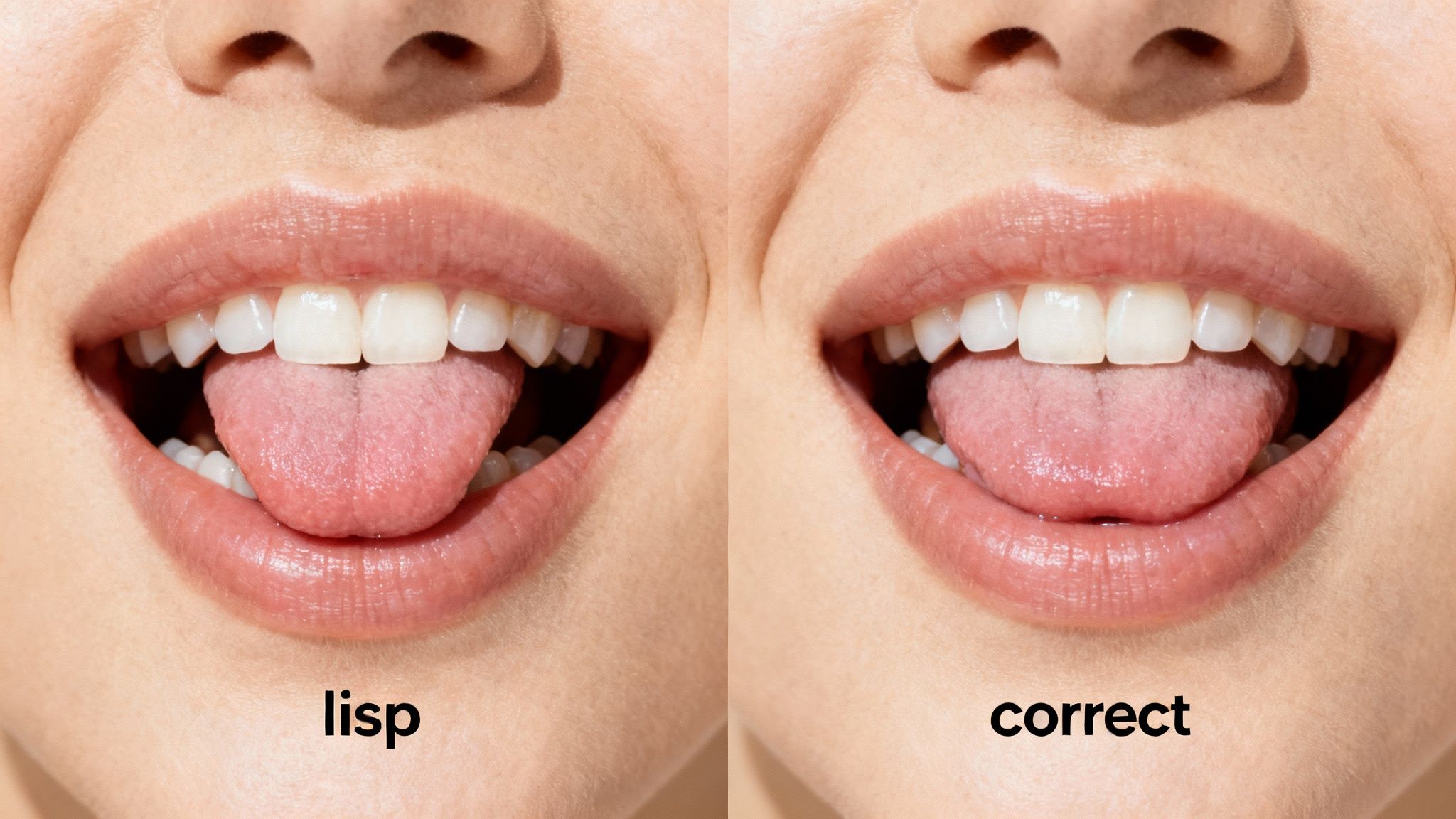
A lisp happens when the tongue tip goes too far forward, either touching or even poking out between the front teeth. This changes the /s/ sound into something that sounds more like a /θ/ (the “th” in “think”).
A word like “sing” might come out sounding more like “thing.” The fix here is all about control—learning to pull the tongue back just a fraction. Your tongue tip needs to stay behind your teeth, never making contact.
From ‘Rice’ to ‘Rise’: The Devoicing Dilemma
Another mistake I see all the time is devoicing. This is when a voiced /z/ sound at the end of a word gets switched to a voiceless /s/. It’s why “prize” can end up sounding like “price,” or “his” turns into “hiss.”
This is a really common pattern for speakers of languages like German or Spanish, where voiced consonants at the end of a word are rare.
The fix for this is physical; you literally have to feel the vibration. Place your fingers on your throat and say a long, clean “sssss.” You shouldn’t feel anything. Now, keep your mouth in the exact same position but “turn on” your voice to make a “zzzzz” sound. That buzzing you feel is the difference. Practice holding that vibration on final sounds in words like “is,” “was,” and “designs.”
These aren’t just minor slips of the tongue. In a fast-paced professional environment, mispronunciations like these can cause real confusion. Research on EFL students confirms this isn’t just anecdotal; while many struggle with sounds like /θ/, a huge portion—up to 32%—also have trouble with ‘s’ consonant clusters, and 20% admit to frequent mispronunciations in general. You can find more insights on these common pronunciation challenges.
From Single Sounds to Fluent Sentences
Knowing the theory behind the /s/ sound is one thing. Actually building the muscle memory to nail it in a real conversation? That takes consistent, structured practice.
Think of this as your workout plan for mastering the English /s/. We’ll start with the absolute basics—the isolated sound itself—and progressively build up to complex, professional sentences. This method ensures you develop a rock-solid foundation before you ever have to worry about it in a high-stakes meeting.
This step-by-step progression is designed to train your mouth and your ear at the same time, moving you from conscious effort to automatic, crystal-clear pronunciation.
Practice Progression for the /s/ Sound
To build new muscle habits, you need a clear progression. The table below outlines the exact path we’ll follow, moving from simple to complex to ensure each skill builds on the last. This is how you make a new pronunciation pattern stick for good.
| Practice Level | Focus | Example Exercise |
|---|---|---|
| Isolation | Producing a clean, sustained /s/ sound. | Hold a steady "sssss" for 5-10 seconds, focusing on consistent airflow and correct tongue position. |
| Syllables | Attaching the /s/ sound to basic vowels. | Repeat simple syllables like: see, say, sigh, so, sue. |
| Words | Integrating the /s/ into initial, medial, and final positions. | Practice lists of words: success, missing, case; safe, basic, pass. |
| Clusters | Mastering the /s/ next to other consonants. | Drill tricky combinations: stress, tasks, asks, months, sixth. |
| Sentences | Using the /s/ sound in natural conversational flow. | Read sentences aloud: The system access is secure and seamless. |
Following this structure prevents you from getting overwhelmed and ensures you're truly mastering each stage before moving on.
Starting with the Basics
Your very first goal is simple: just make the sound. Find a quiet spot and practice holding a long, steady "ssssss."
Listen closely. Is it a clean hiss? Or does it sound a bit slushy or weak? This exercise isolates the core mechanic of airflow, which is everything for the /s/ sound.
Once you can produce that clean "sssss" consistently, start attaching it to vowels. This helps your mouth learn to transition smoothly in and out of the sound. Practice repeating sequences like "sa-se-si-so-su" to build agility.
Integrating /s/ into Full Words
Now for the fun part—placing the sound inside actual words. To cover every scenario you'll face in daily conversations, it’s crucial to practice the /s/ in all three positions: beginning, middle, and end.
- Initial Position: success, system, sales, simple, software
- Medial Position: missing, necessary, basic, processes, analysis
- Final Position: case, this, focus, business, plus
Pay extra attention to words where the /s/ is right next to another consonant. These consonant clusters are often the trickiest part of learning how to pronounce s correctly. Words like statistics, tasks, and months demand precise, rapid tongue movements. Slow them way down at first, almost exaggerating each sound, then gradually build up your speed.
Pro Tip: Record yourself practicing these word lists. Listening back is one of the most powerful tools you have. It lets you catch errors you might not even notice while you're speaking, giving you instant feedback on whether your /s/ is truly clear or if it’s accidentally shifting toward another sound.
Putting It All Together in Sentences
Finally, it's time to practice in a more natural context. The goal here isn't just to get one word right, but to maintain that clarity through an entire thought.
As you get more comfortable, you’ll start to notice how sounds blend together in what linguists call connected speech. If you want to dive deeper into this, our guide on sound changes in American English is a great resource for understanding these natural patterns.
Start with simple sentences before moving on to more complex phrases you'd use at work. Here's a great one for business contexts: She sells strategic software solutions successfully. This sentence is a fantastic workout for your pronunciation skills, packing multiple /s/ sounds into various positions.
Advanced Drills for Professional Scenarios

This is where the real work begins—and where you start seeing massive gains. Moving beyond simple word lists is how you build genuine, real-world confidence.
In a professional environment, clarity isn't just about making a clean /s/ sound by itself. It’s about making sure that sound works flawlessly in complex sentences, distinguishes between critical words, and upholds grammar rules without you even having to think about it.
That innocent-looking 's' is a surprisingly common stumbling block. English is demanding with its 44 phonemes, and the /s/ sound is a true chameleon. Research shows that a staggering 55% of ESL students drop the final 's' in words. Even after years of speaking English, many people still process /s/ sounds based on the rhythms of their native language. You can dive deeper into the common pronunciation hurdles and their causes here.
Fine-Tuning with Minimal Pairs
The fastest way I've found to sharpen both your ear and your tongue for tricky sounds like /s/ and /z/ is to drill minimal pairs. These are words that differ by only a single sound, which forces your brain to zoom in on that one crucial difference.
Think about it: mixing up "price" and "prize" in a sales negotiation or "sink" and "think" during a technical demo can cause real confusion. Drilling these pairs builds the muscle memory you need to avoid those slips under pressure.
-
/s/ vs /z/: Start by saying each pair aloud. Really exaggerate the voiceless hiss of the /s/ and feel the vibration in your throat for the voiced buzz of the /z/.
- price / prize
- advice / advise
- rice / rise
- seal / zeal
-
/s/ vs /θ/ (the "th" sound): This is a classic pair for overcoming a lisp or the common habit of substituting "th" for /s/.
- sink / think
- seem / theme
- pass / path
- some / thumb
Key Takeaway: Don't just practice these as single words. Put them into a full sentence. For example: "The prize depends on the price." This simulates the cognitive load of a real conversation and helps the learning stick.
The Grammatical Functions of S in Business
Beyond just being a sound in a word, the /s/ is a grammatical workhorse in English. Mastering its function in plurals, possessives, and verbs is non-negotiable if you want to sound polished and authoritative. Mispronouncing these endings can, unfortunately, signal a lack of fluency to your listeners.
- Plurals: reports, clients, processes, statistics
- Possessives: the manager's decision, the company's assets
- Third-Person Verbs: she analyzes, he oversees, the system launches
A fantastic way to combine all these skills is to create practice sentences that are specific to your job. This makes the exercise immediately relevant and helps you internalize the sounds in a context you use every single day. For more targeted practice, our guide on accent reduction exercises for business professionals is a great next step.
Industry-Specific Practice Sentences
Create and repeat sentences you might actually say at work. This kind of contextual practice is far more powerful than reciting generic tongue twisters.
- For Business/Sales: Our analysis of the sales statistics suggests several possibilities.
- For Technology: Secure system access is essential for all processes.
- For Healthcare: Please assess the patient's symptoms and schedule a series of follow-up consultations.
By regularly drilling these advanced scenarios, you move past simply knowing how to pronounce the /s/ sound. You begin to own it, ensuring your expertise is what shines through in every professional conversation.
Common Questions About Pronouncing S
Even after you've put in the hours, some specific questions always seem to pop up when you're trying to nail the English /s/ sound. In a professional setting, those small details are everything. Little uncertainties can really get in the way of speaking with confidence, so let's tackle some of the most common questions I hear from my clients.
These are the tricky spots that can make or break your clarity in a fast-paced conversation. My goal is to give you direct, practical answers you can start using right away.
How Do I Tell /s/ and /z/ Apart in Fast Speech?
This is probably the #1 question I get, and for good reason. When people talk quickly, the line between the voiceless /s/ and the voiced /z/ can get incredibly blurry. The secret isn't just to listen harder—it's to understand the rules behind when English speakers use each sound.
One of the biggest patterns is with the plural "-s" ending. If the sound right before it is voiceless (like /p/, /t/, /k/, /f/), the ending stays a clean, voiceless /s/.
- Examples: reports, statistics, tips, tasks
But, if the sound before the "-s" is voiced (like /b/, /d/, /g/, /v/, /m/, /n/, /l/, /r/, or any vowel sound), the ending automatically flips to a voiced /z/. This covers a huge percentage of plural words you use every day.
- Examples: designs, systems, services, managers, ideas
Quick Tip: Don't just trust your ears, trust your throat. Place a hand on your throat and say "reports"—you shouldn't feel a buzz at the end. Now say "designs"—you'll feel that vibration kick in for the final sound. This physical feedback is your most reliable guide for getting this right every time.
What Is the Best Way to Practice Tricky Consonant Clusters?
Consonant clusters like "sts" in statistics, "sks" in tasks, or "xths" in sixths are notoriously tough. Your tongue has to do some serious gymnastics in a split second. If you try to rush through them, you'll end up with a mumbled or slushy sound.
The most effective strategy is to slow it way, way down. Break the word apart and build it back up, piece by piece.
- Start at the end. For a word like statistics, just isolate that final cluster: s…t…s. Feel each individual sound.
- Add the last syllable. Now, tack on the preceding vowel: tis-tics.
- Build the full word. Finally, put it all together slowly: sta-tis-tics.
This slow, methodical practice builds the precise muscle memory you need. Once your mouth knows the path, you can execute these complex sounds cleanly when you speed back up to a normal conversational pace.
Why Do I Still Lisp on Certain Words?
Sometimes a slight lisp, where the tongue pushes a little too far forward on an /s/, can hang around on specific words even after you've mostly fixed the habit. This usually happens when the /s/ is followed by a sound that also uses the front of the mouth, like the high front vowel /i/ in words like "see" or "system."
Your tongue is already moving forward for the vowel, and it can easily overshoot its target for the /s/ that comes before it.
To fix this, concentrate on pulling the very tip of your tongue back just a tiny bit on those words. Think of it as setting a stronger anchor behind your teeth before you let the air out. A great way to feel this is by practicing pairs like "so" (where the tongue is naturally further back) versus "see" (where it's more forward). This helps you gain conscious control over that subtle but critical adjustment.
At Intonetic, we guide professionals through these exact challenges to build clear, confident communication skills. If you're ready to master the nuances of American English pronunciation and be understood the first time, every time, book your free assessment today.