How to pronounce acronyms: Master quick tips for clearer speech
When it comes to pronouncing acronyms, it seems simple on the surface. You either say each letter individually, like FBI, or you pronounce it as a word, like NASA. But knowing which path to take, especially in a professional setting, is the real challenge. One wrong turn can leave your audience confused and, worse, make you seem less credible.
Why Acronym Pronunciation Matters in Business

Picture this: you’re in a high-stakes meeting, about to make a critical point, and you stumble over a common term like 'GDPR' or 'EBITDA'. It might feel like a minor slip, but those small hesitations can subtly chip away at your professional authority.
When you pause or mispronounce a term that everyone else uses effortlessly, it can signal a lack of confidence or familiarity, even if you’re a complete expert in your field. This isn't just about sounding "correct"—it’s about being effective, authoritative, and understood the first time.
For non-native English professionals, getting acronyms right is a crucial communication skill that builds trust and sidesteps costly misunderstandings.
The Real-World Impact of Pronunciation
The consequences of fumbling an acronym can be surprisingly significant, affecting everything from client relationships to the bottom line. A moment of hesitation might cause a listener to second-guess your expertise, whereas a clear, confident delivery reinforces it.
Just look at the financial impact in high-volume environments. In enterprise contact centers handling over 500,000 monthly calls, pronunciation errors on acronyms drive 15-18% of all calls to human escalation. This adds up to an estimated $1.8 to $2.16 million in preventable costs each year.
These numbers prove that clarity isn’t just a "soft skill"—it carries a direct and measurable financial cost. When a customer struggles to understand an acronym, it creates friction, wastes resources, and ultimately damages their experience with your brand.
Building Authority Through Clarity
Beyond just avoiding mistakes, nailing your pronunciation is a powerful way to build your professional presence. When you speak with total clarity, your ideas land exactly as you intended, without forcing your audience to mentally decipher your words.
This skill is fundamental to improving your overall https://intonetic.com/how-to-improve-english-pronunciation-for-business-professionals/, making sure you can command attention in any room. It polishes your professional image and directly contributes to your ability to speak confidently at work.
The Two Core Rules for Pronouncing Any Acronym
You see a string of capital letters in an email or presentation—say, GDPR—and a tiny moment of panic sets in. Do you spell it out letter by letter? Or is there a word you’re supposed to know?
That split-second decision is one every professional faces. Thankfully, it’s not about memorizing an endless list. It really just comes down to spotting one simple phonetic clue that tells you everything you need to know. Once you see it, you can confidently pronounce almost any acronym you encounter.
The whole system boils down to two types of acronyms: initialisms and word-form acronyms.
Rule 1: Spell It Out for Initialisms
An initialism is an acronym you pronounce one letter at a time. This is the most common type, and it's your safest bet when you're unsure.
The dead giveaway is a lack of pronounceable vowels. If the letters are all consonants or a jumble that doesn't form a natural-sounding word, you just default to saying the letters. It’s that simple.
You see this everywhere in business and tech:
- FBI (Federal Bureau of Investigation) – We say "eff-bee-eye."
- HR (Human Resources) – It's always "aitch-are."
- CPU (Central Processing Unit) – Everyone says "see-pea-you."
- BYOB (Bring Your Own Bottle) – You’ll hear "bee-why-oh-bee."
Look at them—FBI, HR, CPU. There’s no easy way to squish those letters into a word. So, we spell them out.
A great rule of thumb is: when in doubt, spell it out. It is always better to pronounce an acronym letter by letter than to incorrectly invent a word that doesn't exist. This approach keeps you sounding clear and professional, even when you're uncertain.
If you're working on nailing the precise sounds of individual English letters, digging into the International Phonetic Alphabet can be a huge help for improving your English pronunciation with the IPA.
Rule 2: Say It as a Word for Word-Form Acronyms
The second kind of acronym is the one we pronounce as a single, complete word. These are often easier and faster to say, which is why they catch on.
The telltale sign here is the presence and placement of vowels that create clean, pronounceable syllables. It’s almost as if they were designed to be spoken like regular words.
Think about these common ones:
- NASA (National Aeronautics and Space Administration) – Pronounced "NA-suh."
- NATO (North Atlantic Treaty Organization) – Pronounced "NAY-toe."
- RADAR (Radio Detection and Ranging) – Pronounced "RAY-dar."
- PIN (Personal Identification Number) – Pronounced "pin."
See how the vowels (A, E, I, O, U) are sprinkled in just the right places? They give the acronym a phonetic backbone, turning a string of letters into a word.
Initialism vs. Word-Form Acronyms: A Quick Guide
So, how do you make the call in a split second? It comes down to looking for those vowels. This quick table breaks down the decision-making process for you.
| Acronym Type | Pronunciation Rule | Telltale Clue | Example (How to Say It) |
|---|---|---|---|
| Initialism | Say each letter individually. | The letters don't form a natural, pronounceable word (often lacks vowels). | IBM (eye-bee-em) |
| Word-Form Acronym | Pronounce the letters as a single word. | The letters include vowels that create a clear syllable structure. | OSHA (OH-shuh) |
Once you get the hang of spotting this pattern, that little moment of panic will disappear. By internalizing these two simple rules, you’ll have a reliable mental shortcut for pronouncing acronyms clearly and confidently in any conversation.
Pronouncing Acronyms in Your Industry
Have you ever been in a meeting and hesitated before saying an acronym out loud, worried you might get it wrong? We’ve all been there. Once you move past the general rules, you have to tackle the specific jargon of your professional world.
Getting this right is about more than just correctness. It’s a powerful, subtle signal to your colleagues that you not only understand the concepts but are also fluent in the culture of your field. It shows you belong.
Let's walk through some common acronyms in tech, healthcare, and finance so you can use them with total confidence.
Cracking the Code on Tech Acronyms
The tech world practically runs on abbreviations. Mispronouncing one can instantly make you feel like an outsider, even if you know the material inside and out. While many follow the patterns we've discussed, a few tricky ones always trip people up.
- API (Application Programming Interface) This is a classic initialism. You say each letter individually: A-P-I. You'll never hear an experienced developer call it "appy."
- SaaS (Software as a Service) With its two vowels, this one is pronounced as a single word: Sass. It should rhyme with "pass."
- SQL (Structured Query Language) Here’s a famous exception. Even though it has no vowels, the most common pronunciation by far is "sequel." While you might hear an old-school programmer say "S-Q-L," saying "sequel" will make you sound current.
This decision tree gives you a great visual shortcut for the basic thought process.
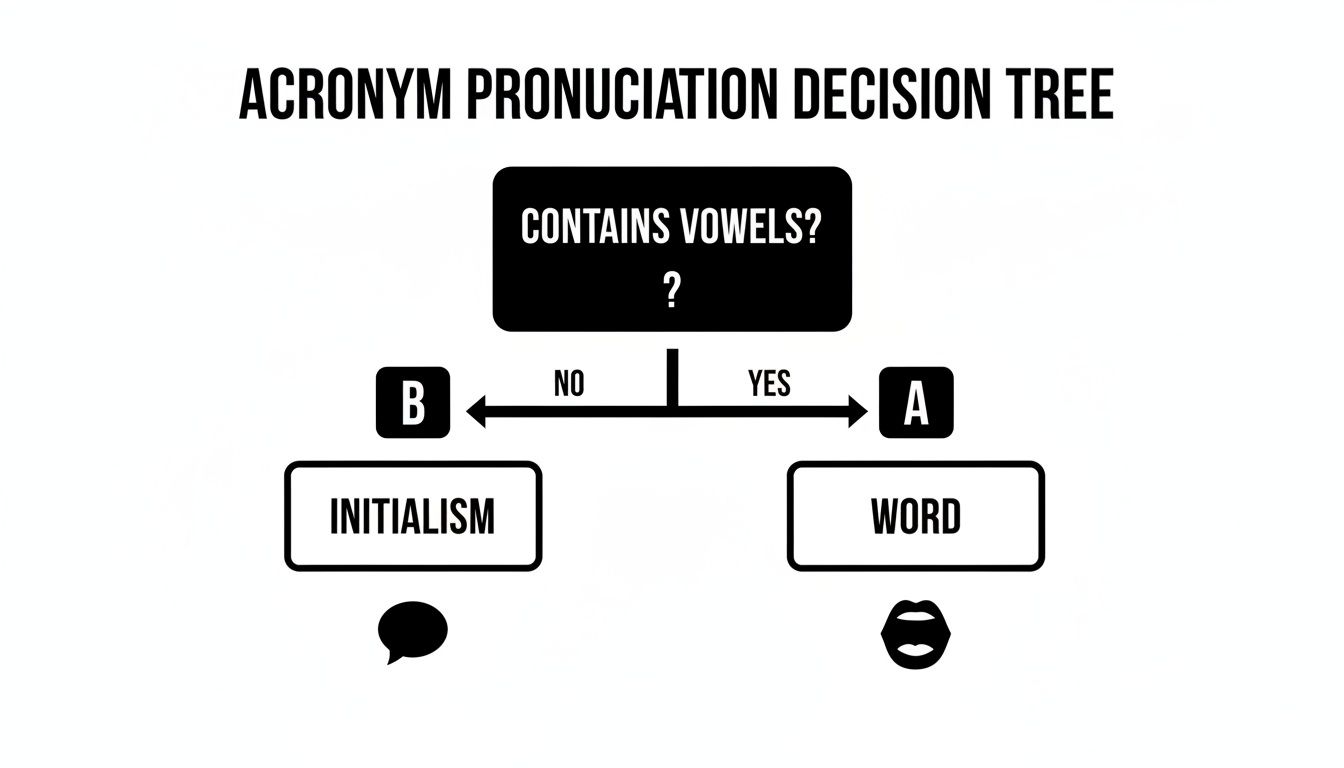
As you can see, vowels are usually the key that turns a string of letters into a word. But as SQL proves, you always have to listen for those industry-specific exceptions.
Speaking with Precision in Healthcare
In any medical or healthcare setting, precision is non-negotiable. That absolutely extends to the language you use. Pronouncing these terms correctly is fundamental for clear communication where the stakes are incredibly high.
- HIPAA (Health Insurance Portability and Accountability Act) This is a word-form acronym pronounced as two syllables: "HIP-uh." It's never spelled out letter by letter.
- MRI (Magnetic Resonance Imaging) A straightforward initialism. Just say the letters: "M-R-I."
- ER (Emergency Room) Another simple one you’ll hear spoken as two distinct letters: "E-R."
Mastering industry-specific terms is about more than just correctness; it’s about building trust. When you speak the same language as your peers, you create an instant connection and reinforce your expertise without having to say a word.
Sounding Fluent in Finance
The world of finance is filled with dense, intimidating-looking acronyms. The good news? Their pronunciations are usually quite regular once you know the common patterns.
- EBITDA (Earnings Before Interest, Taxes, Depreciation, and Amortization) Despite its intimidating length, this is spoken as a word. Pronounce it "EE-bit-dah."
- QoQ (Quarter-over-Quarter) An initialism, plain and simple. Say each letter out loud: "Q-o-Q."
- APR (Annual Percentage Rate) This is another standard initialism you'll hear pronounced as "A-P-R."
There's actually a scientific reason why getting this right matters for smooth communication. The brain processes regular, predictable acronyms much faster than irregular ones. A normative study showed that acronyms with confusing pronunciation rules literally slow down our ability to process them. This is the exact kind of cognitive friction that Intonetic’s training on English's 44 core phonemes is designed to smooth out. For a deeper dive, check out the fascinating research from Deepgram on common errors.
Ultimately, knowing these conventions helps you speak more smoothly, think more clearly, and project unshakable confidence.
Phonetic Tips for Tricky Letters and Stress
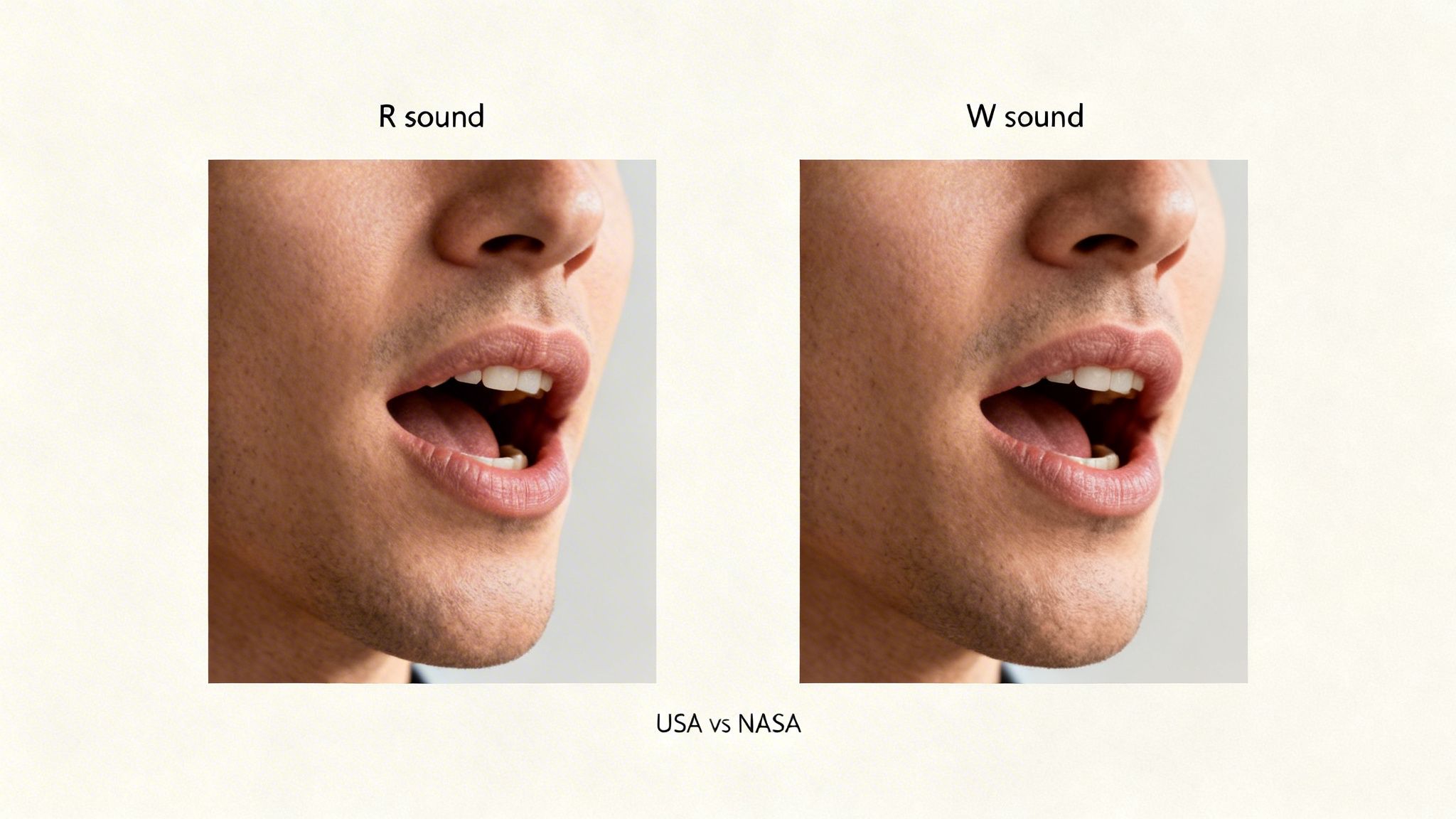
Knowing the rules for how to pronounce an acronym is only half the battle. The other half is actually getting your mouth to produce the sounds with clarity and confidence. This is especially true for some tricky English letters that can be a real hurdle for non-native speakers.
Even if you know you're supposed to spell out "HR," forming that distinct American 'R' sound can feel awkward. So let's get into the mechanics of these difficult sounds and then talk about the crucial role of stress in making your speech sound natural and authoritative.
Nailing Difficult Consonant Sounds
I've seen it with countless clients: certain letters are notoriously difficult because they require specific tongue and lip positions that might not even exist in your native language. Getting these right can make a massive difference in how clearly you're understood.
Here are a few of the most common troublemakers found in initialisms:
- The American 'R' Sound (as in HR): To make this sound, your tongue needs to pull back in your mouth, with the sides touching your top molars. Your lips will be slightly rounded, but the real key is that the tip of your tongue doesn't touch anything. Think of it as a low growl: ar /ɑr/.
- The 'L' Sound (as in SQL): For a crisp, clear 'L', the tip of your tongue must press firmly against the ridge right behind your top front teeth. The sound escapes around the sides of your tongue. The sound is el /ɛl/.
- The 'W' Sound (as in WWW): This sound starts with your lips in a tight, rounded 'O' shape, almost like you're about to whistle. From there, your lips spread open as you release the sound. Try it with "WWW": double-u /ˈdʌbəl.juː/.
For those who want to get really precise, it helps to understand how to map written words to their exact phonetic sounds. This is a technique covered when using a pronunciation lexicon in Tutorial AI.
The Music of Acronyms: Stress and Intonation
Beyond the individual sounds, stress patterns dictate the rhythm and music of your speech. Getting the stress right is absolutely vital for sounding natural. For acronyms, the rules for stress are actually quite simple and depend on whether you're saying an initialism or a word.
When you pronounce an initialism (spelling it out), the primary stress almost always falls on the very last letter. This creates a rising intonation that signals you've finished the term.
Just listen to how a native speaker says these. You'll hear the emphasis pop at the end.
- U-S-A
- F-B-I
- C-E-O
- H-R
This final-letter stress is one of the most consistent and reliable patterns in American English. If you can master this rhythm, your pronunciation will instantly sound more authentic.
On the other hand, for word-form acronyms, the stress just follows the same rules as any other English word. For example, in NASA, the stress is on the first syllable (NA-suh). In EBITDA, it’s also on the first syllable (EE-bit-dah). This is a core concept of English rhythm, and you can dive deeper into the difference between stressed and unstressed syllables in our full guide.
By focusing on both the micro-level mechanics of tricky letters and the macro-level rhythm of stress, you can polish your pronunciation and speak with much greater clarity.
Your Action Plan for Mastering Acronyms
Knowing the rules is one thing, but true confidence comes from practice. Let's move from theory to action with a few simple strategies you can weave into your daily work.
These aren't about cramming or memorization. Instead, think of them as small, repeatable habits that will quickly make pronouncing acronyms feel like second nature.
Create a Personal Acronym Dictionary
This might be the most powerful habit you can build. Start a running list of the acronyms that pop up in your specific role and industry. You can use a notes app, a spreadsheet, or even a small notebook you keep on your desk.
For every acronym you add, jot down a few key details:
- The Acronym: e.g., 'QBR'
- The Full Name: e.g., 'Quarterly Business Review'
- Pronunciation Type: e.g., 'Initialism'
- How to Say It: e.g., 'kyoo-bee-are'
The simple act of writing this down helps lock it into your memory. It also becomes your personal cheat sheet, perfect for a quick review before a big meeting.
Practice Active Listening in Meetings
Every meeting is a free pronunciation lesson. Your colleagues are your best resource, so start paying close attention to the acronyms they use and—most importantly—how they say them. When you hear a new one, just jot it down to add to your dictionary later.
This is the fastest way to learn the unwritten rules and exceptions specific to your workplace. The English language has over 170,000 words, but the average person actively uses only around 20,000, which is why acronyms are such a common professional shortcut. Observing how native speakers use them is key, and you can find more interesting facts about word usage over at word.tips.
Drills and Daily Practice
Confidence is built on repetition. You can build this muscle memory with quick daily exercises that don't take up much time at all. In fact, our guide on how to practice English pronunciation daily has several techniques you can easily adapt for this.
Technique: Graceful Clarification
If you're ever unsure about an acronym in a live conversation, don’t panic. Instead of saying, "I don't know," try a more collaborative approach: "That's a new one for me. Could you spell it out for clarity?" This frames your question as a detail-oriented habit, not a knowledge gap, preserving your authority.
For learners who want to improve their accent and clarity without one-on-one coaching, Intonetic now offers 2 self-paced programs as a monthly subscription called Intonetic Accent Studio, priced at $7 per month and $27 per month. The difference is that the $27 per month program gets them personalized feedback on their progress. These programs are for learners who aren't looking for to do one on one coaching, but still want to improve their accent and clarity. You can learn more at our page for American accent training.
Frequently Asked Questions About Acronyms
Okay, so you’ve got the basic rules down for telling acronyms and initialisms apart. But then you run into a term that just feels… weird. It doesn't quite fit the mold, and you're left wondering what to do.
Don't worry, this is completely normal. Learning the nuances is an ongoing process, and a few common questions pop up all the time. Let’s clear up those lingering uncertainties so you can handle any acronym with total confidence.
What About Hybrid Acronyms Like JPEG or CD-ROM?
This is a fantastic question, and you’ll find these "hybrids" are surprisingly common, especially in tech. A hybrid is just what it sounds like: a mix where you pronounce one part by spelling out the letters and the other part as a single word.
You simply handle each piece according to its type. For example:
- JPEG (Joint Photographic Experts Group): You say the initial 'J' (JAY) and then the word-form 'PEG'.
- CD-ROM (Compact Disc Read-Only Memory): You say the initialism 'CD' (see-dee) and follow it with the word 'ROM' (rahm).
The secret to mastering hybrids isn't memorizing a long list—it's active listening. Pay close attention to how your experienced colleagues say them. After a little exposure, the unique rhythm of these terms will start to feel second nature.
How Can I Ask for a Pronunciation Without Looking Uninformed?
This is all about how you frame the question. It's a moment to show you’re engaged and detail-oriented, not a moment that reveals a knowledge gap. Instead of an uncertain phrase like, "I don't know that one," you can take control of the situation.
Try using a collaborative, confident phrase. For instance:
- "That's a new one for me. For my notes, could you spell that out and just confirm how we're pronouncing it?"
- "Just to make sure we're all on the same page, are we saying 'S-Q-L' or 'sequel' for this project?"
This approach positions you as a thoughtful communicator who cares about precision, not as someone who's out of the loop. It keeps the conversation moving while you get the clarity you need. You can find more practical tips like this in our general FAQs for clear communication.
Do Pronunciation Rules Vary by Region in the US?
For the most part, no. The fundamental rules—spelling out initialisms versus saying word-form acronyms—are standard across American English for major, widely used terms like FBI, NASA, or CEO.
Where you might notice tiny differences is in the vowel sounds due to regional accents, but the basic method of saying the acronym (word vs. letters) doesn't change. For professional communication, sticking with the standard, most common pronunciation is always your safest and clearest bet.