How to Improve English Speaking Fluency for Professionals
The secret to leveling up your English speaking fluency isn’t about memorizing more vocabulary. It’s about mastering the mechanics of the language—the pronunciation, stress, and rhythm that make speech sound natural and clear. A real breakthrough happens when you stop practicing randomly and start a focused cycle: first, pinpointing your specific intelligibility issues, then drilling targeted sounds and intonation patterns, and finally, applying those new skills in your day-to-day professional life.
Your Path to Speaking English with Confidence
Do you feel like your English speaking skills have hit a wall? It’s a common frustration for accomplished professionals. You know the language inside and out, but you can’t quite speak it with the clarity and authority you want. This guide is your blueprint to get off that plateau and build fluency that works in the real world.
The whole journey begins with a mental shift. Stop thinking about knowing more words and start focusing on mastering the music of English. We’ll walk you through how to identify the precise habits holding you back, from common pronunciation mistakes to the subtle rhythms that make you sound persuasive.
The Fluency Gap for Professionals
If you’re facing this challenge, you are far from alone. Out of the 1.75 billion people worldwide using or learning English, it’s estimated that only about 20% of non-native speakers achieve what they’d consider full fluency.
This leaves a huge number of talented professionals—executives, tech leads, doctors, you name it—grappling with communication hurdles that can get in the way of their success. In high-stakes meetings or crucial presentations, clarity isn’t just a “nice to have,” it’s everything.
To get there, you need a simple, repeatable process. This framework breaks it down into three core stages: pinpointing your issues, practicing the solutions, and then applying your new skills where it matters most.
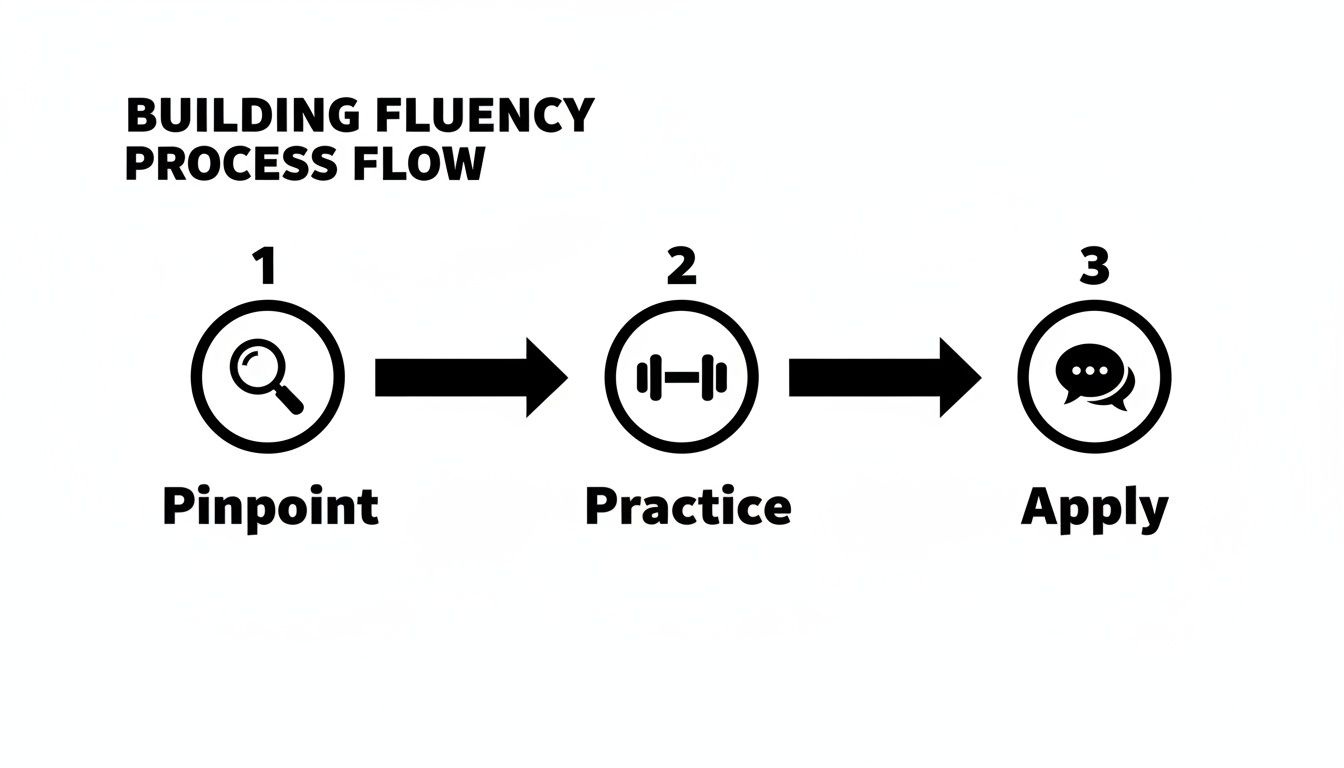
This visual really drives home a key point: just practicing more isn’t the answer. A targeted, cyclical approach is what actually delivers results you can see and hear.
To achieve this, we need to understand what “fluency” truly means for a professional. It’s not just about grammar; it’s a combination of four distinct skills that work together to create clear, impactful speech.
The Four Pillars of English Speaking Fluency
| Pillar | What It Means | Why It Matters for Professionals |
|---|---|---|
| Intelligibility | Being easily and accurately understood without causing listener strain. This covers correct pronunciation of vowels and consonants. | When your ideas are understood the first time, meetings are more efficient, and your credibility is reinforced. |
| Prosody | The “music” of the language—intonation (pitch changes), stress (emphasis on syllables), and rhythm (the flow of speech). | Correct prosody signals confidence and authority. It helps listeners follow your logic and keeps them engaged. |
| Connected Speech | How sounds link together, are modified, or even omitted in natural, flowing sentences (e.g., “going to” becomes “gonna”). | Mastering this makes your speech sound smooth and natural, not robotic or choppy. |
| Pacing & Pausing | The speed of your speech and the strategic use of silence to add emphasis, create suspense, or give listeners time to process. | Effective pacing prevents you from sounding rushed or nervous. Strategic pauses make key points land with greater impact. |
By focusing on these four pillars, you move beyond just “speaking English” and into the realm of truly effective professional communication.
From a Source of Stress to a Professional Advantage
The framework you’re about to learn is designed to focus your practice on small, high-impact changes that make a huge difference in how you’re perceived. The goal is to turn your speaking skills from something you worry about into a powerful asset that helps you lead, persuade, and connect.
True fluency isn’t about erasing your accent; it’s about ensuring your ideas are heard and understood without friction, the first time you say them. It’s about clarity, not perfection.
This process is also deeply tied to your confidence. As you gain more control over the sounds and rhythms of English, you’ll notice a massive shift in how you feel when you speak up. We have a whole guide on how to build confidence while improving pronunciation that dives deeper into this connection.
Get ready to finally break through your speaking hurdles and start communicating with the authority and impact your expertise deserves.
Pinpointing Your Personal Fluency Gaps
Before you can fix anything, you have to know what’s broken. Generic practice is like throwing spaghetti at the wall to see what sticks—it’s a huge waste of time and rarely works. The first, and honestly most critical, step is to get an objective look at your own speech and find the specific habits that are tripping you up.
This all starts with a tool you already have: your smartphone. Just record yourself speaking for two or three minutes. You could read a short article, but it’s far better to speak off-the-cuff. Try answering a question like, “What are your career goals for the next five years?” Speaking spontaneously is what reveals your real-world speech patterns.

And let’s be clear, the stakes for getting this right are higher than ever. Think about this: 98.5% of employers across 38 countries now screen candidates for English skills. More importantly, 50% of them offer better starting salaries to people who can speak clearly and confidently.
This shows a direct line between fluency and career growth, especially in fields like tech, healthcare, and management. While there are 1.5 billion English speakers worldwide, only a small fraction reach true proficiency, giving a massive advantage to those who do.
Analyzing Your Speech Recording
Okay, you’ve got your recording. Now it’s time to listen back—not to judge yourself, but to gather data. The goal is to move beyond a vague feeling like, “Ugh, I sound terrible,” and start asking specific, targeted questions.
Use this checklist as your guide:
- Individual Sounds (Phonemes): Are there specific consonants or vowels that get muddy? Common culprits include the ‘th’ sound (is it think or sink?), the difference between /l/ and /r/ (light vs. right), and the tiny but crucial vowel shifts, like in ship vs. sheep.
- Word Stress: Am I putting the emphasis on the right part of the word? Getting this wrong can completely change a word’s meaning. For example, you “pro-JECT” your voice (a verb), but you work on a “PRO-ject” (a noun).
- Sentence Rhythm (Intonation): Does my voice rise and fall naturally, or does it sound flat and robotic? A falling tone at the end of a statement sounds confident; a monotone delivery can make you sound bored or disengaged.
- Clarity & Listener Effort: Let’s be honest—would a native speaker have to lean in and really work to understand you? How often did you get stuck, pause weirdly, or stumble over a word?
This kind of self-analysis is a core skill. If you want a more structured and expert-driven breakdown, a professional accent reduction assessment can give you a crystal-clear roadmap.
Creating Your Priority List
After listening to your recording, you’ll probably have a list of things to work on. Here’s the key: don’t try to fix everything at once. That’s a recipe for burnout. The next step is to prioritize.
The goal isn’t to erase your accent; it’s to maximize your intelligibility. Zero in on the 10-12 highest-impact sounds and patterns that cause the most confusion. This targeted approach is what ensures every minute of practice actually makes a difference.
For example, if you’re a native Spanish speaker, nailing the difference between the /b/ and /v/ sounds might be a top priority. If your first language is Mandarin, focusing on those tricky final consonants like ‘t’ and ‘d’ could be a total game-changer for your clarity.
By the end of this diagnostic phase, you should have a concrete, written list of your top 10-12 targets. This list is the foundation of your entire practice plan. It turns your daily work from a guessing game into a strategic, high-impact exercise.
Designing Your Daily Fluency Workout
Knowing what to practice is only half the battle. The real secret to improving your English speaking fluency is consistency—turning targeted exercises into a non-negotiable daily habit.
For a busy professional, this can’t be a two-hour commitment. It needs to be a short, intense, and repeatable routine that fits into the pockets of your day, like during a commute or a coffee break.
This is where the 20-minute daily “Fluency Workout” comes in. Think of it as a structured session designed to build critical muscle memory in your mouth, tongue, and vocal cords. Just like a physical workout, it targets specific muscle groups to build the strength and coordination you need for effortless, automatic speech.

This routine isn’t about learning new vocabulary. It’s a purely mechanical drill focused on the physical act of speaking. The goal is automaticity—the ability to produce sounds and rhythms correctly without conscious thought, freeing up your mental energy to focus on your message.
Part 1: The 5-Minute Sound Drill
Kick off your workout with five minutes of high-repetition drills focused on your personal priority list of sounds. This is where you isolate the vowels and consonants that cause the most friction in your speech and train your mouth to produce them accurately and quickly. Don’t just say them; exaggerate the mouth movements.
Your tools for this segment are simple but powerful:
- Minimal Pairs: These are word pairs that differ by only one sound, like ship and sheep, or think and sink. Cycling through them rapidly forces your mouth to make the small but crucial adjustments needed for clarity.
- Tongue Twisters: They aren’t just for kids. Tongue twisters are specifically designed to be difficult, forcing you to articulate challenging sound combinations. Find ones that feature your target sounds, like “Thirty-three thousand feathers” for the ‘th’ sound.
The key here is repetition. Research shows that repeating a text or phrase three to four times yields the most benefit for building fluency. After that, the returns diminish, so it’s better to move on to a new phrase.
Part 2: The 10-Minute Rhythm and Intonation Practice
Next, dedicate ten minutes to mastering the “music” of English. This is where you move from individual sounds to the flow of full sentences. It’s correct rhythm and intonation that make you sound natural and confident, rather than robotic.
The most effective technique for this is shadowing. This involves listening to a native speaker and repeating what they say in real-time, just a split second behind them. You’re not just mimicking the words; you’re copying their pitch, their pauses, and the rise and fall of their voice.
Pro Tip: Don’t use a movie or a dramatic TV show for shadowing. The delivery is often unnatural for professional settings. Instead, choose a podcast, a TED Talk, or a news report where the speech is clear, professional, and paced for comprehension.
Start by shadowing for just 30 seconds at a time. It will feel awkward at first, but with practice, you’ll start to internalize the natural cadence of English. This exercise trains your ear and your voice to work together, bridging the gap between understanding and speaking. For more ideas, our guide on how to improve your English speaking skills offers additional strategies you can incorporate.
Part 3: The 5-Minute Spontaneous Speech Challenge
Finally, end your workout with a five-minute impromptu speaking drill. This is your pressure test. The goal is to train your brain to access language and structure thoughts on the fly, a crucial skill for meetings and Q&A sessions.
Use a random topic generator or an AI tool to give you a prompt. It could be anything from “Describe your ideal vacation” to “Explain a complex concept from your industry to a 10-year-old.”
Once you have your topic, start speaking and do not stop for the full five minutes.
It doesn’t matter if you make mistakes, stumble, or repeat yourself. The objective is to keep talking and push through the discomfort of searching for words. This exercise builds mental agility and reduces the hesitation that often plagues non-native speakers. It forces you to rely on the vocabulary and structures you already know, solidifying them through active use.
This complete 20-minute workout, performed daily, creates a powerful feedback loop. The sound drills improve your clarity, the shadowing refines your naturalness, and the spontaneous speech challenge builds your confidence. It’s a small time investment that pays massive dividends in your journey toward speaking English with authority and ease.
Mastering the Music of Spoken English
True fluency is more than just pronouncing words correctly. It’s about getting the music of the language right—that mix of stress, rhythm, and intonation that tells listeners you’re confident and makes your message stick. When you get a handle on these elements, you stop just saying English words and start communicating with real authority.
This musical quality is what separates clear, engaging speech from something that sounds robotic and is tough to follow. It’s why two people can say the exact same sentence, but one sounds convincing while the other sounds hesitant. For professionals, nailing this is a game-changer in meetings, presentations, and client calls.

The professional upside here is huge. Global data shows a clear link between English proficiency and economic power. Countries in the top quartile enjoy a 40% higher GDP, and individuals who are fluent can earn up to a 30% wage premium. The catch? Worldwide skills have actually been dipping for four years, which creates a massive opportunity for anyone willing to put in the work.
For executives, tech leaders, and healthcare professionals, this means focusing on intelligibility by mastering intonation, stress, and rhythm is the key to building trust in every single conversation.
Content Words vs. Function Words
The first step in controlling this “music” is knowing what to emphasize. Native speakers do this without thinking, stressing content words—the nouns, main verbs, adjectives, and adverbs that carry the real meaning.
Think of these as the strong beats in a song. They’re the words that deliver the core information.
On the flip side, function words are the small grammatical connectors. This includes articles (a, an, the), prepositions (in, on, at), and helping verbs (is, am, are). Native speakers tend to de-stress these, blurring them together and saying them more quickly and softly.
- Take this sentence: “The team will meet for a quick status update.”
- Stressed Content Words: team, meet, quick, status, update
- Unstressed Function Words: The, will, for, a
When you learn to punch the content words and glide over the function words, your speech instantly sounds more natural and rhythmic. For a much deeper dive, our guide to rhythm and timing in American English breaks down more advanced techniques.
Practical Drills to Feel the Beat
You can’t just think your way to good rhythm; you have to feel it. The goal is to build muscle memory for the beat of the language.
A surprisingly effective drill is simply tapping out the rhythm. Take any sentence and tap your finger on the table for every single stressed syllable.
Let’s try it with: “Can you send me the rePORT by the end of the day?”
Your taps should land on: CAN… SEND… re-PORT… END… DAY. See how the little words like “you,” “me,” “the,” and “of” just squeeze in between those main beats? This simple exercise starts building the physical habit of English sentence stress.
By focusing on the rhythm instead of just individual words, you train your brain to group thoughts into meaningful chunks. This makes your speech flow better and makes it way easier for your listener to follow along.
Using Intonation to Sound Confident
Intonation is the melody of your speech—the rise and fall of your voice’s pitch across a sentence. It’s a powerful tool that adds meaning and emotion that words alone just can’t capture. A few key patterns can make a world of difference in how you come across.
- Falling Intonation: In American English, we almost always end statements and commands with a falling pitch. It signals that you’re done and sounds confident and final. When you wrap up a point in a presentation, saying, “And that’s our Q3 forecast” with a clear downward tone makes it sound like a solid fact.
- Rising Intonation: This one’s for yes/no questions. The pitch goes up at the end, which is a clear signal to your listener that a simple “yes” or “no” is what you’re looking for. Think of “Are you joining the call?”
- Rising-Falling Intonation: You’ll hear this a lot in lists or more complex thoughts. For instance: “We need to discuss the budget (rise), the timeline (rise), and the project scope (fall).” That final drop in pitch tells everyone the list is finished.
Try practicing these patterns using sentences from your own work emails or presentations. Getting this melody right is what elevates your communication from just being understood to being truly influential.
Applying Your Skills in Real-World Scenarios
Drills and structured workouts are fantastic for building muscle memory. They’re your gym. But lasting, confident fluency isn’t forged in the gym—it’s forged out in the real world, under the pressure of actual professional interactions. Your workplace isn’t just where you perform your job; it’s your ultimate practice arena.
The key here is a simple mindset shift. Start seeing every meeting, every presentation, and even every casual chat as a low-stakes chance to put your practice into play. This isn’t about being perfect overnight. It’s about being intentional. Real improvement happens incrementally, one conversation at a time.
You’ll want a game plan for the big moments and a separate strategy for the small ones. By consciously preparing for high-stakes events and actively using everyday interactions, you create a powerful cycle of practice, application, and confidence.
Preparing for High-Stakes Conversations
Client presentations, team-wide meetings, performance reviews—these high-visibility moments can be nerve-wracking. But instead of letting anxiety run the show, you can flip the script and use them as structured opportunities to showcase your improved clarity. The trick is to prepare your delivery, not just your content.
Here’s a practical way to do it:
- For an Important Meeting: Forget trying to script everything you want to say. That’s a recipe for sounding robotic. Instead, identify just two or three key talking points you absolutely must land. Rehearse saying only these points out loud, focusing on crystal-clear articulation and confident intonation. This targeted practice ensures your most critical messages hit the mark.
- For a Major Presentation: Grab your script or slides and mark them up like a musician’s sheet music. Underline the key content words you need to stress. Draw a rising arrow (↗) for questions and a falling arrow (↘) for statements. This physical act of marking up your script actually primes your brain to deliver the lines with the right rhythm and melody when you’re live.
This level of preparation transforms a stressful event into a controlled experiment. You’re no longer just hoping for the best; you’re consciously applying the techniques from your drills in a way that directly benefits your career.
Your goal isn’t just to survive these conversations. It’s to use them as a live-fire exercise. Each successful interaction, no matter how small, rewires your brain to associate speaking English with competence and confidence, not fear.
Using Low-Stakes Interactions for Daily Practice
Of course, not every conversation is a high-pressure performance. Your daily interactions—the quick chats by the coffee machine, the casual questions to a colleague—are a goldmine of practice opportunities without the stress. Think of these as your daily reps.
These moments are perfect for experimenting with a new sound or a different intonation pattern because the consequences are basically zero. If you mispronounce a word while chatting about the weekend, it’s just a learning moment, not a career-defining blunder.
Use these opportunities strategically:
- Small Talk: When a colleague asks how your weekend was, don’t just say “Good.” Challenge yourself to respond with a full sentence, focusing on natural intonation.
- Asking for Clarification: Practice using phrases like, “Could you elaborate on that point?” and concentrate on creating smooth, connected speech.
- Summarizing a Point: After someone shares a complex idea, try paraphrasing it back to them. This is a brilliant way to test both your listening comprehension and your speaking clarity at the same time. This skill is crucial in many professional contexts, and you can sharpen it by using techniques for reading and summarizing dense texts.
Tracking Your Real-World Progress
So, how do you know if any of this is actually working? You need simple, observable metrics you can track in the wild. Forget complicated spreadsheets; focus on these two things.
- The “Repeat” Metric: Simply start paying attention to how often people ask you to repeat yourself. As your clarity improves, you’ll notice this happening less and less. It’s one of the most direct and honest indicators that your practice is paying off.
- The “Complexity” Metric: How confident do you feel jumping into a conversation to share a complex or nuanced idea without a script? Think back a year ago—would you have stayed silent? If you now find yourself more willing to engage in these deeper discussions, it’s a sure sign your fluency and confidence are growing.
By consistently applying your skills in both high- and low-stakes scenarios, you bridge the gap between practice and reality. You effectively turn your daily work life into a dynamic and highly effective language lab.
When to Consider Professional Accent Coaching
Self-study is an amazing tool for improving your English fluency, but even the most dedicated professional can hit a frustrating wall. You might be doing all the drills and practicing every day, yet still feel like your message isn’t landing with the impact you want.
This is often the point where an expert guide becomes a game-changer.
Recognizing you’ve hit this plateau is the first step. Maybe you notice that despite your best efforts, people in meetings are still asking you to repeat yourself. Or perhaps you find yourself holding back in high-stakes moments, not because you lack the ideas, but because you lack total confidence in your delivery. These are clear signs you’ve gone as far as you can on your own.
Why Self-Study Sometimes Isn’t Enough
Some of our speech habits are so deeply ingrained they become completely invisible to us. Without an objective, expert ear, it’s nearly impossible to spot the subtle yet critical issues in your own speech patterns.
An experienced coach can pinpoint the exact sound, stress, or intonation pattern that’s tripping up your listeners—something a generic app or even your own recordings will almost always miss.
These are the common hurdles that are incredibly tough to clear by yourself:
- Fossilized Errors: These are pronunciation mistakes you’ve practiced for years, so they’ve become automatic and feel completely natural to you.
- Lack of Objective Feedback: It’s just plain hard to accurately judge your own rhythm and intonation. You’re too close to it. You need a trained, external perspective.
- Inefficient Practice: You could be spending hours fixing issues that aren’t actually impacting your clarity, while the real, high-impact problems go unnoticed.
When a Coach Becomes a Powerful Tool
If any of this sounds familiar, a structured coaching program is the key to breaking through that ceiling. A truly personal approach always starts with a detailed assessment to build a practice plan that focuses on your specific needs. This isn’t about erasing your accent; it’s about refining your speech for maximum clarity and impact in a professional setting.
A great coach provides more than just drills. They offer laser-focused feedback, build your confidence from the ground up, and create a strategic roadmap to help you communicate with authority. This transforms your practice from a guessing game into a focused, results-driven process.
Working with a professional brings accountability and expert guidance, making sure every minute you spend practicing is actually effective. If you’re wondering what that looks like in practice, you can learn more about the benefits of working with an online accent coach and see how it can fast-track your progress.
Ultimately, coaching is an investment in making your professional voice as powerful as your ideas.
A Few Common Questions I Hear All the Time
As you get started, it’s natural for some very specific questions to pop up. Having a plan is one thing, but dealing with the real-world doubts and challenges that come along with it is another. Let’s tackle some of the most common questions professionals ask when they get serious about improving their English speaking clarity.
How Long Does This Actually Take?
Everyone wants to know this, but there’s no magic number. Your progress really depends on your starting point, your language background, and how consistently you practice.
That said, with focused daily work on your priority sounds and intonation—even just 20 minutes a day—most professionals tell me they feel a real boost in confidence and clarity within 8-12 weeks. For a deep, lasting change that feels automatic, you’re likely looking at a 3-6 month period of dedicated effort. The key isn’t the total time, but the quality and consistency of your daily habits.
Should My Goal Be to Eliminate My Accent?
Absolutely not. Your accent is part of your story and your identity. The real goal is clarity, not elimination.
Professional fluency is about being easily and accurately understood the first time you speak. It’s about removing the need for your listener to strain to catch your meaning.
Your focus should be on modifying the 10-12 specific sounds and rhythm patterns that have the biggest impact on how well people understand you. This is a strategic approach. It ensures your message lands clearly while letting your unique voice come through. An accent only becomes a problem when it gets in the way of your message.
What If I’m Too Busy for Daily Practice?
This is, without a doubt, the biggest hurdle for busy professionals. The trick is to redefine what “practice” actually means. It doesn’t have to be a formal study session chained to your desk.
Think smaller. Integrate it into your day.
- Got a commute? That’s perfect for running through your sound drills.
- Listening to a podcast on your lunch break? Use the shadowing technique for a few minutes.
- That quick 5-minute coffee chat with a colleague? It’s a low-stakes chance to try out a new intonation pattern.
By weaving these micro-practices into your existing routine, you build momentum without needing to find a huge block of free time. Small, frequent practice is far more powerful than a long, drawn-out session once a week.
Are you ready to stop guessing and start a focused plan for clearer, more confident speech? The Intonetic Method provides the expert assessment, personalized coaching, and structured accountability you need to be understood the first time, every time. Book your free assessment today and get your personalized fluency starter guide.