How to Enunciate Better and Speak With Clarity
To get better at enunciation, you have to start by becoming an honest listener of your own voice. It sounds simple, but this is the step most people skip. It involves recording yourself speaking and then playing it back to catch the specific habits—like slurring words or talking a mile a minute—that are holding you back. This self-assessment is the absolute foundation; without it, any exercises are just guesswork.
Find Your Sticking Points First
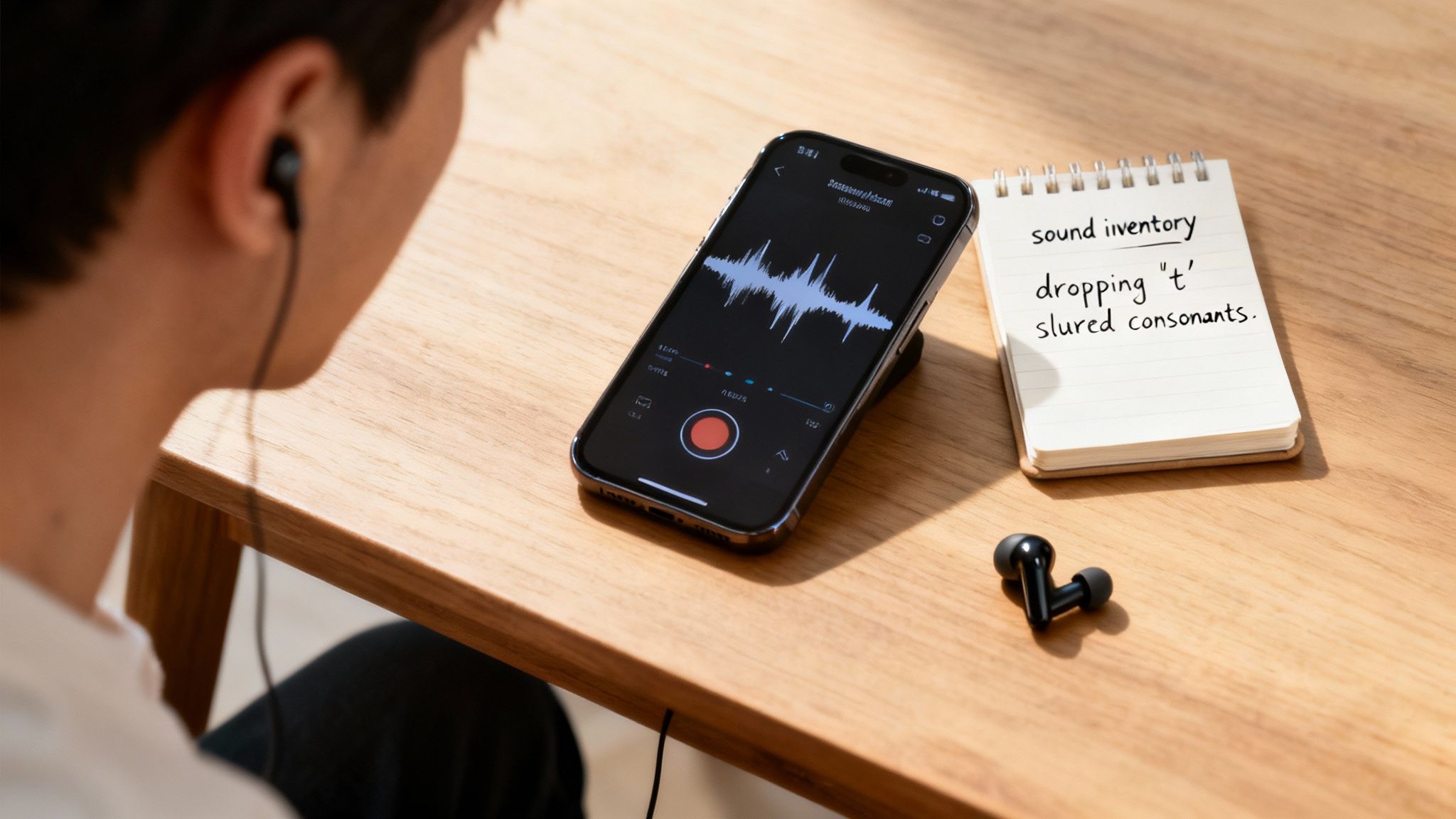
Before you even think about drills or exercises, you need a clear starting line. Improving enunciation isn't about running through generic tongue twisters; it's about targeted, focused practice on your unique challenges. The best way to do this is to create a personal 'sound inventory'—a practical map of your specific speaking patterns.
The process itself is surprisingly straightforward. Find a quiet spot, pull out your smartphone, and open the voice memo app. Record yourself talking for just two or three minutes. The key here is not to read from a script. Just talk naturally about your day, a project you're working on, or a movie you just saw. You want to capture how you really sound in everyday conversation.
What to Listen For
Now, play it back. Your job is to be a detective, not a judge. You're just gathering data, so leave any self-criticism at the door. Listen for the subtle details you'd normally miss in the heat of a conversation.
- Dropped Consonants: Do you say "goin'" instead of "going," or "firs'" instead of "first"? Those final consonants, especially 't', 'd', and 'g', are often the first casualties when we speak quickly.
- Slurred Sounds: Do certain words melt into each other? For instance, does "did you eat yet?" come out sounding more like "jeet-jet"? This is incredibly common.
- Pacing and Speed: Pinpoint any moments where you start speeding up. People who are passionate about a topic often accelerate without realizing it, sacrificing clarity along the way.
- Vowel Clarity: Are your vowel sounds crisp and distinct? Can a listener easily tell the difference between words like "sit" and "seat," or "cot" and "caught" when you say them?
This exercise isn't about finding flaws. It's about gathering intelligence. Once you have this inventory, you can stop guessing what the problem is and start focusing your energy where it will make a real difference.
Building Your Personal Sound Inventory
As you listen, grab a notebook or open a doc and jot down what you hear. The more specific, the better. Don't just write "I mumble." Instead, write, "I tend to drop the final 't' sound on words like 'don't' and 'can't'." That level of detail is what turns a vague goal into a concrete, actionable plan.
To help you get started, here’s a breakdown of some of the most common issues I see, what might be causing them, and a quick tip to start thinking about a fix.
Common Enunciation Pitfalls and Their Causes
| Common Pitfall | Potential Cause | Quick Self-Correction Tip |
|---|---|---|
| Mumbling or Slurring | Speaking too quickly, insufficient mouth movement, or low energy. | Intentionally exaggerate your lip and jaw movements when you practice speaking. |
| Dropping Word Endings | Rushing to the next word before the current one is fully formed. | Make a conscious effort to "land" the final consonant sound (like the 't' in 'cat'). |
| Speaking Too Fast | Nerves, excitement, or a habit of thinking faster than you can speak. | Practice speaking in shorter phrases and consciously insert brief pauses. |
| "Mushy" Vowels | Lazy tongue or lip positioning; not creating enough space in the mouth. | Open your mouth slightly wider than feels natural when speaking. |
| Weak Consonants | Insufficient airflow or not making firm contact with articulators (tongue, teeth, lips). | Focus on making crisp, sharp sounds for consonants like P, T, and K. |
Once you’ve identified your own patterns, you’ll be in a much better position to choose the right exercises and drills to fix them.
This self-assessment lays the groundwork for real, lasting progress. When you sound clearer, you don't just communicate better—you spend less time repeating yourself and more time making an impact.
By isolating your specific challenges, you ensure that every practice drill you perform is directly solving a problem. This targeted approach is the fastest way to build new muscle memory for clearer, more confident speech.
If you want a more structured analysis, a professional accent reduction assessment can break down your speech patterns and highlight the priority areas that will give you the biggest bang for your buck. With your inventory complete, you'll have a custom-built roadmap showing you exactly where to go next.
Warm Up Your Speech Muscles

Think of an athlete stretching before a race. Now, apply that same logic to speaking. Before any important conversation or presentation, you need to warm up your articulators—that’s the jaw, lips, and tongue. Treating clear speech as a physical skill is a complete game-changer.
When you find yourself mumbling or slurring words, it’s usually not because you don't know what to say. It’s a physical issue. Your speech muscles are either too tense or too sluggish to form sounds with the precision they need.
Just a few minutes of focused warm-ups can make a massive difference. These simple exercises wake up your articulators, get the blood flowing, and start building the muscle memory you need for crisp, clear diction. You're basically prepping your equipment for peak performance.
Release Jaw Tension
A tight jaw is one of the biggest culprits behind mumbling. Simple as that. When your jaw is tense, your mouth doesn’t open enough to let sounds out properly, leaving them trapped and muffled. Dealing with this tension should be your first priority.
Think about how you feel in a stressful meeting—you might be clenching your jaw without even noticing. It's a common habit that restricts movement and leads to lazy, unclear speech. These stretches are all about creating space and freedom for your jaw to move.
- The Big Yawn: Open your mouth as wide as you comfortably can, like you’re in the middle of a huge, satisfying yawn. Hold it for 5-10 seconds and really feel that stretch.
- Side-to-Side Slide: Gently move your lower jaw from left to right. Don't force anything; the movement should be smooth and easy. This helps loosen up the muscles controlling that horizontal movement.
- Massage the Hinge: Place your fingertips on your temporomandibular joints (TMJ), right in front of your ears. As you slowly open and close your mouth, apply gentle pressure and massage the area in a circular motion. You'll be surprised how much tension gets stored there.
By consciously relaxing your jaw, you're not just preparing to speak better—you're breaking a physical habit that directly causes unclear speech. A loose jaw is the foundation for an open, resonant voice.
Build Tongue Agility
Your tongue is an incredibly nimble muscle, but just like any other muscle, it can get lazy. To produce sharp, distinct consonant sounds like T, D, L, and R, your tongue has to move with speed and precision, hitting the exact right contact points in your mouth.
These drills are designed to build that dexterity. They might feel a bit silly at first, but they are a serious workout for your primary tool of articulation.
- Tongue Push-Ups: Start by pressing the tip of your tongue firmly against the ridge behind your top front teeth. Then, press it against the back of your bottom front teeth. Repeat this up-and-down motion 10 times.
- Around the World: Slowly and deliberately, trace the entire outer surface of your teeth with the tip of your tongue. Go clockwise, then switch to counter-clockwise.
- Point and Stretch: Stick your tongue straight out and try to touch your nose, then your chin. Hold each stretch for a few seconds to increase its range of motion.
Activate Your Lips
Crisp vowel sounds and consonants like P, B, and M are impossible without the right lip shape and movement. Lip exercises make sure your lips are responsive and ready to form those distinct shapes needed for clear enunciation.
A classic and incredibly effective technique is the lip trill, or "lip buzz." Just press your lips together loosely and blow air through them to create a buzzing or motorboat sound. This does more than just relax the lips; it also helps you regulate your airflow, a key part of vocal control. If you want to dive deeper, our guide on how to use breathing exercises for better English speech has some excellent techniques that pair perfectly with these physical warm-ups.
A Five-Minute Pre-Meeting Warm-Up
You can do this routine pretty much anywhere—in your car, at your desk, or in the restroom before a big presentation. It's quick, discreet, and effective.
| Exercise | Duration | Purpose |
|---|---|---|
| Jaw Massage | 1 Minute | Release tension that causes mumbling. |
| Lip Trills | 1 Minute | Activate lips and control breath. |
| Tongue Stretches | 2 Minutes | Build precision for sharp consonants. |
| Smile and Pucker | 1 Minute | Improve lip flexibility for vowels. |
This little routine primes your speech muscles, making sure that when you start talking, your words come out sharp, clear, and effortless. It’s a small investment of time that pays huge dividends in how clearly you communicate.
Practice Drills for Lasting Diction
With your speech muscles warmed up, it's time to get into some focused training. Think of this as your personal library of diction drills, designed to go beyond generic advice and tackle specific phonetic challenges head-on. This is where you build the muscle memory that translates directly into real-world clarity.
Effective practice isn't about mindlessly repeating tongue twisters until you're blue in the face. It’s about precision. It's about targeting the exact sounds that trip you up, isolating those weaknesses, and turning them into strengths.
Target Problem Consonants
Some consonants are just plain tricky. They demand very specific placement of your tongue, lips, and teeth. If you flagged sounds like 'th', 'r', or 'l' during your self-assessment, targeted word lists are going to be your best friend.
The goal here isn't speed; it's deliberate, slow repetition. Focus entirely on the physical sensation of making the sound correctly.
- For the 'TH' Sound (as in 'think'): Thousand, theory, thank, thoughtful, through. Feel the tip of your tongue gently touching the back of your top front teeth. It’s a light touch, not a hard press.
- For the 'L' Sound (as in 'light'): Listen, literally, loyal, allow, feeling. Make sure the tip of your tongue firmly presses against that ridge right behind your top teeth. That contact is crucial.
- For the 'R' Sound (as in 'right'): Around, rural, library, bring, correct. This is all about the middle of your tongue. Lift it toward the roof of your mouth, but make sure the tip doesn't touch anything.
This kind of focused repetition is literally building new neural pathways. You're teaching your mouth how to create these sounds accurately and automatically, so you don't have to think about it in the middle of a conversation.
Master Minimal Pairs for Vowel Precision
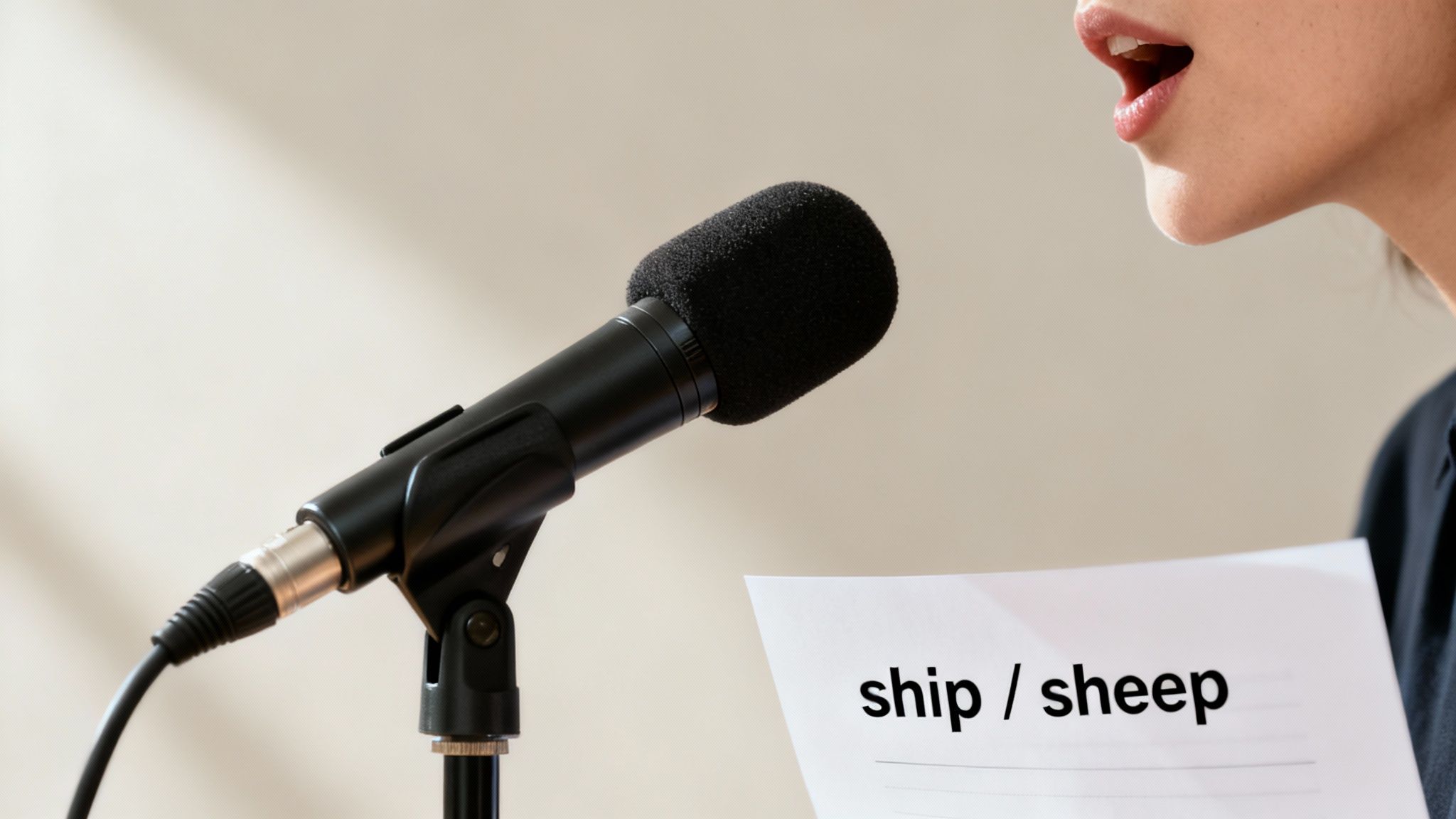
One of the most powerful techniques for refining your speech is practicing with minimal pairs. These are just pairs of words that are almost identical, differing by only a single sound—usually a vowel. The classic example is 'ship' versus 'sheep', or 'sit' versus 'seat'.
This drill forces your ear to tune into the subtle differences between sounds, which in turn trains your mouth to produce them more accurately. It's an incredibly effective way to sharpen your vowel clarity.
By practicing minimal pairs, you are essentially calibrating your auditory feedback loop. Your ear learns to recognize the target sound, and your mouth learns to create it, creating a powerful cycle of self-correction.
For instance, lots of speakers struggle with the short 'i' sound (as in 'live') and the long 'ee' sound (as in 'leave'). Practicing these pairs builds the specific muscle memory for the distinct jaw and tongue positions required for each. To get started, you can learn more about how to use minimal pairs to correct your English pronunciation and find word lists tailored to your needs.
Use Over-Articulation to Build Precision
This technique will feel a bit strange at first, but trust me, it’s a secret weapon used by actors and public speakers everywhere. Over-articulation is exactly what it sounds like: deliberately exaggerating your mouth movements as you speak. You'll open your jaw wider, stretch your lips further, and make your tongue movements way more pronounced than you ever would normally.
Here’s a simple way to try it:
- Grab a short text. A paragraph from a book or a news article is perfect.
- Read it aloud slowly. As you read, over-enunciate every single syllable. Imagine you're trying to be understood by someone hard of hearing across a large, noisy room.
- Feel the stretch. Really pay attention to the muscles in your jaw, lips, and tongue. You should feel them working much harder than usual.
- Go back to normal. After a minute or two of this, read the same passage again in your normal speaking voice.
The difference is immediate. Your speech will feel more effortless and sound significantly crisper. This exercise is like lifting heavier weights at the gym; when you go back to your normal weight, it feels much lighter. Over-articulation builds a reserve of muscular control that makes your everyday speech cleaner without sounding unnatural.
Control Your Pacing and Rhythm
Great enunciation isn't just about shaping sounds correctly; it's about delivering them with a sense of control. I've seen it countless times: a speaker has perfect articulation, but their words are a blur because they're rushing. Speeding through your sentences is the fastest way to become unintelligible.
Think of it this way—a rapid-fire delivery forces your listeners to work overtime just to catch up. They spend so much energy trying to decode what you're saying that the meaning behind your words gets completely lost. Slowing down isn't about sounding sluggish; it's about giving your message the space it needs to land with real impact.
Slow Down Without Sounding Unnatural
A lot of people worry that slowing down will make them sound robotic or condescending. That's a valid concern. The secret isn't to drag out your words, but to get comfortable with pauses and phrasing. You're aiming for a deliberate, measured pace that communicates thoughtfulness and authority.
One of the most powerful ways to practice this is by speaking in shorter phrases, or what we call "thought groups." Instead of trying to barrel through a long, complex sentence in one breath, you break it down into smaller, logical chunks.
For instance, don't rush through this:
"We need to analyze the quarterly sales data to identify key trends before our meeting on Friday so we're prepared for the executive review."
Instead, try delivering it with strategic pauses built in:
"We need to analyze the quarterly sales data // to identify key trends // before our meeting on Friday // so we're prepared for the executive review."
Each pause is a micro-moment. It lets your articulators reset for the next phrase and, just as importantly, gives your listener a split second to process what you just said.
The Power of the Strategic Pause
Pauses are the punctuation of spoken language. They do more than just slow you down—they add weight, create suspense, and put a spotlight on your most important points. A well-placed pause is a non-verbal cue to your audience that says, "Listen closely. This next part really matters."
Rushing your speech often signals anxiety or a lack of confidence. In contrast, comfortable silence conveys authority and shows you are in complete control of your message and the room.
Try this simple exercise. Grab a book, open to any page, and read a paragraph aloud. This time, consciously insert a one-second pause wherever you see a comma and a two-second pause where you see a period. It will feel exaggerated at first, I promise. But what you're doing is training your brain to recognize natural stopping points and building the habit of using silence to your advantage.
Find the Natural Rhythm of English
Beyond just speed, effective speech has a certain musical quality to it. This comes from stress and intonation—the patterns of emphasizing certain syllables and words to create meaning. Speech that's monotonous and flat is just as hard to follow as speech that's rushed because it gives the listener zero clues about what's important.
English is a stress-timed language. This means some syllables and words get more emphasis than others, which is what creates its distinct rhythm. Generally, content words (like nouns, verbs, and adjectives) are stressed, while function words (like articles and prepositions) are unstressed.
Take this simple sentence: "Dogs chase cats." The rhythm comes from hitting those three key words.
Now, look at this one: "The dogs will chase the cats." Even with the extra unstressed words, the core rhythm is exactly the same.
To start improving your own rhythm, begin by identifying the single most important keyword in each of your sentences. Then, give that word just a little extra emphasis. This simple shift can make your speech dramatically more dynamic and easier for others to follow. For a deeper dive, exploring the fundamentals of rhythm and timing in American English can unlock the secret to more natural-sounding speech.
When you finally master pacing and rhythm, you ensure that all your hard work on enunciation pays off, delivering your words with the clarity and impact they truly deserve.
Use Modern Tools for Faster Progress
Practicing enunciation drills in a vacuum can feel like pure guesswork. Are you actually getting better, or just cementing the same old mistakes? This is where technology steps in, acting as your personal speech coach and offering the objective feedback you need to see real, measurable progress.
The great news is you don't need fancy, expensive software to get started. The smartphone in your pocket is one of the most powerful tools available for anyone wondering how to enunciate better. When you pair your physical exercises with these data-driven insights, you can speed up your learning and finally fix those stubborn issues.
Leverage Automatic Speech Recognition
The speech-to-text or voice command function on your phone is an incredible, real-time diagnostic tool. It’s essentially an unbiased listener that transcribes exactly what it hears, not what you think you’re saying. If the text comes out garbled or just plain wrong, that’s a direct reflection of your clarity.
For example, try dictating this classic tongue twister into your phone's notes app: "The thirty-three thieves thought that they thrilled the throne throughout Thursday."
Did it come out as "The dirty tree thieves taught…"? If so, you've just received instant, specific feedback on your 'th' sound. This simple trick turns every text message or voice search into a mini-enunciation drill. Keep in mind that there are several factors that affect what affects speech to text accuracy, but it’s still an incredibly useful benchmark.
Create a Record and Review Loop
While speech-to-text is great for quick spot-checks, the voice memo app is your go-to for deeper analysis. The simple act of recording yourself and listening back is a cornerstone of self-improvement for a reason—it closes the painful gap between how you sound inside your head and how you actually sound to everyone else.
Start by recording yourself reading a short paragraph from a book or news article. When you listen back (preferably with headphones), become a detective. Don't try to fix everything at once. One day, listen only for dropped final consonants. The next, focus exclusively on your pacing. This targeted listening makes the feedback loop much more effective.
The image below breaks down the different types of speech pacing you might hear in your recordings.
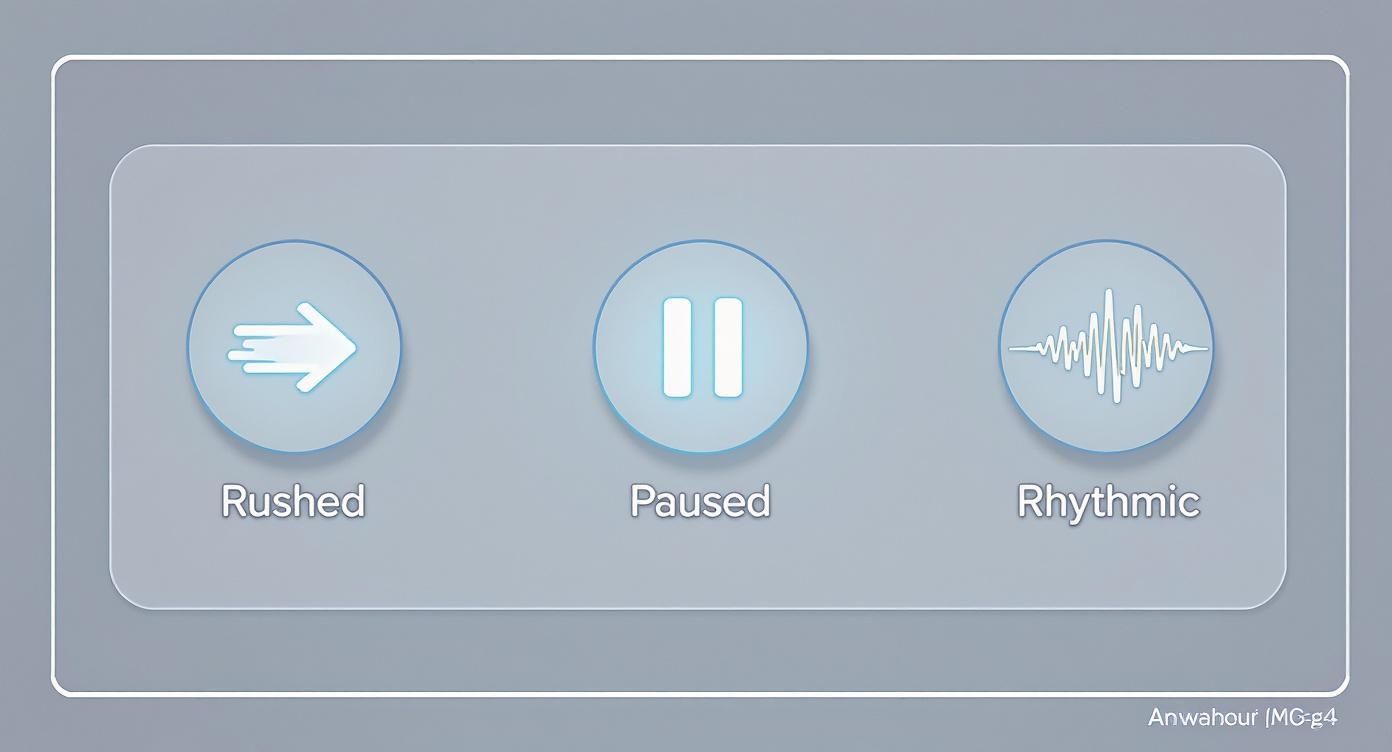
This visual is a great way to help you categorize your delivery, pinpointing moments where you sound rushed versus when your speech has that clear, confident, rhythmic flow we’re all aiming for.
This record-and-review method is so powerful because it forces you to be an active participant in your own learning. You're not just practicing mindlessly; you're analyzing, diagnosing, and prescribing your own solutions.
Comparison of Enunciation Practice Tools
To help you get started, here's a look at the different types of tools available to aid your enunciation practice, highlighting their strengths and best use cases.
| Tool Type | Primary Function | Best For | Example |
|---|---|---|---|
| Speech-to-Text | Instant transcription of spoken words | Quick, real-time checks on individual sounds and word clarity | Your phone's built-in dictation or voice assistant (Siri, Google Assistant) |
| Voice Memo Apps | Recording and playback for self-analysis | Deeper analysis of pacing, intonation, and overall flow | Standard "Voice Memos" on iOS or "Recorder" on Android |
| Specialized Apps | Structured drills and visual feedback | Guided practice with targeted exercises like tongue twisters and minimal pairs | ELSA Speak, Speeko |
| Video Recording | Visual feedback on mouth and jaw movements | Assessing physical articulation alongside sound production | Your phone's camera app |
Each tool offers a different piece of the puzzle. Combining a few of them into your routine will give you a much more complete picture of your progress. By integrating these modern tools with the physical exercises we've covered, you create a robust system for building clear, confident, and impactful speech.
Common Questions About Enunciation
As you start putting these exercises into practice, a lot of questions are bound to pop up. It's totally normal to hit a few snags or just wonder if what you're doing is actually working. Let's tackle some of the most common questions I hear from people who are serious about improving their enunciation.
How Long Does It Take to See a Real Difference?
This is always the first question, and the honest-to-goodness answer is: it depends. How quickly you see results comes down to two things: where you're starting from and how consistently you practice. After all, you're working to reshape habits that have been with you for a lifetime, and that doesn't happen overnight.
That said, many people start to feel a difference in their own speech within a few weeks of consistent, daily practice. Even 10-15 minutes a day adds up. You'll be the first one to notice it. The real turning point, though, is when other people start to notice, and that often happens within a couple of months.
Think of this less like a race and more like building strength at the gym. Small, consistent efforts compound over time to create big, lasting changes. Focus on building the habit, and the results will take care of themselves.
Will Improving My Enunciation Make Me Sound Fake or Robotic?
This is a huge—and valid—fear. The last thing you want is to trade mumbling for a delivery that sounds stiff and unnatural. This usually happens when people try to apply their exaggerated practice drills directly to normal conversation, focusing way too hard on hitting every single syllable perfectly.
The trick is to understand the difference between your practice voice and your performance voice. Those over-articulation exercises are designed to be a workout; they aren't the final product. The real magic happens when the new muscle memory you're building starts to integrate seamlessly into your natural way of speaking.
Your authentic voice and personality should always be front and center. Better enunciation just clears away the physical roadblocks, letting your message land exactly as you intended.
What If I Keep Forgetting to Enunciate During Real Conversations?
It happens to everyone. You get nervous, excited, or just caught up in the moment, and suddenly those old habits sneak back in. This doesn't mean your practice is failing! It just means the new neural pathways need a bit more reinforcement to become automatic.
Here are a few things that can help bridge that gap between the practice room and the real world:
- Set a small, daily goal. Don't try to be "on" 24/7. Just focus on speaking with deliberate clarity during one low-stakes moment each day, like ordering your morning coffee or leaving a voicemail.
- Use a physical cue. Stick a little colored dot on your computer monitor or phone. When you glance at it, let it be a reminder to take a breath and focus on your articulation for the next sentence you say.
- Enlist a friend. Ask someone you trust to give you a gentle, pre-arranged signal if they notice you're starting to mumble or rush your words.
Can Technology Really Help Me Improve?
Absolutely. We're way past the point of just recording yourself and hoping for the best. Modern tools can give you the kind of objective feedback that used to require a professional coach sitting right next to you.
AI-powered speech tech, in particular, has gotten incredibly good at analyzing pronunciation. For instance, a recent study compared two different AI-based learning tools and found a massive difference in effectiveness. One system showed average gain scores of 0.891 versus 0.650 for the other—that’s a 37% greater improvement rate. If you're curious about the details, you can learn how AI tools are enhancing pronunciation learning.
What this means for you is that technology can serve as an unbiased ear. It can pinpoint specific sounds and patterns you might not even notice yourself, turning a subjective goal into something you can measure and track. It helps you practice smarter, not just harder.
At Intonetic, we combine personalized coaching with structured, high-repetition practice to help you build clear, confident speech that feels natural. If you're ready to be understood the first time, every time, learn more about our proven approach at https://intonetic.com.