
How to calm nerves before a speech: Quick Techniques for Confidence
If you want to know how to calm your nerves before a speech, the answer isn’t found in last-minute breathing tricks. It’s all about strategic preparation. That racing heart and shaky voice are almost always symptoms of feeling underprepared. The good news? A solid rehearsal plan is the single best way to channel that nervous energy into genuine, focused confidence.
Why Your Preparation Defines Your Confidence

Let’s be clear: those sweaty palms and that knot in your stomach aren’t a personal failing. It’s an almost universal experience. But the most effective antidote isn’t some magic pill you take backstage. It’s the quiet, deliberate work you put in days and hours beforehand. The psychological link between feeling unprepared and feeling intense anxiety is incredibly strong.
And this isn’t just a feeling—it’s backed by some pretty stark numbers. In fact, a staggering 90% of the anxiety you feel moments before you speak can be traced directly back to a lack of preparation.
The Anxiety-Reduction Power of Preparation
The data consistently shows a direct line between practice and calm. When you rehearse effectively, you’re not just memorizing words; you’re actively lowering your body’s stress response.
| Statistic | Key Finding |
|---|---|
| 90% of Anxiety | Directly linked to a feeling of being underprepared. |
| 60% Less Cortisol | Speakers who rehearse thoroughly experience significantly lower pre-speech stress hormone spikes. |
| 75% Boost in Confidence | Reported by speakers who practiced their opening lines at least 10 times. |
This tells a clear story: preparation is your most powerful tool against stage fright. You’re not just hoping for confidence; you’re building it, one practice run at a time.
From Unprepared Anxiety to Rehearsed Confidence
Think about what happens when you feel unprepared. Your brain is forced to juggle a dozen things at once under immense pressure—trying to recall your next point, manage your pacing, watch your body language, and read the room. It’s a recipe for cognitive overload, which is exactly what triggers that classic “fight or flight” panic.
A structured rehearsal plan completely flips this dynamic. It automates your content, moving it from the brain’s overtaxed “active recall” folder into its “muscle memory” drive. This frees up precious mental space to focus on what actually matters in the moment: connecting with your audience.
For professionals speaking a non-native language, this is a game-changer. Rehearsal doesn’t just help you remember your points; it smooths out pronunciation and locks in your pacing. This is a massive part of how you improve your English speaking skills under pressure.
The point of preparation isn’t to become a robot who delivers a perfect script. It’s to build a foundation so solid that you have the freedom to be authentic, engaging, and truly present with your audience.
A Practical Framework for Preparation
So, where do you start? Don’t try to memorize your entire speech in one go. That’s a surefire way to get overwhelmed.
Instead, I always have my clients master their opening first. A strong, confident start builds unstoppable momentum that will carry you through the entire presentation. Once you know you can absolutely nail the first two minutes, your self-assurance skyrockets.
This mindset shift is huge. The way top athletes approach performance is a great model; they understand that exploring how to build confidence isn’t about luck, but about dedicated practice. Treat your preparation as your greatest strategic advantage. It’s what turns that anxious, buzzing energy into a focused, powerful, and compelling delivery.
Using Your Breath to Control Your Nerves

Before you can command a room, you have to get a handle on your own body. We’ve all heard the advice to “just breathe,” but let’s be honest—it’s pretty useless without a clear method. To actually calm your nerves before a speech, you need a specific, science-backed toolkit to manage the very real physical symptoms of anxiety.
That racing heart and shallow breathing? That’s your “fight or flight” response kicking in. It’s an ancient survival mechanism that’s great for dodging predators but not so helpful when you’re about to present to your team. The good news is that controlled breathing directly counteracts this by activating your parasympathetic nervous system—your body’s “rest and digest” mode.
This isn’t just a feeling; it has a measurable impact. Studies show that targeted deep breathing can slash speech anxiety by up to 50% in just a few minutes. Specific techniques like 4-7-8 breathing have been proven to lower heart rates by 20-30 beats per minute right before a speech.
The 4-7-8 Breathing Technique Explained
One of the most powerful and discreet exercises you can do is the 4-7-8 breathing method. The best part? You can do it anywhere—backstage, at your desk, or even in the restroom minutes before you walk on.
Here’s how it works:
- First, exhale completely through your mouth. Make a little “whoosh” sound.
- Now, close your mouth and inhale quietly through your nose for a count of four.
- Hold your breath for a count of seven. This is the important part.
- Finally, exhale completely through your mouth, making that whoosh sound again, for a count of eight.
Repeat this cycle three or four times. That long exhale is the secret sauce; it slows your heart rate and sends a powerful signal to your brain that everything is under control.
By focusing intently on the count and the physical sensation of your breath, you interrupt the cycle of anxious thoughts. You anchor yourself in the present moment, which prevents your mind from spiraling into worst-case scenarios about your speech.
Getting comfortable with different breathing exercises like 4-7-8 and box breathing is a game-changer for managing those pre-speech jitters.
Connecting Breath to Mindfulness
This process isn’t just a physical trick; it’s practical mindfulness in action. Each controlled breath pulls your focus away from the “what ifs” and grounds you in the physical reality of the here and now.
This is especially crucial for non-native English speakers. When you ground yourself, you free up mental bandwidth that might otherwise be spent worrying about your accent or finding the right words.
Instead of fighting the adrenaline, you’re learning to manage it. By using your breath as an anchor, you can walk onto that stage with a steady, confident presence, ready to connect with your audience. To dive deeper into this, check out our guide on how to use breathing exercises for better English speech.
Your Pre-Speech Vocal and Mental Warmup
A powerful speech doesn’t just happen the moment you step on stage. It’s built in the crucial minutes leading up to it, with a voice that’s primed and a mind that’s focused. Think of it like an athlete stretching before a big game—you need a targeted warmup.
This is especially true if English isn’t your first language. When you’re already navigating concerns about clarity and accent, nerves can add a whole other layer of stress. This routine is my go-to method for taking back control. It’s a practical way to calm your nerves by focusing on the two things you can control: your voice and your thoughts.
Priming Your Voice for Clarity
When you get nervous, your body’s natural reaction is to tense up. The muscles in your jaw, throat, and chest tighten, which can lead to a shaky, quiet, or monotone voice. That tension makes it so much harder for your audience to connect with your message.
A few simple vocal exercises can release that tension and get your vocal cords ready for clear, confident delivery.
Start with these quick physical exercises:
- Lip Trills: You might feel a little silly, but this works wonders. Vibrate your lips together while you exhale, making a “brrrrr” sound. This is a fantastic way to relax your lips and facial muscles while gently engaging your breath support. Do this for about 30-60 seconds.
- Humming: Gently hum a simple tune. The goal is to feel the vibration in your lips, nose, and chest. This warms up your vocal cords without straining them and helps you tap into your natural vocal resonance.
- Jaw Loosening: Gently massage the muscles around your jaw hinge with your fingertips. Then, just let your jaw hang loose and gently move it from side to side. You’d be surprised how much tension you hold there.
Once you feel a bit looser, it’s time to focus on articulation. For non-native speakers, warming up the tongue and lips is absolutely critical for crisp pronunciation, which is a massive confidence booster.
Tongue twisters aren’t just for kids; they are a targeted workout for your mouth. For a great list to get you started, you can find some really effective vocal warm-ups and tongue twisters that will help sharpen your enunciation.
Mastering Your Mental Game
The internal monologue you have in the minutes before you speak can either be your biggest cheerleader or your worst critic. The key is to consciously steer your thoughts away from fear and toward a positive, successful outcome. This isn’t just wishful thinking; it’s a proven psychological technique used by performers and athletes everywhere.
“The words you say to yourself, the tone you’re using influences your state of confidence. If your voice sounds shaky, you’ll feel shaky. If it sounds strong, you’ll feel strong.”
Instead of letting your mind spiral into “what-if” disasters, take control with visualization. Find a quiet corner, close your eyes, and mentally rehearse your delivery from start to finish.
Picture yourself standing confidently. See yourself speaking clearly. Imagine looking out and seeing audience members nodding along, engaged with what you’re saying. Feel that sense of accomplishment as you deliver your final line to genuine applause.
This mental rehearsal primes your nervous system for success. Here’s the cool part: your brain can’t always tell the difference between a vividly imagined experience and a real one. By visualizing a successful speech, you are essentially creating a positive memory in advance. This makes the real thing feel more familiar and way less intimidating when you finally step on stage.
Rehearsal Techniques That Actually Work
Let’s be honest: just reading your speech over and over in your head isn’t practice. Real rehearsal is an active, strategic process. It’s about building muscle memory for your content so you don’t have to scramble to remember what comes next.
When your delivery becomes second nature, you free up precious mental bandwidth. Suddenly, you can focus on what really matters—connecting with your audience—instead of just surviving the next sentence.
This is a game-changer for non-native English speakers. Smart practice tackles those common anxieties around pacing and pronunciation head-on, turning potential weaknesses into strengths. The goal isn’t to sound like a native speaker; it’s to be understood clearly and confidently.
Break Your Speech into Manageable Chunks
Staring at a 20-minute presentation and trying to memorize it all at once is a surefire way to feel overwhelmed. Don’t do that to yourself.
Instead, borrow a technique from psychology called chunking. Break your entire talk down into smaller, logical sections. Think of it like this: the introduction is one chunk, your first key point is another, your second point is the next, and so on.
Now, focus on mastering just one chunk at a time. Practice it until it feels natural, until you can deliver it without staring at your notes. Once you’ve got that one down cold, move on to the next. This approach makes the whole process feel much less intimidating and gives you a series of small wins that build real momentum.
The Record, Review, and Refine Method
You can’t fix what you can’t hear. This is where your smartphone becomes your most powerful coaching tool. Go ahead and record yourself delivering one of those chunks you just created.
Then, listen back with a critical but kind ear. You’re not looking for perfection; you’re looking for patterns.
Pay special attention to these three things:
- Pacing: Are you speeding up when you get nervous? Rushing is a natural response to anxiety, but it can make your message—especially with an accent—very difficult for the audience to follow.
- Clarity: Pinpoint any specific words you stumble over. Is there a key term you consistently mispronounce? Isolate those words and practice them on their own.
- Pauses: Are you using silence strategically? A well-placed pause can add powerful emphasis, and it gives both you and your listeners a moment to breathe and process.
This simple exercise gives you the objective feedback you can’t get from practicing in your head. After you listen, refine that section and record it again. Repeating this cycle just two or three times for each chunk will make a massive difference in your delivery. It’s a core component of how you can use simulation exercises to improve your English accent in a practical, real-world way.
The goal of recording yourself is not to achieve perfection. It is to build self-awareness so you can make small, targeted improvements that have a big impact on your overall clarity and confidence.
This infographic breaks down the essential components of a well-rounded pre-speech warmup, combining vocal, mental, and visualization steps.
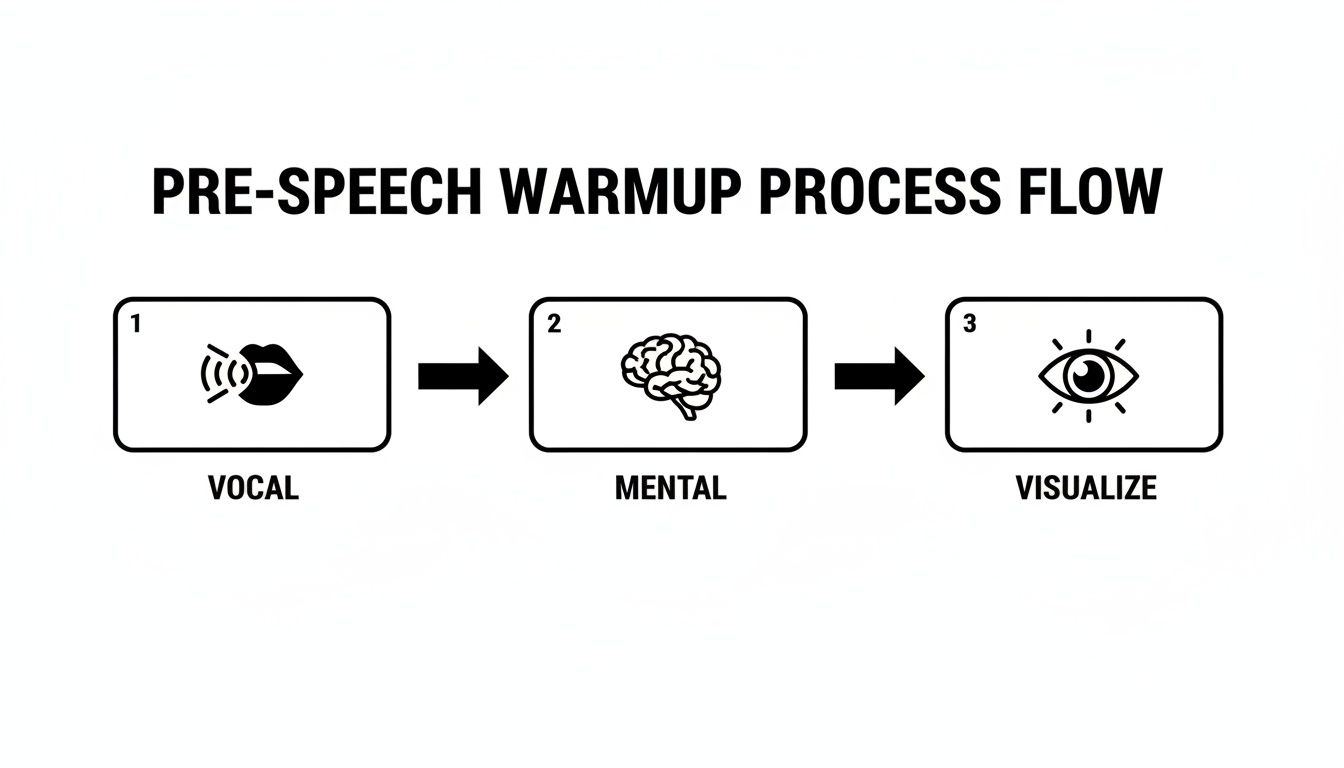
As the visual flow shows, a truly effective routine addresses your instrument (your voice), your mindset, and your performance expectations in equal measure. Neglecting one area can undermine your efforts in the others.
On-Stage Strategies to Stay Calm and Composed

The moment you step into the spotlight is where all your preparation pays off. This isn’t about trying new exercises; it’s about having a few in-the-moment tactics ready to go. These are the small, powerful moves that help you manage that initial rush of adrenaline and stay in control from your first word to your very last.
Think of your first few seconds on stage as the most critical. Before you even think about speaking, ground yourself. Plant your feet firmly, take one slow and deliberate breath, and make eye contact with one or two people in the audience. This isn’t just a pause—it’s you claiming your space and setting the pace.
Find Friendly Faces
When you scan the room, your brain has a funny way of locking onto the one person who looks bored or critical. It’s a classic anxiety trap. Your job is to consciously override that instinct.
Instead, actively search for the friendly faces. Look for the people who are smiling, nodding, or leaning in with interest. Making eye contact with these allies creates an instant, positive feedback loop. It’s a silent conversation that tells your brain, “I’m connecting. They get it.” This simple act can shift the dynamic from a terrifying monologue into a genuine conversation.
Remember, the audience wants you to succeed. When you find an ally in the crowd and speak to them for a few moments, it reminds you that you’re not facing a threat; you’re sharing ideas with supportive people.
Project Confidence with Your Body
Here’s a great trick: your nervous system can’t always tell the difference between feeling confident and acting confident. You can use this to your advantage. Even if you feel shaky on the inside, stand tall, pull your shoulders back, and make your gestures open and purposeful.
Try to avoid those classic nervous habits:
- Aimless pacing: It’s okay to move, but do it with purpose. Take a step forward to emphasize a key point.
- Clasping your hands: Keep your hands open and ready to gesture naturally. This signals openness and ease.
- Shifting your weight: Stand with your weight evenly distributed. It creates a stable, grounded presence that looks (and feels) more confident.
When you project confidence with your body, you send powerful signals back to your brain that help dial down the anxiety. You can literally “fake it ’til you become it,” letting your physical posture shape your mental state.
Handling Mistakes Gracefully
Let’s be real: mistakes happen. Even the most experienced speakers stumble over a word or briefly lose their place. The secret isn’t avoiding mistakes—it’s knowing how to recover without letting it derail your whole talk.
If you make a small error, just correct yourself and move on. No need for a big, dramatic apology. The audience is far more forgiving than you are, and chances are they barely noticed.
And if you lose your train of thought? Use a strategic pause. Take a calm sip of water, glance at your notes, and then re-engage with your audience. To them, it looks deliberate and thoughtful, not panicked. Your ability to recover from a slip-up without getting flustered is the true mark of a pro.
Your Top Pre-Speech Worries, Answered
Even with the best prep routine, those last-minute “what-if” scenarios can really mess with your head. Let’s tackle them head-on. Having a solid game plan for these common fears is one of the best ways to walk on stage feeling like you’re ready for anything.
What’s the Single Best Thing to Do Right Before I Go on Stage?
Deep, controlled breathing. It’s that simple.
Just before you’re introduced, do the 4-7-8 breathing technique we covered earlier. Breathe in for a count of four, hold it for seven, and then exhale slowly for eight. Do this three to five times.
This isn’t just a feel-good trick; it’s a physiological reset. This specific breathing pattern activates your parasympathetic nervous system, which is your body’s natural “rest and digest” mode. It literally slows your heart rate and tells your brain you’re safe, short-circuiting that “fight or flight” response before it takes over.
How Can I Stop My Voice from Shaking?
A shaky voice is almost always a physical problem, not a mental one. It stems from two culprits: shallow breathing and tension in your throat and chest. You can beat it with a simple three-part strategy.
First, always do your vocal warmups. A few minutes of humming or gentle lip trills will relax your vocal cords and get them ready.
Second, breathe from your belly (diaphragmatically). This gives your voice a much stronger, more stable column of air to ride on compared to quick, shallow breaths from your chest.
And finally, slow down. Intentionally. Build in pauses between your key points. This not only gives you a moment to take another deep, supportive breath but also makes you sound more confident and in control.
A steady voice comes from a relaxed body and controlled breath. Don’t try to fight the shaking—prevent it with the right physical prep.
I’m Worried My Accent Will Make Me Hard to Understand. What Should I Do?
This is a huge concern for so many professionals, and it’s completely valid. But here’s the crucial mindset shift: your goal is clarity, not perfection. Your accent is part of who you are, and trying to erase it will only make you sound stiff and unnatural.
Instead, focus on being understood. A great first step is to learn how to overcome accent anxiety and speak fearlessly by concentrating on the things you can actually control.
Here are a few quick, practical tips:
- Hit your final consonants. Pay special attention to the sounds at the ends of words, like the ‘t’ in “report” or the ‘d’ in “and.” These are often the first to get dropped and can make a big difference in clarity.
- Slow down just a little. Record yourself and check your pace. Speaking just 10% slower than you normally would can dramatically improve how well your audience follows along.
- Lean on your visuals. Use simple slides with key phrases or data points. This gives your audience a second way to process the information, reinforcing your message.
Above all, reframe your thinking. Instead of worrying, “I hope they understand me,” tell yourself, “I’m here to share something valuable.” When you speak from a place of passion and expertise, that’s what your audience will remember—not your accent.
At Intonetic, we specialize in helping professionals achieve exactly that—clear, confident communication that ensures your ideas are heard and respected. If you’re ready to move beyond accent anxiety and speak with authority, book a free assessment today.