How do you improve your english speaking skills? Practical routines and tips
If you want to improve how you speak English, the first step is surprisingly simple: record yourself talking. It’s the fastest way to get a real, honest look at your current skills. This simple act turns that vague feeling of being a “bad speaker” into a concrete, actionable plan that’s built around your specific habits. From that point on, it’s all about consistent, focused practice.
Assess Your Current Speaking Skills To Find Your Starting Point
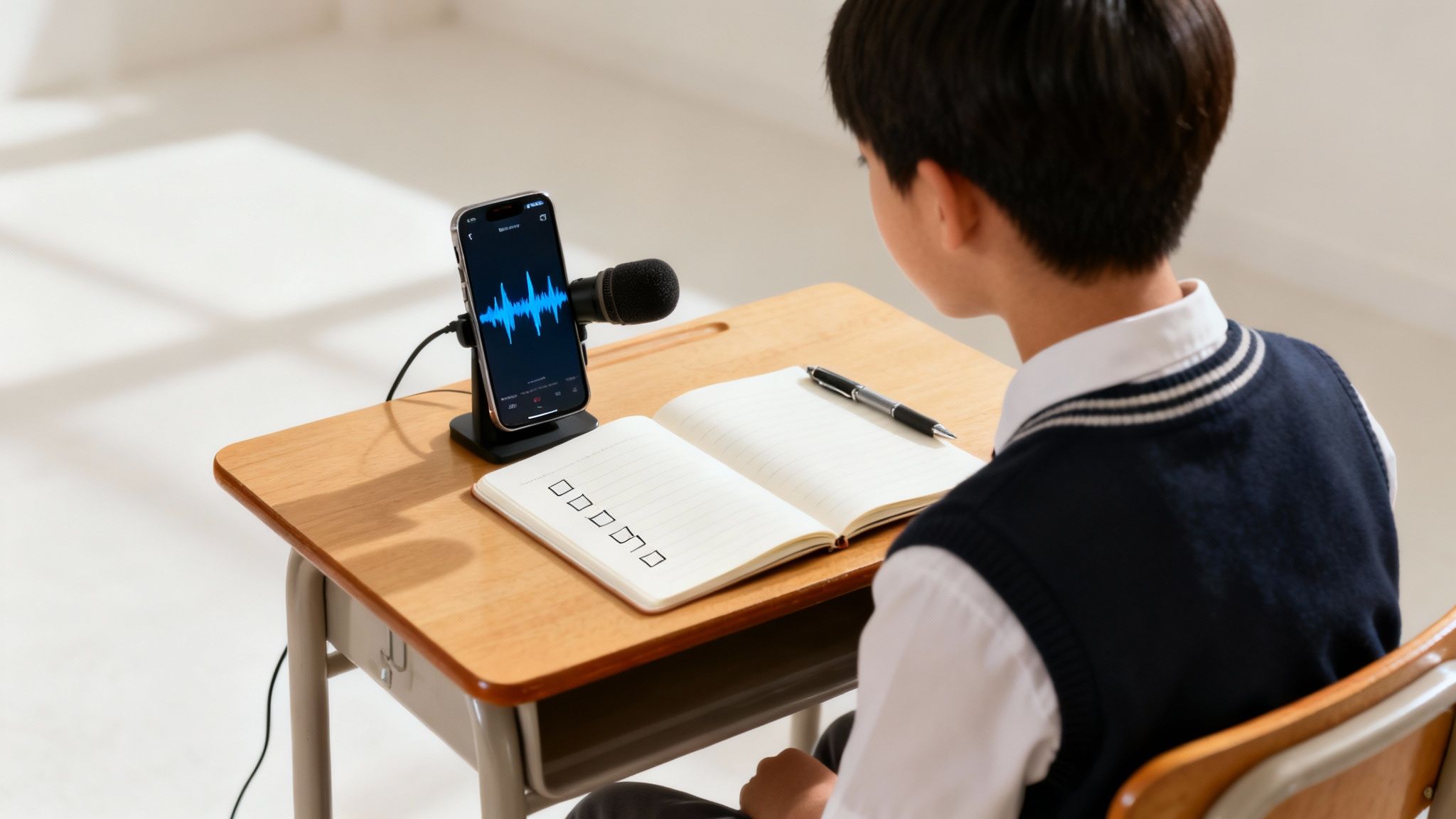
Before you can build effective habits, you need a clear snapshot of where you are right now. The point here isn’t to be self-critical; it’s to gather data. Goals like “speak better” are impossible to track, but pinpointing your actual challenges gives you a clear roadmap for improvement.
The most powerful thing you can do is record yourself. No fancy equipment needed—the voice memo app on your phone is perfect. Just pick a short article to read aloud, describe what you did yesterday, or answer a common interview question for about 2-3 minutes.
What To Listen For In Your Recording
When you play it back, try not to cringe or focus only on mistakes. Listen for patterns. A great trick for getting an objective view is to run your recording through one of the many audio to text converter tools. This can be a real eye-opener, showing you mispronunciations you didn’t even know you were making.
Keep an ear out for these key elements:
- Pronunciation: Are there specific sounds that trip you up? For many learners, sounds like “th,” “r,” or the subtle difference between “v” and “w” are common hurdles.
- Filler Words: How often do you lean on crutches like “um,” “ah,” “like,” or “you know”? Make a quick tally to get a baseline number.
- Pacing and Rhythm: Is your speech too fast or choppy? Or is it too slow and monotonous? A natural, conversational flow is what you’re aiming for.
- Intonation: Does your pitch rise and fall naturally? Flat intonation can make you sound bored or disengaged, even when you’re not.
A self-assessment isn’t about judgment; it’s about diagnosis. Identifying that you overuse ‘like’ or struggle with the ‘th’ sound gives you a concrete problem to solve, making your practice sessions 10x more effective.
Setting Tangible Goals From Your Assessment
Once you have this data, you can finally set specific, measurable goals. If you want a more structured approach, a formal evaluation can give you a professional benchmark. Our detailed accent reduction assessment is designed to establish exactly this kind of clear starting point.
Based on what you find, your initial goals might look something like this:
- Cut my use of “um” by 50% in the next two weeks.
- Master the American “r” sound by practicing targeted drills for 10 minutes every day.
- Record a one-minute talk each week to track improvements in my speaking rhythm.
This foundational step is absolutely crucial. Research from Cambridge Assessment English suggests that hitting an intermediate level can take anywhere from 600 to 1,000 hours of focused study, with speaking practice being a massive part of that. By starting with a clear assessment, you make sure every single hour you invest is pushing you in the right direction.
Mastering English Pronunciation And Intonation
Knowing the right words is only half the battle. To speak English with real confidence, you have to get a feel for the music of the language. This is where prosody—the rhythm, stress, and intonation of speech—becomes an absolute game-changer.
Think of it this way: vocabulary and grammar are the notes on the page, but prosody is the performance that brings those notes to life. It’s what makes your speech engaging, easy to follow, and natural to a native listener. Without it, even perfectly structured sentences can fall flat or, even worse, be completely misunderstood.
Beyond Words The Importance Of Sentence Stress
In English, we don’t give every word the same amount of attention. We instinctively emphasize certain words to highlight the most critical part of our message, and changing that emphasis can completely alter the meaning.
Take this simple phrase: “I didn’t say he stole the money.”
- Stressing “I” implies someone else said it.
- Stressing “say” suggests you hinted at it without actually speaking the words.
- Stressing “he” means you think another person was the thief.
- Stressing “money” implies he stole something else entirely.
This subtle art of emphasis is a huge part of sounding fluent. A great way to practice is to pick one sentence, record yourself saying it over and over, and stress a different word each time. When you listen back, you’ll hear just how much the meaning shifts.
The Power Of Shadowing For Natural Rhythm
One of the most effective techniques I’ve seen for internalizing the natural flow of English is shadowing. This isn’t about memorizing lines; it’s about building muscle memory for your mouth and your mind. The process is simple but incredibly powerful:
- Find a short audio clip (just 1-2 minutes) of a native speaker. Podcasts, audiobooks, or a TED Talk are all great sources.
- Listen to it once just to get the gist of the content.
- Play it again, but this time, speak along with the recording in real-time. Your goal is to mimic their pace, their pauses, and the rise and fall of their voice.
Don’t get hung up on catching every single word perfectly. The real objective is to copy the melody of their speech. Shadowing trains your brain to recognize and reproduce the natural cadence of English conversation without having to consciously think about the rules.
Mastering the “music” of English is often the missing link between knowing the language and truly speaking it. Intonation and rhythm build a bridge of understanding, ensuring your message is not just heard, but also felt by your listener.
If you want to go deeper into these nuances, a detailed guide with targeted exercises can make all the difference. You can learn more about mastering American English intonation with examples in our dedicated article.
Correcting Common Pronunciation Hurdles
Every single learner has a few specific sounds that are tougher than others, usually because of how different they are from their native language. Identifying these tricky spots and drilling them is how you turn frustrating mistakes into fuel for rapid growth.
I’ve put together this quick-reference table to help you pinpoint some of the most common errors I see and how to start correcting them.
Common Pronunciation Errors And Corrections
| Common Mistake (Example) | Correct Pronunciation (How to say it) | Simple Tip |
|---|---|---|
| “Sink” vs. “Think” (Mixing ‘s’ and ‘th’) | The “th” sound requires placing your tongue tip lightly between your teeth. | Use a mirror to make sure your tongue is in the right position for the “th” sound. You should see the tip! |
| “Ship” vs. “Sheep” (Short ‘i’ vs. Long ‘ee’) | The ‘ee’ in “sheep” is a longer, more tense sound made with a wider smile. | Exaggerate the vowel sounds. Say “ship” quickly and really stretch out the “eeee” in “sheep.” |
| “Very” vs. “Wery” (Mixing ‘v’ and ‘w’) | For “v,” your top teeth gently touch your bottom lip. For “w,” your lips form a small circle. | Feel the vibration on your lip for the “v” sound. There should be zero vibration for “w.” |
| Dropping the final consonant (“min” for “mind”) | Ensure you fully pronounce the consonant sound at the end of a word, like the ‘d’ in “mind.” | Record yourself and listen specifically for the last sound of each word. Slowing down helps a ton. |
By tackling these common hurdles head-on, you’re not just fixing small errors—you’re fundamentally improving how clear and professional you sound every time you speak.
How To Build A Consistent Speaking practice Routine
Fluency isn’t born from a few marathon study sessions. It’s built brick by brick, through small, consistent actions you take every single day. The real secret to improving your English speaking skills is weaving practice into the fabric of your life, making it a natural habit instead of a chore—no matter how packed your schedule is.
This approach isn’t about blocking out two hours you don’t have. It’s about finding minutes and moments, focusing on frequency over sheer duration. Success comes from making English a part of your daily rhythm.
Embrace Micro-Speaking Habits
The most effective way to build this rhythm is through micro-speaking habits. These are tiny, one-to-five-minute activities you can sneak into any part of your day, turning dead time into productive practice. The goal is simple: get your mouth moving and your brain thinking in English, without the pressure of a formal lesson.
Here are a few ways to get started:
- Narrate Your Commute: As you walk to the train or drive to the office, describe what you see out loud. “That cyclist is weaving through traffic. I see a man ordering coffee. The light just turned green.” It feels a little strange at first, but it’s incredible training for forming sentences on the fly.
- Summarize a Podcast: After listening to a short news clip or a segment of a podcast, hit pause. Try to summarize the key points out loud in under two minutes. This is a fantastic exercise for both listening comprehension and your ability to articulate ideas concisely.
- Think Out Loud in English: When you’re making your morning coffee or mapping out your day, do it in English. “Okay, first I need to draft that follow-up email. Then, I’ll prep for the 10 AM stand-up.”
Create a Structured Weekly Plan
While these micro-habits build your daily momentum, a structured weekly plan ensures you’re also hitting your larger, more specific goals. This is where you shift from spontaneous chatter to deliberate, focused practice designed to stretch your professional communication skills.
A simple weekly plan might look something like this:
- Monday: Find a language exchange partner online and schedule a 30-minute call for later in the week.
- Wednesday: Prepare and record a five-minute mock presentation on a work-related topic. Just use your phone’s voice recorder.
- Friday: Listen back to Wednesday’s recording. Pinpoint one area to improve—maybe your pacing was too fast, or you used too many filler words. Then, re-record it, focusing on that one improvement.
This kind of structure gives your practice a clear purpose. You’re not just speaking; you’re speaking to get better at something specific.
The most effective routines balance the spontaneous nature of daily micro-habits with the focused intention of weekly goals. One builds reflexes, the other builds capability. Together, they create unstoppable momentum toward fluency.
Track Progress Through Real-World Wins
Finally, it’s time to change how you measure success. Instead of obsessing over the number of hours you’ve practiced, start noticing your wins in the real world. Did you lead your team meeting without stumbling over your words? Did you handle that unexpected client call with confidence? These are the victories that truly matter.
This simple three-part cycle—listen, mimic, record—is a powerful way to frame your daily pronunciation work.
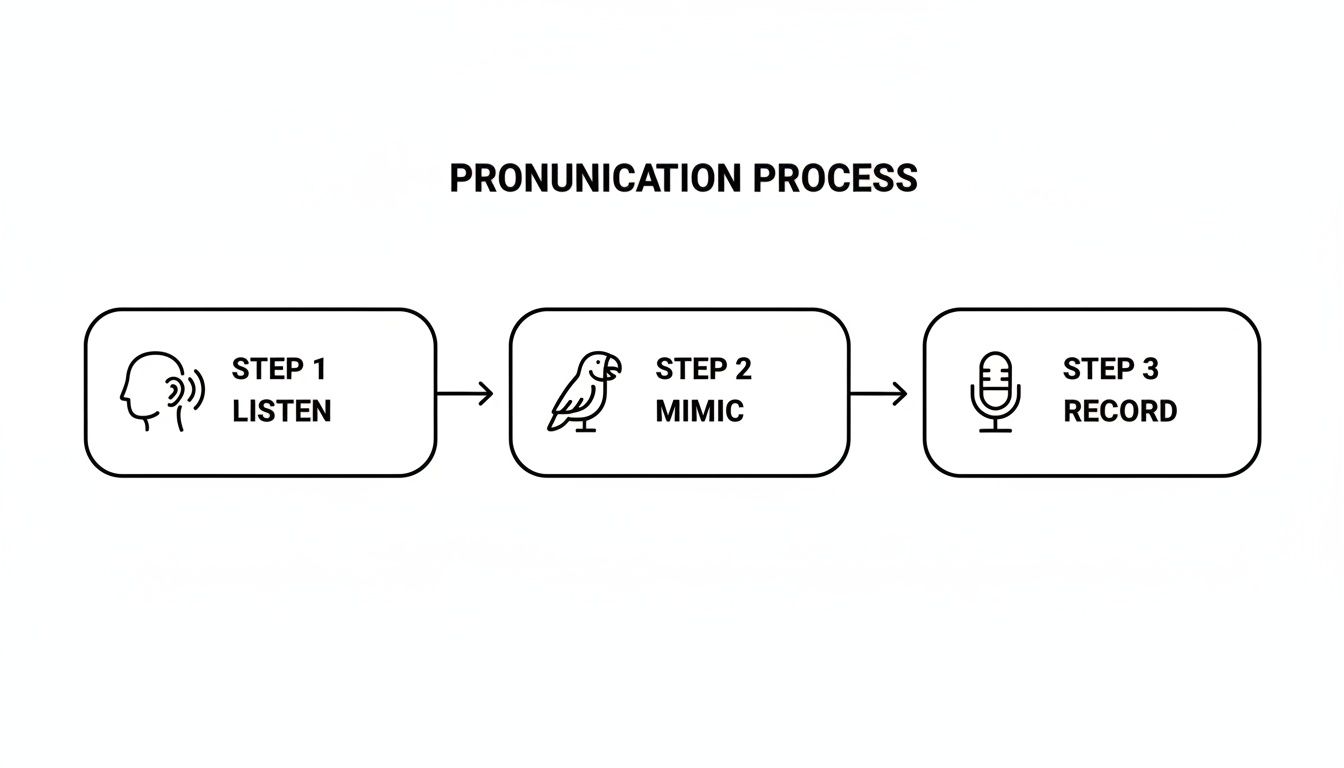
This feedback loop is fundamental to refining your pronunciation. If you want to dive deeper into making this a core part of your schedule, our guide on how to practice English pronunciation daily for rapid progress offers even more actionable steps.
When you have a consistent routine, you’ll find these small wins start happening more and more often. That’s how you know your hard work is paying off where it actually counts.
Using Technology To Accelerate Your Fluency
Your smartphone can be one of the most powerful speaking coaches you’ll ever have. If you use today’s technology smartly, you can get the kind of high-impact, targeted practice that makes new speaking habits feel automatic. This is about more than just downloading a few apps—it’s about building a system for consistent, data-driven improvement.
This tech-forward approach is quickly becoming the new standard. In fact, the global language learning market is projected to hit $187.69 billion by 2028, and a huge part of that growth is driven by AI-powered speaking tools. Some studies even show that AI conversation partners can help learners improve fluency up to 40% faster than traditional methods simply by providing endless, on-demand practice.
AI Tools for Instant Pronunciation Feedback
The biggest challenge with practicing on your own has always been the lack of immediate feedback. You could practice a word a hundred times, only to discover you were just reinforcing the wrong pronunciation. AI-powered apps completely change this dynamic.
These tools use speech recognition to analyze your pronunciation in real-time, stacking your sound production up against a native speaker’s model. They can pinpoint exactly which sounds you’re struggling with and give you instant, actionable corrections.
- Targeted Drills: Get immediate feedback on tricky sounds like the American “r” or the “th.”
- Sentence-Level Analysis: See how your intonation and rhythm measure up in full sentences, not just isolated words.
This immediate feedback loop is absolutely critical for building correct muscle memory right from the start. For a deeper look at this, our guide on improving American English pronunciation using online tools and apps offers a ton of great resources.
Practice Conversations Without the Pressure
For many professionals, the fear of making mistakes in front of colleagues can be paralyzing. This is where AI conversation partners offer a huge advantage. They provide a safe, judgment-free space to practice real-world dialogues anytime you want.
You can run through common workplace scenarios like giving a project update, jumping into a brainstorm, or even just making small talk. For personalized guidance, AI teacher chatbots can offer customized lessons and real-time feedback.
This type of 24/7 access to conversational practice is a game-changer. It gives you the sheer volume of repetition needed to move beyond memorized phrases and start speaking spontaneously and with confidence.
Use Voice Recorders To Track Your Progress
Finally, one of the simplest yet most effective tools is already on your phone: the voice recorder. Recording yourself regularly—maybe reading a short article or just summarizing your day—creates a powerful audio journal of your progress.
Listen back to a recording from three weeks ago, then listen to one from today. You’ll hear tangible improvements in your pacing, clarity, and how often you lean on filler words. This concrete evidence of your growth is an incredible motivator and a key part of seeing real results.
Putting Your Skills to the Test in Real-World Conversations

All those drills and practice routines have one single purpose: to help you perform under pressure when a conversation isn’t scripted. This is where your hard work translates into a real career advantage, especially in professional settings where clear, confident communication is everything.
Making that leap from practice to performance can feel daunting, I get it. The key is to arm yourself with practical, situational language first. When you know exactly how to phrase a question or politely disagree, you remove the mental burden of searching for words. This frees you up to focus on what’s actually being said. The goal here is to feel prepared, not perfect.
Navigating Common Workplace Scenarios
Every workplace has its own communication rhythm, from formal all-hands meetings to casual chats by the coffee machine. Moving smoothly between these scenarios makes you sound more competent and feel like you truly belong. Instead of trying to memorize a dictionary of phrases, focus on a few high-impact ones for the situations that come up most often.
Here are some of my go-to phrases for those tricky moments:
- To Politely Interrupt: “Could I just jump in here for a moment?” or a slightly more assertive, “I have a quick thought on that, if I may.”
- To Ask for Clarification: “I want to make sure I understand correctly. Are you saying that…?” This shows you’re listening carefully. Another great one is, “Could you elaborate a little more on that point?”
- To Disagree Respectfully: “I see your point, but have we considered…?” is a classic for a reason. Or, try, “That’s a valid perspective. I have a slightly different take on it.”
Think of these phrases as conversational tools. They buy you a few precious seconds to gather your thoughts and signal to your colleagues that you’re engaged and respectful, even when you’re pushing back on an idea. This is a massive part of effective professional communication.
Mastering a few key situational phrases is like having a toolkit for conversations. You don’t need a different tool for every single job, just the right ones for the most common tasks. This builds confidence and makes your participation in discussions much smoother.
From Small Talk to Big Meetings
Your ability to build rapport is just as critical as your ability to present data. Small talk can feel trivial, but it’s the social glue of any workplace. It builds the relationships and trust that make those high-stakes conversations much easier down the line.
Start in low-pressure environments. The kitchen or the first few minutes before a meeting are perfect training grounds.
- Initiate with an open-ended question: Ditch the “How are you?” which usually gets a one-word answer. Try something like, “Working on anything exciting this week?” or “Any interesting plans for the weekend?”
- Find common ground: Listen for hobbies, projects, or interests you share. A simple, “Oh, you’re a fan of that author too?” can unlock a much more meaningful conversation.
The skills you sharpen in these casual chats transfer directly to bigger meetings. Once you’re comfortable speaking up in a low-stakes setting, contributing to a high-stakes discussion feels far less intimidating. This is exactly why it’s so helpful to explore resources focused on improving English pronunciation with real-life conversation practice, as they bridge that crucial gap between theory and reality.
By consciously practicing in both casual and formal settings, you create a powerful feedback loop. The confidence you gain from a successful chat by the coffee machine fuels your courage to speak up in the team meeting, and vice versa. Every single successful interaction, no matter how small, is a step toward becoming a more articulate and influential communicator at work.
A Few Common Questions I Hear All The Time
As you start getting serious about improving your spoken English, some questions always come up. It’s completely normal. Getting clear, practical answers to these helps you stay on track and not get discouraged. Let’s tackle a few of the big ones.
The biggest hurdle for almost everyone is the fear of making a mistake. I get it. It’s a paralyzing feeling, but it can stop your progress cold. The trick is to completely reframe how you think about errors. They aren’t failures; they’re just data, showing you exactly what to work on next.
The goal isn’t perfection—it’s clear, effective communication. Every single mistake you make and learn from is a step toward fluency, not a red flag. Embrace them. They’re part of the deal.
Instead of freezing up, just focus on getting your message across. You’d be surprised how patient most people are. They’ll appreciate the effort you’re making.
“Seriously, How Much Daily Practice Is Enough?”
This is a classic. And honestly, the answer has less to do with total hours and more to do with pure consistency. A marathon two-hour session once a week is far less effective than 15-20 minutes of focused work every single day. No contest.
Consistency is what builds muscle memory and keeps the language right at the front of your mind. You just need to find a daily target that you can actually stick with.
- Shadow a podcast for 10 minutes on your commute.
- Spend 5 minutes narrating what you’re doing out loud (making coffee, writing an email).
- Drill one specific pronunciation sound for 5 minutes.
This small, daily investment compounds like crazy over time, leading to huge gains without burning you out. The real aim is to weave English speaking into the fabric of your daily routine.
“Should I Try to Erase My Accent?”
This is a crucial point, so let’s be clear: the goal is clarity, not accent elimination. Your accent is part of your story, part of your identity. Trying to sound exactly like a native speaker from Chicago or London is usually an unrealistic and totally unnecessary goal.
The real target is much more practical: to be easily and clearly understood the first time you speak.
This means fine-tuning the specific sounds that are tripping people up and mastering the natural rhythm and intonation of English. When your message comes across cleanly, your accent just becomes an interesting part of who you are, not a barrier to communication. A good coach can help you pinpoint those high-impact areas so you’re not wasting your time.
At Intonetic, we zero in on building clear, confident communication skills without trying to erase your identity. Our program is built for busy professionals like you, offering personalized coaching and practical tools to help you sound more authoritative and be understood in every conversation. Book your free assessment today to get a starter guide and discover your personal path to fluency.