8 Crucial Examples of Stressed Syllables to Master in 2026
In American English, where you place the emphasis, or stress, within a word can change its meaning entirely, define its grammatical function, and instantly signal your level of fluency. For non-native professionals, mastering this single aspect of pronunciation is often the fastest path to being understood the first time, every time. It’s not just about sounding ‘correct’; it’s about conveying authority, ensuring clarity in high-stakes conversations, and eliminating the friction of miscommunication.
This guide moves beyond abstract rules to provide high-impact, practical examples of stressed syllables that appear daily in business, tech, and healthcare settings. We’ll break down not just what to stress, but why it matters, providing replicable tactics you can apply immediately to sound more natural and confident. Think of each example as a micro-lesson in American English rhythm, the foundational skill for influential communication.
You’ll learn how shifting the stress in a word like “record” changes it from a noun to a verb, a critical distinction in technical documentation or a sales presentation. By analyzing these subtle but powerful shifts, you will gain a deeper understanding of the spoken language’s mechanics. To further enhance your professional English and communication clarity, consider exploring dedicated English lessons that offer practical tips on pronunciation for English learners. Let’s dive into the examples that will refine your speech and boost your impact.
1. COMpany vs. comPANy
The mispronunciation of “company” is a classic example of how a small shift in syllable stress can significantly impact professional perception. For many non-native English speakers, the tendency is to stress the second syllable, producing com-PAN-y. However, standard American English pronunciation places the stress firmly on the first syllable: COM-pa-ny.
This distinction is crucial in business settings. When an executive introduces their com-PAN-y, it can subtly undermine their authority and credibility, signaling a non-native pattern that may distract from their message. Mastering COM-pa-ny is a foundational step in developing a powerful, standard American accent.
Strategic Analysis
Let’s break down the impact in common professional scenarios:
- Pitch Meetings: A tech founder introducing their “COMpany” sounds confident and fluent. Introducing their “com-PAN-y” can make them seem less polished, potentially affecting investor confidence.
- Client Presentations: A sales professional representing their “COMpany” projects expertise. The incorrect stress can create a slight, subconscious barrier, making the speaker seem like an outsider.
- Internal Communications: A healthcare administrator discussing “COMpany” policy communicates with clarity and authority. The alternative can cause momentary confusion or diminish the weight of the announcement.
Actionable Takeaways
To master this crucial word, integrate these specific tactics into your practice:
- Exaggerate the Stress: Repeat the word aloud, putting heavy, exaggerated emphasis on the first syllable: COM-puh-nee. The other syllables should be weak and quick.
- Record and Compare: Record yourself saying, “I am the CEO of this company.” Then, listen to a recording of a native speaker saying the same phrase. Compare the rhythm and stress patterns.
- Practice in Context: Don’t just practice the word in isolation. Repeat full, relevant sentences like, “Our COMpany values innovation,” or “Welcome to our COMpany headquarters.”
For a deeper dive into the mechanics of word stress, you can find a comprehensive guide on stressed and unstressed syllables. Correcting this single, high-frequency word is one of the fastest ways to enhance your professional presence.
2. PREsent vs. preSENT
The pair PREsent and preSENT is a powerful example of a heteronym, where syllable stress dictates not just pronunciation but the word’s fundamental meaning and grammatical function. Stressing the first syllable, PRE-sent, creates a noun (a gift) or an adjective (current). Shifting the stress to the second syllable, pre-SENT, transforms it into a verb (to show or offer).
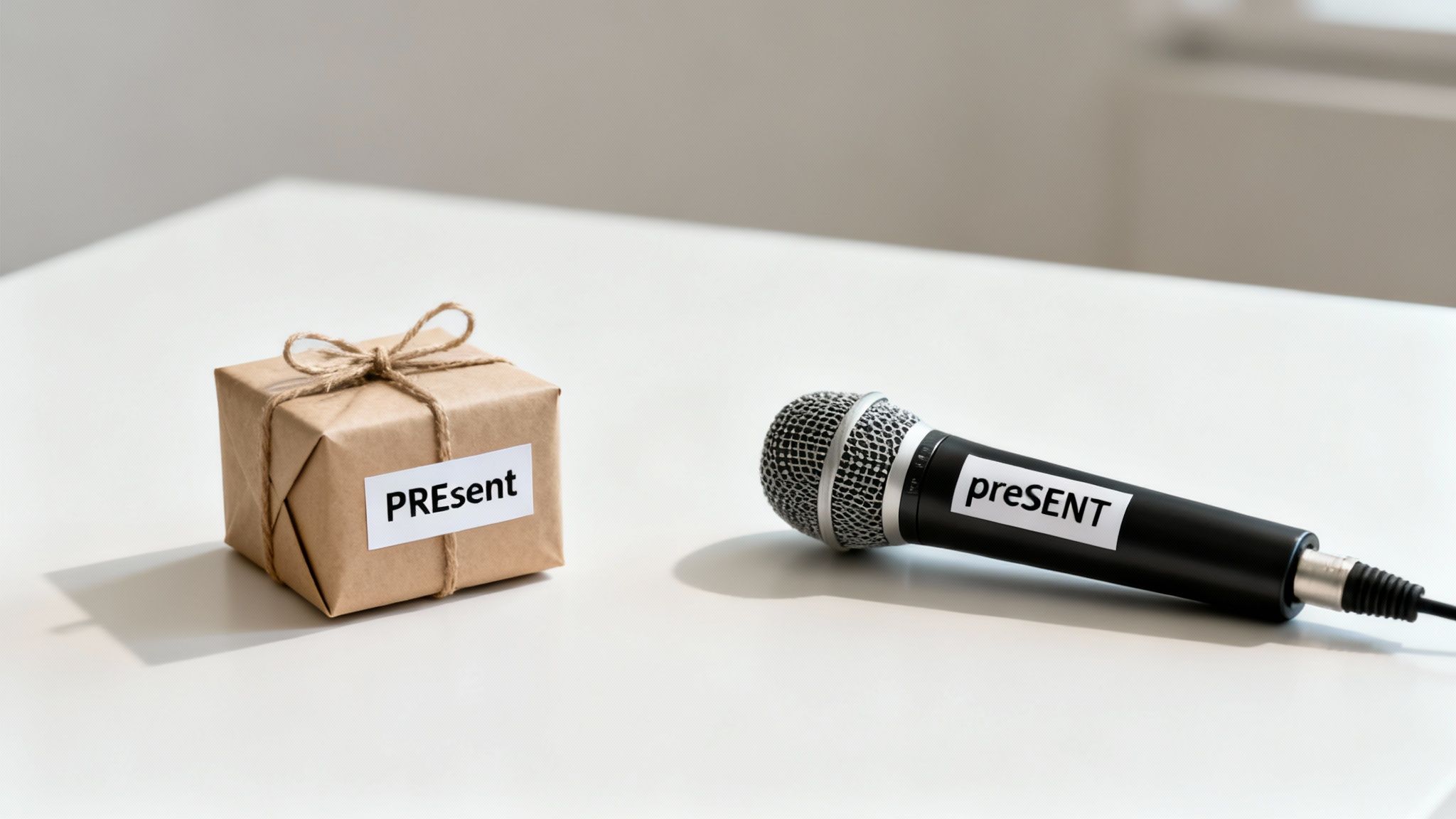
This distinction is non-negotiable for clear professional communication. Using the incorrect stress pattern can lead to direct confusion, forcing listeners to mentally correct the error and breaking the flow of your message. Mastering these two forms is essential for anyone who needs to convey information with precision and authority, from tech leads to medical professionals.
Strategic Analysis
Let’s break down the impact in common professional scenarios:
- Executive Briefings: A CEO discussing “the pre-SENT situation” could cause a moment of confusion. Stating that “the PREsent market is volatile” is immediately clear and authoritative.
- Tech Demonstrations: A software engineer who says, “I will now PREsent the solution,” sounds incorrect. The verb form, “I will now preSENT the solution,” projects confidence and technical command.
- Healthcare Consultations: A doctor telling a patient about their “pre-SENT symptoms” creates ambiguity. Using the correct adjective form, “PREsent symptoms,” ensures clarity in a critical conversation.
Actionable Takeaways
To master this crucial pair, integrate these specific tactics into your practice:
- Create Paired Sentences: Practice saying sentences that use both forms back-to-back. For example: “I will preSENT this PREsent to the team at the PREsent time.” This drill forces your brain to switch between the stress patterns.
- Use Pitch and Length: When you say PRE-sent (the noun/adjective), make the first syllable higher in pitch and slightly longer. For pre-SENT (the verb), do the opposite: make the second syllable higher and longer.
- Record Minimal Pairs: Record yourself saying phrases like “PREsent the data” (incorrect) and “preSENT the data” (correct). Listening back will highlight the difference and help you self-correct.
Understanding how syllable stress impacts meaning is a key step beyond single-word pronunciation. For more on this, exploring the differences between syllable stress and sentence stress can provide a broader context for your intonation practice. Correctly using heteronyms like PREsent and preSENT is a hallmark of an advanced and articulate English speaker.
3. inTERest vs. INterest
The word “interest” presents a subtle yet revealing challenge in syllable stress that often separates proficient speakers from those with a native-like rhythm. While some regional variations exist, standard American English overwhelmingly favors stressing the first syllable: IN-ter-est. Non-native speakers, however, frequently default to stressing the second syllable, resulting in in-TER-est.
This specific mispronunciation can make speech sound less fluid and natural, particularly in professional contexts where conveying nuance is key. Correcting the stress on this common word helps align your speech with the expected cadence of American English, making your communication more effective and effortlessly understood. Mastering IN-ter-est is a key step in refining your overall intonation.
Strategic Analysis
Let’s examine the impact of this stress pattern in various professional scenarios:
- Financial Presentations: A financial professional stating, “This investment has strong INterest potential,” sounds authoritative. The incorrect in-TER-est can slightly disrupt the flow and perceived expertise of the analysis.
- Tech Product Demos: A product manager noting, “We’re seeing growing INterest in this feature,” communicates with clarity. The alternative pronunciation might require a moment of mental processing from the listener, distracting from the core message.
- Healthcare Consultations: A doctor explaining, “Patient INterest in preventive care is increasing,” conveys information clearly and empathetically. The non-standard stress could subtly reduce the naturalness of their delivery.
Actionable Takeaways
To internalize the standard American pronunciation, focus on these targeted exercises:
- Treat it as Two Syllables: Many native speakers reduce the word, making it sound more like IN-trest. Practice saying it this way to feel the strong first syllable and the quick, weak ending.
- Focus on Schwa Reduction: In IN-ter-est, the middle syllable ‘ter’ often reduces to a very weak schwa sound. Practice saying IN-trəst, barely pronouncing that middle sound, to mimic the natural American rhythm.
- Use Contextual Repetition: Integrate the word into full sentences relevant to your field. Repeat phrases like, “What is the INterest rate?” or “This is a topic of great INterest,” to build muscle memory.
Understanding how word stress influences rhythm is fundamental. For a deeper look, you can master American English intonation with examples to see how these small changes create a bigger impact.
4. acCESS vs. ACcess
The noun-verb stress shift in “access” is one of the most critical examples of stressed syllables for professionals in technology and data-driven fields. Using the incorrect pattern can create confusion and signal a lack of technical fluency. As a noun, the stress is on the first syllable (AC-cess). As a verb, it shifts to the second (ac-CESS).
For a software engineer, saying “Users need ac-CESS to the API” when they mean “Users need AC-cess” can cause a listener to momentarily parse the meaning, breaking the flow of communication. Mastering this distinction is essential for anyone discussing permissions, data, or systems with authority and clarity.

Strategic Analysis
Let’s break down the impact in common professional scenarios:
- Software Engineers: Explaining that a script will “ac-CESS the database” (verb) is clear and precise. In contrast, discussing “data AC-cess controls” (noun) requires the opposite stress to convey the correct technical concept.
- Security Professionals: When briefing a team, stating, “We need to limit AC-cess to these files,” communicates a clear policy. Saying, “You cannot ac-CESS the server without credentials,” provides a direct instruction with the correct verb form.
- Healthcare IT: A specialist discussing “patient AC-cess to records” (noun) sounds knowledgeable. Describing how a new system will “ac-CESS patient data” (verb) demonstrates command over technical language.
Actionable Takeaways
To master this crucial word pair, integrate these specific tactics into your practice:
- Create Verb-Noun Pairs: Practice saying sentence pairs that use both forms. For example: “You need AC-cess (noun). Let me show you how to ac-CESS (verb) the system.” Repeat this aloud to build muscle memory.
- Exaggerate the Shift: When practicing, make the stressed syllable much louder and longer. For the noun: “AAAC-cess.” For the verb: “ac-CEEESS.” This helps train your ear and mouth to feel the difference.
- Practice in Technical Contexts: Use the words in sentences directly related to your work. Say, “This API key grants read-only AC-cess,” or “The application will ac-CESS the user’s location data.”
Understanding how stress shifts affect meaning is a key component of speech rhythm. For a deeper look, you can explore the secrets to natural-sounding speech and how it impacts your communication.
5. exPERT vs. EXpert
The pronunciation of “expert” is a powerful tool for establishing professional authority, yet it’s a common stumbling block. Many non-native speakers incorrectly stress the first syllable, saying EX-pert. However, in standard American English, the primary stress falls on the second syllable for the noun and adjective: ex-PERT.

This distinction is more than just a minor pronunciation error; it directly impacts how your credibility is perceived. When you introduce yourself as an EX-pert, it can subtly signal a lack of fluency that contradicts the very authority you’re trying to claim. Mastering the ex-PERT pronunciation is a high-impact adjustment that reinforces your professional standing.
Strategic Analysis
Let’s break down the impact of this stressed syllable example in common professional scenarios:
- Executive Self-Introduction: An executive who says, “I’m an ex-PERT in strategic planning,” sounds decisive and self-assured. The incorrect stress can slightly soften that impact, making the claim less convincing.
- Doctor-Patient Communication: A physician advising a patient to “consult an ex-PERT for a second opinion” instills confidence and trust. The alternative pronunciation might create a flicker of doubt at a critical moment.
- Tech Lead Credibility: A tech lead stating, “As an ex-PERT in cloud architecture…” immediately establishes their authority. Misplacing the stress can make them seem less seasoned to stakeholders or team members.
Actionable Takeaways
To master this crucial word and project confidence, integrate these specific tactics into your practice:
- Use Contrastive Drilling: Practice saying the incorrect and correct versions back-to-back: EX-pert, ex-PERT. This contrast helps train your ear and mouth to feel the difference, making the correct pattern more automatic.
- Practice in Self-Introduction Contexts: Regularly record yourself saying phrases like, “My name is [Your Name], and I am an ex-PERT in [Your Field].” Listen back to ensure the stress is firmly on the second syllable.
- Pair with Related Words: Practice “expert” alongside related forms to solidify the stress patterns. Notice how the stress stays on the second syllable in ex-PER-tise but shifts to the first in EX-pert-ly.
For more exercises that can sharpen your listening skills, you can explore the use of minimal pairs in English to correct pronunciation. Correctly stressing “expert” is a quick and effective way to ensure your perceived authority matches your actual knowledge.
6. reCORD vs. REcord
The distinction between the verb re-CORD and the noun RE-cord is a critical example of how syllable stress defines a word’s function. For professionals in data-heavy fields like healthcare, tech, and sales, this common word pair can create significant ambiguity if mispronounced. The standard American English pattern stresses the second syllable for the verb (re-CORD) and the first for the noun (RE-cord).
Mastering this heteronym is essential for clear communication, especially when giving instructions or referencing documentation. Saying, “We need to RE-cord the meeting,” when you mean “We need to re-CORD the meeting,” can cause a momentary but crucial processing delay for listeners. Accurate stress ensures your instructions are understood instantly and without confusion, reinforcing your professional precision.
Strategic Analysis
Let’s break down the impact in common professional scenarios:
- Healthcare: A doctor instructing a nurse to “re-CORD the patient’s vitals” communicates a clear, immediate action. Conversely, asking them to “RE-cord the vitals” is grammatically incorrect and could cause a slight hesitation in a time-sensitive environment. The noun form is used when saying, “Please update the patient’s RE-cord.”
- Tech: A project manager asking a developer to “re-CORD all bug instances” issues a direct command. Referencing “the error re-CORD” instead of “the error RE-cord” can sound unprofessional and imprecise, especially in technical documentation or stand-up meetings.
- Sales: In a training session, a manager might say, “Always re-CORD your client interactions in the CRM to keep the RE-cord up-to-date.” Using the correct stress for both the action and the object is key to clear, authoritative instruction.
Actionable Takeaways
To master this functional word pair, integrate these specific tactics into your practice:
- Use Paired Sentences: Practice saying sentence pairs that use both forms. For example: “You must re-CORD this transaction in the official RE-cord.” This forces you to switch the stress pattern actively.
- Focus on the Vowel Sound: Notice how the vowel sound changes with the stress. In RE-cord (noun), the “e” is a clear /ɛ/ sound. In re-CORD (verb), the first “e” is often reduced to a schwa /ə/ sound. Listening for this change can help you produce it correctly.
- Practice in Professional Contexts: Role-play specific scenarios. Record yourself leaving a voicemail for a colleague about a customer RE-cord, or practice giving instructions on how to re-CORD data during a system update.
7. obJECT vs. OBject
The word pair “object” and “object” is one of the most powerful examples of stressed syllables changing a word’s fundamental meaning and grammatical function. Stressing the first syllable creates a noun, OB-ject, referring to a thing. Stressing the second syllable creates a verb, ob-JECT, meaning to disagree or oppose.
This distinction is not merely academic; it is a critical communication tool in professional environments. The ability to correctly articulate both forms allows a speaker to move seamlessly between discussing tangible items and expressing formal opposition. Confusing the two can lead to significant misunderstandings, turning a simple statement about an item into an unintended declaration of protest.
Strategic Analysis
Mastering this heteronym is crucial for clear and precise communication in high-stakes professional contexts:
- Executive Negotiations: A CEO stating, “We ob-JECT to these terms,” delivers a firm, unambiguous message. Saying, “We OB-ject to these terms,” would sound nonsensical and weaken their position.
- Technical Discussions: A software engineer explaining, “This data OB-ject is corrupted,” clearly identifies a problem. Saying, “This data ob-JECT is corrupted,” would confuse the entire development team.
- Healthcare Consultations: A medical director who says, “Patients may ob-JECT to the new policy,” is preparing their team for potential pushback. Incorrect stress would obscure the message’s intent.
Actionable Takeaways
Use these targeted exercises to build fluency with both forms of the word:
- Create Paired Sentences: Practice sentences that use both the noun and the verb to highlight the contrast. For example: “I ob-JECT to the design of this physical OB-ject.”
- Role-Play Disagreements: Record yourself in a mock meeting scenario where you need to politely but firmly disagree. Say, “With all due respect, I must ob-JECT.” Listen back to ensure the stress is clearly on the second syllable.
- Physical Association: When practicing the noun OB-ject, touch or point to a physical item. When practicing the verb ob-JECT, use a hand gesture that signifies “stop” or “no.” This physical link reinforces the mental distinction.
This single word pair is a prime example of how stress functions grammatically in English. By mastering it, you demonstrate a higher level of language proficiency and communicative precision.
8. proGRESS vs. PROgress
The word “progress” is a powerful heteronym, a word that changes its meaning and grammatical function based on which syllable is stressed. This is a crucial distinction for professionals, as using the wrong stress can fundamentally alter the meaning of a sentence. The noun form, meaning advancement or development, stresses the first syllable: PRO-gress. The verb form, meaning to move forward, stresses the second: pro-GRESS.
Mastering this pair is essential for communicating achievement and action with precision. When an executive discusses the company’s pro-GRESS, it can sound like a command rather than a report on achievements. Conversely, asking a team to PRO-gress can cause a moment of confusion. Nailing the correct stress pattern for both the noun and the verb is a key indicator of advanced English fluency and adds a layer of polish to professional communication.
Strategic Analysis
Let’s break down the impact in common professional scenarios:
- Executive Reporting: A director stating, “We’ve made significant PROgress this quarter,” clearly communicates achievement. Saying, “We’ve made significant pro-GRESS,” is grammatically incorrect and could confuse listeners.
- Project Management: In a daily stand-up, a team lead might ask, “What is the PROgress on the user-testing module?” to get a status update. To move the meeting along, they would say, “Let’s pro-GRESS to the next item on the agenda.”
- Career Development: An employee might ask their manager, “What does it take to pro-GRESS to a senior role?” to inquire about the process of advancement. Later, they might document their achievements in a performance review as “Key areas of PROgress.”
Actionable Takeaways
To master this dynamic word pair, integrate these specific tactics into your practice:
- Create Paired Sentences: Write and repeat sentence pairs that use both forms. For example: “Our PROgress has been steady, so we can now pro-GRESS to the next phase.” This builds muscle memory for the switch.
- Focus on Function: Before you speak, consciously identify whether you are naming a concept (noun: PROgress) or describing an action (verb: pro-GRESS). This mental check will guide your pronunciation.
- Record and Analyze: Record yourself giving a mock project update. Say, “The PROgress report is positive. We will pro-GRESS with the launch as planned.” Listen back to ensure you are clearly shifting the stress between the two uses.
8 Word-Pair Stress Comparison
| Word | Implementation Complexity 🔄 | Resource Requirements ⚡ | Expected Outcomes ⭐📊 | Ideal Use Cases | Key Advantages 💡 |
|---|---|---|---|---|---|
| COMpany vs. comPANy | Low — single stress correction | ⚡ Minimal: short drills & recordings | ⭐⭐⭐⭐ — noticeable credibility boost | Executives, sales, introductions | Quick win; high visibility in meetings |
| PREsent vs. preSENT | Medium — stress changes part of speech | ⚡ Moderate: paired sentences & pitch tracking | ⭐⭐⭐⭐ — clearer meaning; less confusion | Presentations, reporting, meetings | Signals grammatical control; frequent use |
| INterest vs. inTERest | Medium — three-syllable variability | ⚡ Moderate: exposure to native models & drills | ⭐⭐⭐ — improved naturalness; subtle impact | Finance, academia, executive briefings | Teaches multi-syllable stress awareness |
| ACcess vs. acCESS | Medium — noun/verb stress distinction | ⚡ Moderate: domain-specific role-play | ⭐⭐⭐⭐ — improved technical clarity | Tech, IT, healthcare IT discussions | Reduces ambiguity in technical terms |
| exPERT vs. EXpert | Medium — counter‑intuitive stress shift | ⚡ Moderate: contrastive drilling & intros | ⭐⭐⭐⭐⭐ — strong perceived expertise gain | Executives, subject-matter experts | High impact on authority and confidence |
| REcord vs. reCORD | Medium — stress marks grammatical function | ⚡ Moderate: documentation-focused practice | ⭐⭐⭐⭐ — clearer documentation & communication | Healthcare, tech, sales documentation | Essential for accurate record-keeping |
| OBject vs. obJECT | Low–Medium — common heteronym pattern | ⚡ Minimal–Moderate: diplomatic scenarios | ⭐⭐⭐ — better negotiation & clarity | Management, legal, team discussions | Useful for expressing disagreement precisely |
| PROgress vs. proGRESS | Low — predictable noun/verb stress | ⚡ Minimal: motivational sentence practice | ⭐⭐⭐⭐ — enhanced executive polish | Executives, PMs, team leads | Memorable; reinforces growth narratives |
From Awareness to Action: Your Next Steps to Clearer Communication
Navigating the nuances of English pronunciation can feel like learning a complex new set of rules, but as we’ve demonstrated, mastering syllable stress is less about memorization and more about understanding a core system of communication. The examples of stressed syllables we’ve dissected, from the noun/verb pairs like REcord and reCORD to compound words and phrasal stress, reveal a fundamental truth: stress is meaning. Where you place the emphasis directly impacts clarity, listener comprehension, and your professional credibility.
The journey from recognizing these patterns to applying them automatically requires a strategic approach. Simply knowing that PROgress is a noun and proGRESS is a verb is only the first step. The real transformation happens when you internalize the rhythm, making the correct stress pattern your default, even under pressure. This is where deliberate practice moves from a chore to a career-enhancing skill.
Key Insights and Actionable Takeaways
To bridge the gap between knowledge and execution, focus on these core principles:
- Stress Governs Meaning: As seen with words like OBject (a thing) versus obJECT (to disagree), the stressed syllable is not a minor detail. It is the primary signal that distinguishes meaning and grammatical function. Your key takeaway is to treat stress as a critical component of vocabulary, not just pronunciation.
- The “Two-Syllable Rule” is a High-Leverage Tool: The pattern of stressing the first syllable for nouns and the second for verbs is one of the most powerful shortcuts in American English. Actively seek out and practice these pairs. This single habit can correct dozens of common pronunciation errors.
- Listen Actively, Not Passively: True improvement begins with your ear. Don’t just hear words; listen for their musicality. When you encounter a new word, pay attention to which syllable is louder, longer, and higher in pitch. Mimic what you hear from native speakers in meetings, podcasts, or films.
Your Path to Unconscious Competence
Moving forward, your goal is to make correct syllable stress an unconscious habit. This transition requires consistent, focused effort beyond just reviewing a list of examples.
- Record and Analyze Yourself: Use your phone to record yourself reading a short paragraph or practicing the example words from this article. Listen back and compare your stress patterns to those of a native speaker. This simple diagnostic tool is incredibly effective for identifying your specific challenges.
- Implement the “Shadowing” Technique: Find a short audio clip of a speaker you admire. Listen to one sentence at a time and repeat it immediately, trying to replicate their rhythm and intonation exactly. This trains not just your mouth, but your entire auditory processing system.
- Focus on One Pattern a Week: Don’t try to fix everything at once. Dedicate one week to mastering noun/verb stress pairs. The next week, focus on compound nouns. This focused, incremental approach builds lasting habits without overwhelming you.
By integrating these practices, you are not just learning to pronounce individual words correctly. You are learning the rhythmic foundation of professional American English, ensuring your ideas are not only heard but also understood and respected.
Ready to accelerate your progress and achieve clear, confident communication? Intonetic provides a structured, 12-week accent coaching program designed to identify your specific stress and intonation patterns and give you the personalized feedback needed to master them. Visit Intonetic to book a free assessment and discover how targeted coaching can transform your professional presence.