
8 Examples of minimal pairs You Should Know

Mastering English pronunciation hinges on the ability to distinguish between subtle, yet critical, sound differences. A single misplaced sound can change the meaning of a word entirely, leading to confusion in high-stakes professional environments. This comprehensive listicle is designed to help you conquer these challenges by providing a structured catalog of examples of minimal pairs.
Minimal pairs are two words that differ by only a single sound, such as ‘pat’ and ‘bat’. Isolating and practicing these specific contrasts is one of the most effective methods for improving accent clarity and listening comprehension. Mispronouncing a key term in a client meeting or a technical discussion can undermine your credibility, and this guide provides the tools to prevent that.
This article offers more than just a list. For each pair, you will find:
- Detailed Breakdowns: Clear analysis of phoneme contrasts using the International Phonetic Alphabet (IPA) and articulatory notes.
- Actionable Drills: Sentence-level prompts and workplace-specific vocabulary to integrate practice into your daily routine.
- Strategic Application: Methods for using these pairs in targeted drills and Intonetic-style practice to achieve measurable improvement.
We will move directly into specific, high-impact examples of minimal pairs, focusing on common areas of difficulty for non-native speakers. From the subtle difference between /ɪ/ and /i:/ in ‘bit’ versus ‘beat’ to the challenging /l/ and /r/ distinction in ‘light’ and ‘right’, each section is structured to deliver targeted, practical insights. This guide is your direct path to clearer, more confident communication.
1. /p/ vs /b/ – ‘pat’ and ‘bat’
The /p/ vs /b/ contrast is one of the most fundamental examples of minimal pairs in the English language, making it the perfect starting point for pronunciation training. These two sounds share the exact same place of articulation (bilabial, using both lips) and manner of articulation (plosive, a puff of air). The single distinguishing feature is voicing: /p/ is voiceless, while /b/ is voiced. This subtle difference is crucial for clarity in professional communication.
Strategic Analysis
The core challenge for many non-native speakers, particularly those whose native languages don’t differentiate between voiced and voiceless stops, is perceiving and producing this voicing. The words ‘pat’ /pæt/ and ‘bat’ /bæt/ isolate this single variable. Mastering this pair builds the foundational skill needed to differentiate many other crucial word pairs in a business context.
Key Insight: The primary articulatory difference is the vibration of the vocal cords. The voiceless /p/ is characterized by a strong puff of air (aspiration) at the beginning of a word, while the voiced /b/ has minimal to no aspiration and immediate vocal cord vibration.
Actionable Tips for Practice
To master this distinction, focus on both the physical sensation and the auditory output. These targeted drills can be integrated into your daily routine.
- Tactile Feedback: Place your fingertips gently on your throat (larynx). When you say “bat,” you should feel an immediate vibration from the /b/ sound. When you say “pat,” the vibration should only begin with the /æ/ vowel sound; there is no vibration for /p/.
- Aspiration Check: Hold a piece of paper or your hand about an inch from your lips. When you say “pat,” the initial /p/ should produce a distinct puff of air that moves the paper. The /b/ in “bat” will produce very little air movement.
- Sentence-Level Drills: Practice the sounds in context to build muscle memory and automaticity.
- “He will pack the files back up.”
- “Can you buy a new pin for the storage bin?”
- “The big team needs to pick a leader.”
This foundational pair is essential because the voicing contrast applies to other consonant pairs like /t/ vs /d/ and /k/ vs /g/. You can discover more techniques for integrating these sounds by reviewing our detailed guide on how to use minimal pairs to correct your English pronunciation.
2. /t/ vs /d/ – ‘tap’ and ‘dap’
Following the bilabial stops, the /t/ vs /d/ contrast is another foundational minimal pair that hinges on the voicing feature. These sounds share the exact same place of articulation (alveolar, tongue tip on the ridge behind the upper teeth) and manner of articulation (plosive, a brief stop and release of air). The only difference is voicing: /t/ is voiceless, while /d/ is voiced. Mastering this distinction is vital for clear pronunciation in technical and business settings.
Strategic Analysis
The challenge with /t/ and /d/ mirrors that of /p/ and /b/. Many learners, particularly those whose native languages lack this specific voiced/voiceless distinction in the alveolar position, may merge the two sounds. The words ‘tap’ /tæp/ and ‘dap’ /dæp/ perfectly isolate this phonetic variable, allowing for focused practice on producing and perceiving the presence or absence of vocal fold vibration.
Key Insight: The articulatory difference is the vibration of the vocal cords. The voiceless /t/ often begins with a noticeable puff of air (aspiration), especially at the start of a stressed syllable. The voiced /d/ has little to no aspiration and involves immediate vocal cord vibration.
Actionable Tips for Practice
To internalize this contrast, learners should focus on both the physical feeling of producing the sound and the auditory difference. These drills are designed to build conscious control and muscle memory for accurate production.
- Tactile Feedback: Place your fingers on your throat (larynx). When you say “dap,” you should feel a clear vibration the moment you start the /d/ sound. In contrast, when you say “tap,” the vibration will not start until the /æ/ vowel sound begins; the /t/ itself is silent.
- Aspiration Check: Hold the back of your hand or a small piece of paper close to your lips. When articulating “tap,” the initial /t/ will produce a distinct puff of air you can feel on your hand. The /d/ in “dap” will produce significantly less air movement.
- Sentence-Level Drills: Integrate these sounds into meaningful sentences to practice them in a more natural, connected context.
- “You need to try to keep the data dry.”
- “The whole team seemed to deem it a success.”
- “Write down the address of the town hall.”
This alveolar pair is critically important as it reinforces the voicing contrast rule learned with /p/ and /b/. Consistent practice with these examples of minimal pairs builds a strong foundation for tackling other phonetic challenges in English.
3. /s/ vs /z/ – ‘sip’ and ‘zip’
The /s/ vs /z/ contrast is a vital minimal pair that highlights the voicing difference in fricative consonants. Both sounds share the same place of articulation (alveolar, with the tongue tip near the ridge behind the upper teeth) and manner of articulation (fricative, forcing air through a narrow channel). The only difference is voicing: /s/ is voiceless, while /z/ is voiced. This distinction is crucial not only for word clarity but also for grammatical accuracy in English.
Strategic Analysis
The challenge for learners, particularly those whose native languages do not feature voiced fricatives, is producing the sustained vibration of /z/ without reverting to the more common /s/. The words ‘sip’ /sɪp/ and ‘zip’ /zɪp/ cleanly isolate this variable. Mastering this pair has a significant impact on intelligibility, as this sound contrast is fundamental to forming plurals (cats vs. dogs), possessives (Pat’s vs. Bob’s), and third-person singular verbs (he walks vs. he runs).
Key Insight: The primary articulatory difference is the vibration of the vocal cords during continuous airflow. The voiceless /s/ produces a hissing sound with no vocal cord movement, while the voiced /z/ creates a buzzing sound due to constant vibration.
Actionable Tips for Practice
To master this pair, focus on sustaining the consonant sound to feel and hear the voicing contrast. These targeted drills can be practiced discretely or within sentences.
- Tactile Feedback: Place your fingertips on your throat. When you say “zip,” you should feel a continuous “buzzing” vibration from the initial /z/ sound. When you say “sip,” the vibration should only start with the vowel /ɪ/; the initial /s/ is silent in the throat.
- Auditory Extension: Practice prolonging each sound to make the contrast more obvious. Hold the initial sound for a few seconds: “ssssssip” versus “zzzzzzip.” This extended practice helps train your ear and muscles to recognize and produce the buzzing quality of /z/.
- Sentence-Level Drills: Integrating these sounds into full sentences helps build automaticity for clear, professional speech.
- “The price of the ticket is a prize.”
- “Did you see the new zoo or talk to Sue?”
- “He will put the peas in a state of peace.”
This fricative pair is a gateway to understanding how voicing works with continuous sounds, a key feature of English phonology. The /s/ and /z/ sounds are among the most frequent in the language, making mastery of this minimal pair a high-impact goal for any professional.
4. /ɪ/ vs /i:/ – ‘bit’ and ‘beat’
The /ɪ/ vs /i:/ contrast is one of the most challenging yet crucial vowel distinctions for non-native English speakers. This minimal pair highlights the difference between the short, lax front vowel /ɪ/ (as in ‘bit’) and the long, tense front vowel /i:/ (as in ‘beat’). Unlike consonant pairs distinguished by voicing, these vowels differ in length, tongue tension, and tongue position, making them a common source of misunderstanding in professional settings.
Strategic Analysis
For speakers of languages like Spanish, Italian, or Japanese, where vowels are typically pure and short, the concept of vowel length and tension as a distinguishing feature can be foreign. The words ‘bit’ /bɪt/ and ‘beat’ /biːt/ isolate this complex vowel contrast. Mastering this pair is fundamental because it affects the meaning of hundreds of common words, such as ‘ship’ vs ‘sheep’, ‘live’ vs ‘leave’, and ‘it’s’ vs ‘eats’.
Key Insight: The primary difference is physical. For /i:/ in ‘beat,’ the tongue is high and far forward in the mouth, and the mouth muscles are tense, almost like a smile. For /ɪ/ in ‘bit,’ the tongue is slightly lower and more relaxed, and the mouth is less spread.
Actionable Tips for Practice
Mastering these vowels requires focusing on the physical sensations of tongue position and muscle tension, along with auditory discrimination. These drills will help you internalize the difference.
- Muscle Tension Contrast: Say “eeee” (/i:/) and feel the tension in your cheeks and jaw, as if you are smiling widely. Then, relax your mouth slightly and let your jaw drop a little to say “ih” (/ɪ/). The physical shift from tense to lax is the key sensation to practice.
- Exaggerate the Length: To train your ear, deliberately exaggerate the duration of the long vowel. Practice saying “beeeeeat” and contrast it with a short, clipped “bit.” This over-correction helps solidify the distinction before you normalize the sounds in natural speech.
- Sentence-Level Drills: Use the sounds in context to make their production automatic and to understand their impact on meaning.
- “He will ride the ferris wheel.”
- “Did you see him sit in the front row?”
- “Please fill out the form so you can feel prepared.”
This vowel pair is essential for clear English pronunciation. To explore all the vowels and consonants of English, you can review our guide on how to pronounce the 44 sounds in English.
5. /æ/ vs /ʌ/ – ‘cat’ and ‘cut’
The /æ/ vs /ʌ/ contrast highlights a critical vowel distinction in English, particularly in American English, and serves as one of the most useful examples of minimal pairs for pronunciation refinement. Both are short, unrounded vowels, but their primary difference lies in place of articulation within the mouth. The /æ/ sound is a low-front vowel, while /ʌ/ is a low-mid back vowel. This shift from the front to the back of the mouth is a subtle yet vital phonetic change that significantly impacts meaning.
Strategic Analysis
For speakers of languages with fewer vowel sounds (like Spanish or Japanese), distinguishing between similar vowels like /æ/ and /ʌ/ can be a major hurdle. The words ‘cat’ /kæt/ and ‘cut’ /kʌt/ are perfect for isolating this front-back vowel movement. Mastering this pair is not just about two words; it’s about internalizing the mechanics of vowel placement, which unlocks clarity across hundreds of other words in professional and social settings.
Key Insight: The main articulatory difference is tongue position and jaw height. For /æ/ (‘cat’), the tongue is low and forward, and the jaw drops significantly, creating a wide mouth opening. For /ʌ/ (‘cut’), the tongue is lower and further back, with the jaw in a more relaxed, neutral position.
Actionable Tips for Practice
To master this vowel pair, focus on the physical sensations of jaw and tongue placement. These drills help build the muscle memory required for consistent and accurate production.
- Mirror Work: Stand in front of a mirror and say “cat.” Notice how your jaw drops and your mouth opens wide, almost into a square shape. Now, say “cut.” Observe how your mouth is much more relaxed and neutral, with less jaw movement. Visually confirming the correct mouth posture is highly effective.
- Feel the Tongue: When producing the /æ/ in “cat,” concentrate on feeling the front part of your tongue low in your mouth, almost touching the back of your bottom teeth. For the /ʌ/ in “cut,” the sensation should be more in the center or back of your tongue, in a resting state.
- Sentence-Level Drills: Embed the sounds into sentences to practice them in a natural flow and improve automaticity.
- “The cat will cut through the alley.”
- “He put his baseball bat on the shelf, but it fell.”
- “She ran until the sun came up.”
This distinction between a front and a back vowel is a recurring theme in English phonetics. By focusing on these core examples of minimal pairs, you are building a scalable skill that will improve your overall vowel accuracy and make your speech sound more natural and clear.
6. /ŋ/ vs /n/ – ‘sing’ and ‘sin’
The /ŋ/ vs /n/ contrast is a critical minimal pair that highlights how a change in the place of articulation can completely alter a word’s meaning. Both are nasal sounds, meaning air escapes through the nose. However, the /ŋ/ sound is a velar nasal, produced with the back of the tongue against the soft palate (velum), while the /n/ is an alveolar nasal, produced with the tip of the tongue against the alveolar ridge behind the top teeth. This distinction is vital for grammatical accuracy, especially with the “-ing” suffix.
Strategic Analysis
For many learners, particularly speakers of Romance or Slavic languages where /ŋ/ is not a distinct phoneme, this contrast is challenging. The words ‘sing’ /sɪŋ/ and ‘sin’ /sɪn/ perfectly isolate this difference. The difficulty often lies in physically producing the /ŋ/ sound without adding a hard /g/ sound afterwards (‘sing-guh’). Mastering this pair is key to correctly pronouncing gerunds and present participles, which are ubiquitous in professional English.
Key Insight: The primary difference is tongue position. The /n/ sound is made at the front of the mouth, while the /ŋ/ is produced at the very back. Crucially, the /ŋ/ sound in English almost never appears at the beginning of a word, only in the middle or at the end.
Actionable Tips for Practice
To master this distinction, focus on developing awareness of your tongue’s position inside your mouth. These targeted exercises will help build the necessary muscle memory for clear and accurate pronunciation.
- Tactile Feedback: To feel the velar position for /ŋ/, try saying the word “go” (/goʊ/). Hold your tongue in the position you use for the /g/ sound; this is the same place where you produce /ŋ/. Now, keeping your tongue there, make a nasal sound. This is the /ŋ/ in “sing.”
- Contrastive Drills: Practice alternating between the two sounds to feel the front-to-back movement of the tongue. Say “sin… sing… sin… sing” slowly, focusing on where your tongue touches the roof of your mouth for each sound.
- Sentence-Level Drills: Integrating these sounds into full sentences helps automate the correct production in fluent speech.
- “The whole gang will ban that activity.”
- “He had a thin thought about the thing.”
- “Winning that award was a great boon for the singer’s booming career.”
This nasal contrast is fundamental for grammatical clarity. By isolating and practicing this specific pair, you enhance your ability to produce one of the most common grammatical endings in English, making your speech sound more natural and precise.
7. /l/ vs /r/ – ‘light’ and ‘right’
The /l/ vs /r/ contrast is one of the most widely recognized examples of minimal pairs, particularly for learners whose native languages do not distinguish between these two sounds. Both are approximants, meaning airflow is only slightly constricted. The key difference lies in the place and manner of articulation: /l/ is an alveolar lateral approximant, while /r/ is an alveolar or postalveolar retroflex approximant. Mastering this distinction is a significant milestone for many professionals aiming for clear, standard English pronunciation.

Strategic Analysis
The challenge for speakers of languages like Japanese, Korean, or Mandarin is that /l/ and /r/ are often perceived as variations of the same sound (allophones). The words ‘light’ /laɪt/ and ‘right’ /raɪt/ perfectly isolate this phonemic contrast. Overcoming this difficulty is not just about pronunciation; it’s about preventing critical miscommunications, such as confusing “election” with “erection” or “collect” with “correct” in a business setting.
Key Insight: The primary articulatory difference is tongue shape and airflow. For /l/, the tongue tip touches the alveolar ridge (just behind the top front teeth) while air flows around the sides of the tongue. For /r/, the body of the tongue bunches up and the tip curls back slightly, with air flowing over the center of the tongue.
Actionable Tips for Practice
To master this pair, focus on the physical placement and movement of your tongue. Visual and tactile feedback are essential for developing the necessary muscle memory.
- Tongue Placement Drill: Use a mirror to practice. For /l/ (‘light’), press the tip of your tongue firmly against the alveolar ridge. For /r/ (‘right’), pull the tongue back and tense it, ensuring the tip doesn’t touch the roof of your mouth.
- Airflow Awareness: To feel the lateral airflow of /l/, try saying “la-la-la” and notice how the air escapes from the sides of your mouth. For /r/, feel the vibration and airflow coming over the center as you say “ra-ra-ra.”
- Sentence-Level Drills: Integrate the sounds into sentences to practice smooth transitions and improve automaticity.
- “He will collect the correct data.”
- “The leader is a good reader.”
- “Please lock the door near the rock.”
Consistent practice with these sounds is vital for professional clarity. For a deeper understanding, you can explore how to master English consonant sounds for better accent.
8. /θ/ vs /ð/ – ‘thigh’ and ‘thy’
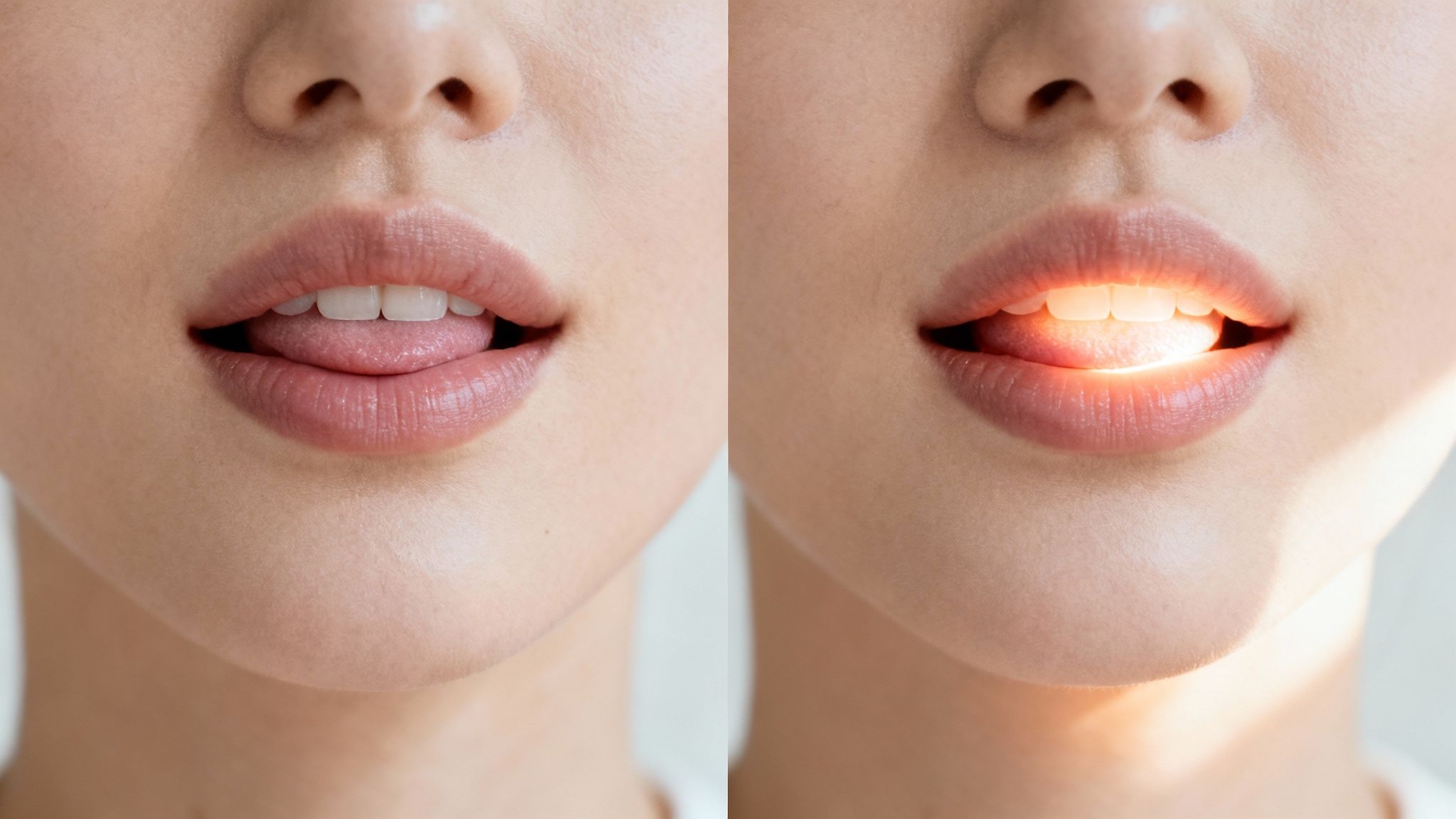
The /θ/ vs /ð/ contrast is notorious among English learners, as these interdental fricatives are rare in other world languages. Both sounds share the exact same place of articulation (dental, with the tongue tip lightly touching or placed between the upper and lower teeth) and manner of articulation (fricative, creating friction as air passes through a narrow opening). The only difference is voicing: /θ/ is voiceless, while /ð/ is voiced. Mastering this pair is a significant milestone in achieving a standard English accent.
Strategic Analysis
The primary challenge is articulatory, as most learners are unaccustomed to placing their tongue between their teeth to produce a sound. The words ‘thigh’ /θaɪ/ and ‘thy’ /ðaɪ/ isolate the voicing variable for this difficult placement. Learners often substitute these sounds with more familiar ones like /t/, /d/, /s/, or /z/, which can significantly impact clarity. For example, confusing “think” with “sink” or “then” with “den” can alter meaning in crucial business discussions.
Key Insight: The articulatory position is key: the tongue tip must be visible between the teeth or just behind them, creating a narrow channel for air. The voiceless /θ/ is a gentle, continuous stream of air, while the voiced /ð/ adds vocal cord vibration to that same stream of air.
Actionable Tips for Practice
Mastering these sounds requires developing new muscle memory. Focus on the physical sensation of tongue placement and the presence or absence of vocal cord vibration.
- Tactile Feedback: Place your fingers on your throat. When you say “thy” or “this,” you should feel a continuous vibration for the initial /ð/ sound. When you say “thigh” or “think,” the vibration should only start with the vowel; the /θ/ itself is silent vibration-wise.
- Mirror Work: Use a mirror to visually confirm your tongue placement. For both /θ/ and /ð/, the tip of your tongue should be visible between your front teeth. Exaggerate the movement initially to get the feel for it.
- Sentence-Level Drills: Integrating the sounds into sentences helps build fluency and automaticity, especially with high-frequency words.
- “They think that is the right answer.”
- “Are these things more valuable than those?”
- “My brother will bathe after going to the gym.”
Because this contrast is so challenging, dedicated practice is essential. For more specialized exercises, you can explore our comprehensive breakdown on how to produce the voiced and voiceless TH sounds.
8 Minimal Pairs Comparison
| Minimal pair | Complexity 🔄 | Resources ⚡ | Expected outcomes 📊 | Ideal use cases ⭐ | Tips 💡 |
|---|---|---|---|---|---|
| /p/ vs /b/ — “pat” / “bat” | Low — voicing contrast is obvious | Low — audio examples, throat-feel, mirror | High — clear phonemic distinction; quick gains | Introductory phonetics, ESL, speech therapy | Feel larynx vibration; minimal-pair drills; show lip position |
| /t/ vs /d/ — “tap” / “dap” | Low–Moderate — voicing clear; final position harder | Low — audio drills, repetition | High — improved voicing awareness and articulation | Phonology lessons, articulation therapy, ESL practice | Practice in isolation then sentences; contrast positions |
| /s/ vs /z/ — “sip” / “zip” | Moderate — fricatives have continuous airflow; quieter cues | Low–Moderate — audio, sustained-fricative practice | High — better fricative voicing; aids plural/verb morphology | Morphology teaching, pronunciation courses, hearing checks | Use extended fricatives; feel voicing; use plural examples |
| /ɪ/ vs /iː/ — “bit” / “beat” | High — involves both vowel quality and length | Moderate — vowel chart, spectrograms, listening tasks | High — reduces common vowel substitutions; clearer vowel categories | Advanced ESL, voice training, accent reduction | Use vowel trapezoid; exaggerate length; minimal-pair drills |
| /æ/ vs /ʌ/ — “cat” / “cut” | High — front vs central/back tongue placement | Low–Moderate — mirror, kinesthetic exercises, audio | High — improves American English vowel accuracy | American English pronunciation, accent reduction, ESL | Use mirror; exaggerate mouth openness; multisensory practice |
| /ŋ/ vs /n/ — “sing” / “sin” | Moderate — place contrast (velar vs alveolar); /ŋ/ non-initial | Low — -ing word lists, tactile feedback on soft palate | High — clearer gerund/present-participle pronunciation | Gerund teaching, speech therapy, ESL curricula | Feel velar closure; practice -ing sets; contrast final positions |
| /l/ vs /r/ — “light” / “right” | Very high — subtle tongue shaping; cross-linguistic transfer | Moderate — mirror, ultrasound or video for resistant learners | Variable — effective with focused, prolonged practice | Accent reduction, intensive L2 pronunciation, research | Start medial/final positions; tongue-shape drills; tongue twisters |
| /θ/ vs /ð/ — “thigh” / “thy” | High — interdental fricative gesture is rare and precise | Low–Moderate — mirror, modeling, frequent drills | High (perception) / Moderate (production) — recognition strong; production slower | Global ESL, speech therapy, accent modification | Place tongue between teeth; practice high-frequency “th” words; contrast common substitutes |
Final Thoughts
Our journey through these foundational examples of minimal pairs has illuminated the incredible precision required for clear, articulate English speech. We have dissected the subtle yet crucial differences between voiced and voiceless consonants like /p/ and /b/, explored the distinct tongue positions for vowels such as /ɪ/ and /i:/, and tackled notoriously challenging pairs like /l/ vs /r/ and /θ/ vs /ð/.
The core lesson is this: mastering English pronunciation is not about grand, sweeping changes. Instead, it is a game of inches, or more accurately, millimeters. The distinction between a clear “pat” and “bat” or a crisp “sing” and “sin” hinges on minuscule adjustments in your lips, tongue, and airflow. Each pair we examined serves as a targeted workout for your articulatory muscles, building the awareness and control necessary for high-stakes communication.
From Awareness to Automaticity: Your Strategic Path Forward
The true value of practicing with examples of minimal pairs lies in transforming conscious effort into unconscious competence. Your goal is to move beyond simply knowing the difference between sounds to producing them correctly and automatically, even under pressure.
To achieve this, your practice must be both consistent and intentional. Here are the key strategic takeaways to guide your next steps:
- Isolate and Amplify: Dedicate specific practice sessions to one single minimal pair. Use the “listen, repeat, record, compare” cycle to train your ear and voice simultaneously. Exaggerate the target sounds at first to feel the physical differences in your mouth.
- Context is King: Move from single words to phrases and full sentences as quickly as possible. The goal is real-world application, not just acing a word list. Integrate the professional vocabulary examples into your daily drills to make your practice immediately relevant to your career.
- Leverage Technology for Feedback: Objective feedback is your greatest ally. Your own ear can be deceiving, especially when you are just starting out. Recording yourself is a powerful first step. The careful examination of minimal pairs helps us appreciate the intricate nature of phonemes, a concept that is directly applied in advanced technologies such as Speech Recognition Software for Mac, which must differentiate these subtle sounds to function accurately. You can use similar principles to analyze your own speech.
The Lasting Impact of Phonemic Mastery
Why invest this dedicated effort? Because mastering these phonemic distinctions directly impacts how you are perceived professionally. Clear pronunciation builds credibility, enhances authority, and eliminates the cognitive friction that can cause misunderstandings. When your colleagues, clients, or patients don’t have to strain to understand your words, they can focus entirely on the value of your message.
Think of each minimal pair as a key that unlocks a higher level of clarity. The difference between asking for a “sheet” of paper versus something else entirely in a meeting is not just a pronunciation error; it’s a potential barrier to effective collaboration. By diligently working through these examples of minimal pairs, you are not just refining your accent; you are sharpening your most critical professional tool: your voice.
Embrace this detailed, focused work. Be patient with the process and celebrate the small victories. Each correctly articulated phoneme is a step toward more confident, impactful, and effortless communication. The precision you cultivate here will echo in every meeting, presentation, and conversation you have, empowering you to lead and influence with unparalleled clarity.
Ready to move from practice lists to real-time, coach-led feedback? Here at Intonetic, we offer a personalized on-on-one accent coaching experience with SLP-produced practice sheets and audio files, as well as daily feedback so you can be sure that you’re on the right track. Get started today by completing our free accent assessment so you can see which sounds you can improve to shortcut your improvement.