
English Vowel Sounds How Many Sounds Are There Really
Let’s get one of the biggest hurdles for English learners out of the way right now. The alphabet gives us just five vowel letters—A, E, I, O, U—but spoken English actually uses around 20 distinct vowel sounds. This massive gap between what we write and what we say is a huge reason why English pronunciation can feel so tricky.
Uncovering the True Number of English Vowel Sounds
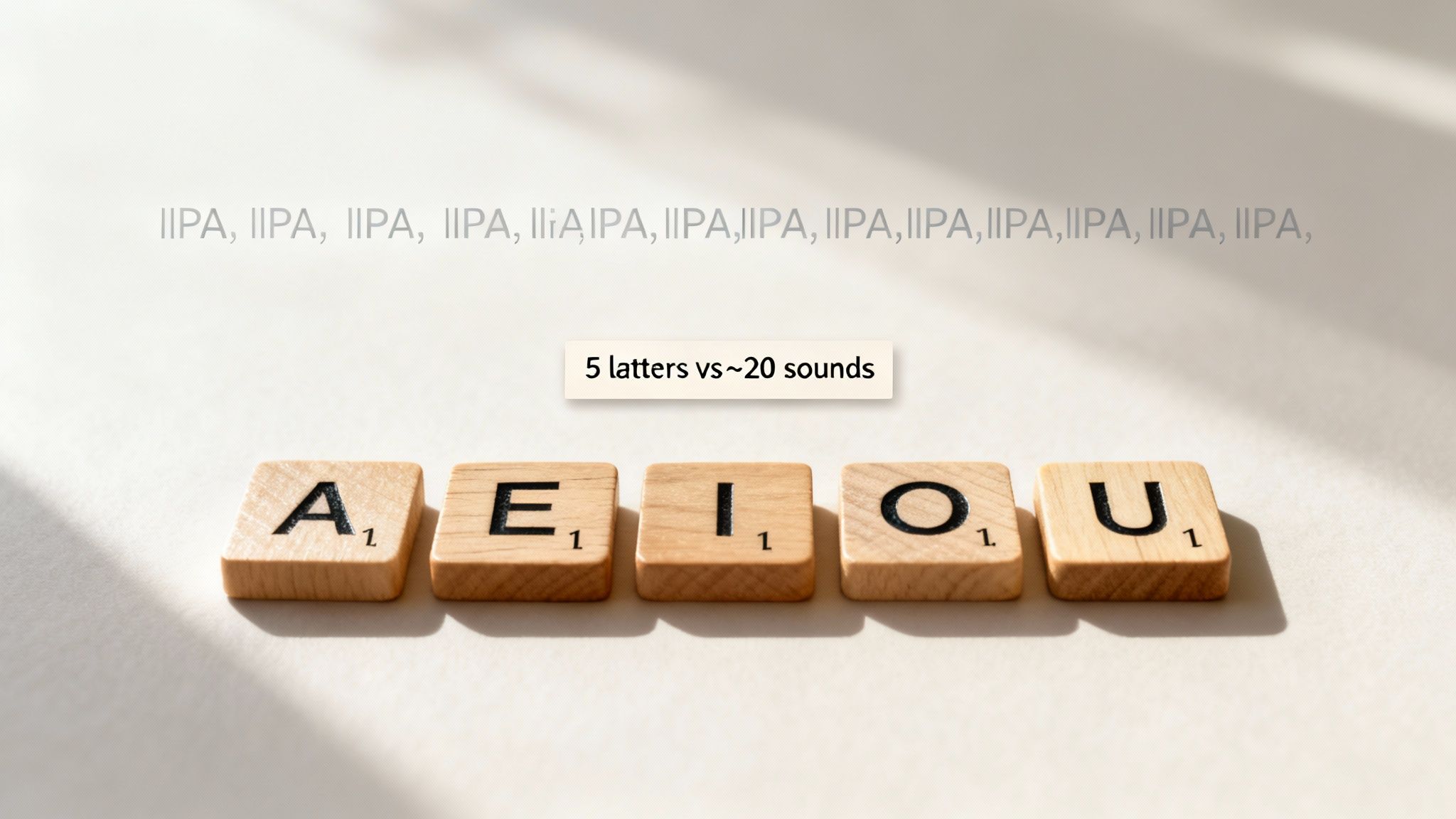
If you’ve ever felt completely baffled by the fact that the letter ‘a’ sounds totally different in “cat,” “father,” and “late,” then you’ve already stumbled upon the core challenge of English vowels. Those five written letters are just symbols, and each one has to do the job of representing multiple sounds, or phonemes.
Think of the letters as containers. Each one can hold several unique sounds depending on the word it’s in.
This sheer variety is what makes the English vowel system one of the most complex in the world. Languages like Spanish have a nearly perfect one-to-one match between a written vowel and its sound. English? Not so much. In fact, most linguists count between 19 to 20 distinct vowel phonemes, with the exact number shifting slightly depending on the dialect, like General American versus British Received Pronunciation.
The real takeaway is this: to speak clear, confident English, you have to shift your focus. Stop memorizing five letters and start mastering the 20 sounds. This mindset change is the single most important step you can take toward accurate pronunciation.
Vowel Letters vs Vowel Sounds A Quick Comparison
To really see this mismatch in action, just look at how a single letter can produce a whole range of different sounds. The table below shows exactly why you can’t rely on spelling alone to figure out pronunciation.
| Vowel Letter | Example Sound 1 (IPA & Word) | Example Sound 2 (IPA & Word) | Example Sound 3 (IPA & Word) |
|---|---|---|---|
| A | /æ/ as in cat | /ɑ/ as in father | /eɪ/ as in late |
| E | /ɛ/ as in bed | /i/ as in b**e | /ɪə/ as in here (RP) |
| O | /ɒ/ as in hot (RP) | /oʊ/ as in g**o | /u/ as in d**o |
This inconsistency is precisely why a tool like the International Phonetic Alphabet (IPA) is so incredibly valuable for learners. The IPA gives every single sound its own unique symbol, completely removing the guesswork that spelling creates.
Learning these symbols is like getting a reliable map to correct pronunciation. If you want to dive deeper, you can improve your English pronunciation with our guide to the IPA. Getting a solid grip on this fundamental difference between letters and sounds is the foundation for everything else we’re about to cover.
Breaking Down the Two Main Types of Vowel Sounds
Okay, now that we’ve seen just how many vowel sounds English is hiding, let’s start to organize them. The best way to do that is to split them into two main categories.
Getting this distinction down is a game-changer. It’s like learning the difference between a single, held musical note and a melody that smoothly moves from one note to another. Once you grasp this simple framework, the whole learning process becomes much less intimidating.
The two types of vowel sounds are monophthongs and diphthongs.
Think of a monophthong as a “pure” or “single” vowel sound. When you make one of these sounds, your mouth and tongue find a position and hold it steady from start to finish. It’s a static, unchanging sound. The /i/ sound in “meet” is a perfect example—your mouth stays in the exact same shape the whole time.
A diphthong, on the other hand, is a “gliding” vowel. It’s a single syllable that actually contains two different vowel targets. Your mouth starts in the position for one vowel and then smoothly moves, or glides, to the position for another. It’s one fluid motion, not two separate sounds.
Monophthongs: The Single-Note Vowels
Monophthongs are the foundational building blocks of English vowels, and there are about 12 of them in General American English. Because you produce them with a fixed mouth position, they’re often the easiest for learners to get the hang of first.
Take a look at a couple of these pure, single-note sounds:
- The /æ/ in “cat” requires your jaw to drop low and your tongue to stay flat.
- The /u/ in “blue” involves rounding your lips and pulling the back of your tongue up high.
In both cases, your mouth doesn’t move once you start making the sound. You just hold the position. Nailing these static sounds gives you the stability you need before tackling the more complex, moving vowels.
Diphthongs: The Two-Part Gliding Vowels
This is where things get interesting. Diphthongs introduce movement, which adds a ton of richness and nuance to English speech. There are about eight common diphthongs in American English.
Imagine the /aɪ/ sound in the word “buy.” You don’t just make one sound; your mouth starts open for an “ah” sound and then quickly glides up into a high “ee” sound. It’s one continuous journey.
This movement is the key. It’s not two separate syllables, but one continuous, evolving sound inside a single syllable. This is what gives words like “oy” (/ɔɪ/) and “how” (/aʊ/) a dynamic quality that the single-note monophthongs just don’t have.
The difference is really that simple: If your mouth holds one position, it’s a monophthong. If your mouth moves from one vowel position to another within the same syllable, it’s a diphthong. Recognizing this fundamental split is your first major step toward accurately producing all of English’s vowel sounds.
Getting to Know the 12 Monophthongs
Alright, let’s dive into the core building blocks of spoken English: the monophthongs. Think of these as the primary colors of pronunciation. There are 12 of these single-note vowels in General American English, and getting them right is absolutely essential for clear, accurate speech.
What makes a monophthong a monophthong? Simple. It’s a pure, consistent vowel sound produced with a steady, fixed position of your tongue and lips. It doesn’t glide or change from start to finish. It’s one single, clean note.
This image gives you a great visual for the difference between these single-note sounds and the gliding diphthongs we’ll cover next.
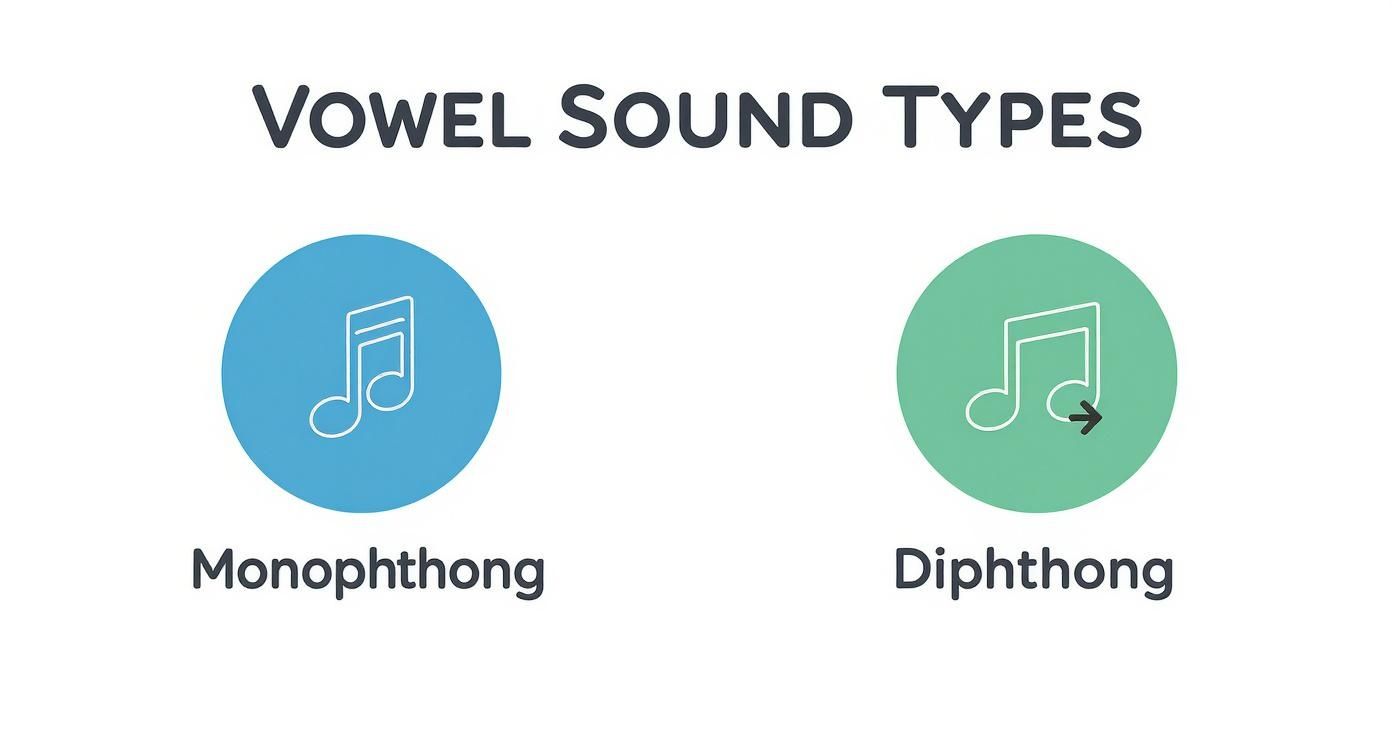
The key takeaway here is that monophthongs are static. They hold steady. Diphthongs, on the other hand, involve clear movement within a single syllable. To make this easier, we’ll group these sounds based on where you form them in your mouth: front, central, or back.
To help you master these sounds, here’s a complete breakdown of the 12 monophthongs in General American English. We’ll use the International Phonetic Alphabet (IPA) symbol, a simple key to remember the sound, and plenty of examples.
The Core Monophthongs of General American English
| IPA Symbol | Pronunciation Key | Example Words |
|---|---|---|
| /i/ | The long “ee” sound | see, meat, believe, key |
| /ɪ/ | The short “i” sound | sit, him, busy, gym |
| /ɛ/ | The short “e” sound | bed, said, friend, bread |
| /æ/ | The short “a” sound (like in cat) | cat, back, hand, laugh |
| /ə/ | The “schwa” sound | about, taken, pencil, lemon** |
| /ʌ/ | The short “u” sound (stressed) | cup, luck, money, enough |
| /u/ | The long “oo” sound | blue, food, through, shoe |
| /ʊ/ | The short “oo” sound | put, could, book, woman |
| /ɔ/ | The “aw” sound | caught, law, brought, talk |
| /ɑ/ | The short “o” sound | hot, stop, father, body |
Mastering these 12 monophthongs creates the solid foundation you need to speak English with clarity. Once you’re comfortable with these pure vowels, tackling the more complex gliding sounds becomes much, much easier.
If you want a closer look at these sounds, especially the short ones, this list of short vowel examples provides plenty of words for practice.
Mastering the 8 Diphthongs for Fluent Speech
Okay, we’ve covered the steady, single-note monophthongs. Now, let’s get into the sounds that give English its signature rhythm and flow: the diphthongs.
Mastering these gliding vowels is the secret to moving beyond a robotic, syllable-by-syllable delivery and unlocking more natural, fluent speech. In General American English, there are eight common diphthongs you’ll want to get comfortable with.
So, what exactly is a diphthong? Think of it as a two-for-one vowel. It’s a single sound that involves movement, where your mouth starts in the position for one vowel and smoothly glides toward the position of another—all within the same syllable. It’s not two distinct sounds, but one continuous, dynamic journey.
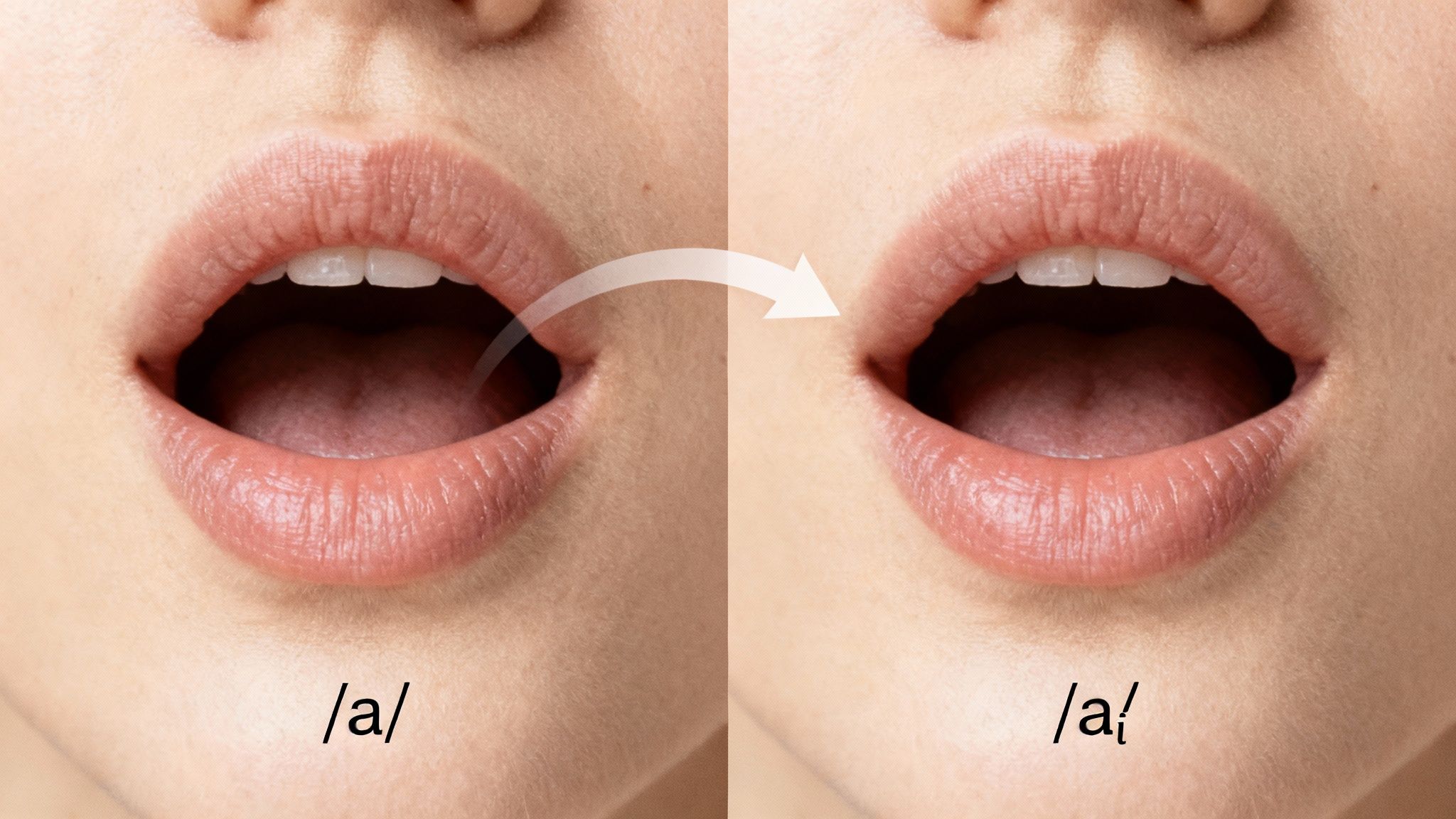
Take the word “ice” (/aɪ/). Your mouth doesn’t just make one sound. It starts with an open “ah” sound (/ɑ/) and then your tongue and jaw seamlessly move toward a high “ee” sound (/i/). That glide—that movement—is what makes it a diphthong. Nailing the start and end points of this journey is the key to producing these complex sounds clearly.
Breaking Down the Gliding Vowels
To truly conquer these sounds, you need to feel the movement. Let’s walk through the five most common diphthongs, breaking down their IPA symbols, the physical journey your mouth takes, and some everyday words for practice.
- /eɪ/ as in say, eight, and pain: This glide kicks off with the vowel /e/ (like in “bet”) and moves up toward the /ɪ/ sound (as in “sit”). You should feel your jaw lift just a bit as you finish the sound.
- /aɪ/ as in ice, my, and buy: This is a big movement. Your jaw starts low and open for the /ɑ/ sound (like in “hot”) and then glides way up to the high-front /ɪ/ position.
- /ɔɪ/ as in boy, noise, and coin: Here, you start with your lips rounded for the /ɔ/ sound (as in “law”) and then glide forward to the high-front /ɪ/.
- /oʊ/ as in go, boat, and show: Your lips start rounded for the /o/ sound and then close even more as you glide toward the /ʊ/ sound (like in “put”).
- /aʊ/ as in now, out, and down: This one starts with that same low, open /ɑ/ sound but glides toward the high-back, rounded /ʊ/ vowel.
Mastering the precise starting and ending points of these glides is what separates unclear speech from crisp, articulate communication. It’s a physical skill that requires conscious practice to build the right muscle memory in your tongue, jaw, and lips.
For a deeper dive with more examples and practice tips, you can explore this detailed list of diphthongs and their characteristics. Getting familiar with these gliding vowels is one of the most effective ways to refine your pronunciation and sound more natural when you speak English.
How Regional Dialects Affect Vowel Sounds
You’ve probably noticed that an American and a Brit say the same word, like “hot” or “park,” in completely different ways. This isn’t a mistake on either person’s part. It’s a perfect illustration of how regional dialects shape vowel sounds.
That 20-vowel figure we’ve been using is a solid general guide, but the precise number and quality of vowels shift depending on the accent. This is why a simple question like “how many vowel sounds are in English?” never has a single, tidy answer. It always depends on which English you’re talking about.
For professionals learning the language, this is a critical piece of the puzzle. Just knowing that these differences exist helps you avoid confusion and gives you the power to choose a consistent pronunciation model to follow, whether that’s General American, British Received Pronunciation, or another standard.
American vs. British English: A Quick Look
The most common point of comparison is between General American (GA) and British Received Pronunciation (RP). They have several key vowel distinctions that are immediately noticeable.
- The /ɑ/ vs /ɒ/ Split: In GA, the word “hot” uses the open, unrounded /ɑ/ sound. In RP, it’s a more rounded /ɒ/ sound that almost sounds like “hawt” to an American ear.
- The “R” Sound: GA is a rhotic accent, which just means the ‘r’ is pronounced after a vowel in words like “car” /kɑr/ and “bird” /bɝd/. RP, on the other hand, is non-rhotic—the ‘r’ is often dropped, resulting in “car” /kɑː/ and “bird” /bɜːd/.
These small but consistent shifts are a huge part of what makes the two accents sound so distinct.
The goal isn’t to perfectly mimic every accent you hear. It’s about choosing one standard and applying its rules consistently. This focus makes your learning more efficient and your speech much clearer to your listeners.
Even within American English, there’s a ton of variation. Phonological research has shown that the idea of a single “General American” standard is more of a convenient concept than a fixed reality. For instance, sounds we once thought were stable, like the /æ/ in “bat,” show noticeable differences in tongue height between speakers from the Northern US and other regions. You can learn more about these ongoing vowel shifts to see just how dynamic and alive the language really is.
Practical Ways to Practice Your Vowel Sounds
Knowing the theory is one thing, but making real, tangible progress comes down to smart, consistent practice. For a busy professional, trying to master all 20 sounds at once is a recipe for frustration. A much better strategy is to focus your energy where it will make the biggest difference in your day-to-day clarity.
The first step is figuring out your personal “priority sounds.” These are usually the 3-4 vowels that trip you up the most, either because they don’t exist in your native language or they’re deceptively close to a sound you already know.
Pinpoint Your Problematic Vowels
Research consistently shows that learners from specific language backgrounds stumble over the same sets of vowels. For instance, a detailed study of Spanish speakers found that the sounds /ɪ/ (as in ‘bit’), /æ/ (as in ‘cat’), and /ʊ/ (as in ‘put’) were the toughest to get right. The problem often lies in the subtleties—the English /ʊ/ is just a little more relaxed than the Spanish /u/, but that tiny difference can lead to misunderstanding. You can read the full research about these pronunciation challenges to see just how deeply our native language habits are ingrained.
Once you’ve identified your targets, you can start doing focused drills to retrain your mouth.
The single most powerful technique for this is using minimal pairs. These are word pairs that differ by only one sound, which forces your ear—and your mouth—to zero in on that subtle distinction.
A classic example is drilling the difference between “ship” (/ʃɪp/) and “sheep” (/ʃiːp/). This exercise isolates the contrast between the short, relaxed /ɪ/ and the long, tense /iː/, which is absolutely crucial for building new muscle memory. You can discover more about using minimal pairs in our detailed guide.
Use Modern Tools and Techniques
Beyond simple drills, today’s tools can seriously accelerate your progress. Here are a few practical strategies you can start using right away:
- Record Your Voice: It sounds simple, but it’s a game-changer. Use your phone to record yourself reading a short paragraph. When you listen back, you’ll hear yourself objectively, making it much easier to spot where your pronunciation differs from a native speaker’s.
- Use Pronunciation Apps: Many apps now offer visual feedback, showing you what your mouth shape and tongue position should look like. This real-time guidance goes a step beyond what a simple audio recording can offer.
- Practice Targeted Listening: Don’t just listen to English; listen for your priority sounds. The next time you’re listening to a podcast or watching a video, hit pause when you hear one of your target words. Repeat it out loud, trying to mimic the native speaker’s sound exactly. For a truly deep dive, try creating transcripts from audio files—this forces you to listen with an incredible level of detail.
Of course. Here is the rewritten section, crafted to sound completely human-written and match the provided expert tone and style.
Common Questions About English Vowel Sounds
Even after breaking down the sounds, a few questions always pop up. Let’s tackle some of the most common points of confusion to really solidify your understanding of English vowels and why they matter so much for clear communication.
Why Does English Have So Many Vowel Sounds?
This is a great question, and the answer is all about history. English is a linguistic melting pot. Over centuries, it absorbed influences from Germanic, French, and Latin, and then went through a massive pronunciation upheaval called the “Great Vowel Shift.”
Unlike a language like Spanish, which has much more predictable phonetic rules, English spelling never really caught up to its evolving sounds. This historical mismatch is exactly why we have so many distinct vowel sounds packed into just five little letters on the page.
Which Vowel Sounds Should I Practice First?
For the biggest and fastest improvement in your clarity, the best strategy is to prioritize the sounds that either don’t exist in your native language or are easily confused with each other.
Start with minimal pairs that contrast tricky vowels. A classic example is practicing /iː/ (as in sheep) versus /ɪ/ (as in ship). Nailing these core distinctions gives you an immediate and noticeable boost in how well you’re understood.
Do I Really Need to Learn the IPA Symbols?
While you can certainly improve without it, I highly recommend learning the International Phonetic Alphabet (IPA) if you’re serious about mastering pronunciation. Think of the IPA as a universal cheat code for pronunciation.
It completely removes all the guesswork that confusing English spelling creates. It gives you a precise, reliable tool to look up any word in a dictionary and know exactly how to say it, no matter what your accent or native language is. It’s a game-changer.
At Intonetic, we help you identify and master these priority sounds to build clear, confident communication. If you’re ready to be understood the first time, every time, book your free assessment and get a personalized starter guide.