
Building Trust with Customers: building trust with customers through clarity
Building trust with customers is all about being reliable. It’s about being transparent, keeping your promises, and showing up as a competent professional. When a customer sees you as dependable, their confidence in you—and by extension, your company—starts to build. That’s the foundation of any lasting professional relationship.
How Unclear Communication Silently Erodes Customer Trust
Here’s something I’ve seen happen time and time again: trust isn’t usually lost in one big, dramatic moment. It’s more like a slow leak. It erodes bit by bit, one small misunderstanding at a time.
For professionals who are non-native English speakers, subtle issues with pronunciation, an unfamiliar accent, or a flat intonation can create an invisible barrier. This barrier slowly chips away at a customer's confidence, often without either person realizing what's happening.
Think about a tech consultant walking a client through a complex new software solution. If their rhythm is a little off or they mispronounce a few key terms, the client might ask them to repeat themselves once or twice. No big deal.
But if it keeps happening, the client's internal monologue starts to shift. It goes from, "I didn't catch that word," to "I'm not sure they really understand this concept." Even if the consultant's technical knowledge is absolutely flawless, the perception of their expertise starts to waver.
The Connection Between Clarity and Competence
This happens because our brains are wired to associate clear, confident speech with competence. It’s not always fair, but it’s a cognitive shortcut we all take. When a message is hard to process, the listener can misinterpret it as a lack of knowledge or confidence on the speaker's part. In high-stakes fields, this can be incredibly damaging.
A patient struggling to understand a doctor’s instructions might lose faith in the entire treatment plan. A potential buyer who gets confused during a sales presentation might start to feel the salesperson is being evasive or untrustworthy. These perceptions are often rooted in accent bias, a real and unfair challenge for many professionals. You can learn more about this in our guide to understanding the hidden workplace challenge for non-native speakers.
The reality is simple but profound: if a customer has to work too hard to understand you, they will eventually stop trying. Their confidence fades, and with it, the trust that is essential for any successful business relationship.
The data backs this up. A global survey of 20,000 people found that the top ways businesses build trust are by being reliable and keeping promises. The impact is huge: when a customer trusts a business, they are 90% more likely to recommend it and 88% more likely to buy more. Clear, unambiguous communication is what delivers on that promise of reliability.
Of course, clarity isn't just about your speech. Poor audio quality on a call can be just as damaging, making your message muddled and unprofessional. It's worth understanding the critical role of sound quality in communication to make sure nothing gets in the way of building that trust.
Mastering the Mechanics of Trustworthy Speech
Knowing why clear communication builds trust is one thing. Knowing how to achieve it is where the real work begins. The way you speak—how you pronounce words, the melody of your voice, and the rhythm of your sentences—forms the mechanical foundation of how customers perceive you. Getting these details right isn't about erasing your identity; it's about making sure your expertise comes through loud and clear.
When communication starts to fray, it's rarely one big breakdown. It’s more like a slow unraveling. It begins with a simple misunderstanding, which can lead to a customer losing confidence in what you're saying. Over time, that loss of confidence erodes the trust you've worked so hard to build.
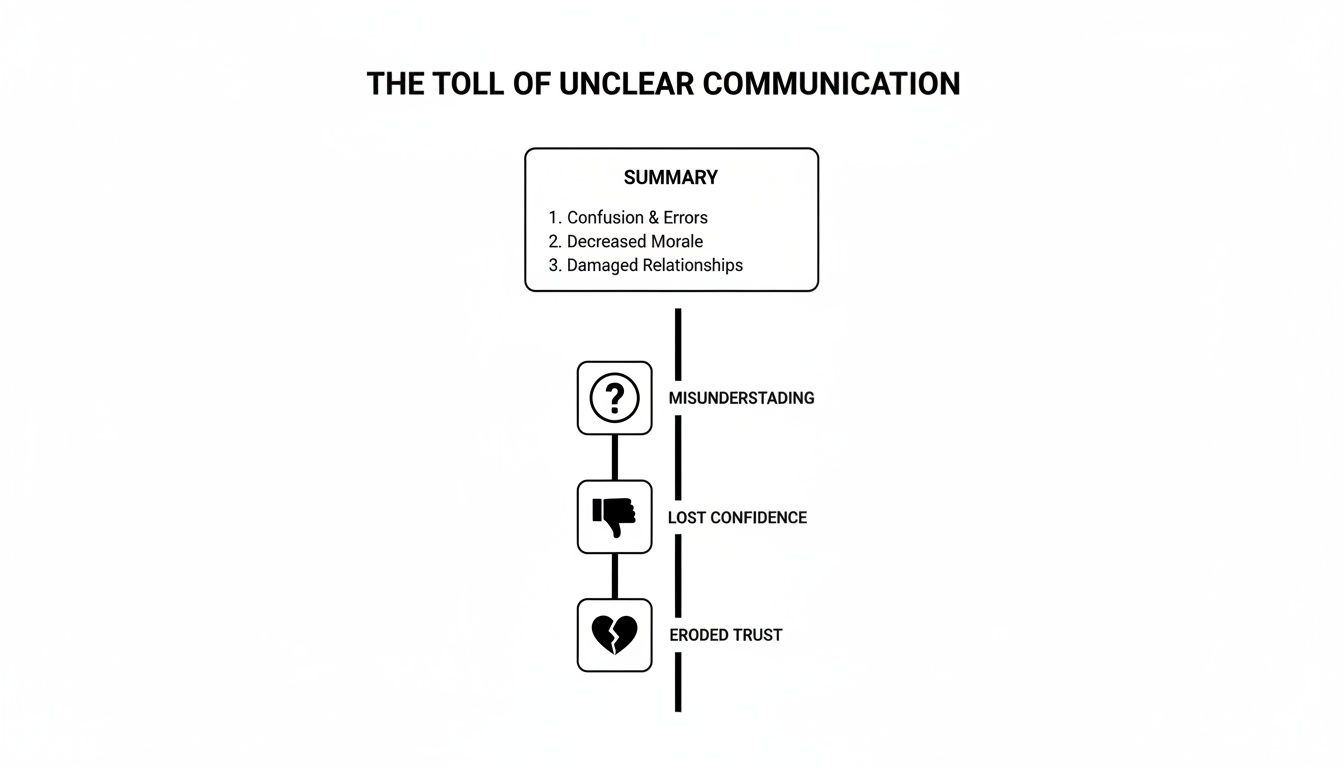
Each of these steps feeds into the next, turning small communication hiccups into major roadblocks that can seriously undermine your professional credibility. To stop this from happening, we need to focus on three core pillars of trustworthy speech.
To better understand how these elements work together, let's break them down into a practical framework. Think of this as your roadmap to building trust, one sound and sentence at a time.
The Three Pillars of Trustworthy Communication
| Pillar of Communication | Impact on Customer Trust | Common Challenge | Actionable Solution |
|---|---|---|---|
| Clear Pronunciation | Makes your message effortless to understand, signaling competence and attention to detail. | Confusing similar vowel or consonant sounds (e.g., "ship" vs. "sheep," "think" vs. "sink"). | Isolate and practice the 10-15 most impactful sounds in American English using minimal pair drills. |
| Confident Intonation | Projects authority and certainty, preventing confident statements from sounding like hesitant questions. | Using a rising pitch at the end of statements, which signals uncertainty to listeners. | Practice a downward intonation pattern on declarative sentences. Record yourself and listen for the drop in pitch. |
| Strategic Rhythm | Commands attention and adds weight to your words, showing you're in control of the conversation. | Speaking too quickly out of nervousness, causing listeners to miss key information. | Intentionally pause for 1-2 seconds before and after making a critical point. This gives it emphasis. |
By mastering these three pillars, you’re not just improving your accent—you’re building a more reliable and trustworthy communication style from the ground up.
Fine-Tuning Your Pronunciation for Clarity
Precise pronunciation is the bedrock of being understood. When customers don’t have to strain to decode your words, they can focus completely on your message. This has nothing to do with erasing your accent but everything to do with sharpening the key sounds that have the biggest impact on listener comprehension.
For instance, many of my clients initially struggle with the distinction between the short “i” sound (as in “sit”) and the long “ee” sound (as in “seat”). A simple mix-up can completely change a sentence’s meaning, forcing the listener to pause and mentally rewind. When these little moments of confusion happen repeatedly, they can subtly chip away at your perceived command of the topic.
You don’t need to tackle all 44 sounds of English at once. A much smarter approach is to identify and relentlessly practice the specific sounds that are most challenging for you. Our guide on how to enunciate better is a great place to find practical exercises for this.
Think of your speech like a finely tuned instrument. Even a single key that’s slightly off can disrupt the entire melody. Focusing on the most critical sounds ensures your message is delivered with harmony and precision.
Using Intonation to Convey Confidence
Intonation is the music of your speech—the rise and fall of your pitch that conveys emotion and certainty. A classic pitfall for many non-native speakers is using a rising intonation at the end of a statement, which instantly makes a confident assertion sound like a question.
Just listen to the difference:
- “We can deliver the project by Friday?” (rising tone)
- “We can deliver the project by Friday.” (falling tone)
The first version sounds like you’re seeking approval, riddled with uncertainty. The second is decisive and authoritative. Mastering that downward inflection for statements is one of the most powerful non-verbal cues for building trust. Start practicing this by reading sentences aloud and consciously dropping your pitch at the final word.
The Power of Rhythm and Strategic Pausing
Finally, let’s talk about rhythm. Your pacing and use of pauses add tremendous weight and authority to your words. If you speak too quickly, you can come across as nervous, and your listener will struggle to keep up. Speak too slowly, and you might be perceived as hesitant or unsure.
The secret weapon here is the strategic pause. A well-placed pause just before you reveal a key piece of data or right after you make an important point is incredibly effective. It gives the listener a moment to process what you’ve just said and signals that it was significant. It shows you’re in complete control of the conversation and confident in your message, reinforcing the very trust you’re working to build.
The Art of Active Listening and Empathetic Responses
Speaking clearly gets your message across, but building real trust with a customer is a dialogue, not a monologue. What you hear is every bit as important as what you say.
A true connection forms when a customer feels like you haven’t just heard their words, but you’ve genuinely understood them. This is where active listening stops being a passive activity and becomes one of your most powerful tools for building rapport.

It’s about giving someone your full, undivided attention, which I know is a huge challenge in a world buzzing with distractions. But demonstrating that focus sends a clear signal of respect—it shows the customer they are your absolute priority in that moment.
Listening isn’t just about waiting for your turn to talk. It’s about absorbing the complete message, including the unspoken feelings simmering just beneath the surface. For a deeper dive, check out our insights on enhancing English pronunciation through listening practice.
Beyond Saying “I Understand”
The whole point of active listening is to cultivate real empathy—the ability to connect with a customer’s feelings and see things from their perspective. But simply saying, “I understand,” can fall flat. In fact, sometimes it can even feel dismissive.
True empathy isn’t about stating the obvious; it’s shown through specific actions that validate the customer’s experience. This is how you build a rock-solid foundation of trust.
Here are a few simple techniques to show you’re really dialed in:
- Paraphrase and Confirm: Restate their main point in your own words. It proves you were listening and gives them a chance to clarify anything you might have missed.
- Ask Insightful Questions: Go beyond surface-level stuff. Ask questions that show you’re thinking critically about their situation and trying to get to the root of the problem.
- Acknowledge Their Feelings: Use phrases that validate their emotional state. Saying, “That sounds incredibly frustrating,” shows you’re connecting on a human level, not just a transactional one.
To truly master this, I’d recommend exploring this ultimate guide to empathy in customer service.
Putting Empathy Into Practice
Let’s look at how these small shifts in language can make a huge difference in day-to-day interactions. Instead of a generic reply, try using these more specific, empathetic sentence starters to forge a much stronger connection.
Example Scenarios:
- For a Sales Professional: Instead of, “I get it,” try, “So, if I’m hearing you correctly, the main roadblock for your team has been the slow integration process with your current tools. Is that right?” This confirms you’ve identified their specific pain point.
- For a Healthcare Provider: Rather than, “I understand you’re worried,” say, “It’s completely normal to feel anxious about this procedure. Can you tell me what specific concerns are on your mind so we can address them together?” This opens the door for a much more honest and productive conversation.
- For a Manager: Instead of, “I hear your feedback,” try, “Thank you for sharing that. It sounds like the lack of clarity on project deadlines is creating stress for the team. Let’s walk through how we can fix that.” This validates their concern and immediately pivots toward a solution.
These phrasing adjustments are subtle, but they are incredibly powerful. They transform a conversation from a simple exchange of information into a genuine opportunity to build lasting trust with your customers and colleagues.
Building a Reputation for Transparency and Reliability
While clear speech and active listening create that crucial first connection, long-term trust is built on what happens after the conversation ends. It’s all about your reputation. Are you known for being transparent? Can people count on you, every single time? This is where you move beyond the mechanics of communication and into the art of managing expectations.
Think of it like building a bridge. Every promise you make is a steel beam, and every time you follow through, you’re laying down another solid plank. If you say you’ll send a project update by Wednesday, that update absolutely has to land in their inbox on Wednesday. This isn’t just about being organized; it’s the ultimate trust signal. It shows your customer that your words and your actions are one and the same.
Set Crystal Clear Expectations from Day One
Your mission, right from the very first interaction, is to obliterate ambiguity. Whether you’re on a sales call or kicking off a new project, leaving any room for assumptions is just asking for trouble later on. Here’s a secret most professionals miss: customers don’t actually expect perfection. They expect honesty.
So, instead of painting a rosy, best-case-scenario picture, get real about potential bumps in the road.
- Good: “We should have this done in two weeks.”
- Better: “Our target is two weeks. Just a heads-up, if we hit any snags integrating with your existing software, it could add a day or two. I’ll give you a firm update this coming Monday either way.”
See the difference? This simple shift shows you’ve thought ahead. It reframes a potential delay not as a failure, but as a managed risk. You’re not making excuses; you’re demonstrating that you’re in control of the situation, which paradoxically builds even more trust.
The most reliable professionals don’t just promise results; they promise clarity. They hand the customer a transparent roadmap showing exactly where things stand, where they’re headed, and what might be around the corner.
The Undeniable Power of Follow-Through
Let’s be blunt: follow-through is the engine of reliability. It’s the simple, consistent act of doing exactly what you said you would do. And I’m not just talking about the big project milestones. It’s the little things that build a mountain of credibility.
If you say, “I’ll send the meeting notes this afternoon,” those notes need to be in their inbox before you log off. Every single promise you keep, no matter how small, adds another brick to your foundation of trust. Over time, these actions create an unshakeable track record.
This isn’t just a gut feeling; there’s data to back it up. A 2025 study of customer experience leaders found that 44% agree transparent communication is a definite factor in strengthening brand confidence. Even more telling, 34% of those leaders said that simple visibility into processes—like keeping customers updated on project status—significantly boosts trust. You can find more insights on this topic by reading about building customer trust on CMSWire.com.
When you pair transparent expectations with flawless follow-through, you leave no space for doubt. Your customers learn that when you make a commitment, it’s as good as done. That is how you build a reputation that precedes you and becomes your single most valuable professional asset.
Adapting Trust-Building Strategies to Your Profession
The core principles of building trust—clarity, empathy, and reliability—are universal. That’s the easy part. The real challenge is figuring out how to apply them in your specific role, because the pressures you face are unique.
The communication hurdles for a software engineer are worlds apart from those of a doctor. Likewise, the needs of a sales lead are completely different from those of a C-level executive. Let’s break down how to tailor these trust-building strategies to your professional world and turn abstract ideas into real-world results.

For Tech Professionals Explaining Complex Ideas
If you’re in tech, you live and breathe complexity. Your biggest challenge is translating that deep knowledge for non-technical stakeholders without making them feel confused or, even worse, intimidated.
It’s a classic scenario: a project manager or client struggles to follow your technical explanation, and they start to question your expertise—not because you don’t know your stuff, but because the bridge of communication isn’t there.
- Actionable Tip: Lean on analogies. Instead of diving into the weeds of a “microservices architecture,” try framing it differently. You could say, “Think of it like building with LEGOs. Instead of one giant, inseparable model, we’re building with smaller, independent blocks. This lets us update one piece without having to rebuild the entire thing.”
This simple shift replaces jargon with a relatable concept. It proves you’re not just technically brilliant, but also an effective communicator—a massive trust-builder.
For Healthcare Providers Conveying Empathy and Authority
In healthcare, the stakes are sky-high. Patients need to trust both your medical knowledge and your genuine concern for their well-being. It’s a delicate balance. Your tone, pacing, and intonation carry just as much weight as the words you choose.
A rushed or monotonous explanation of a diagnosis can feel dismissive, immediately eroding a patient’s confidence. They need to feel your authority as an expert and your empathy as a caregiver, simultaneously.
Scenario: A patient is anxious about a new medication’s side effects.
- Less Effective: “These are the risks, but they are rare.” (This is factually correct, but it’s cold and dismissive of their fear.)
- More Trustworthy: “I understand it’s concerning to read about potential side effects. Let’s walk through them together, and I’ll explain what we’ll do to monitor you closely. Your safety is our top priority.”
That second response uses a reassuring tone and collaborative language (“together,” “we’ll”) to build a partnership. That partnership is the very foundation of patient trust.
For Sales Professionals Shortening the Sales Cycle
In the world of sales, trust is currency. When a customer doubts your honesty or feels you don’t understand their needs, they’ll drag their feet, delay decisions, or just walk away. Clear, confident communication has a direct impact on your bottom line.
A huge part of this comes down to perceived competence. A global B2B buyer report found that competency is the top trust priority for 30% of buyers in North America. The data shows that when B2B buyers trust a company, they are nearly twice as likely to recommend it.
Every part of your speech—from crisp pronunciation to decisive intonation—shapes how competent a buyer perceives you to be. You can also learn more in our guide to improving communication skills for customer service professionals.
For Executives Projecting Leadership and Vision
As an executive, your words carry immense weight. You aren’t just sharing information; you are inspiring action, aligning entire teams, and building confidence in the company’s vision. A flat or uncertain delivery can gut the power of even the strongest message.
Your rhythm and use of strategic pauses become critical leadership tools. Pausing right before a key announcement builds anticipation. A steady, confident pace conveys stability and control. Mastering this kind of vocal executive presence is non-negotiable for building trust with employees, investors, and the board. It ensures your leadership is not just seen, but truly heard.
Your Path to Becoming a Trusted Communicator
Building trust with customers isn’t about finding a single, secret technique. It’s the natural result of consistently applying a few core principles.
Throughout this guide, we’ve broken down how trust is built on a foundation of clear, reliable, and empathetic communication. From the mechanics of your speech to the promises you keep, every element works together to shape how your customers see you.
This might feel like a lot to take on, but improving these skills is an entirely achievable goal. It’s not about changing who you are. It’s about building a structured path to make sure your expertise and good intentions are always coming through loud and clear.
Your Next Step Forward
The hardest part is often just figuring out where to start. Are there specific English sounds that trip you up and cause misunderstandings? Does your intonation sometimes fail to project the confidence you actually feel? Pinpointing these specific areas is the key to making real, noticeable progress.
This is exactly where a focused, personalized approach makes all the difference. A structured program gives you the right tools without the guesswork. We designed Intonetic for this very purpose—to give professionals a clear roadmap to trustworthy communication.
- One-on-One Coaching: Get direct, honest feedback from an expert who understands your unique challenges.
- AI-Powered Drills: Use smart technology for the high-repetition practice needed to build new, permanent habits.
- Industry-Specific Practice: Rehearse the actual conversations you have every single day in your role.
This blend of personal guidance and targeted practice is what helps you become a more trusted and effective communicator, faster.
Becoming a trusted communicator is a skill. And like any skill, it can be developed with the right coaching and consistent effort. It’s about making sure your communication style is just as strong as your professional expertise.
The journey starts with a single step: understanding exactly where you are right now. The most effective way to see your communication strengths and weaknesses is through a professional evaluation.
To get a clear blueprint for your improvement, consider getting a free accent reduction assessment. It’s a no-risk way to get a personalized evaluation and discover your clear path forward to becoming the trusted voice your customers need to hear.
Ready to transform your professional communication and build unshakable trust? Start your journey with Intonetic by booking your free assessment today. Find out more at https://intonetic.com.