Master American English Accent Training for Clear Speaking in 2026
You’ve just laid out a brilliant idea in a high-stakes meeting. Your data is solid, the logic is flawless, but you’re met with polite, confused looks. The power of your message—the very essence of your professional value—got lost somewhere between your mouth and their ears.
This communication gap is exactly what American English accent training is designed to close.
What Is American English Accent Training and Why It Matters
At its core, this training is a structured method for fine-tuning your speech patterns to better align with the natural sounds and rhythms of standard American English. It’s important to be clear: the goal is not to erase your native accent or your identity. Far from it.
The real aim is to add a powerful new skill to your communication toolkit, enhancing your clarity so that every idea you share lands with the impact it deserves.
Moving Beyond Words to True Understanding
Think of it like a talented musician learning a new genre. A classical pianist doesn't forget how to play Mozart when they start learning jazz. They simply master a new set of rules, rhythms, and expressions to perform flawlessly in a different context.
Accent training works the same way. You aren’t changing your core instrument (your voice and identity). You’re just mastering the specific nuances needed to perform with confidence and precision in a professional American English environment.
The ultimate objective is intelligibility—making sure you are understood the first time, every time. It’s about removing the friction that forces listeners to focus on how you’re speaking instead of what you’re saying. When your pronunciation is clear and your intonation feels familiar to your audience, your message can finally take center stage.
A Strategic Investment in Your Professional Growth
For ambitious non-native English-speaking professionals, from software engineers to doctors, clear communication is currency. It directly impacts your ability to lead, influence colleagues, and build trust with clients.
The demand for these skills is massive. The English language learning market is projected to explode to $147.1 billion by 2035, a clear signal of just how critical this skill is in the global professional world.
Investing in American English accent training gives you several key professional advantages:
- Greater Authority and Influence: When you speak with clear, confident intonation, your words simply carry more weight. You come across as more authoritative and persuasive.
- Reduced Miscommunication: In fields like healthcare or tech, a small misunderstanding can lead to serious consequences. Clear speech prevents costly errors and ensures everyone is on the same page.
- Increased Confidence: Constantly being misunderstood is draining. It can erode your confidence, causing you to hold back your best ideas. As your clarity improves, so does your willingness to speak up and lead.
- Stronger Professional Relationships: Easy, effective communication is the bedrock of trust. When colleagues and clients understand you without effort, it fosters smoother collaboration and much stronger connections.
This process is quite different from what is commonly known as "accent reduction." To get a better handle on the nuances, you can check out our guide on what accent reduction is and how it compares.
Ultimately, American English accent training is far more than just a series of pronunciation drills.
It is a strategic investment in your career, empowering you to break through communication barriers, unlock your full professional potential, and ensure your valuable contributions are always heard and respected.
The Core Components of an American English Accent
Trying to master the American English accent can feel like staring up at a massive, unclimbable mountain. It’s overwhelming. But what if I told you it’s not one giant challenge, but four smaller, more manageable hills to climb?
That’s exactly what it is. Effective American English accent training breaks everything down into four distinct, interconnected skills. Once you see how they fit together, the entire process becomes much clearer and far less intimidating.
Let's walk through these four fundamental pillars. I'll use some simple analogies that have helped my clients grasp these concepts quickly and put them into practice.
The Four Pillars of Accent Training Explained
Before we dive deep into each component, here's a quick overview of the four pillars. Think of this as your roadmap for what we'll be covering. Each pillar builds on the last, creating a complete system for clear and confident speech.
| Pillar | Analogy | What It Is | Impact on Clarity |
|---|---|---|---|
| Pronunciation | The Lego Bricks | The individual sounds (phonemes) used to build words. | Incorrect sounds make words unrecognizable, like using misshapen bricks. |
| Intonation | The Melody | The rise and fall of your voice's pitch during speech. | Conveys emotion, confidence, and grammatical meaning (question vs. statement). |
| Stress | The Spotlight | The emphasis placed on specific syllables and words. | Guides the listener's attention to the most important parts of your message. |
| Rhythm & Linking | The Flow | The smooth connection between words and the overall beat of a sentence. | Moves speech from choppy and robotic to natural and fluid. |
Now that you have the big picture, let’s look at how each of these pillars works in the real world and why mastering them is so important.
Pronunciation and Phonemes: The Building Blocks
First up is pronunciation. This is all about the individual sounds—or phonemes—of American English. Think of these sounds as the Lego bricks you use to build words. If your bricks are the wrong shape, the whole structure you’re trying to build will be unstable and hard for anyone to recognize.
American English has roughly 44 distinct sounds. But here’s a pro tip: trying to learn all of them at once is a classic mistake. It's inefficient and frankly, exhausting.
A much smarter strategy is to focus on the 8-12 high-impact sounds that cause the biggest problems for your specific accent. For many professionals, this means tackling the American 'R', the tricky 'TH' sounds, or certain vowels. Nailing just these few sounds delivers the fastest, most noticeable improvement in your clarity. If you want to see the full inventory, our guide on how to pronounce all 44 sounds in English is a great place to start.
Intonation: The Melody of Speech
Next, we have intonation. This is the music of your speech—the melody created by your pitch rising and falling as you talk. It’s what transforms a flat, monotone sentence into something that feels alive with emotion and meaning.
Take this simple sentence: "You're coming to the meeting."
- Say it with a falling pitch, and it’s a confident statement. You're telling someone what's happening.
- Say it with a rising pitch, and it instantly becomes a question. You're expressing uncertainty.
Getting intonation right is how you project confidence, ask questions without sounding demanding, and signal that you’ve finished a thought so others know it’s their turn to speak. It’s a subtle but incredibly powerful tool.
Word and Sentence Stress: The Spotlight
If phonemes are the bricks and intonation is the melody, then stress is the spotlight. It's the emphasis you place on certain syllables within words (like "pro-JECT" vs. "PRO-ject") and on certain words within sentences. This spotlight tells your listener exactly what’s important.
In American English, meaning is carried in stressed words. Incorrect stress can make speech difficult to follow, even if every sound is pronounced perfectly. It’s the difference between speaking words and actually communicating an idea.
Look at how shifting the spotlight completely changes the meaning of this sentence: "I didn't say he stole the money."
- "I didn't say he stole the money." (Someone else said it.)
- "I didn't say he stole the money." (I only implied it, maybe with a look.)
- "I didn't say he stole the money." (He stole something else, like the files.)
See? The words are identical, but the meaning is completely different. This is why mastering stress is non-negotiable for clear communication.
Rhythm and Linking: The Flow
Finally, rhythm and linking are what give your speech that smooth, connected flow that sounds so natural in native speakers. Rhythm is the beat of your sentences, while linking is the skill of blending words together seamlessly.
Without good linking, speech sounds choppy and robotic. You end up speaking… one… word… at… a… time. Native speakers don’t do this. They naturally connect sounds between words, which is why "want to" often becomes "wanna" and "an apple" sounds more like "anapple." Learning to create this fluid, connected cadence is the final piece of the puzzle.
When you bring all four of these components together, the impact on your professional life can be profound.
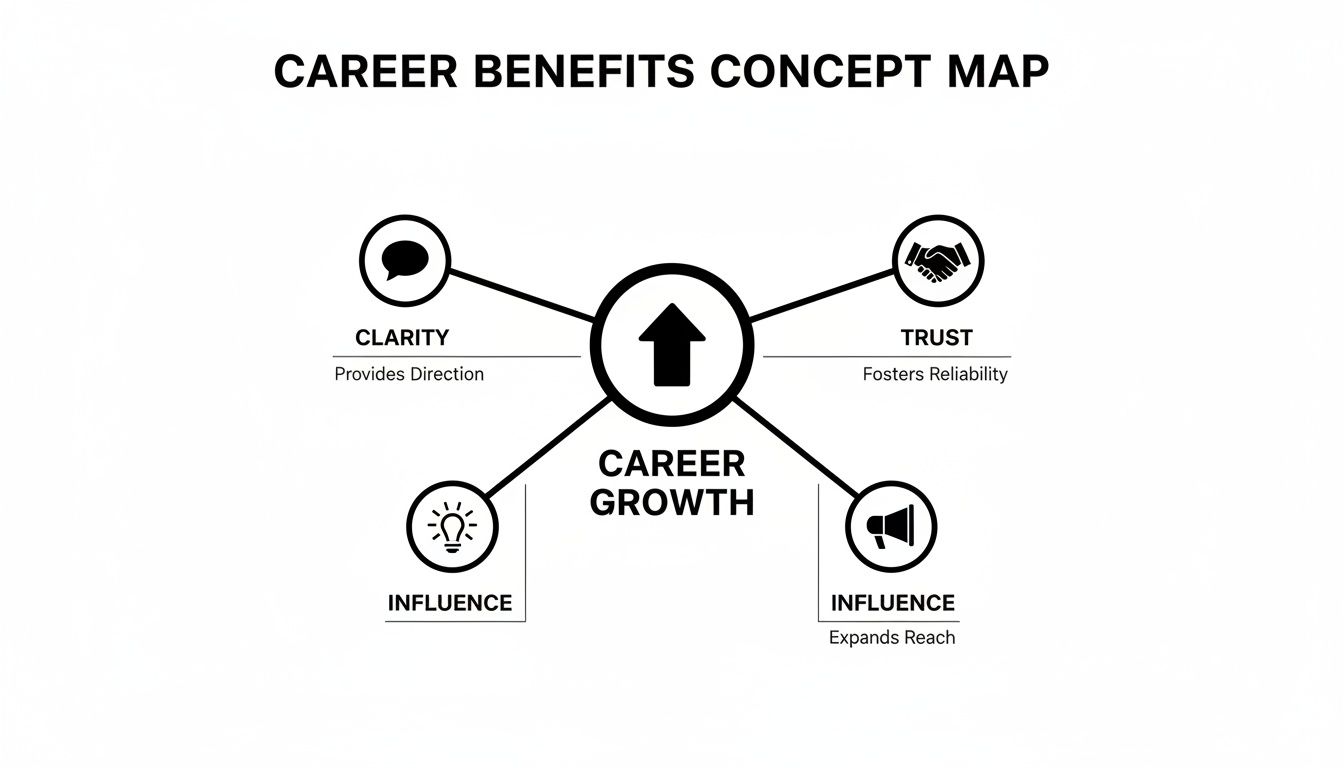
As this shows, improving your speech isn't just about sounding different—it's about building the clarity, trust, and influence that are the foundations of real career growth. Understanding these four pillars is your first step toward practicing with purpose and getting the results you want.
Actionable Exercises for Your Daily Practice
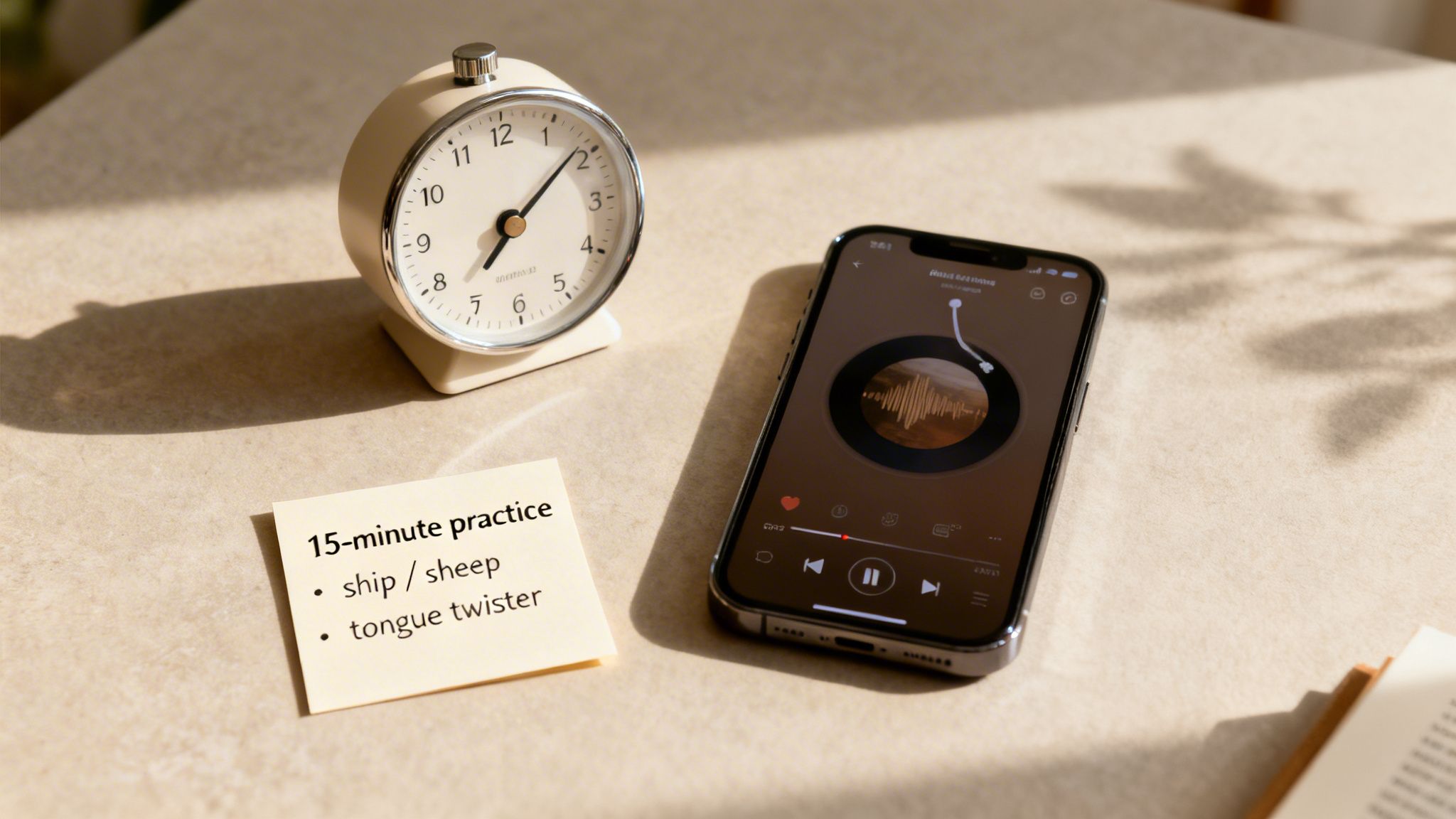
Understanding the theory behind the American accent is one thing, but actually building it into your speech is a whole different ballgame. This is where consistent, deliberate practice comes in—it’s how you build new muscle memory and make new habits stick.
The good news? You don’t need marathon study sessions. The key to successful American English accent training is a simple, repeatable routine. Even just 15 minutes a day is enough to start targeting the core components and see real progress.
Sharpening Your Pronunciation
Getting your pronunciation right starts with two things: training your ear to hear the subtle differences in sounds and training your mouth to physically make them. My two favorite exercises for this are minimal pair drills and tongue twisters.
Minimal Pair Drills: These are word pairs that sound almost identical, differing by just a single sound. Think ‘ship’ vs. ‘sheep’ or ‘cat’ vs. ‘cot’.
- How to practice: Find a list of minimal pairs for a sound you find tricky (like the short 'i' and long 'ee'). Listen to a native speaker say each word, paying close attention to the difference. Then, record yourself saying the same words and compare it to the original. This is a fantastic way to sharpen your ear and start self-correcting.
Tongue Twisters: These aren't just for fun. They're high-repetition workouts for your mouth, building the muscle control and articulation you need for clear speech.
- Example: To get the American 'R' sound down, try this classic: "Around the rugged rock, the ragged rascal ran." Start slow, really exaggerating that 'R' sound. As you get more comfortable, gradually speed up while keeping the sound crisp and clear.
Capturing the Melody of Intonation
Intonation is the music of a language. And the fastest way to learn that music is to mimic the people who have already mastered it. For this, the "shadowing" technique is incredibly powerful.
Shadowing is when you listen to a short audio clip and repeat it almost at the same time, like a verbal shadow. It forces your brain to focus on the speaker's pitch, rhythm, and stress—not just the words.
How to Practice Shadowing:
- Choose a short clip: A 15-30 second audio or video clip of a native speaker works best. I often recommend TED Talks or podcasts with clear speakers.
- Listen first: Play the clip once just to get the gist of the content and the overall vocal melody.
- Shadow: Now, play it again and start speaking along with the recording. Your goal is to to match the speaker's pitch—where their voice rises and where it falls. Don't stress about getting every single word perfect. You're trying to capture the musicality.
Mastering Word and Sentence Stress
Stress is how you put a spotlight on certain words to guide your listener and make your meaning clear. A simple but highly effective way to practice this is by shifting the focus within a single sentence.
- The Spotlight Exercise: Take a basic sentence like, "She didn't take the red car."
- Practice: Say the sentence over and over, stressing a different word each time. Notice how the entire meaning shifts.
- "She didn't take the red car." (Someone else did.)
- "She didn't take the red car." (She did something else to it, maybe she just looked at it.)
- "She didn't take the red car." (She took the blue one instead.)
This drill teaches you to use stress intentionally, ensuring your main point always lands exactly where you want it to.
Creating a Natural Rhythm
Rhythm is what makes your speech flow smoothly instead of sounding choppy. The secret here is linking, where you blend the end of one word into the beginning of the next.
- Linking Practice: Start by identifying common word pairs where sounds connect. For instance, "an apple" naturally sounds more like "anapple," and "want to" often becomes "wanna."
- Drill: Make a list of these common links and practice saying them in short phrases until it feels second nature.
- "I need an apple."
- "Do you want to go?"
- "I'll be back in an hour."
If you’re ready to build a more structured plan, our guide on how to practice English pronunciation daily is a great place to start. By turning these exercises into a short, consistent daily habit, you'll lay a strong foundation for clear, confident, and natural-sounding American English.
How to Choose the Right Accent Training Program for You
Choosing to invest in your communication skills is a big step. But with so many options for American English accent training—from personal coaching to apps you can use on your phone—picking the right path can feel pretty overwhelming. This guide is here to help you cut through the noise and find a program that actually fits your professional goals and the way you learn best.
The world of language learning has changed a lot recently. We've seen a massive shift to online and flexible learning, with the North America online language learning market valued at a huge $2.5 billion in 2023. It's even expected to reach $9.8 billion by 2031. This boom means you have more convenient options than ever, but it also means you need to be smart about where you put your time and money.
Differentiating Between Coaching, Courses, and Apps
First things first, let's break down the main types of programs out there. Each one offers a completely different experience.
-
One-on-One Coaching: This is the most personalized route. You get an expert coach who works with you directly, creating a plan based on your specific speech habits and professional needs. It's perfect if you need focused, custom feedback.
-
Self-Paced Courses: Think of these as structured, video-based programs you can work through on your own time. They give you a clear roadmap for learning but usually don't have the same level of direct, personal feedback as coaching.
-
Accent Training Apps: These apps are great for daily drills and exercises. Many use AI to give you instant feedback on your pronunciation. They're fantastic for practice and reinforcing what you've learned, but they often don't provide the strategic, big-picture guidance of a full course or a coach.
It's also helpful to know that the platforms delivering this training have become incredibly sophisticated, which can give a real competitive edge for language training institutes. Understanding this helps you spot a program that’s built on a solid, effective learning system.
A Checklist for Evaluating Programs
Not all accent programs are created equal. Far from it. Use this checklist to ask the right questions and learn to spot the difference between a program with a solid methodology and one that’s just selling a quick fix.
1. Is There a Personalized Assessment?
A quality program should never be a one-size-fits-all solution. It must start with a detailed assessment to pinpoint your specific pronunciation challenges, intonation habits, and rhythm. Without this diagnostic step, you risk wasting time on generic exercises that don’t even touch on your real priorities.
2. What Is the Feedback Structure?
Trying to learn in a vacuum is incredibly slow and often leads to practicing mistakes. You need a clear feedback loop to know if what you're doing is actually working.
The single most important factor in accelerating progress is targeted, expert feedback. It helps you identify auditory "blind spots"—the errors you can't yet hear in your own speech—and correct them before they become ingrained habits.
Look for programs that offer consistent feedback, whether it’s from a live coach, through video or audio submissions you send in, or via genuinely helpful AI analysis.
3. Is the Curriculum Comprehensive?
Real accent training is so much more than just pronouncing sounds correctly. A truly effective curriculum has to cover the other critical pieces of the puzzle: intonation (the melody of your speech), stress (which words you emphasize), and rhythm (the overall flow). If a program only focuses on individual sounds, it’s missing most of what makes speech clear and natural.
Finding the Right Fit for Your Needs
The best program is the one that fits your budget and schedule while giving you a structured, supportive, and personalized path to follow. To dig deeper into what to look for in a live coach, check out our guide on the 7 critical questions to ask when choosing the right accent coach.
Setting Realistic Goals and Tracking Your Progress

Before we even talk about practice routines, let’s tackle one of the most important questions I get: what does "success" in American English accent training actually look like? Getting this right from the start is the key to staying motivated when the work gets challenging.
It's easy to fall into the trap of aiming for a "perfect" American accent. But let me be direct: that goal is both unrealistic and, more importantly, completely unnecessary. The real objective isn't perfection—it’s progress. True success is about the real-world results that boost your professional life and your confidence.
Redefining Success Beyond Perfection
So, instead of chasing some vague idea of perfection, let's look at success through a more practical lens. Think of it like starting a new fitness routine. You might feel stronger after just a few workouts, but the real, visible transformation takes consistent effort over time. Accent training works the exact same way.
You can absolutely expect to notice real gains in your clarity and confidence within the first 8-12 weeks of focused, consistent practice. But the kind of change that sticks—the kind that becomes second nature—is built over months, not days.
Success isn't about erasing your accent or your identity. It's about hitting key milestones that prove your communication is getting stronger. It’s about being understood the first time, every time.
To see if you're on the right track, forget about perfection and start looking for these real-world signs:
- Are people asking you to repeat yourself less often? This is the number one sign that your clarity is improving.
- Do you feel more confident speaking up in fast-paced meetings? This shows you're starting to trust that your words will land clearly.
- Are colleagues mentioning that your presentations sound great? Outside feedback is a powerful confirmation of your progress.
- Is building rapport with clients or customers getting easier? When your speech is clear, it builds trust and makes interactions feel smoother.
Setting Milestones for Your First 90 Days
A big goal like "improve my accent" can feel overwhelming. The secret is to break it down into smaller, manageable milestones. A well-structured plan for the first three months makes your progress feel real and keeps you from getting discouraged.
Here’s what a typical 90-day journey might look like.
Month 1: Building Your Foundation and Awareness
- Goal: Pinpoint your top 3-5 pronunciation challenges. You can't fix what you can't hear.
- Action: Record yourself reading a short paragraph. Then, find a recording of a native speaker reading the same text and listen to them back-to-back.
- Metric: Can you clearly and consistently hear the difference between your sounds and the target sounds?
Month 2: Creating New Habits
- Goal: Start integrating one or two new pronunciation skills into short, controlled sentences.
- Action: Dedicate 15 minutes a day to focused drills, like minimal pairs or shadowing exercises.
- Metric: Can you produce your target sounds correctly in your practice drills about 80% of the time?
Month 3: Applying Your Skills with Confidence
- Goal: Take your new skills out of practice and into the real world in low-stakes conversations.
- Action: Try using a new intonation pattern in a team huddle or a new sound in a casual call with a trusted colleague.
- Metric: Did the conversation feel smoother? Did you get a positive reaction or feel more understood?
We dive much deeper into this timeline in our guide on setting realistic goals for accent improvement in 3 months.
This isn't just a "nice-to-have" skill. The corporate world is taking notice. The global Business English Language Training market is projected to hit USD 23,105.17 million by 2026, which shows just how vital clear communication has become for anyone looking to get ahead.
When you set realistic goals and track the metrics that actually matter, accent training stops being a huge, intimidating mountain to climb. It becomes a series of achievable steps, where every bit of effort translates directly into measurable improvements in your confidence and your career.
Start Your Journey to Clearer Communication Today
So, we've covered a lot of ground. You can see now that American English accent training isn't some mysterious talent—it’s a skill built on the core pillars of pronunciation, intonation, stress, and rhythm. The path to clearer speech was never about erasing your identity. It’s about adding a powerful communication style to your professional toolkit.
For professionals who are ready to improve their clarity with a flexible, independent approach, we’ve created Intonetic Accent Studio. It's a self-paced monthly subscription that gives you a structured system without the commitment of one-on-one coaching. You can choose a plan for just $7 per month, or a plan for $27 per month which adds personalized feedback from an expert coach on your progress.
Take Your First Step
Investing in your communication is one of the most powerful investments you can make in your career. It opens doors to greater influence, builds trust, and ensures your best ideas are always understood.
As you get started, it can be helpful to use tools that get you familiar with the fundamental exercises. For example, you can try a starter app to build some initial momentum with daily drills.
The most crucial step is the first one. By choosing a structured program, you move from simply wanting clearer speech to actively building it.
Whether you're looking for foundational practice on your own or expert guidance to speed up your progress, there’s a path forward that fits your goals. Take that first step and see which program aligns with where you want to go. Your future self will thank you for it.
To start your journey toward clearer, more confident communication, explore the Intonetic Accent Studio programs today.
Your Top Questions About Accent Training Answered
Taking the leap into American English accent training is a big move for your career. It’s totally normal to have questions about what the process looks like, how long it takes, and what you can realistically expect. I get these questions all the time from ambitious professionals, so let's clear them up.
Here are some honest, straightforward answers to the most common questions I hear.
How Long Until I Start Noticing a Real Difference?
This is always the first question, and it's a great one. While mastering clear speech is a lifelong skill, you’ll start feeling and hearing tangible improvements in your clarity and confidence within about 8-12 weeks of consistent practice.
Think of it like getting in shape. You feel better after just a few workouts, but the real, lasting changes—the kind that become automatic—come from sticking with it over time. The secret isn't cramming for hours, but building a consistent daily habit.
Will I Lose My Original Accent?
Absolutely not. This is a huge misconception, and it's important to clear it up. Good accent training is not about erasing your identity or your native accent. It's about adding another communication style to your repertoire, just like a bilingual person switches between languages depending on the situation.
The real goal is to give you choice and control. You're learning how to switch to a clearer, more standard American speaking style when it matters most—like in a big presentation or a client meeting. Your original accent is part of your story; this just adds a new tool to your professional toolkit.
Can't I Just Do This on My Own with Apps?
Self-study with apps and YouTube is a great way to practice, but it has one major blind spot: you can't hear your own mistakes. Progress really takes off when you get targeted, expert feedback.
An experienced coach acts like a mirror for your speech. They can instantly spot the subtle errors you’re not even aware you’re making. Without that outside ear, it’s far too easy to practice the wrong way and lock in bad habits. A coach's guidance is the shortcut that stops you from spinning your wheels.
Is This Only for People Who Are Already Fluent?
Not at all. This kind of training is for any non-native professional who feels like their pronunciation is holding them back, regardless of how great their grammar or vocabulary is.
If you know your stuff but you keep getting asked to repeat yourself or you see that look of confusion on people's faces, then this training is designed for you. It's focused purely on the music of your speech—the sounds, rhythm, and melody—to make sure the brilliant ideas you already have are heard loud and clear.
If you're ready to take that next step toward clearer, more confident communication, Intonetic has a clear path. For professionals who aren't looking for one on one coaching, but still want to improve their accent and clarity, Intonetic now offers 2 self-paced programs as a monthly subscription called Intonetic Accent Studio, priced at $7 per month and $27 per month. The difference is that the $27 per month program gets them personalized feedback on their progress.
Explore the program that fits your goals and start your journey today.