Breaking Down Communication Barriers in Healthcare for Patient Safety
In healthcare, we often talk about communication barriers as if they're abstract hurdles. But they’re not. They are very real breakdowns in how we share and understand information—whether it's between a doctor and a patient, or between two nurses during a shift change. These aren't just minor mix-ups; they can be linguistic, cultural, or even baked into the very systems we work in, with a direct and sometimes devastating impact on patient safety.
Why Clear Communication in Healthcare Is a Critical Lifeline
When the stakes are this high, clear communication isn't a "soft skill." It's a core clinical competency, as vital as knowing how to read an EKG or administer medication. Every conversation is a crossroad where we either build a bridge to safety or open a door to risk. A poorly understood question or a rushed handoff can unravel the entire fabric of care.
That’s why effective communication in healthcare is the absolute lifeline for patient safety and trust. When that line frays, the human and financial costs are immense. These aren't just inconvenient hiccups; they are a major source of preventable harm.
The Staggering Cost of Miscommunication
This isn't just anecdotal. The data paints a stark picture. A landmark analysis of 23,000 medical malpractice lawsuits found that communication failures were a contributing factor in a shocking 30% of all cases.
Think about that. These breakdowns were linked to nearly 2,000 preventable deaths and cost $1.7 billion in malpractice payouts. The full research really puts the scope of the problem into perspective.
Suddenly, clear dialogue feels less like a nice-to-have and more like a fundamental safety protocol, right up there with surgical checklists and hand hygiene. When a patient’s concern is dismissed or a critical lab value gets lost in translation, the system has failed.
The Clinician's Role in Bridging the Gap
For every healthcare professional, mastering clear communication is just as crucial as their clinical training. This is especially true for non-native English-speaking clinicians, who face the dual challenge of navigating complex medical jargon alongside the nuances of a second language. Tackling these communication barriers in healthcare requires a real commitment, both from individual providers and the organizations they work for.
This guide will break down the main types of barriers you'll encounter—from language and cultural divides to systemic and even psychological hurdles. By understanding where these fault lines lie, we can build targeted strategies to protect our patients and improve outcomes.
For clinicians looking to sharpen their own clarity, our guide on how to speak English clearly and confidently is a great place to start. When we prioritize clear communication, we shift from just treating a disease to truly and safely caring for the person in front of us.
The Four Hidden Fault Lines in Clinical Communication
When a serious communication breakdown happens in a hospital, it’s almost never a single person’s fault. It’s more like an earthquake—the result of pressure quietly building along hidden fault lines in the system. One small slip triggers a cascade of failures, and suddenly, patient safety is on the line.
If we want to move past just blaming individuals, we have to understand these fault lines. They represent the primary communication barriers in healthcare, the systemic cracks that set the stage for miscommunication long before an incident occurs.
Let's take a closer look at each one.
To get a quick sense of these barriers, this table breaks down the main categories, what drives them, and what they look like in a real clinical setting.
Overview of Healthcare Communication Barriers
| Barrier Type | Primary Driver | Clinical Example |
|---|---|---|
| Linguistic & Cultural | Differences in language, professional jargon, and cultural norms. | A doctor uses the term "neoplasm" with a patient who doesn't understand, causing fear and confusion. |
| Systemic & Organizational | Flawed workflows, information silos, and a culture of speed over clarity. | A rushed shift change where a nurse omits a patient’s new allergy, leading to a medication error. |
| Psychological & Interpersonal | Human factors like burnout, fear, intimidation, and team hierarchies. | A junior resident hesitates to question a senior physician's order, even when they suspect it's wrong. |
| Physical & Technical | The environment and the tools used for communication. | A critical lab alert is buried in a poorly designed EHR tab and missed by the care team. |
Each of these barriers creates a distinct type of friction, but they often overlap and compound each other, making the potential for error even greater.
Linguistic And Cultural Barriers
This is the most familiar barrier, but it goes much deeper than just speaking different languages. It’s about how our professional training and cultural backgrounds shape the way we use and understand words.
Medical jargon is a classic example. When a clinician tells a patient they have a "positive cardiac marker" instead of saying "a sign of a possible heart attack," they create an instant wall. The patient might be too intimidated or confused to ask for clarification, leaving them anxious and uniformed.
It’s not just about jargon, though. Cultural norms can be just as powerful. A patient from a stoic culture might downplay their pain level, causing a provider to misjudge the seriousness of their condition. These subtle forces can silently steer a clinical encounter in the wrong direction.
The consequences aren't just theoretical. When these communication fault lines rupture, the costs—both human and financial—are steep.
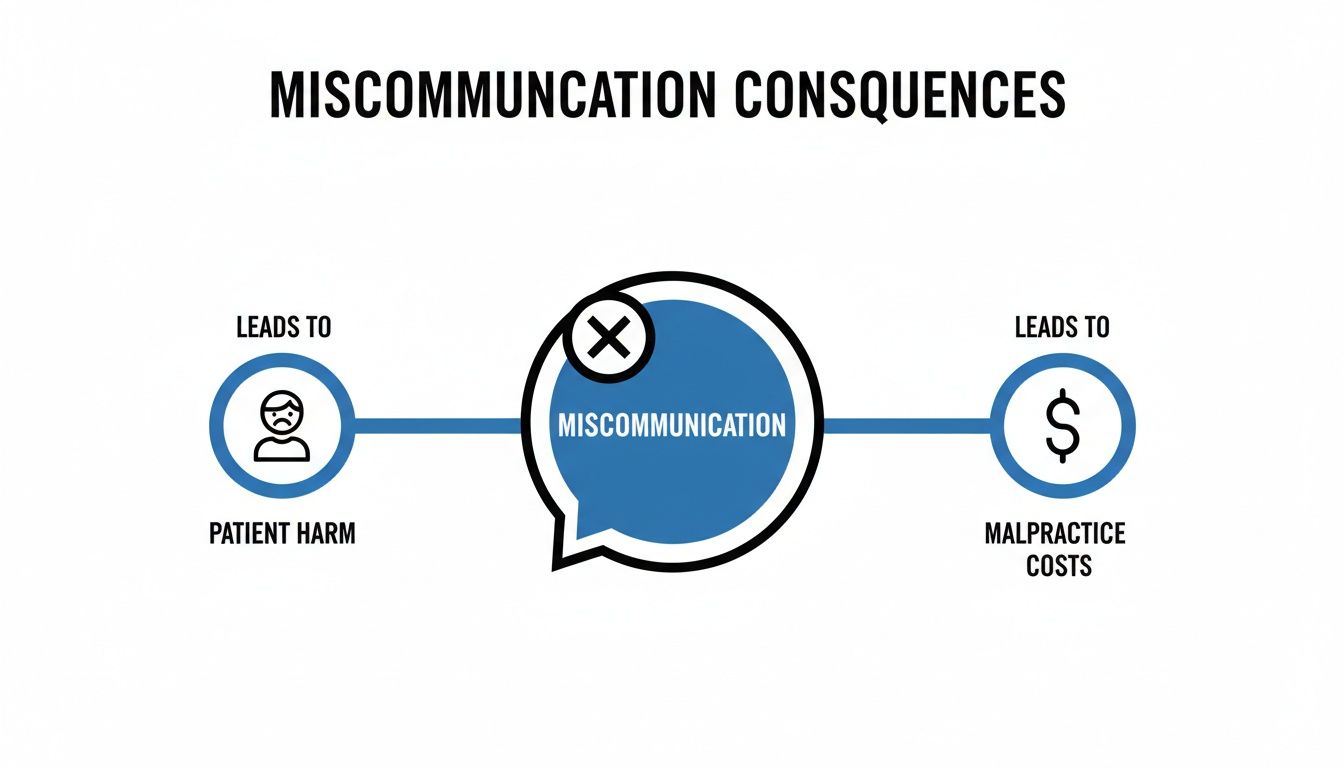
The takeaway is brutally simple: miscommunication isn’t a soft skill issue. It’s a direct threat to patient safety and a major driver of malpractice claims.
Systemic And Organizational Barriers
Some of the most dangerous barriers are baked right into the healthcare system's DNA. We’re talking about broken processes, departments that don’t talk to each other, and a culture that often values speed over safety.
Think about rushed patient handoffs between shifts. Without a clear, required protocol, it’s incredibly easy for a tired nurse to forget a crucial detail, setting up the next shift for a potential error.
Information silos are another massive problem. A 2022 study found that 22% of primary care physicians said they rarely or never sent clinical information to specialists during referrals. Even worse, 35% reported rarely or never getting information back from the specialist. This fragmentation leads to duplicate tests, conflicting treatments, and dangerous delays.
These aren't individual failings; they are cracks in the foundation of the system itself.
Psychological And Interpersonal Barriers
This is the human side of the equation—the messy reality of emotions, stress, and power dynamics. When a provider is burned out, their ability to listen with empathy plummets. They’re more likely to miss the subtle nonverbal cue that says a patient is terrified or doesn't understand.
From the patient's perspective, fear is a huge barrier. They might worry about "bothering" a busy doctor with what feels like a silly question, or they might not admit to skipping their medication out of embarrassment. This leaves the clinician making decisions with incomplete, and sometimes dangerously wrong, information.
And within the care team, hierarchy can be a communication killer. A junior nurse who spots a potential error in a senior physician's order might stay silent, afraid of being seen as insubordinate. When people don’t feel psychologically safe to speak up, critical checks and balances disappear.
Physical And Technical Barriers
Finally, the physical environment and the tools we rely on can erect their own barriers. A chaotic and noisy emergency department, for example, makes it nearly impossible to guarantee a verbal order was heard correctly.
Technology can be just as problematic. We’ve all seen Electronic Health Record (EHR) systems that are clunky, non-intuitive, and don’t play well with other software. A critical allergy alert might be buried three clicks deep in a tab no one ever looks at. Even something as basic as a bad phone connection during a telehealth call can prevent a provider from gathering the information they need.
For clinicians who find themselves in noisy environments or on poor-quality calls, even small improvements in verbal delivery can make a huge difference. Understanding how to use stress patterns effectively can cut through the noise. You can learn more about the difference between syllable and sentence stress and how it impacts clarity.
The Human Cost of Unclear Medical Communication
It’s easy to tune out when you hear statistics about medical errors. The numbers can feel abstract and distant. But behind every data point is a real person, a family, and a life turned upside down by a simple breakdown in communication.
These aren't just textbook case studies. They are real moments where small gaps in understanding ballooned into devastating outcomes, turning routine care into a life-altering event.

A Medication Error Over the Phone
Picture this: a talented and dedicated resident physician, whose native language isn't English, calls in a medication order. He needs "fifteen milligrams" of a powerful blood thinner for a patient who just came out of surgery.
On the other end of the line, a busy nurse is juggling alarms, patient requests, and a dozen other tasks on a noisy unit. Through the static and stress, she hears "fifty milligrams"—a dangerously high dose.
The resident’s pronunciation, combined with the chaotic environment, created just enough ambiguity for a catastrophic error to slip through. The patient suffered a major bleeding event, leading to an emergency intervention and a long stay in the ICU. The resident was brilliant, but a subtle linguistic hurdle had tragic consequences.
This kind of thing happens far more often than we'd like to admit. It’s a stark reminder that in healthcare, how you say something is every bit as important as what you say. Clarity isn’t a nice-to-have; it’s a core safety function.
These moments can also be complicated by unconscious biases. When a listener struggles to understand an accent, it can sometimes lead to impatience or even misjudgment of the speaker's competence. To understand this better, you can learn more about what accent bias is and how it presents a hidden challenge in professional environments.
When Symptoms Get Lost in Translation
Let's look at another common scenario, this time involving a patient with low health literacy—someone who struggles to find, understand, and use health information. An older man arrives at the ER complaining of a "burning pressure" in his chest.
Intimidated by the medical jargon and the rushed pace, he has a hard time describing his symptoms and ends up downplaying how bad he really feels. He couldn't find the right words to explain the pain radiating down his arm or the fact that he was short of breath.
The clinical team, interpreting his vague report as simple indigestion, sent him home with antacids. A few hours later, he had a massive heart attack at home. A life-threatening emergency was missed because the patient didn’t have the vocabulary or the confidence to make himself understood.
This story shows how critical it is for clinicians to create a space where patients feel safe enough to share their whole story, even if they can't use perfect medical terms.
A Handoff That Unraveled
Finally, imagine a busy surgical floor during shift change. A nurse, wrapping up a grueling 12-hour shift, gives a quick report on her patients to the incoming nurse. In her haste, she forgets to mention one small but critical detail.
A patient who had knee surgery that morning had complained of some new, mild tenderness in his calf—a classic, if subtle, sign of a potential deep vein thrombosis (DVT). The detail wasn't documented clearly, and it got lost in the verbal shuffle.
The oncoming nurse, completely unaware of this new symptom, carried on with routine care. The next day, the patient developed a pulmonary embolism. It was a life-threatening complication that could have been prevented if that one piece of information had been passed along clearly and systematically. This wasn't a failure of clinical knowledge, but a failure of process.
These stories aren't about pointing fingers. They're sober reminders of our shared responsibility. Every conversation, every handoff, and every phone call is a chance to either strengthen the net of patient safety or let a small crack appear.
How Accent and Language Challenges Impact Patient Trust
For the countless dedicated healthcare professionals who speak English as a non-native language, clinical skill is just one part of the job. The other part—just as critical—is communication. And it’s here, in the subtle details of speech, where small differences in accent, intonation, or rhythm can become significant communication barriers in healthcare.
This isn't about just being understood. It’s about building trust. When a patient is already feeling anxious or is in pain, their ability to take in new information shrinks. A clinician's accent, even a slight one, can make it just a little bit harder for the patient to follow complex instructions or feel confident in the care they’re getting.
This gets even tougher in high-stress moments or over the phone, where you lose all visual cues. A misheard medication dosage or a misunderstood post-op instruction isn't just a simple mistake—it can lead to serious patient harm.

The Unspoken Signals of Speech
It goes way beyond just pronouncing words correctly. The "music" of our speech—our intonation and rhythm—sends powerful, unspoken messages. A downward inflection at the end of a statement often signals confidence and authority. But what if an unintentional upward lift makes a clinician sound uncertain, even when they are 100% sure of their diagnosis?
Imagine a doctor explaining a serious condition. If their speech rhythm feels hurried or their emphasis lands on unexpected words, a patient might not see them as efficient. They might see them as rushed, dismissive, or even lacking empathy.
This is where the subtle cracks in the doctor-patient relationship begin to form. Trust isn't just built on what you know; it's built on the patient's feeling that they have been heard, understood, and cared for with confidence.
The Double Burden for NNES Providers
This puts an incredible amount of pressure on non-native English-speaking (NNES) providers. They’re often performing a tough mental juggling act: translating complex medical concepts in their head, forming them into clear English sentences, delivering them with precision, and trying to navigate the patient's emotional state all at once. It's exhausting.
And this challenge is often doubled when the patient also has a different linguistic background. In the United States alone, around 26 million people have limited English proficiency. When both the provider and the patient are working hard just to understand each other, the chances of a misunderstanding skyrocket.
Reframing Clarity as a Professional Skill
Talking about these challenges isn't about trying to erase an accent or diminish a provider's background. Far from it. It's about seeing communication clarity for what it is: a distinct, learnable professional skill, just like suturing or reading lab results.
For NNES clinicians, targeted training is an incredibly powerful tool for both patient safety and their own career growth. If you're looking for the right kind of support, check out our guide on choosing the best accent coach for healthcare workers.
By investing in this skill, providers can cut down on misunderstandings, build stronger patient trust, and make sure their expertise truly shines through, every single time.
Actionable Strategies for Building Clearer Communication
Knowing what causes communication breakdowns is one thing. Actually fixing them—in the middle of a hectic shift or a difficult patient conversation—is something else entirely. The next step is putting proven, evidence-based strategies into action.
The good news is that these aren't complex, abstract theories. They are practical tools that both healthcare organizations and individual clinicians can use to build a more resilient system of communication, one that protects patients and empowers providers every single day. Let's walk through some of the most effective approaches.

System-Wide Solutions for Organizational Excellence
For healthcare organizations, the most powerful changes come from standardizing key processes and providing the right resources. These top-down strategies create a safety net that supports every single member of the care team.
A few of the most impactful strategies include:
- Implementing SBAR for Handoffs: The SBAR (Situation, Background, Assessment, Recommendation) protocol is a game-changer for handoffs. It provides a simple, structured framework for passing along critical information, ensuring that handoffs between shifts or departments are consistent and complete. This dramatically reduces the risk of vital details getting lost in translation.
- Promoting the Teach-Back Method: This is one of the most powerful tools for making sure a patient truly understands. After explaining a treatment plan, the clinician simply asks the patient to explain it back in their own words. It's not a test of the patient's knowledge, but a check on how well the provider explained it.
- Providing Professional Medical Interpreters: Relying on a patient's family member or a non-medical staffer for translation is a massive risk. Professional interpreters are trained in medical terminology and cultural nuances, ensuring every word is conveyed accurately and confidentially. Making them easy to access—whether in-person, by phone, or through secure video—is a non-negotiable for bridging language gaps safely.
When these protocols are embedded into daily workflows, they systematically lower the chances of a communication failure.
Individual Practices for Clinical Clarity
While system-wide changes are crucial, individual clinicians also have immense power to break down barriers, one patient at a time. It’s about cultivating specific communication habits that can transform an interaction from purely transactional to truly trust-building.
The most effective clinicians don’t just deliver information; they ensure it is received and understood. This requires a conscious effort to listen actively, simplify language, and confirm comprehension at every step.
Here are a few key individual skills:
- Active Listening: This is more than just hearing words. It means giving your full attention, noticing non-verbal cues, and reflecting back what you hear to confirm you've understood. It sends a powerful message to the patient: "I hear you, and you matter."
- Using Plain Language: Medical jargon is one of the biggest and most common barriers. Make a deliberate effort to swap technical terms for simple ones. For instance, say "swelling" instead of "edema," or "high blood pressure" instead of "hypertension." It’s a simple switch that makes healthcare far more accessible. For more tips on improving your verbal delivery, check out our guide on how to enunciate better.
When you use these practices consistently, you empower patients to become active partners in their own care.
Enhancing Clarity for Non-Native English Speakers
For the many healthcare professionals who are non-native English speakers, the goal isn't to erase an accent but to improve intelligibility. This means making sure your pronunciation, intonation, and speech rhythm are easily understood by patients and colleagues, especially during stressful, high-stakes situations.
For professionals who want to enhance their verbal clarity and confidence without one-on-one coaching, Intonetic now offers 2 self-paced programs as a monthly subscription called Intonetic Accent Studio, priced at $7 per month and $27 per month. The difference is that the $27 per month program gets them personalized feedback on their progress. These programs are for learners who aren't looking for to do one on one coaching, but still want to improve their accent and clarity. You can learn more about these highly accessible programs at the Intonetic Accent Studio page. This kind of focused training builds confidence and directly supports patient safety.
Practitioner's Checklist for Clearer Communication
To help put all these ideas into practice right away, here’s a quick checklist clinicians can use to navigate common communication hurdles in their daily work.
Practitioner's Checklist for Clearer Communication
| Strategy | When to Use | Benefit |
|---|---|---|
| Use SBAR Format | During every patient handoff, shift change, or referral. | Guarantees all critical information is transferred consistently. |
| Perform Teach-Back | After explaining a diagnosis, medication, or discharge plan. | Confirms true patient understanding and reveals gaps in communication. |
| Request an Interpreter | The moment a language barrier is identified with a patient. | Ensures accurate and confidential communication, building trust. |
| Speak in Plain Language | In all conversations with patients and their families. | Reduces patient confusion and anxiety, empowering them to ask questions. |
By weaving these strategies into the fabric of daily practice, both organizations and individuals can actively dismantle the barriers to clear communication. This fosters a culture where clarity is the standard and patient safety is always the top priority.
Building a Culture of Communication Safety
While tools and techniques are useful, true, lasting change goes much deeper. If we want to permanently dismantle communication barriers in healthcare, we have to build a culture where communication safety is treated with the same seriousness as infection control. It's a deliberate pivot away from a reactive, blame-first mindset.
What we need is a system where clear, unambiguous communication is a core value, built on a bedrock of psychological safety. This means creating an environment where every single person on the team—from the newest medical assistant to the chief of surgery—feels safe enough to ask questions, raise a concern, or challenge something that feels off, all without the slightest fear of being punished or shamed for it.
The Role of Leadership in Setting the Tone
This kind of cultural shift always starts at the top. It's not enough for leaders to just sign off on the budget; they have to actively model the very behaviors they want to see in their teams.
Think about the powerful message it sends when a hospital director, in the middle of a big meeting, openly admits they don't understand something and asks for clarification. It tells everyone in the room that curiosity is valued more than certainty and that patient safety will always trump personal ego.
A leader’s commitment shows up in real, tangible actions:
- Investing in Training: Earmarking real budget dollars for team-based communication workshops and individual coaching.
- Breaking Down Silos: Purposefully creating cross-departmental projects that force different teams to actually work together and understand each other’s worlds.
- Celebrating Transparency: Publicly recognizing and rewarding the individuals who speak up to prevent an error, framing their actions as heroic, not disruptive.
Fostering Trust with Patients and Systems
Of course, a robust culture of communication safety must extend to patients, too. This includes ensuring absolute patient data privacy and building trust through resources like a HIPAA Compliant Call Center. When patients feel confident that their personal information is secure and that they can speak openly without being judged, they transform from passive recipients of care into active partners.
A culture of safety is one where it is safe to be unsafe. People feel comfortable admitting their mistakes and reporting problems, which is the only way an organization can learn from its failures and improve.
This proactive approach fundamentally changes the entire workplace. Instead of being hidden, errors start to be seen for what they are: valuable data points. They become opportunities to pinpoint weak spots in the system and make it stronger for the next patient.
Investing in clarity at every single level—from high-level hospital protocols right down to an individual's speech patterns—is one of the most powerful things a healthcare organization can do. It directly improves patient safety, boosts team morale, and raises the overall quality of care. It’s not just another expense; it’s the very foundation of medical excellence.
Your Top Communication Questions, Answered
Theory is one thing, but what about the real-world questions that pop up on a busy hospital floor? Here are my answers to the questions I get asked most often by clinicians just like you.
What's the Best Way to Make Sure My Patients Actually Understand Me?
Hands down, it’s the teach-back technique. This isn't just a good idea; it's an evidence-based game-changer for patient comprehension.
After you've explained something important—like a new medication or discharge instructions—you simply ask the patient to explain it back to you in their own words. It’s not a quiz on their memory. It’s a check on how well you explained it. This one small step instantly flags any confusion, letting you clarify critical details right on the spot.
We're on a Tight Budget. What's a Low-Cost First Step We Can Take?
If you need a big impact for a minimal investment, start by standardizing your patient handoffs. Implementing a simple, structured protocol like SBAR (Situation, Background, Assessment, Recommendation) costs you nothing more than the time it takes to train your team.
This simple framework ensures that all the critical information gets passed along accurately between shifts or departments. You’ll see a dramatic drop in errors that stem from forgotten details or miscommunication, giving you a huge return on patient safety for almost no financial cost.
I'm a Non-Native English Speaker. Will Accent Training Erase My Identity?
Not at all. Let’s be clear: modern accent and clarity training is not about erasing your accent or changing who you are. The sole focus is on intelligibility—making sure your pronunciation, intonation, and rhythm are clear enough to be easily understood by anyone.
Think of it as adding a powerful professional skill to your communication toolkit. When your medical expertise is always heard and understood clearly, it builds immense trust with patients and colleagues, which is a cornerstone of patient safety.
For learners who want to improve their accent and clarity but aren't looking for one-on-one coaching, you can find out more by visiting Intonetic's American Accent Training programs.