A Pro Guide to the Different Accents in American English
If you've ever felt like American English is a moving target, you're not wrong. The US is a patchwork of different accents in American English, from the classic Southern drawl to the sharp sounds of a New York City speaker. But here's a little secret: many of those famous regional sounds are actually starting to blend together.
Navigating America's Shifting Accent Landscape

Whether you're in a boardroom in Chicago or a startup in Silicon Valley, the way you speak shapes how your ideas are received. While the US has incredible linguistic diversity, knowing the landscape of different accents in American English is a game-changer for non-native professionals who need to be understood without a hitch.
This guide isn't about erasing your accent—your voice is part of your story. It’s about building the kind of confidence that comes from knowing you’ll be understood the first time, every time. We'll break down the major accents you'll hear and, more importantly, pinpoint the specific features that actually get in the way of clarity. By focusing on just a few key elements, you can make a massive improvement in high-stakes moments, like a pitch to investors or a critical team presentation.
Why a "Neutral" Accent Is a Powerful Tool
The idea of a "neutral" or "General American" accent gets a bad rap. It’s not about finding the one "correct" way to speak. Think of it more like a common denominator—a version of English that's easily understood from coast to coast and that most Americans perceive as not having a strong regional accent.
For a professional, mastering the core features of General American isn't about losing your identity. It's about adding a powerful tool to your communication toolkit, giving you clarity and confidence in any room you walk into.
This approach means you'll connect clearly whether you’re on a call with a client from Boston, a colleague from Texas, or an investor from California. When you adopt these widely recognized patterns, you lower the "listening effort" for your audience. They can stop trying to decode your sounds and start focusing on the value of your message. You can read more in our guide on what makes an American accent sound neutral.
The Great American Accent Leveling
Interestingly, linguists have noticed that the accent map of America is being redrawn in real-time. Thanks to increased mobility and social mixing, many iconic regional accents are softening. For instance, the classic Southern accent you might hear in a movie is becoming less common among younger generations in cities like Atlanta.
This trend is called "accent leveling," and for professionals working on their clarity, it actually simplifies things. It means you don’t have to master a dozen different regional dialects.
Instead, your path forward is clear:
- Focus on Clarity: Your number one goal should be universal understanding, not mimicking a specific regional sound.
- Target Core Features: Concentrate on the foundational sounds, rhythm, and intonation of General American—the very things that are becoming more common everywhere.
- Build Confidence: When you master these core elements, you reduce communication friction and can speak with natural authority.
Understanding General American English
If you think of the different accents in America as a complex map, then General American (GenAm) is the compass that helps you find your way. It's less of a specific regional accent and more of a "default setting"—a way of speaking that’s widely understood across the United States and often perceived by Americans as being "accent-less."
This perception makes it an incredibly powerful and practical tool for professionals. When your goal is clear, high-stakes communication, aligning your speech with GenAm features simply makes it easier for your listeners to understand you. Instead of working to process unfamiliar sounds, they can focus entirely on your message—whether you're a doctor explaining a diagnosis or an executive pitching a new product.
The Key Features of General American
So, what exactly makes an accent "General American"? It’s often defined more by what it lacks—strong regional markers—than by what it has. That said, a few core phonetic traits are absolutely central to its sound and are critical for non-native speakers to master for maximum clarity.
The single most important feature is rhoticity. This is just a technical way of saying the "r" sound is pronounced clearly wherever it appears in a word.
- In a GenAm accent, you clearly hear the "r" in words like car, hard, and corner.
- In contrast, some regional accents (like a classic Boston or some British accents) are non-rhotic, dropping the "r" to produce sounds like cah and hahd.
Since the vast majority of Americans speak with a rhotic accent, mastering this one feature alone can dramatically improve how easily you are understood. You can learn more about its specific characteristics in our deep dive on the General American accent.
A Strategic Baseline, Not an Identity Eraser
Another key characteristic of GenAm is the relative stability of its vowels. It generally avoids the major vowel shifts that define other regional accents, like the Southern Vowel Shift or the Northern Cities Vowel Shift. This consistency is precisely why it's so often used by national news broadcasters—it's a reliable, neutral standard.
Adopting features of General American isn't about erasing your cultural identity or losing your unique voice. It's a strategic choice to equip yourself with the clearest possible tool for professional environments, ensuring your expertise is always heard and understood.
For non-native executives, tech leads, and healthcare providers, focusing on GenAm is simply a matter of efficiency. By targeting its core elements—like rhoticity and standard vowel sounds—you invest your practice time where it will have the greatest impact. It's the most direct path to reducing misunderstandings and speaking with confidence, no matter who is in the room. This focus on key sounds is a core part of building a clear, confident speaking style.
A Tour of Major American Regional Accents
Once you move past the idea of a single "American" accent, you start to notice the rich variety of sounds across the United States. And this isn't just a fun fact for trivia night—it's a massive advantage for any professional who needs to communicate clearly with people from all over the country.
Think about it. Knowing what to expect when you hear a speaker from Boston versus one from Atlanta can make a huge difference in your listening comprehension. It helps you tune your ear to their specific patterns, making conversations smoother and more effective.
Let's take a quick trip around the country to get familiar with some of the most recognizable different accents in American English you'll likely run into.
Before we dive in, it helps to have a baseline. This is what linguists often call General American—the neutral, "newscaster" accent we've been discussing. It’s built on two core features: pronouncing all the 'r' sounds and using neutral vowel sounds.
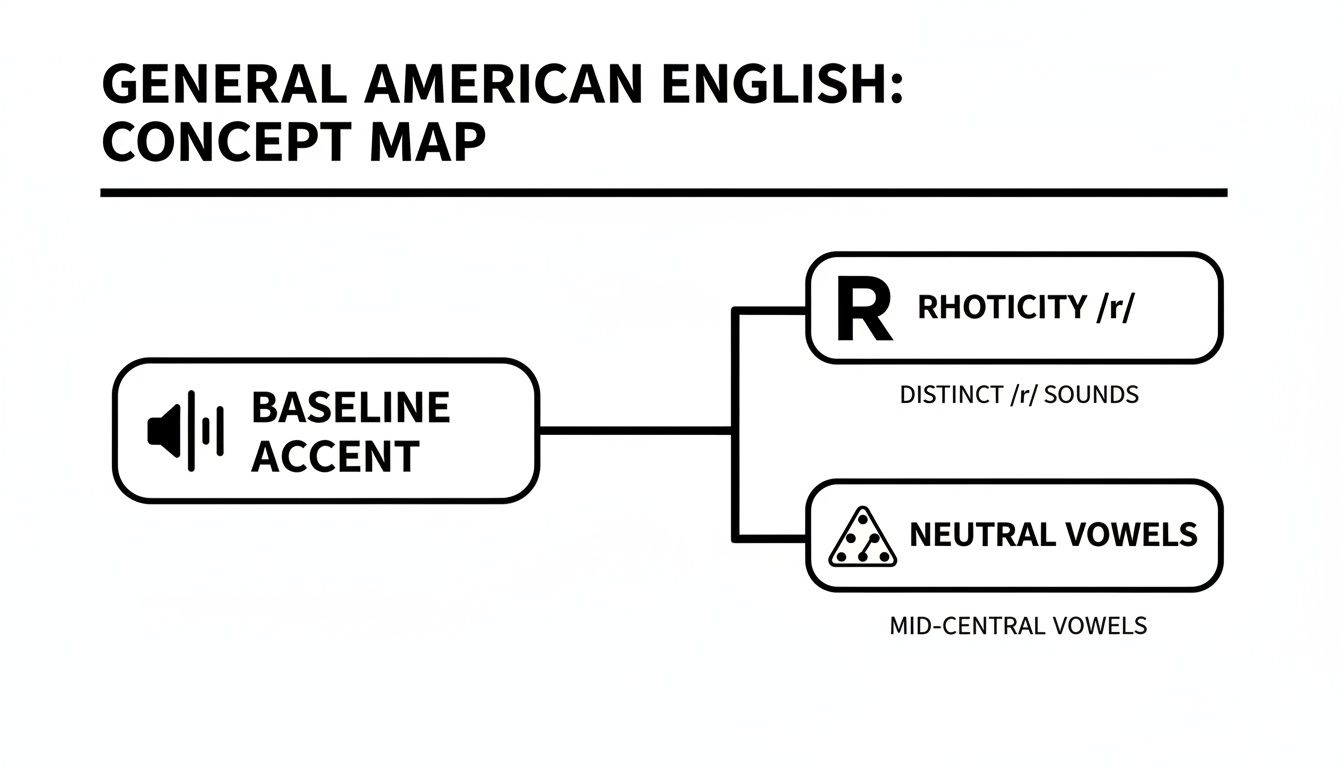
This visual helps you see how those building blocks form the foundation of the accent. Now, let's see how regional accents play with these rules.
To make sense of these variations, it's helpful to compare their standout features against the General American baseline. The table below breaks down the key phonetic markers for some of America's most well-known accents.
Key Features of Major American Regional Accents
| Accent Region | Key Phonetic Feature | Example (vs. GenAm) |
|---|---|---|
| Southern | Southern Vowel Shift and the "drawl" (stretching single vowels into two sounds) | The word bed can sound like beh-yud; fin can sound like feen. |
| New England | Non-rhoticity (dropping the 'r' sound after a vowel) | "Park the car" becomes "Pahk the cah." |
| New York City | Can be non-rhotic; "th" sound becomes "d"; distinct vowel in coffee | "The coffee" sounds like "De caw-fee." |
| Midland | Perceived as "neutral"; lacks the most distinct features of other regions | Sounds very close to the General American baseline. |
| Western | Cot-Caught Merger (words like cot and caught sound identical) | A speaker might say, "I caught a fish" and it sounds like "I cot a fish." |
As you can see, the main differences often come down to how speakers pronounce their vowels and whether or not they say their "r"s. These key features are what make each accent unique.
The Classic Southern Drawl
When most people imagine a "Southern accent," this is usually what they're thinking of. Found across the Southeastern U.S., its signature is a slower, more melodic cadence that can be very pleasant to the ear.
One of its most defining traits is the "Southern Vowel Shift," where certain vowels take a little detour. For instance, the short "i" in a word like fin can slide into an "ee" sound, making it sound more like feen. The "drawl" itself often means stretching a single vowel sound into two, so a word like bed gets drawn out into something like beh-yud.
The New England Accent
Primarily heard in Eastern New England and made famous by cities like Boston, this is one of the most distinctive accents in the country. Its most well-known feature is non-rhoticity—the habit of dropping the "r" sound when it comes after a vowel.
You'll instantly recognize it in a classic phrase like:
- "Park the car in Harvard Yard" which becomes "Pahk the cah in Hahvahd Yahd."
- Or how the word corner sounds more like "cawnah."
This "r-dropping" is a dead giveaway and is the primary thing that sets the traditional Boston accent apart from rhotic General American.
The New York City Accent
The accent of New York City and the surrounding metro area is another one of America's most iconic and easily identified speech patterns. Like its New England neighbor, the traditional NYC accent can also be non-rhotic, although you hear it less and less these days.
A couple of other hallmarks really make it stand out. One is how it handles "th" sounds. The "th" in words like that and the often becomes a hard "d" sound, turning them into dat and de. Another is the unique vowel in words like coffee and talk, where the sound gets raised and rounded into a distinct "caw-fee."
The Midland Accent
Stretching like a belt across the country from Pennsylvania through parts of Ohio, Indiana, and Illinois, the Midland is often considered a sort of "transitional" accent zone. Linguists point out that its speech patterns borrow qualities from both its Northern and Southern neighbors.
What's most fascinating about the Midland accent is that many Americans perceive it as the "standard" or "default" way of speaking. In fact, a huge portion of what we now call General American actually grew out of the speech patterns found right here in the Midland region.
It's what the Midland accent lacks—the strong, defining features of other regions—that makes it sound so "neutral" to so many people.
The Western Accent
Covering the largest and most recently settled part of the country, the Western accent is arguably the one that hews closest to General American. It's spoken by a massive portion of the population.
This accent is fully rhotic, meaning every single "r" is pronounced loud and clear. One of the biggest sound changes happening in American English right now is gaining steam here: the "cot-caught merger." For speakers with this merger, words like cot and caught are pronounced exactly the same. You might not even notice it unless you're listening for it, but this change is spreading rapidly across many of the different accents in American English.
Getting to know these primary accent groups gives you a fantastic framework for navigating conversations in the US. When you can spot these key patterns, you're not just improving your listening skills—you're getting a much deeper appreciation for the rich sound of American English. To get a closer look at that "standard" sound, you might find it helpful to read our article on what an American accent sounds like.
The Real Challenges for Non-Native Speakers
While it’s fascinating to explore the rich variety of accents in American English, for non-native professionals, the focus is almost always on a more practical goal: being understood clearly and confidently. The challenge isn't about perfectly mimicking a Boston or Texas accent; it's about identifying the specific pronunciation habits that most often cause confusion for listeners.
It's easy to feel overwhelmed by the 44 distinct sounds in American English. But here's the good news: not all sounds are created equal. In my experience, a small handful of phonetic features are responsible for the vast majority of communication breakdowns. These are the high-impact areas where a little focused practice makes a huge difference.
The True Barriers to Clarity
For many of my clients, the biggest hurdles aren’t complex grammar rules but the physical sounds of English. These challenges usually fall into two buckets: specific sounds (the vowels and consonants) and the overall "music" of the language (stress and intonation).
Critical Consonant Sounds
- The 'th' sounds: Found in words like think and that, these sounds simply don't exist in many languages. When speakers substitute them with 't', 'd', 's', or 'z', it can instantly flag them as non-native and sometimes change a word's meaning entirely (think thought vs. sought).
- The 'r' sound: As we've seen, a clearly pronounced 'r' (rhoticity) is a cornerstone of General American. Difficulty with this sound can make words like work, world, and girl incredibly tough to produce and for others to understand.
- The 'l' and 'w' sounds: Differentiating between words like light and white is a common challenge. So is producing a clear "dark L" at the end of words like feel or call. These are frequent sticking points.
Crucial Vowel Distinctions
Believe it or not, vowel errors often cause more misunderstandings than consonant mistakes. A classic example is the difference between the short 'i' in ship and the long 'ee' in sheep—a mix-up that can lead to some awkward moments.
Mastering these minimal pairs is vital for clarity. This is often where accent bias can quietly creep into professional interactions, as listeners may struggle to understand what you mean. You can read more about understanding the hidden workplace challenge of accent bias in our detailed guide.
Why Rhythm and Stress Matter More Than You Think
Beyond individual sounds, the single biggest key to being easily understood is mastering suprasegmentals—the rhythm, stress, and intonation of English. This is the "music" of the language. Get it wrong, and you can confuse your listener even if every single sound is perfect.
Just think about the word "record."
Stress the first syllable, RE-cord, and it’s a noun (a vinyl record, a world record).
Stress the second syllable, re-CORD, and it becomes a verb (to record a video).
This simple example shows that word stress isn't just a minor detail; it's fundamental to a word's meaning. Incorrect stress patterns are one of the main reasons non-native speakers can be hard to understand, forcing listeners to work much harder to figure out the message.
This musicality isn’t just for single words; it shapes entire sentences. American English has a stress-timed rhythm, meaning the time between stressed syllables is more or less equal. This creates a distinct cadence that, when you get the hang of it, makes your speech flow naturally and fluently for a native listener.
The United States has incredible linguistic diversity, with over 350 languages spoken nationwide. Only 78.5% of the population speaks just English at home. Over 41 million people—about 13%—speak Spanish, while 3.5% (roughly 11 million) use Chinese. For non-native executives and tech professionals, this data highlights why prioritizing the widely understood patterns of General American is such a powerful strategy for clear communication. You can dive deeper into the data on language use across the U.S. from the Census Bureau.
Your Action Plan for Better Accent Clarity

Alright, you now have a map of the major American accents. The next step is turning that knowledge into a smart, focused plan to improve your own clarity. This isn't about chasing some vague idea of a "perfect" accent. It's about making strategic changes that give you the biggest impact, fast, so you're understood without effort in any professional or social setting.
Think of it like tuning a guitar. You don't just tighten every string randomly. You focus on one string at a time, listen carefully, and make precise adjustments until it's in harmony. We're going to apply that same targeted approach to your speech.
Identify Your Priority Sounds
Your accent modification plan should start with the highest-impact sounds—the ones causing the most communication friction. Out of the 44 sounds in American English, I've found that only a handful are typically responsible for the majority of misunderstandings. The trick is to identify your specific priority sounds.
These are almost always the phonemes that don't exist in your native language or are produced in a completely different way. For many non-native speakers, the usual suspects are:
- The tricky 'th' sounds (as in think and this)
- The American 'r' (especially in words like work and car)
- Key vowel differences (like the short 'i' in 'ship' vs. the long 'ee' in 'sheep')
Pouring your energy into just these few sounds first will give you a noticeable boost in clarity much faster than trying to fix everything at once.
Master the Music of English
Once you've started working on individual sounds, the next layer is the "music" of American English: its intonation and rhythm. These elements are just as crucial for being understood as the sounds themselves. This includes word stress, sentence focus, and the natural melody of your voice.
Mastering the rhythm and stress patterns of American English is like learning the secret handshake of fluency. Even if your individual sounds aren't perfect, getting the music right tells your listener that you're speaking their language, which makes you instantly easier to understand.
For example, learning to stress the right syllable in a word (like PRO-fess-ion-al) or using a falling pitch to end a statement will completely change how people perceive your speech. A great way to get a feel for this is by listening to native speakers in a relaxed context. Resources like AI podcasts for language learning can be a goldmine for hearing these natural patterns in action.
Build Muscle Memory with Targeted Drills
Knowing what to change is the first step. Building the muscle memory to do it automatically is where the real work begins. And no, randomly repeating words won't get you there. You need specific drills designed to retrain your mouth.
One of the most powerful tools for this is the minimal pair. These are simple pairs of words that differ by only one sound, forcing your brain and mouth to feel the distinction.
- live vs. leave
- cot vs. caught
- thin vs. sin
Practicing these pairs builds the precise muscle control needed for clear speech. Over time, what starts as a conscious, deliberate movement becomes an automatic habit. Our guide on connected speech dives deeper into techniques that help your speech flow more naturally.
Get Consistent Feedback
Here’s the honest truth: you can't fix an error you can't hear. Self-study is a fantastic start, but having an external ear to catch your blind spots and guide your practice is what truly accelerates your progress.
For learners who want a clear path forward without committing to one-on-one coaching, Intonetic now offers 2 self-paced programs as a monthly subscription called Intonetic Accent Studio, priced at $7 per month and $27 per month. The key difference is that the $27 per month program includes personalized feedback on your progress from a professional coach.
These programs give independent learners a structured system to build clarity and confidence. Having targeted exercises, combined with the option for an expert ear, ensures you’re practicing correctly and making real, measurable progress toward your goals.
Your Path to Confident Communication
We’ve just journeyed through the incredible diversity of American English accents, and hopefully, one thing has become clear: you don’t need to master every single regional quirk to be understood. Far from it.
While the landscape of American speech is varied, it’s also converging around a common core. Your most powerful strategy isn't to erase your accent or try to sound like someone you're not. It's about adding a set of precision tools to your communication toolkit—specifically, the core features of clear, neutral American English—so your ideas land exactly as you intend, every time.
From Knowledge to Action
The key takeaway is that small, targeted changes in your pronunciation can lead to huge gains in clarity and confidence. Improving your accent is an achievable skill, and you now have the roadmap to get started.
The goal isn't perfection; it's connection. By focusing on the high-impact sounds, rhythms, and stress patterns that truly matter for intelligibility, you empower yourself to communicate with authority and authenticity in any setting.
You've learned how to spot the key features of major American accents, pinpoint the specific sounds that can cause confusion, and appreciate the massive role intonation plays. This is the foundation for making deliberate, impactful changes that will help you be understood the first time, every time.
Frequently Asked Questions
As you start exploring American accents, a lot of questions naturally come up. Let's tackle some of the most common ones I hear from professionals who want to speak more clearly and confidently.
Which American Accent Is the Best to Learn?
This is a question I get all the time. While there’s no single “best” accent, the most practical and strategic goal for non-native professionals is to aim for the features of General American (GenAm).
Think of GenAm as the "default" setting for American English. It's what you typically hear on national news broadcasts and is widely understood everywhere, from New York to California. Focusing on GenAm is a smart move for clear communication in demanding fields like business, tech, and healthcare. It’s about gaining a tool for clarity, not being forced to lose your identity.
How Long Does It Take to Improve My Accent?
It’s not an overnight fix, but you can see results faster than you might think. The timeline really depends on your starting point and how consistently you practice.
With focused, daily effort on the high-impact sounds, rhythm, and intonation, many professionals tell me they notice a significant jump in their clarity and confidence within 8-12 weeks.
The real goal is building new, consistent speech habits, not chasing an unrealistic "perfect" accent. This is all about progress, not perfection.
Will Accent Training Make Me Sound Like Someone Else?
This is a valid concern, and the answer is a clear no. Effective accent coaching is about enhancing your clarity, not erasing your identity.
My goal is to give you more control over your speech so you can be understood easily in any professional situation. Think of it as adding a new tool to your communication toolbox. You'll learn how to adapt your speech when you need to, but you'll always keep your authentic voice and cultural background.
Can I Improve My Accent on My Own?
You can certainly try, but self-study can be a slow, frustrating road. The biggest risk is that you might unknowingly practice the wrong things and reinforce incorrect habits, making them even harder to change later.
A structured program saves you time by immediately pointing out the specific phonetic patterns that are making your speech unclear. And programs with personalized feedback are a game-changer. An expert coach can help you hear the subtle errors you can't catch on your own, which is the fastest way to make real, lasting progress.
If you're ready for a structured approach that gets results, Intonetic now offers two self-paced programs through a monthly subscription called Intonetic Accent Studio, priced at $7 per month and $27 per month. These programs are for learners who aren't looking for to do one on one coaching, but still want to improve their accent and clarity. The key difference is that the $27 per month program gets them personalized feedback on their progress. Explore the programs and start your journey on our American Accent Training page.