
Executive Presentation Skills Training for Global Leaders
In the global boardroom, how you deliver your message is every bit as important as the message itself. If you're a non-native English-speaking executive, you already know that standard public speaking advice doesn't quite cut it. This is about something deeper: mastering the specific delivery style of American English to project confidence, establish authority, and truly connect in high-stakes moments.
Why Executive Presentation Skills Matter More Than Ever

For a leader operating on the global stage, a presentation is never just a presentation. It’s the moment you secure funding, align your international teams, or earn the trust of a new board. Your data can be perfect and your strategy bulletproof, but if the delivery misses the mark, the entire opportunity can slip away. This is especially true when you're in front of a Western business audience, where the cultural and linguistic expectations for leadership are quite distinct.
I’ve seen this happen time and again. I once worked with a brilliant executive from Seoul who was pitching a groundbreaking platform to Wall Street investors. Her strategy was flawless, but her flatter, non-native speech patterns made her sound hesitant, even though she felt completely confident. The investors, who were used to a more dynamic and direct style, subconsciously read her delivery as a lack of conviction. The deal was nearly put on ice because of it.
This gap between what you mean and what they hear is a massive hurdle. It’s not about losing your identity; it’s about adding a powerful tool to your communication arsenal.
The Growing Demand for Polished Communication
It's no surprise that companies are pouring money into this exact area. Projections show that the market for Communication Skills Workshops is set to grow at a staggering 10.30% annually, on its way to becoming a $10.1 billion industry by 2033.
North America is leading the charge, expected to account for $4.6 billion of that market in 2025 alone. This isn't a fluke. It's a clear signal that the C-suite understands that a leader's ability to present masterfully is directly tied to the bottom line.
The challenge for non-native English-speaking leaders isn't a lack of intelligence or expertise. The challenge is ensuring that your brilliance is fully perceived and understood, without being filtered or diminished by subtle differences in communication style.
To give you a clearer picture, here’s a breakdown of the core areas that separate an average presentation from one that commands a room.
Core Pillars of Executive Presentation Mastery
| Pillar | Description | Impact on Executive Presence |
|---|---|---|
| Structure & Storytelling | Building a compelling narrative that is logical, persuasive, and memorable for a Western audience. | Projects strategic thinking and clarity of vision. |
| Visual Design | Creating clean, impactful slides that support the message without distracting from it. | Shows professionalism and an understanding of modern communication norms. |
| Vocal Delivery | Mastering the "music" of American English: intonation, stress, rhythm, and pacing. | Conveys confidence, authority, and emotional conviction. |
| Pronunciation Clarity | Targeting key English sounds that have the biggest impact on listener comprehension. | Ensures your message is heard effortlessly, building credibility and trust. |
Focusing on these pillars doesn't just make you a better speaker; it fundamentally enhances your executive presence and your ability to influence outcomes.
The Unique Hurdles for Global Executives
This is where most standard public speaking courses fall short for non-native speakers. They focus on content and nerves but completely miss the most important part: mastering the "music" of American English.
Here are the key areas where I see global executives face the most distinct challenges:
- Intonation and Stress: Using the right vocal pitch and word emphasis is the difference between sounding confident and sounding uncertain.
- Rhythm and Pacing: A choppy or monotonous delivery feels unnatural to a Western ear. Adopting a more conversational flow is key to keeping them engaged.
- Pronunciation Nuances: It's not about being perfect. It's about fixing the specific sounds that make your audience have to "work" to understand you.
Tackling these specific skills is fundamental to your growth as a leader. Your ability to move up is often directly linked to how clearly you can articulate your vision. To dig deeper into this connection, you can read more about how your accent really affects your career and what you can actually do about it. The rest of this guide will give you a practical roadmap for that exact journey.
Building Your Foundation With Structure and Story

Before we even touch on pronunciation or vocal delivery, we have to talk about the bedrock of any powerful presentation: its structure. It's a common mistake to focus so much on how you're saying something that you neglect what you're actually saying.
Generic templates just don't cut it for executives. A Western business audience, particularly at the leadership level, expects a logical, persuasive argument. It’s not just a nice-to-have; it’s the price of admission for establishing your credibility. Your presentation needs to tell a clear, compelling story. Getting this right is the first, and most important, part of high-level executive presentation skills training.
The Problem-Solution-Impact Framework
There’s a universally understood structure in business that I see work time and time again: the Problem-Solution-Impact framework. It’s direct, it's powerful, and it forces you to put your audience’s needs at the center of your message.
This should be the backbone of every pitch, proposal, or update you deliver.
-
Problem: Start by clearly defining the pain point. What’s the challenge or the missed opportunity? You have to make your audience feel the urgency. Use specific data and even a short anecdote to make the problem real and tangible. Why should they care about this right now?
-
Solution: This is where you present your idea or strategy as the direct answer to the problem you just laid out. Explain how it works, but keep it straightforward. Ditch the jargon.
-
Impact: This is the crucial "so what?" of your presentation. What are the tangible, positive outcomes of your solution? We’re talking increased revenue, saved time, better efficiency, or a stronger market position. Put a number on it whenever you can.
Using this framework sends a clear signal: you're a strategic thinker who understands the business and has a concrete plan to make things better. It also organizes your own thinking, making your message far easier for a busy audience to follow and, more importantly, to remember.
Finding the Human Element in Your Data
Numbers are cold. A 35% increase in efficiency sounds impressive, but it’s just an abstract concept until you tie it to a human story. This is where you move from just informing to truly persuading.
Look at your key data points and ask yourself: who is affected by this? Is there a client whose business was turned around? A team that’s now less frustrated? Weaving these small, real-world scenarios into your presentation transforms dry facts into something memorable.
A story gives weight and context to your analysis. For example, instead of just stating a potential for growth, you can frame it with a personal anecdote or a relatable metaphor to help your audience truly grasp the opportunity.
This doesn't have to be some epic tale. A simple, two-sentence example is often all it takes to make your data hit home on both an emotional and intellectual level. To get this right, understanding the best practices for script writing and compelling narration is key, as the same principles of scripting a story apply directly here.
Designing Slides That Support, Not Distract
Once your story and structure are solid, it's time to think about your visuals. I have one non-negotiable rule for executive-level slides: minimalism. Your slides are there to support you, not to be the star of the show. You are the presentation.
Here are a few guidelines I share with my clients to create clean, high-impact slides:
- One Idea Per Slide: Never, ever cram multiple points onto a single slide. It’s the fastest way to get your audience to read ahead and stop listening to you.
- Embrace White Space: Cluttered slides signal a cluttered mind. Generous empty space makes your content feel more focused, professional, and easier to absorb.
- Go Visual: A high-quality image, a simple chart, or one big, bold number can often make your point more powerfully than a paragraph of text ever could.
Think of your slides as highway billboards. Your audience should be able to grasp the core idea in three seconds flat. This keeps their focus exactly where it needs to be: on you and the powerful story you’re telling.
Mastering the Mechanics of American English Delivery
Once your presentation’s structure and story are locked in, the focus shifts. It’s no longer about what you say, but how you say it. From my experience, this is where the most profound transformation happens in executive presentation skills training for non-native English speakers. Nailing the delivery is that final, critical piece that cements your authority and makes sure your message truly lands.
I often tell my clients to think of American English as having its own distinct “music.” It’s a specific blend of intonation, stress, and rhythm that a native-speaking audience is tuned to hear. When that music is off—if your delivery comes across as flat or robotic—listeners can subconsciously read it as a lack of conviction, no matter how confident you actually feel inside.
But here’s the thing: these mechanics are entirely learnable. This isn’t about erasing your accent or your identity. It’s about adding a new set of vocal tools to your skillset—the ones that signal confidence and clarity to a Western business audience.
The Power of Intonation and Emphasis
Intonation is simply the rise and fall of your voice. In American English, it’s a non-negotiable tool for conveying meaning. For instance, a downward inflection at the end of a sentence signals a statement of fact; it sounds decisive. A rising tone, on the other hand, almost always indicates a question.
Take this simple statement: "Our Q3 profits are up fifteen percent."
- Delivered in a flat tone, it sounds like you’re just reading a number from a spreadsheet. It’s forgettable.
- But with strong vocal emphasis on "fifteen percent" and a firm, downward inflection at the end, the same words convey excitement and absolute confidence.
That small shift is the difference between your audience thinking, "Okay, interesting," and feeling, "Wow, that's a massive win." This distinction is so crucial that companies are now pouring a staggering $3 billion annually into presentation skills training. As the world settles into hybrid work, experts project this market will grow by 8% each year from 2025 to 2030. It’s a clear signal that leaders get the direct link between delivery and results.
Targeting High-Impact Pronunciation
Many executives I work with feel they need to perfect every single sound in English, which is an overwhelming and unnecessary goal. A much smarter approach is to identify and focus on the 10-12 highest-impact sounds that most affect how easily you’re understood. These are the specific vowels and consonants that, if mispronounced, are most likely to trip up your listeners.
A coach can pinpoint these for you, but you can also get a running start on your own. A great technique is to record yourself giving a short presentation, then run it through one of the best speech to text software options to see which words get misinterpreted. This gives you a raw, unbiased look at how your audience might be hearing you.
The goal isn't to sound "perfectly American." The goal is clarity. It's about making sure your audience doesn't have to work to understand you, so they can focus entirely on the value of what you're saying.
Once you know which sounds to work on, the secret is focused repetition. You’re building new muscle memory, making clearer speech feel automatic over time. For many, a key area of focus is mastering the nuances of the General American Accent, which serves as a widely understood baseline for business communication across the U.S. and internationally.
Building New Habits with Practical Drills
Knowledge only becomes skill through consistent practice. The great part is that these drills don’t have to be a major time commitment. You can easily weave them into the spare moments of your day.
Here are a few practical exercises I give my clients to get started:
- Vocal Warm-ups: Before any important meeting, take two minutes for simple vocal exercises. Gentle humming, lip trills (like a horse blowing air through its lips), and relaxed sighs will warm up your vocal cords, preparing you for a more resonant and dynamic delivery.
- On-the-Go Drills: Use your commute for a technique called "shadowing." Listen to a short clip from a native-speaker podcast, then immediately repeat what they said, trying to mimic their exact intonation and rhythm. It's an incredibly powerful way to internalize the "music" of the language.
- Targeted Tongue Twisters: Forget the generic ones. Find or create tongue twisters that use your specific priority sounds. If the "th" sound is a challenge, for example, repeating "They threw three free throws" is far more effective because it's building the exact muscle memory you need.
Integrating Your Skills for High-Stakes Scenarios
So far, you’ve been building the individual pieces of a powerful presentation—the structure, the story, and the mechanics of your voice. Now it's time to bring it all together. This final phase is where we shift from practice to performance, building unshakable confidence for the moments that matter most.
This is where you graduate from isolated drills to full-scale dress rehearsals. Whether you're walking into a high-stakes board meeting, an investor pitch, or a global all-hands, the goal is to make your new, polished delivery feel completely natural—as instinctive as breathing.
Creating a Structured Practice Routine
Effective practice is never about mindless repetition. It has to be intentional. A structured routine is what weaves everything you’ve learned—story, slides, vocal delivery, and pronunciation—into a single, cohesive performance.
Here’s a simple but incredibly effective routine I’ve seen work for countless executives:
- One Full-Length Run-Through: Go through your entire presentation from start to finish without stopping. The point isn't to be perfect; it's to build stamina and get a feel for the complete narrative arc.
- Targeted Section Practice: Zero in on the 1-2 sections that feel the weakest or are most critical to your message. Practice just those parts three to five times until they feel solid.
- Five-Minute Vocal Drill: Spend just five minutes on your specific vocal warm-ups. This could be practicing intonation patterns, word stress, or those few tricky pronunciation sounds you’ve been working on.
This approach ensures you’re not just practicing what you'll say, but actively sharpening how you say it. You're building muscle memory, so when the pressure hits, your skills take over automatically.
The infographic below highlights the core delivery skills to focus on during your practice sessions.
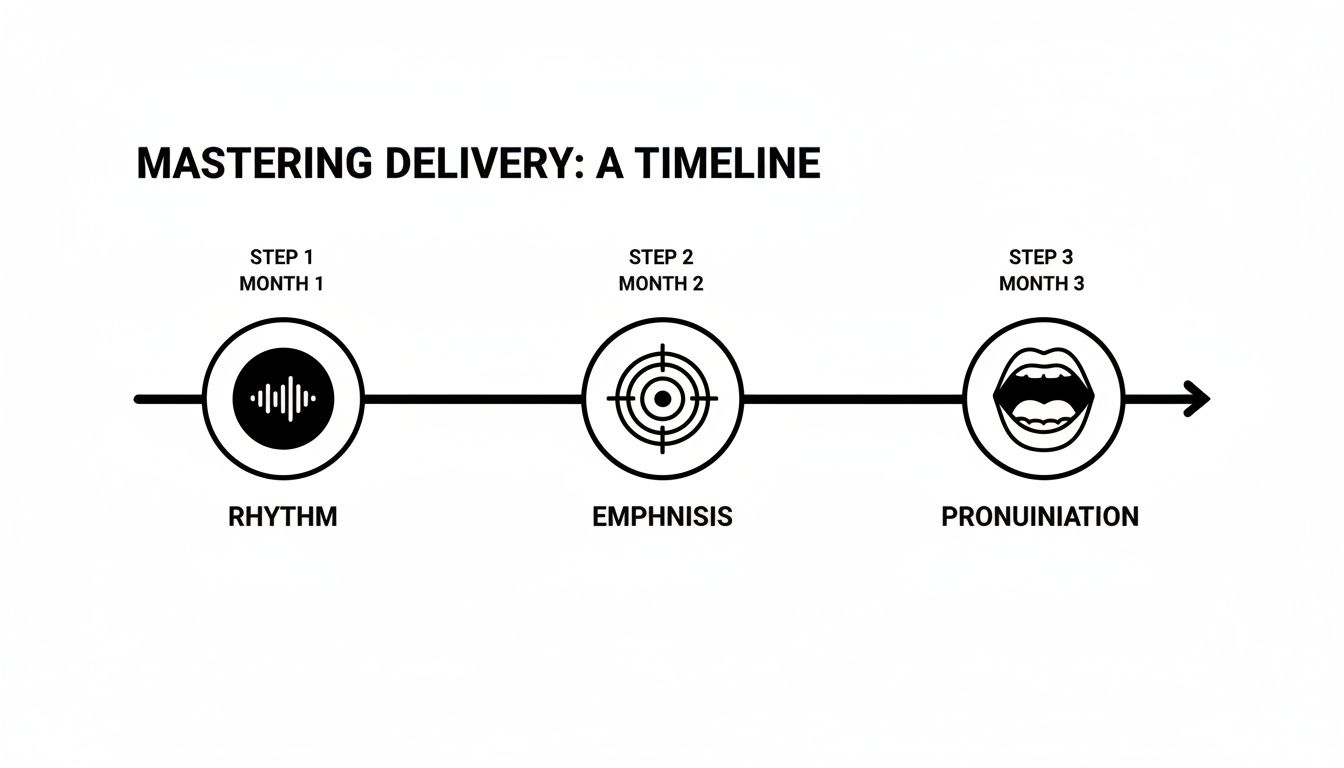
As you can see, great delivery is built in layers. It starts with establishing a solid rhythm, then layering on strategic emphasis, and finally polishing your pronunciation for maximum clarity.
Self-Assessment Through Recording
I’ll be honest: the single most powerful tool for improvement is already in your pocket. Your smartphone.
Recording your practice sessions gives you what no one else can: objective, undeniable feedback. It can be a little confronting at first, but it is the fastest way to close the gap between how you think you sound and how an audience actually hears you.
When you review your recordings, don't just watch passively. Score yourself.
Self-Assessment Rubric:
On a scale of 1-5 (1=Needs Work, 5=Excellent), rate yourself on:
- Pacing & Rhythm: Does my delivery sound conversational, or is it rushed and monotonous?
- Clarity: Are my words crisp and easy to understand, or am I mumbling?
- Intonation & Emphasis: Am I using my voice to sound confident and engaging?
- Engagement: Do I look and sound connected to my message? Am I authoritative?
This simple act turns a vague feeling ("I think that went okay") into hard data you can use. You’ll spot your habits—good and bad—and know exactly what to focus on next time.
Handling Audience Q&A with Poise
A masterful presentation can fall apart in a shaky Q&A. This is often the most revealing part of any executive interaction, where your authority and quick thinking are truly tested. The secret, as always, is preparation.
- Anticipate the Hard Questions: Brainstorm every tough question, objection, or concern your audience could possibly have. Write them down and, more importantly, prepare concise, confident answers for each one.
- Practice Your Answers Out Loud: Don't just think through your responses. Say them. Practice delivering your answers with the same vocal clarity and confidence you used in your presentation.
- Master the "Bridging" Phrase: If you get a curveball question, don't panic. Use a confident bridging phrase like, "That's an excellent question that deserves a more detailed look at the data. I’ll follow up with you and the team directly." This shows you're in control, even without an instant answer.
Mastering the Q&A is the final piece of the puzzle. It’s what proves you can think on your feet while maintaining complete composure and authority. You can learn more about the top reasons to choose Intonetic for confident communication in high-stakes situations in our dedicated article.
Measuring Your Growth and Choosing Your Path Forward
After all the hard work on your story, slides, and vocal mechanics, how do you really know if it's paying off? It's easy to get lost in the day-to-day practice and lose sight of the big picture. We need to move beyond just feeling like we’re getting better and start tracking development with a more objective eye.
This is where you shift from just being a speaker to being your own strategic coach. Just like you'd track KPIs for a major business project, applying a data-driven mindset to your own skill development is what separates slow, haphazard improvement from rapid, targeted growth.
Creating Your Presentation Skills Scorecard
The most effective way I've seen clients get objective feedback is by using a simple scorecard after each practice session they record. Don't just watch the recording back and cringe—that's not productive. Instead, evaluate your performance against a consistent set of criteria.
This simple act is powerful. It forces you to step outside of your own head and view your presentation from the audience's perspective, highlighting the exact spots that need more polish.
Here’s a template I use with my own clients. After you record yourself, just rate each category on a scale of 1 (Needs Significant Work) to 5 (Strong and Confident).
| Metric | Guiding Question | Score (1-5) |
|---|---|---|
| Clarity | Were my words crisp and easy to understand? Did I avoid mumbling or speaking too fast? | |
| Pacing | Did my delivery have a natural, conversational rhythm, or did it feel rushed or monotonous? | |
| Authority | Did my vocal tone and body language project confidence and conviction? | |
| Engagement | Was I using strategic vocal variety and emphasis to keep my audience interested? | |
| Conciseness | Did I get to the point quickly, or did I ramble and use filler words? |
After just a few sessions, you’ll start seeing patterns. Maybe your Clarity is a solid 4, but Pacing keeps getting a 2. That's a huge win! It tells you exactly where to focus your energy next: on building in more intentional pauses and mastering your rhythm. You can go deeper on this with our guide to measure your accent reduction progress accurately.
From Self-Assessment to Your Next Steps
This scorecard data is your roadmap. Consistent self-assessment takes the guesswork out of your training and tells you whether you should keep refining the fundamentals on your own or if it's time to accelerate your growth with a more structured program.
Based on your scores, you can diagnose your biggest opportunity:
- Low scores (1-2) in Clarity and Pacing? This means your main focus should be the core mechanics of delivery. This is where targeted pronunciation, rhythm, and flow drills will give you the biggest and fastest returns.
- Moderate scores (3) in Authority and Engagement? You’ve got a solid foundation. Now it's about refinement. Your practice should shift toward the subtleties—intonation, word stress, and vocal variety—to sound more dynamic and persuasive.
- High scores (4-5) across the board? Fantastic. Your next frontier is maintaining this performance under pressure. The focus now moves to handling tough Q&A sessions and adapting your delivery for different high-stakes scenarios.
This evaluation helps you invest your time where it will make a real, noticeable difference.
The goal of measurement isn't self-criticism; it's strategic improvement. By identifying your specific weak points with data, you can stop guessing and start targeting your efforts for faster, more noticeable results.
Choosing the Right Training Path
The demand for leadership development has created a massive industry. Corporate training budgets have ballooned to $370 billion globally, and the online corporate leadership training market is on track to jump from $41.47 billion in 2025 to a projected $90.82 billion by 2034.
With a sea of options out there—from one-on-one coaching to apps and self-paced programs—it’s vital to pick a path that fits your specific needs, your schedule, and your budget.
For many of the busy executives I work with, the flexibility of self-directed learning is a huge plus. If your scorecard shows a clear need for structured improvement in accent and clarity, but you’re not quite ready for intensive one-on-one coaching, a self-paced program can be the perfect middle ground.
To meet this exact need, Intonetic now offers 2 self-paced programs as a monthly subscription called Intonetic Accent Studio, priced at $7 per month and $27 per month. Both programs give you a structured system to improve, but the $27 per month option also includes personalized feedback on your progress from a coach. These programs are designed for learners who want to improve their accent and clarity on their own schedule.
Frequently Asked Questions About Presentation Training
When executives like you consider diving into executive presentation skills training, a few key questions almost always come up. You’re likely wondering about the timeline, the impact on your identity, and the best way to fit practice into an already packed schedule.
Let's tackle these common concerns head-on with some straight-to-the-point answers based on my experience coaching global leaders.
How Long Does It Take to See Real Improvement?
This is the big one, and the honest answer is: it depends, but a structured plan makes all the difference.
Most executives I work with start to feel a real shift in their confidence and how they structure content within the first month. They're clearer, more concise, and feel more in control of their message.
But for the delivery—those deeper, more lasting changes in intonation, rhythm, and pronunciation clarity—that’s where consistent practice pays off. You’ll typically see significant, automatic improvements after 8 to 12 weeks. The goal isn’t just to learn a technique; it’s to build new muscle memory so it becomes second nature under pressure.
Can I Improve My Accent Without Losing My Identity?
Absolutely. In fact, you must. The goal of modern communication coaching is clarity, not conformity.
Effective training isn't about erasing who you are. It’s about strategically modifying the handful of sounds or rhythm patterns in American English that have the biggest impact on how well your audience understands you. We focus on being understood the first time, every time.
Think of it as adding a powerful tool to your leadership toolkit, not changing your identity. Your unique voice and cultural background are assets. We're just making sure nothing gets in the way of your message.
An executive-level presentation moves beyond simply sharing information; it synthesizes complex ideas into a clear, compelling vision. It's less about the slide deck and more about the leader's ability to inspire and influence.
Is Online Training as Effective as In-Person Coaching?
Yes. For busy executives, it's often far more practical and effective.
High-quality online coaching gives you the flexibility to practice when it works for you—on a plane, between meetings, or late at night. You can get personalized feedback on your own time by sending recordings, and you get access to the best coaches in the world, not just who's available locally.
This approach allows you to integrate practice into your daily work, applying new techniques in your very next meeting or call. It’s this consistent, real-world application that builds and sustains new skills.
Have more questions? You can find more detailed answers in our extensive FAQ section.
Your path to confident, clear communication is unique. To support your journey, Intonetic offers flexible, self-paced programs designed for busy professionals. Learn more about our Intonetic Accent Studio subscription programs.