
American English: Your Guide to the Rules of Pronunciation
If you've ever tried to learn English pronunciation, you've probably felt like you were trying to solve a puzzle with half the pieces missing. The "rules" seem to have more exceptions than followers. This isn't your fault—it's a feature, not a bug, of the English language.
Unlike languages where letters neatly correspond to sounds, English is a wonderful, chaotic mix of linguistic history. Its spelling was largely locked in place by the printing press centuries ago, but the way we actually speak the words has never stopped changing.
Why English Pronunciation Rules Seem So Inconsistent

Trying to master English pronunciation by memorizing spelling rules is a recipe for frustration. You learn the "-ough" in "thought," only to get thrown for a loop by "through," "bough," and "tough." This isn't random; it’s the audible echo of centuries of linguistic evolution.
English is a unique mutt, a blend of Germanic, French, and Latin influences, with each language leaving its fingerprints all over our spelling and sounds. This created the massive disconnect we see today between the written word and the spoken one.
The Three Pillars of Clear Speech
Instead of getting bogged down in endless exceptions, a much smarter approach is to focus on the core elements that actually matter for being understood. Think of clear speech like a sturdy structure built on three essential pillars:
- Individual Sounds (Phonemes): This is your foundation. Getting a solid handle on the key vowel and consonant sounds that trip up most non-native speakers will give you the biggest and fastest boost in clarity.
- Word and Sentence Stress: This is the "music" of English. Knowing which syllable to punch in a word and which words to emphasize in a sentence is what guides your listener's ear and makes you sound natural and dynamic.
- Rhythm and Flow: This is all about linking words together smoothly, which is a hallmark of fluent speech. Understanding how native speakers connect, reduce, and blend sounds is crucial for both speaking clearly and understanding what you hear.
By concentrating on these high-impact areas, you’re basically applying the 80/20 rule to your pronunciation practice. It’s about working smarter, not just memorizing more.
This guide will walk you through these pillars, giving you practical strategies to build your skills step-by-step.
Nail the Most Important English Sounds (Phonemes)
Alright, we've covered why English pronunciation can feel like a moving target. Now, let's get into the practical stuff—what you can actually do about it.
The root of the issue is simple: English has around 44 unique sounds, or phonemes, but only 26 letters to write them down. This mismatch is the number one reason learners get tripped up.
This isn't a new problem. It has deep historical roots that have led to all sorts of regional quirks, challenging an estimated 1.5 billion English learners worldwide. Take the split between American and British English back between 1600 and 1725. That's when differences like the American rhotic 'r' (the hard 'r' sound) got locked in, which now influences 70% of global English through media.
But don't get overwhelmed. You don't need to master all 44 sounds at once. Instead, we'll use the 80/20 rule. By focusing on a small handful of high-impact sounds, you can fix the majority of your clarity issues and see dramatic progress fast.
High-Impact English Phonemes for Professionals
To get the most bang for your buck, let's zero in on the phonemes that cause the most common mix-ups for professionals. Getting these right will instantly make you easier to understand.
Below is a quick-reference table for some of the biggest offenders.
| Phoneme (Sound) | Common Spelling | Example Word | Common Challenge | Quick Tip |
|---|---|---|---|---|
| /i/ (long E) | ee, ea, ie | sheep | Mixing it up with the short /ɪ/ sound. | Smile and feel the tension in your cheeks. Hold the sound a bit longer. |
| /ɪ/ (short I) | i | ship | Making it sound too much like /i/. | Relax your lips and jaw. It's a quick, lax sound. |
| /θ/ (voiceless TH) | th | think | Substituting with /t/ or /s/ ("tink" or "sink"). | Gently place your tongue tip between your teeth and blow air. No voice! |
| /ð/ (voiced TH) | th | this | Substituting with /d/ or /z/ ("dis" or "zis"). | Same tongue position as /θ/, but this time, hum to vibrate your vocal cords. |
| /ɹ/ (American R) | r, wr | red | Using a trilled or tapped 'r' from another language. | Pull your tongue back and up without touching the roof of your mouth. Think "Grrr." |
Focusing on just these five sounds can clear up a massive amount of confusion in your conversations.
The Foundation of Clarity: High-Impact Vowels
Vowel sounds are the absolute core of every syllable. They carry the melody of the language and are often what distinguishes one accent from another. For non-native professionals, two sounds cause more trouble than almost any others: the "long E" and "short I."
- /i/ (long E) as in "sheep": To make this sound, your tongue is high and pushed forward in your mouth. Your lips should be spread wide, almost like you're holding a smile. It's a tense, slightly longer sound.
- /ɪ/ (short I) as in "ship": Here, your tongue is a bit lower and much more relaxed. Your lips are neutral, not spread. The key is that it's a quick, lax sound.
Getting these mixed up is incredibly common and leads to some classic (and sometimes awkward) misunderstandings. You don't want to ask a colleague for a "sheet" of paper and have them hear something else entirely. Practice saying pairs like leave/live, seat/sit, and heat/hit. Pay close attention to the physical difference in your mouth—the tension versus the relaxation.
For a complete look at all the sounds, you can check out our detailed guide to the 44 sounds in English.
Key Consonants That Give Professionals Trouble
While vowels form the core, certain consonants carry a ton of weight in making your speech crisp and clear. For professionals who need to be understood the first time, every time, mastering these is non-negotiable.
Let's break down the three biggest troublemakers.
-
The 'TH' Sounds (/θ/ and /ð/): A huge number of languages simply don't have these sounds, which is why speakers often replace them with /t/, /d/, /s/, or /z/.
- Voiceless /θ/: This is the sound in words like think, three, and path. The trick is to lightly place the tip of your tongue between your teeth and blow air. Your throat shouldn't vibrate at all.
- Voiced /ð/: This one is in words like this, that, and mother. The tongue position is identical, but now you need to turn on your voice. You should feel a buzzing vibration in your throat.
-
The American 'R' (/ɹ/): This sound is notoriously different from the 'r' in Spanish, French, Hindi, and many other languages. The tongue doesn't tap or trill. Instead, it pulls back and bunches up toward the middle of your mouth, without actually touching the roof. A good way to find it is to make the sound a dog makes: "Grrr." Try it in words like red, car, and work.
Mastering these few sounds isn't about erasing your accent; it's about sharpening your clarity. It ensures your message lands exactly as you intend, without your listener having to mentally translate your words. This small investment in sound precision pays huge dividends in professional confidence.
The Music of English: Word Stress and Intonation
If individual sounds are the bricks and mortar of English, then stress and intonation are the architecture—the design that makes it all work. Nailing every single vowel sound is a great goal, but without understanding the rhythm of English, your speech can still sound flat or be tough for listeners to follow. This "music" is one of the most powerful and overlooked rules of pronunciation, and honestly, it’s often more critical for clear communication than perfecting every single sound.
Think of it like a song. A song isn't just a random string of notes; it has a beat, a melody, and moments of emphasis that give it life and meaning. English is exactly the same. Stress and intonation are how you guide your listener's attention, signal what’s important, and make your message engaging and easy to absorb.
Finding the Beat with Word Stress
Every word in English with more than one syllable has a single syllable that gets more emphasis than the others. This is the stressed syllable. We say it a little longer, a little louder, and often at a slightly higher pitch. Finding this beat is non-negotiable because getting the stress wrong can completely change a word or even make it unrecognizable.
Let's take the word "pronunciation." We don't say "pro-nun-ci-a-tion" with equal pressure on each part. Instead, we instinctively give the main punch to one syllable: pro-nun-ci-A-tion. The other syllables are softer and quicker.
This one rule has a huge impact. For instance, just by shifting the stress, you can flip a noun into a verb:
- RE-cord (noun): "Let's check the official record." (The emphasis is up front.)
- re-CORD (verb): "Please record this meeting." (The emphasis shifts to the back.)
Just hearing that difference is the first major step. Try saying those pairs out loud, really exaggerating the stressed syllable. Feel how your mouth and energy change? That's the core rhythm of spoken English right there.
Conducting the Orchestra with Sentence Stress
Just like words have a stressed syllable, sentences have stressed words. If we emphasized every single word equally, we’d sound like a GPS from 2005. Instead, we put the spotlight on the most important "content words"—the ones that carry the real meat of our message.
Content words are your nouns, main verbs, adjectives, and adverbs. We tend to glide right over the smaller "function words" like articles (a, the), prepositions (in, on, at), and conjunctions (and, but).
Look at this simple sentence: "I need to send this report by Friday."
The bolded words are the critical bits of information. A native speaker naturally leans into them, creating a rhythmic, wave-like pattern of strong and weak beats. This is a huge part of what makes speech sound fluent. When you focus on sentence stress, you help your listeners grab your main point instantly without getting bogged down.
Think of yourself as a conductor. You're using stress to tell your audience, "Pay attention here… now here… and this part is key." This is how you create clarity and impact with your words.
Painting Emotion with Intonation
Intonation is the melody of your speech—the rise and fall of your pitch as you talk. It’s how we show emotion, ask questions, and signal that we’re done speaking. The wrong intonation can send a message you never intended, even if your grammar and vocabulary are flawless.
Let’s break down two of the most common patterns in American English:
- Falling Intonation: Your pitch drops at the end of the sentence. This is the standard for statements and for WH- questions (who, what, where, when, why). It signals confidence and finality.
- Example: "We finished the project." (Your voice falls on "project.")
- Rising Intonation: Your pitch goes up at the end. We use this for yes/no questions and to show surprise or double-check information.
- Example: "Are you finished with the project?" (Your voice rises on "project?")
Getting these melodic patterns right is essential for sounding engaging and being understood correctly. If you want to go deeper on this, you can learn how to master American English intonation with our detailed guide.
When you combine the right word stress, sentence stress, and intonation, you stop just saying words. You start delivering a clear, compelling message.
How to Speak Smoothly with Connected Speech
If you listen closely to native English speakers, you’ll notice they don't pronounce every single word separately, like items on a grocery list. Their speech has a certain flow, a musical quality where words seem to melt into one another. This is called connected speech, and learning its unwritten rules is the secret to moving from choppy, robotic delivery to a more natural, fluid style.
Getting a handle on these patterns won't just make you sound more natural; it will completely change your listening skills. Suddenly, you'll find it much easier to keep up with fast-talking native speakers because you'll understand the "shortcuts" they're using. Think of it less like a set of rigid rules and more like learning the choreography that makes the language dance.
The Secret Life of Unstressed Vowels
The absolute superstar of connected speech is a humble, almost lazy vowel sound called the schwa /ə/. It’s that quick, relaxed "uh" sound you hear in words like "about" or "sofa." This is, by far, the most common vowel in English, popping up in nearly every unstressed syllable.
The schwa is the engine of English rhythm. It lets us glide over the less important syllables and words, putting the spotlight squarely on the stressed ones that carry the real meaning. Take the word "pho-to-graph." The first "o" is clear and strong, but the second one reduces to a quick schwa sound.
This idea of reducing vowels is a core principle in the rules of pronunciation and is absolutely fundamental to getting that natural English cadence.
Linking Words Together Like a Pro
Another huge piece of the puzzle is linking, where the last sound of one word hooks seamlessly onto the first sound of the next. This simple trick gets rid of those awkward little pauses between words, creating a smooth, uninterrupted stream of sound. There are a couple of common patterns you'll hear all the time.
-
Consonant to Vowel Linking: When a word ends in a consonant and the next one starts with a vowel, the consonant sound basically jumps over to start the next word.
- "An apple" sounds more like "a napple."
- "Pick it up" flows together as "pi ki tup."
-
Vowel to Vowel Linking: When one word ends in a vowel and the next also begins with one, speakers often add a tiny, almost invisible /w/ or /j/ sound to bridge the gap smoothly.
- "Go away" naturally sounds like "go -w- away."
- "I agree" comes out sounding like "I -y- agree."
Learning to create these links is a game-changer. For a deeper look, check out our practical guide on connected speech and sound changes in American English.
Why the Schwa Sound Is So Common
The schwa isn't just a random quirk; it's baked into the history of the English language. When the Normans conquered England in 1066, the French influence completely shook up English pronunciation. As Anglo-Saxon, Norse, and Norman French merged into what we now call Middle English, a major shift happened.
By around 1400 AD, unstressed vowels started to weaken and morph into the schwa /ə/ sound. This one historical change is largely responsible for the stress-timed rhythm that defines modern English.
This concept map helps visualize how all these musical elements work together.
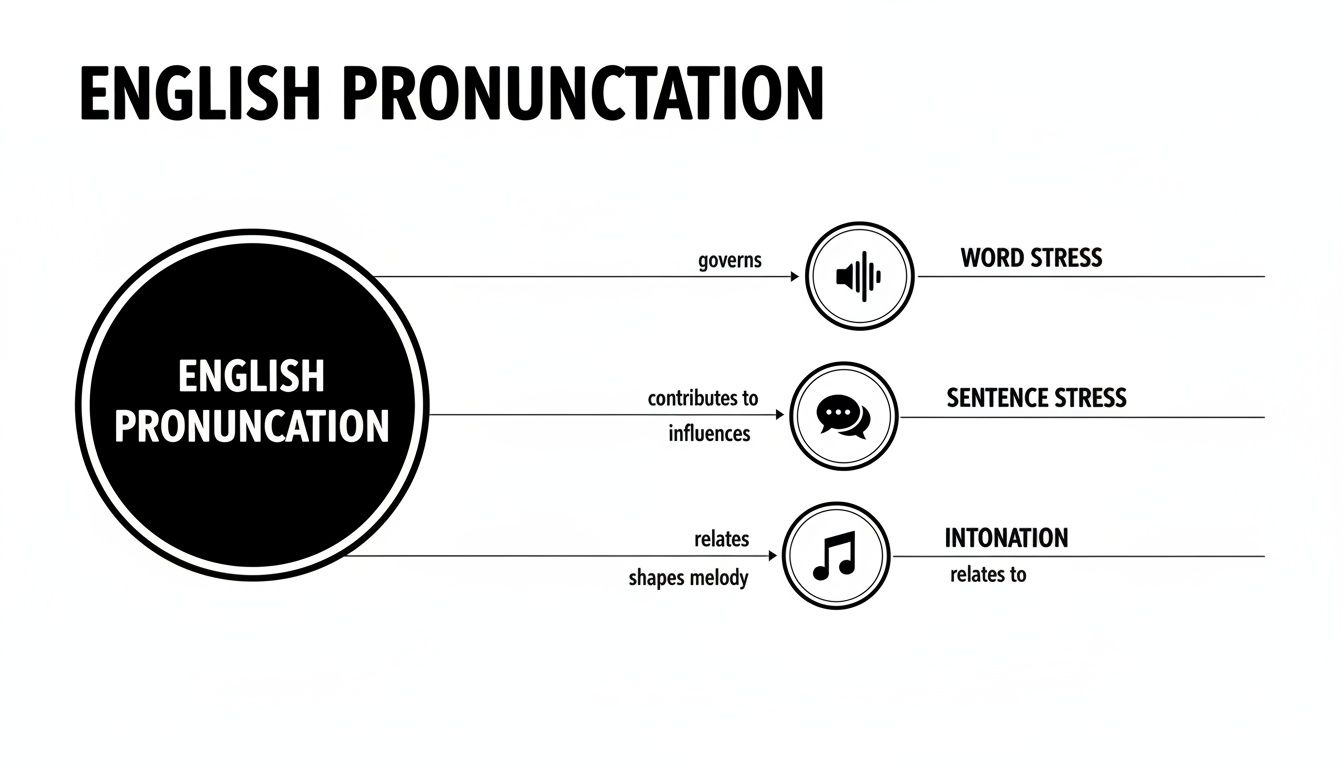
As you can see, things like word stress and sentence stress create the rhythm, and connected speech is what makes that rhythm possible in the real world.
Key Takeaway: Connected speech isn't about talking faster; it's about speaking smarter. By linking words and reducing sounds like the schwa, you group words into logical thought units, which makes it much easier for your listener to follow along.
Navigating Common Pronunciation Exceptions
English pronunciation can feel like a minefield of contradictions. Just when you think you’ve nailed down a pattern, a word like “though,” “through,” or “tough” pops up and seems to break every rule you just learned.
It’s easy to get frustrated, but these words aren’t random quirks designed to trip you up. They’re more like linguistic fossils—remnants of the language's history. Understanding where they come from is the secret to finally making sense of them. Instead of memorizing endless lists of oddballs, the real skill is learning to spot the hidden logic behind the chaos.
The Ghosts of Pronunciation Past
Many of the most confusing spellings in English are leftovers from major historical events that essentially froze spelling in time while the spoken language kept evolving.
The biggest culprit was The Great Vowel Shift, a massive chain reaction of sound changes that took place between roughly 1350 and 1700. This completely rewired how long vowels were pronounced. For instance, the word 'make' went from a simple /a/ sound (like in "father") to the /eɪ/ sound we use today.
Then, in 1476, the printing press arrived in England. This was a game-changer, but it also standardized spelling based on how words were pronounced before the Vowel Shift was even finished. The result? We’re often trying to pronounce 21st-century English using a spelling system that reflects 15th-century sounds. You can dive deeper into this fascinating history on the British Accent Academy's blog.
Demystifying Silent Letters
Silent letters are another classic headache, but they’re not just there for decoration. Most of them used to be pronounced. Over centuries, our speech patterns got simpler, but the old spellings stuck around.
- Silent 'K' and 'G' before 'N': Words like know, knight, and gnat once included a hard /k/ or /g/ sound at the beginning. Try saying it—it’s a bit clunky. Eventually, speakers dropped it to make the words flow better.
- Silent 'B' after 'M': Think of comb, thumb, or dumb. That /b/ sound was gradually softened and then dropped entirely from the end of these words, but we never updated the spelling.
- Silent 'W' before 'R': In words like write, wrong, and wrap, the 'w' was once pronounced. Just like the 'k' in 'know,' it eventually went quiet.
When you realize these letters are historical artifacts, not mistakes, it changes everything. You're not just memorizing a random rule; you're uncovering a piece of the language's story.
The Many Faces of 'Ough'
The "-ough" spelling is notorious for its wild inconsistency. It feels like a guessing game every time. But even here, you can find smaller, more manageable patterns once you know what to look for. This one letter combination can represent at least seven different sounds.
| Pronunciation | Example Word | What to Look For |
|---|---|---|
| /oʊ/ (like 'oh') | though, dough | This is a common one, often found in high-frequency words. |
| /uː/ (like 'oo') | through | A very frequent exception you just have to learn. |
| /ɒf/ (like 'off') | cough, trough | Here, the 'gh' often switches to an /f/ sound. |
| /aʊ/ (like 'ow') | bough, plough | Notice this pattern in words related to nature or farming. |
| /ʌf/ (like 'uff') | rough, tough | I call this the "tough guy" pronunciation. |
While this group definitely requires some memorization, breaking it down into these smaller clusters is a lot less intimidating than treating each word as a totally unique problem.
For a deeper look, check out our guide to commonly mispronounced words in English. Learning to spot these mini-patterns is what turns a frustrating guess into an educated prediction.
Your Practical Plan for Daily Pronunciation Practice
Knowing the pronunciation rules is one thing. Actually turning that knowledge into a natural, automatic habit? That’s a whole different ballgame.
Lasting progress doesn't come from cramming for hours once a week. The real key is short, consistent, daily practice that builds muscle memory over time.
Think of it like going to the gym. You wouldn't expect to build strength by working out for five hours just once a month. You’d get much better results with 20-30 minutes every day. The same logic applies here—when it comes to mastering new speech habits, consistency beats intensity every single time.
A Sustainable Daily Routine
You need a practical routine you can actually stick with. A simple, effective daily plan doesn’t have to take more than 15-20 minutes. Here’s a template you can adapt to fit your schedule and focus on the pronunciation rules that matter most to you.
- Tune Your Ear (5 minutes): Start with active listening. Find a short clip from a podcast, a news broadcast, or a TED Talk. Don't just follow the words; listen for the music—the rhythm, the stressed words, and the intonation patterns.
- Targeted Sound Drills (5 minutes): Next, zoom in on one or two specific sounds you’re working on. Use minimal pairs—words that differ by only a single sound—to really sharpen your accuracy. Drill the difference between the vowels in 'ship' and 'sheep', for example, or the consonants in 'think' versus 'sink'.
- Practice Your Flow with Shadowing (5 minutes): Finally, put it all together. Play a short audio clip and try to speak along with the speaker in real-time. Do your best to mimic their pace, rhythm, and intonation as closely as you can. This is hands-down one of the best ways to internalize the natural cadence of English.
This structured approach is what turns abstract knowledge into a physical skill. You're not just thinking about pronunciation; you're actively training your mouth, tongue, and ears to all work together seamlessly.
This kind of focused, daily work is exactly what leads to noticeable improvement. For a more detailed breakdown, you can learn more about how to practice English pronunciation daily for rapid progress. Ultimately, this consistent effort is what builds the foundation for clear, confident communication long after you've finished this guide.
Your Pronunciation Questions, Answered
Even with the best game plan, questions are bound to pop up. This is where we tackle the most common things that professionals ask when they start getting serious about their pronunciation. Think of this as a quick-reference guide to clear up those nagging doubts.
Let’s dive into the questions I hear most often from my clients.
How Long Does It Take to Improve My Pronunciation?
There's no magic number here. Your starting point, native language, and—most importantly—how consistently you practice all play a huge role. That said, with focused daily effort on the big-ticket items like key sounds and stress patterns, many people tell me they feel a real confidence boost in as little as 4-6 weeks.
Now, getting to the point where clear speech is completely automatic? That’s more of a long-term project, often taking several months. The goal isn't to be perfect overnight. It's about making steady, noticeable progress that helps people understand you better, day by day.
Can I Get Rid of My Accent Completely?
A better question is, "Should I?" Your accent is part of your story and your identity. The whole point of pronunciation work isn't to erase who you are—it's to make sure your message lands perfectly the first time, every time.
Your focus should be on clarity and confidence, not on sounding like someone you're not. This means mastering the core rules of pronunciation that matter most for intelligibility, like rhythm, stress, and those tricky key sounds.
Your goal should be clear communication, not accent elimination. A clear, confident speaker with an international accent is often more compelling than a native speaker who mumbles.
What Is the Single Most Important Pronunciation Rule?
If you only have the bandwidth to focus on one thing, make it word stress and sentence stress. Getting the stress wrong is almost always more confusing for a listener than messing up a single vowel or consonant.
Why? Because stress is the rhythm, the "music" of English. It tells the listener what's important and guides their ear through your sentences. When you get the rhythm right, people can follow you effortlessly, even if a few of your individual sounds aren't quite perfect yet.
What If I Don’t Have Time for Daily Practice?
Even just 10-15 minutes a day beats a long, once-a-week cram session. The secret sauce is consistency. That’s what builds the muscle memory you need to form new, lasting speech habits.
Here are a few ways to sneak practice into a busy day:
- Listen to a podcast during your commute and "shadow" the speaker, repeating what they say.
- Drill a few tricky word pairs (like ship/sheep) while you’re waiting for your coffee to brew.
- Before you hit send, read a work email out loud. Record yourself and listen back for your stress patterns.
Ready to move beyond self-study and get structured guidance? For learners who aren't looking for one on one coaching, but still want to improve their accent and clarity, Intonetic now offers 2 self-paced programs as a monthly subscription called Intonetic Accent Studio, priced at $7 per month and $27 per month. The difference is that the $27 per month program gets them personalized feedback on their progress. Start building clearer, more confident speech today by exploring our American accent training programs.