How to Sound More Articulate A Guide for Professionals
Ever feel like your ideas get lost in translation, stumbling between your brain and your mouth? You know what you want to say, but it comes out jumbled, failing to make the impact it deserves. If that sounds familiar, you're not alone.
The journey to sounding more articulate isn't about becoming someone else. It's a practical, skill-based process. This guide skips the generic "be more confident" advice and dives straight into a real framework to help you get your point across clearly—the first time, every time.
We're going to follow a simple but powerful loop: first, pinpointing the specific speech habits holding you back, then drilling down with targeted exercises, and finally, taking these new skills into your real-world conversations.
This is what that process looks like.
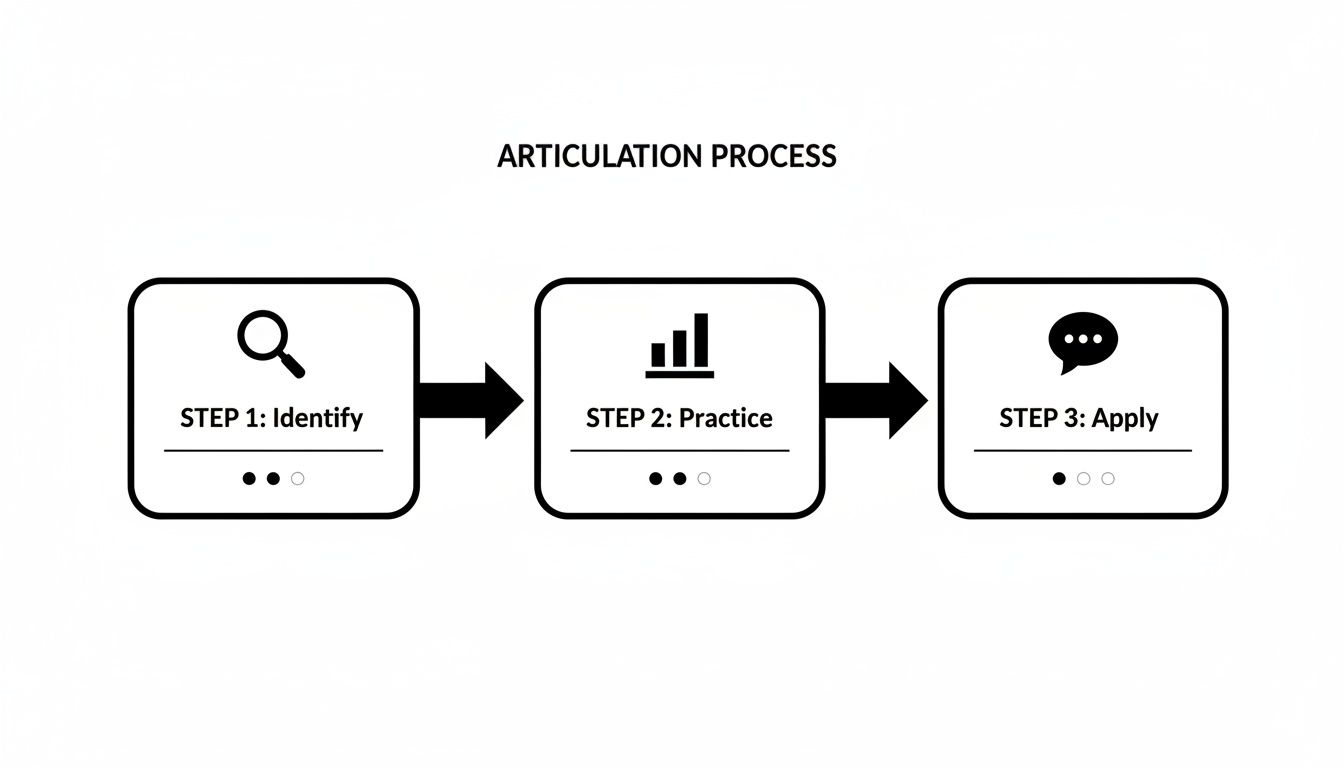
Think of it as a continuous cycle of awareness, practice, and application. It’s how you turn a vague goal like "I want to be more articulate" into a concrete, actionable plan.
Why Does Articulation Matter So Much Right Now?
In a world where we're all connected digitally, clear communication has become a massive professional advantage. The data tells a fascinating story. While there are approximately 1.35 billion English speakers worldwide, overall proficiency has actually been declining for the past four years straight, with 60% of countries scoring lower than before.
This creates a huge opening. For anyone willing to invest in speaking with clarity and precision, there's a real opportunity to stand out. You can dig into more of these global English language statistics and trends yourself.
The goal here is simple: to empower you to communicate with authority in any room you walk into. Mastering the core pillars of articulate speech gives you the confidence to make a real impact, whether you're in a team meeting, giving a presentation, or navigating a high-stakes negotiation.
To get there, we’ll break down articulate speech into its three core components, or pillars. By understanding how each one works, you'll see exactly where your opportunities for improvement lie.
The Three Pillars of Articulate Speech
| Pillar | What It Is | Why It Matters for Articulation |
|---|---|---|
| Pronunciation | The physical act of forming individual sounds and words correctly. | This is the foundation of clarity. If listeners can't understand your words, your message is lost before it even begins. |
| Prosody | The rhythm, stress, and intonation of your speech—the "music" behind your words. | Prosody is what makes you engaging. It conveys confidence, adds meaning, and prevents you from sounding monotone. |
| Thought Structure | The ability to organize your ideas logically and express them sequentially. | A clear structure ensures your delivery is as coherent as your words are precise, guiding the listener from point A to point B without confusion. |
When you start to consciously work on these three areas, you’re not just learning to speak better. You’re developing the power to take complex ideas and make them simple, persuasive, and memorable.
First, Pinpoint Your Articulation Roadblocks
Before you can build new habits, you need an honest look at where you’re starting from. So many professionals I work with are held back by subtle speech patterns they’re completely unaware of, which makes it impossible to get better. The first real step toward speaking more clearly is to become your own speech analyst.
The most effective way to do this is surprisingly simple: record yourself speaking. Just use your phone’s voice memo app and talk for two or three minutes. You can talk about your day, a project you’re working on, or any topic you know inside and out. The goal isn’t to give a perfect speech; it’s to capture a natural sample of how you sound every day.
What to Listen For
Once you have that recording, listen back with a specific checklist. This isn’t about judging yourself—it’s about gathering data. Think of it as detective work that will help you create a laser-focused improvement plan.
Keep an ear out for these common issues:
- Mumbling or Trailing Off: Do your sentences kick off with confidence but then lose steam and volume toward the end? It’s a common habit that can really weaken the impact of your main points.
- Pacing Problems: Are you talking so fast that your ideas just blur into one another? Or is your delivery so slow that you risk losing your listener’s attention? A good target for most professional settings is somewhere between 140–160 words per minute.
- Filler Words: Get a real count of how often you lean on crutches like “um,” “ah,” “like,” or “you know.” These little verbal tics can be distracting and might chip away at your perceived confidence.
- Sound Clarity: This is where you zoom in on individual sounds. Are you dropping the ends of your words, maybe saying “goin’” instead of “going”? Are some of your consonants a bit fuzzy, like the difference between a ‘th’ and a ‘d’? If you want to dig deeper here, reviewing a list of commonly mispronounced words in English can be incredibly insightful.
Challenges for Non-Native Speakers
If English isn’t your first language, your roadblocks might look a little different. In addition to the points above, you’ll want to pay close attention to prosody—the unique rhythm and music of the language.
Your goal isn’t to sound exactly like a native speaker. The real aim is to be clearly and easily understood. Intelligibility is all about clarity, not forcing yourself into a box. Just focusing on a few key rhythm and intonation patterns can make a world of difference in how your message lands.
Listen specifically for these two elements:
- Word Stress: English relies heavily on stressing the right syllable to convey meaning. Think of the difference between “pro-ject” (the noun) and “pro-ject” (the verb). Make a note of any words where your stress pattern doesn’t feel quite right.
- Intonation Contours: Does your pitch tend to stay flat? Using rising and falling tones is how we inject meaning and emotion into our speech. A flat intonation can sometimes be misinterpreted as disinterest or a lack of conviction.
After you’ve done this self-audit, the key is not to get overwhelmed. Just pick two or three primary areas to focus on. This simple act turns a vague goal like “speak better” into a concrete, actionable plan and gives you a clear place to start your practice.
Mastering the Mechanics of Clear Speech

Now that you’ve pinpointed your key challenges, it’s time to get to work with targeted practice. This is where you start building new muscle memory, turning conscious effort into an unconscious skill that shows up in every conversation. We’re going to zero in on two critical areas: sound clarity and prosody.
Think of it like going to the gym for your voice. Just like you’d isolate specific muscle groups to get stronger, we’re going to isolate specific speech mechanics to build clearer, more confident communication.
Sharpening Your Sound Clarity
Sound clarity drills are all about precision. They train your tongue, lips, and jaw to form English sounds distinctly, so your listeners never have to strain to understand you. This is a game-changer, especially for sounds that don’t exist in your native language or the ones you flagged during your self-assessment.
A fantastic place to start is with minimal pairs—words that differ by only a single sound. This exercise forces you to physically feel the subtle differences in your mouth position and airflow.
- Long vs. Short Vowels: Practice contrasting words like ship vs. sheep or sit vs. seat. Pay close attention to how your jaw and tongue shift between the short, relaxed vowel and the long, tense one.
- Challenging Consonants: Target pairs that hit common areas of confusion, like think vs. sink (that tricky ‘th’ sound) or very vs. berry (the ‘v’ sound).
The secret to making these drills stick is repetition and exaggeration. It’s going to feel weird and unnatural at first, but that over-articulation is precisely what builds the muscle memory you need for crisp, clear speech in everyday situations.
If you want to get really granular with the mechanics of each sound, you can explore a comprehensive guide to the 44 sounds in English. It’s a great resource for isolating exactly which phonemes need the most work.
Mastering Prosody and Rhythm
If sound clarity is about the individual words, prosody is the music behind them. It’s the blend of intonation (pitch), stress (emphasis), and pausing that breathes life and meaning into your speech. Without good prosody, you can come across as monotone and unconvincing, even if your pronunciation is technically perfect.
Here are a couple of powerful drills to make your speech more dynamic:
-
Shift the Stress, Change the Meaning: Take one simple sentence and move the emphasis around. You’ll be amazed at how the meaning completely changes.
- “I didn’t say he stole the money.” (Someone else said it.)
- “I didn’t say he stole the money.” (I only implied it.)
- “I didn’t say he stole the money.” (Someone else did.)
-
Use Pauses for Power: Grab an article or a book and read a paragraph out loud. Before and after the most important phrase in each sentence, insert a deliberate one-second pause. This trains you to use silence for impact instead of rushing through your ideas.
This kind of targeted, mechanical practice is becoming more critical than ever in the global business world. Recent proficiency tests show that scores in 26 countries have improved significantly, largely because of the professional demand for clear English speakers. Professionals who dedicate time to focused practice on priority sounds and intonation consistently get better results.
By dedicating just a few minutes each day to these mechanical drills, you aren’t just practicing words—you’re fundamentally rewiring how you communicate. This consistent effort is what turns knowledge into a natural, effortless skill.
Structuring Your Thoughts for Fluent Delivery

Perfect pronunciation is only half the battle. If you want to sound truly articulate, your ideas have to be organized and flow logically from one to the next. Even the clearest, most well-enunciated words will fall flat if they’re delivered in a jumbled stream of consciousness.
Think of it this way: building the mental scaffolding to support your speech is just as critical as mastering the mechanics of your mouth. When you have a reliable framework to fall back on, you can deliver coherent arguments with confidence, especially when you’re put on the spot in a meeting or a Q&A session.
Adopt a Mental Framework
One of the most effective and easy-to-remember structures I’ve seen clients use is the PREP method. It’s a simple, four-step model for making a clear and persuasive point without rambling.
- Point – Start with your main point or answer. State it clearly and directly.
- Reason – Explain why you believe this to be true. Give the logic behind your point.
- Example – Provide a specific, concrete example that brings your reason to life.
- Point – Circle back to your main point to wrap things up and make it stick.
Imagine a software engineer needing to explain a technical trade-off to a non-technical manager. Instead of diving into confusing jargon, they could use PREP to keep it clean and persuasive.
Point: “I recommend we stick with our established technology stack for this project instead of adopting the new framework.”
Reason: “The established stack is proven to be reliable, and our team is already proficient with it. That means we’ll significantly reduce development time and the risk of unexpected bugs.”
Example: “You might remember on the Q3 project last year, we tried a similar new framework and ended up spending an extra 40 hours just on debugging compatibility issues before we could even start on features.”
Point: “So, sticking with our current stack is definitely the safer, more efficient choice if we want to hit our deadline.”
See how that transforms a potentially complex explanation into a logical, easy-to-follow argument? It works almost every time.
Build Bridges Between Your Ideas
Once you have a solid structure, the final piece is ensuring a smooth journey for your listener. This is where transition words become your best friend.
Simple words and phrases like ‘however,’ ‘therefore,’ ‘consequently,’ and ‘in addition’ act as signposts for your audience. They create a logical bridge from one sentence to the next, guiding the listener effortlessly through your train of thought.
Without them, your speech can feel choppy and disconnected. Mastering transitions is a small change that adds a huge layer of polish and professionalism to your speech. For more strategies that apply specifically to high-pressure speaking situations, check out our guide on how to improve English pronunciation for public speaking.
Applying Your Skills In High-Stakes Situations
Consistent practice builds the foundation, but the real test of your articulation skills comes when the pressure is on. During a job interview, a client pitch, or a critical presentation, the stakes are high, and nerves can easily unravel all your hard work. The key is to have a set of go-to tactics that you can rely on when you’re under fire.
It’s in these make-or-break moments that your ability to sound articulate has a direct impact on your professional outcomes. With English being the official language in 55 countries, its dominance in global business is undeniable. For professionals in these markets, from tech executives to sales teams, clear articulation is a non-negotiable for career advancement and credibility.
Pre-Meeting Mental and Vocal Warm-Ups
Never walk into a high-stakes conversation cold. Just like an athlete warms up before a game, you need to prepare your mind and your voice. All it takes is five minutes before your meeting to run through a few simple exercises.
- Vocal Sirens: Gently hum up and down your vocal range. This warms up your vocal cords and helps prevent your voice from sounding tight or shaky.
- Facial Stretches: Exaggerate a yawn, smile as wide as you can, then pucker your lips. This loosens the very muscles you need for crisp enunciation.
- Mindful Breathing: Take three slow, deep breaths, focusing on a long, controlled exhale. This is a fantastic way to calm your nervous system and prevent you from rushing your speech.
The most powerful tool for sounding articulate under pressure is silence. Instead of filling thinking gaps with “um” or “ah,” learn to embrace the pause. A well-timed silence gives you a moment to structure your thoughts and adds weight to the words that follow.
The Paraphrase and Respond Technique
When you’re hit with a complex question, the natural impulse is often to jump right into an answer. Resist it.
Instead, get into the habit of paraphrasing the question back to the person who asked it.
For example, you could say something like, “So, if I’m understanding you correctly, you’re asking how we plan to mitigate the risks tied to the new software rollout?”
This simple technique does two crucial things:
- It confirms you’re on the right track, making sure you answer the question they actually asked.
- It buys you time—a few precious seconds to organize your thoughts before you start speaking.
Learning to apply your articulation skills when it matters most is a game-changer. Practicing with a framework to articulate your value during job interviews can make an enormous difference in your performance. For more strategies on maintaining your cool, you can also learn about confident communication in high-stakes situations.
Moving from Self-Practice to Professional Coaching

Consistent self-practice is fantastic for building a solid foundation. The tools in this guide give you a framework to assess yourself, drill specific sounds, and organize your thoughts much more effectively. But for many professionals I work with, the real game-changer is personalized feedback.
An experienced coach spots the subtle habits in your speech that you simply can’t hear on your own. They can pinpoint exactly where you should focus your energy for the biggest impact, which is crucial for mastering the nuanced intonation and rhythm that signal authority and confidence.
When to Consider a Coach
Personalized coaching is especially powerful if you’re a non-native English speaker in a leadership, tech, or client-facing role where every word counts. A structured program can fast-track your progress in ways that self-study just can’t match.
A great coach doesn’t just correct mistakes; they help you understand why you’re making them. That deeper awareness is what turns conscious, clunky practice into an unconscious, natural skill you can count on in any high-stakes conversation.
Ultimately, getting professional guidance is about making sure you are understood the first time, every time. As you build these new speaking habits, you might also find that working with specialists like productivity coaches helps you carve out the time for consistent practice.
If you feel ready for that dedicated support, our guide on how to choose the right accent coach is the perfect place to start.
Your Articulation Questions, Answered
As you start working on your speech, a few questions are bound to pop up. It’s totally normal. Improving how you sound is all about building new habits, and knowing what to expect can help you stay motivated and on track. Let’s tackle some of the most common questions I hear from professionals.
How Long Does It Take to Sound More Articulate?
This is always the first question, and the honest answer is: it really depends on your consistency. But to give you a real-world benchmark, most professionals I work with start feeling a solid difference in their clarity and confidence after about 8 to 12 weeks of focused practice.
You’ll likely notice some quick wins early on, simply because you’re becoming more aware of your speech patterns for the first time. The real work, however, is making those new habits automatic so they stick around for good.
The goal isn’t a temporary fix; it’s a lasting change in how you communicate. Think of it like learning guitar. You won’t master it overnight, but consistent, focused practice—even just 15 minutes a day—builds on itself. Those small daily drills are what create the muscle memory for a permanently clearer voice.
Can I Improve My Articulation Without Losing My Accent?
Yes, absolutely. In fact, that’s the whole point. Let me be clear: the goal of this work is clarity, not accent elimination.
Your accent is part of your story and identity. We’re not trying to erase that. The objective is simply to make sure your speech is easily understood so your message lands with impact.
This training is about sharpening specific sounds, mastering the natural rhythm of English, and using intonation to your advantage. It’s about making sure people remember your brilliant ideas, not the effort it took them to understand you. You can become remarkably clear while keeping the voice that is uniquely yours.
What Is the Single Most Important Habit to Develop?
If I had to pick just one thing, it would be this: slow down. Rushing your speech is the number one enemy of articulation. When you talk too fast, your words blur together, sounds get dropped, and your listener is left struggling to keep up.
By consciously slowing your pace just a little, you give your brain a moment to find the right words and your mouth the time to form them correctly. It is the simplest change you can make, and the impact on how articulate you sound is immediate and powerful.
Ready to go beyond self-practice and get a personalized roadmap for your voice? At Intonetic, we specialize in helping non-native English-speaking professionals develop the clear, confident voice they need to advance their careers.
Book your free assessment today. You’ll get a no-strings-attached PDF starter guide to kick things off.