A Guide to Online Accent Reduction Courses for Professionals

Think of an online accent reduction course less as a tool to erase your accent and more as a specialized training program designed to make your speech clearer and more impactful. For professionals, it’s like having a personal speech strategist right on your laptop, guiding you toward speaking with more confidence and authority.
What an Online Accent Reduction Course Really Is
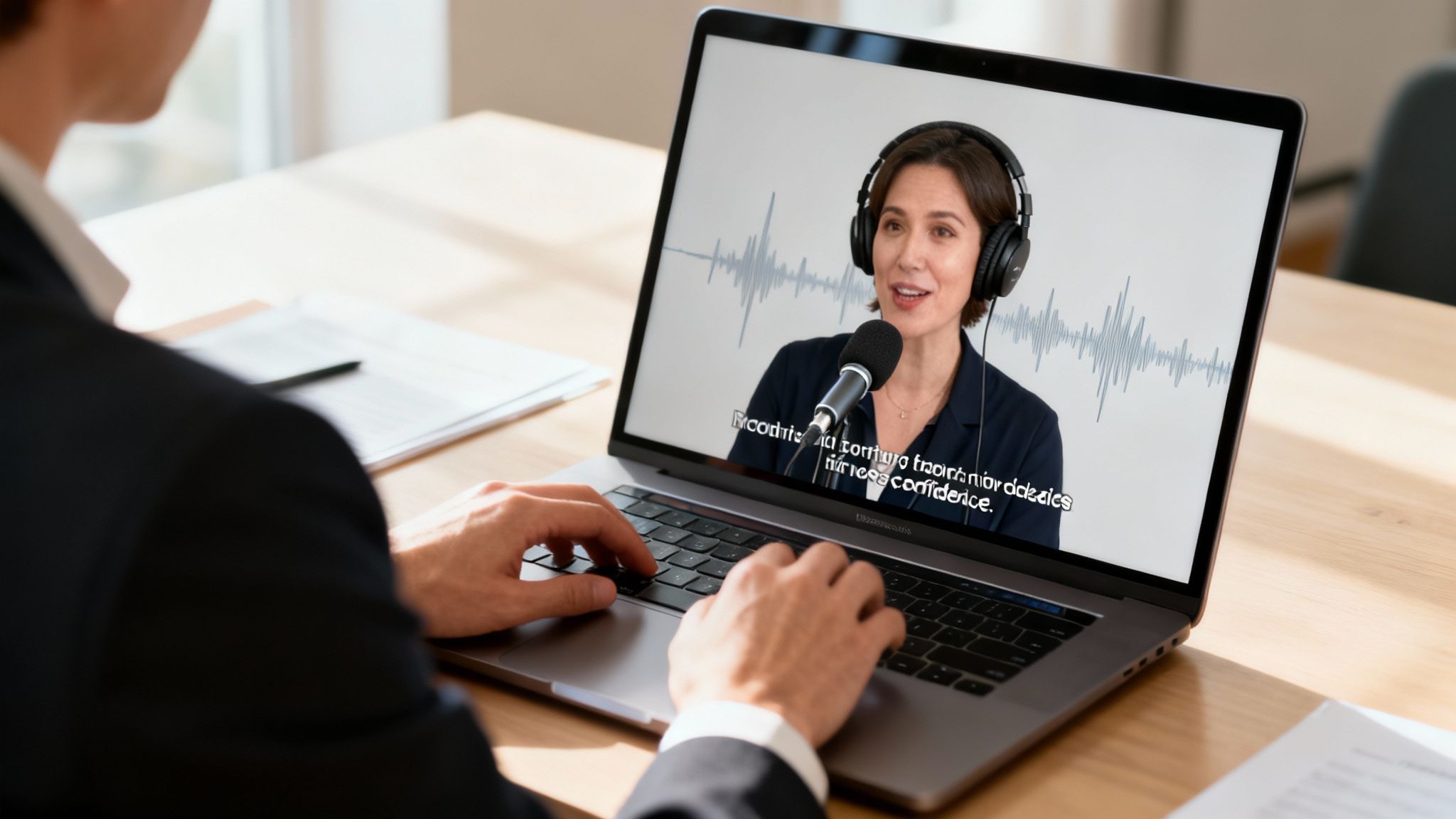
Forget the idea of eliminating your unique background. A high-quality online accent reduction course is all about boosting intelligibility. The real goal is refreshingly simple: to be understood the first time, every time you speak. This isn’t magic; it’s achieved by systematically refining specific speech patterns that might be causing confusion.
Here’s an analogy I like: think of your speech as a musical performance. Your accent is the instrument’s unique tone—it has character and value. The course doesn’t try to replace that instrument. Instead, it fine-tunes your ability to play the notes, rhythm, and melody of American English so your audience can fully appreciate the message you’re delivering.
Core Focus Areas of a Program
Most effective programs are built around a few key pillars of spoken English. This structured approach helps you build new muscle memory for clearer, more natural-sounding speech. A solid curriculum will walk you through:
- Pronunciation: Mastering the specific vowel and consonant sounds that make up American English.
- Intonation: Learning the rise and fall of your voice—the “music” of your speech—to convey meaning and authority.
- Stress: Emphasizing the right syllables in words and the right words in sentences to make your meaning crystal clear.
- Rhythm and Pacing: Developing a natural, comfortable flow that makes you easy to listen to and follow.
The objective isn’t to sound like someone else. It’s to ensure your ideas are received exactly as you intend, without the listener struggling to decode your words. It’s about removing communication friction.
The demand for these programs is exploding. As a growing segment of the online education industry, online accent reduction is quickly becoming a priority for professionals who need flexible, effective training.
The numbers back this up. The global Accent Reduction Platforms market was valued at $1.2 billion and is projected to skyrocket to $4.8 billion by 2033. This isn’t just a niche trend; it shows a massive shift in how executives, tech leads, and ambitious professionals are investing in their communication skills to get ahead in a global market. You can dig deeper into this market growth on marketintelo.com.
Ultimately, a good course provides a clear path to being heard and respected in high-stakes situations, from leading a team meeting to presenting to the board. While a course provides the foundational structure, many professionals also seek out one-on-one coaching to really accelerate their progress. If that sounds interesting, you can learn more about how to choose an online accent coach in our detailed guide.
Understanding the Core Curriculum
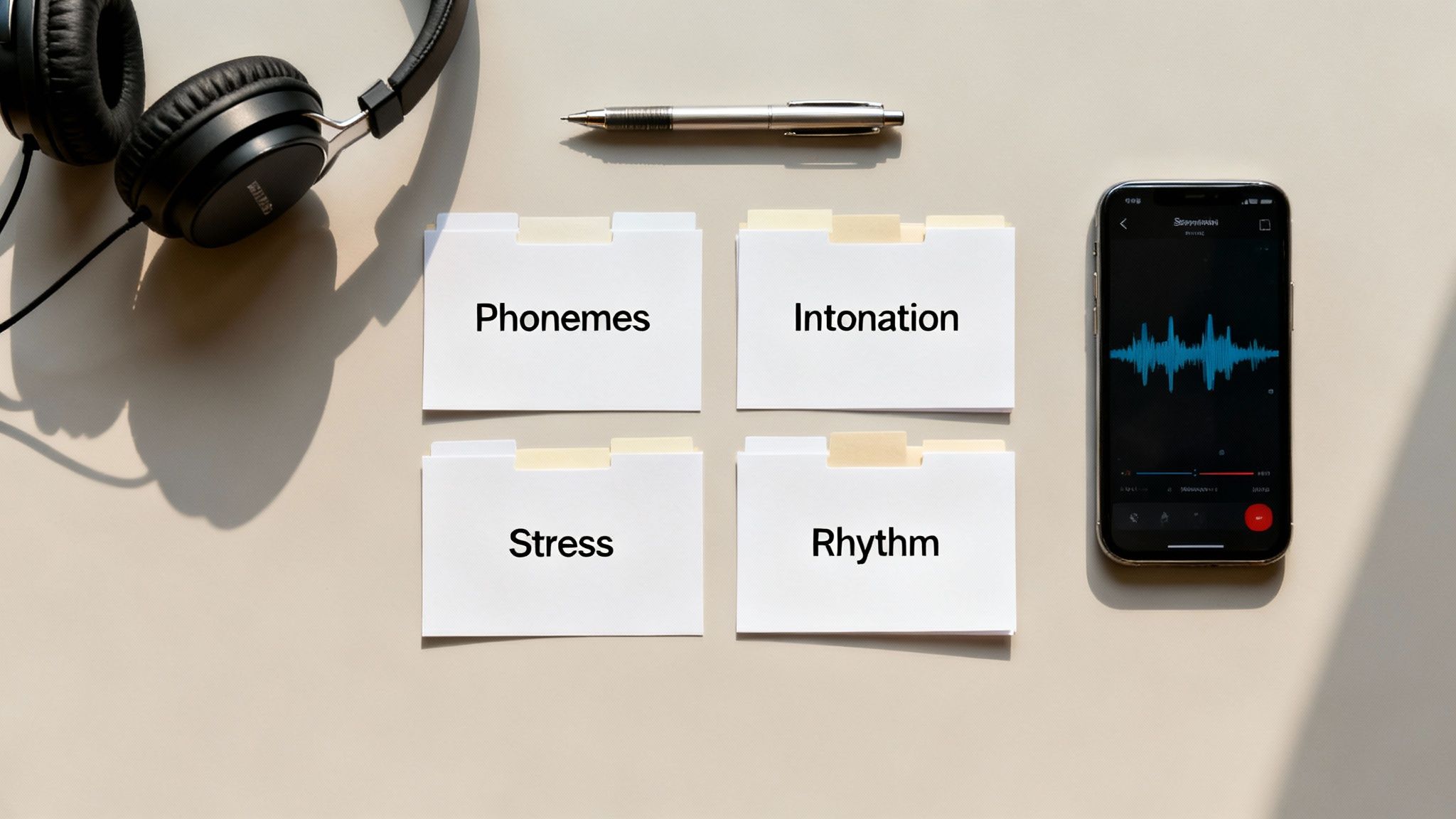
A high-quality online accent reduction course isn’t just a random collection of pronunciation tips. It’s a systematic training program designed to rebuild your specific speech habits from the ground up.
Think of it like a personal training program for your voice. Instead of working every muscle at once and hoping for the best, a good coach first identifies the exact areas that will deliver the biggest impact. Then, they build a focused plan around them.
This plan is almost always built on four essential pillars of clear American English. Mastering these elements together is what separates robotic, hard-to-understand speech from the clear, confident communication that gets you heard.
The Foundation: Sounds (Phonemes)
It all starts with phonemes—the smallest individual sounds of a language. American English uses around 44 distinct sounds, and it’s almost certain that some of them don’t exist in your native language.
Your brain and mouth have spent years, even decades, mastering one set of sounds. Learning new ones requires very specific, targeted practice. For instance, many of my clients initially struggle with the “th” sound (as in “think” and “that”) or hearing the difference between the vowels in “ship” and “sheep.”
A structured course won’t throw all 44 sounds at you at once. A great program begins with an assessment to pinpoint the 8-12 priority phonemes that are causing the most trouble for your clarity. By focusing your energy here first, you get the most significant improvement in the shortest time. If you’re curious, you can explore our guide on how to pronounce the 44 sounds in English for a closer look.
This targeted approach is why pronunciation and fluency tools are seeing such huge growth in the corporate world, with a remarkable 17.06% CAGR. Businesses are realizing that helping their teams become more confident speakers is a major competitive advantage.
The Music of Speech: Intonation
If phonemes are the individual notes, then intonation is the melody. It’s the rise and fall of your voice that injects meaning, emotion, and authority into your words. Speaking with flat intonation can make you sound bored or unsure, even when you feel the complete opposite.
Take a simple phrase like, “I’m fine.”
- With falling intonation, it sounds confident and direct: “I’m fine.”
- With rising intonation, it sounds like a question, full of uncertainty: “I’m fine?”
For anyone in a leadership role, mastering intonation is non-negotiable. It’s how you hold a room’s attention, convey conviction, and keep people engaged.
The Emphasis Points: Word and Sentence Stress
Next up is stress—the art of emphasizing the right syllables and words. Getting this wrong can completely change what you mean or, worse, make you incredibly difficult to follow.
Think about the word “project.”
- Stress the first syllable, PRO-ject, and it’s a noun, like a business plan.
- Stress the second syllable, pro-JECT, and it’s a verb, meaning to forecast something.
This same principle applies to whole sentences. In English, we naturally stress the words that carry the most important information. A good course teaches you to identify and lean into these key “content words”—like nouns, verbs, and adjectives—to make your point land with clarity and impact.
A well-structured online accent reduction course builds these skills progressively. You start with individual sounds (phonemes), then learn to string them together with the right music (intonation) and emphasis (stress), creating a communication style that is both clear and authentic.
The Flow and Cadence: Rhythm
Finally, there’s rhythm, which is the overall flow and pacing of your speech. It’s the unique pattern of stressed and unstressed syllables that gives American English its characteristic cadence.
Many languages are “syllable-timed,” where each syllable gets roughly the same amount of time. English, on the other hand, is stress-timed.
This means the time between the stressed syllables stays fairly consistent, and we rush through or blend the unstressed syllables in between. Getting this rhythm right is what makes you sound smooth and natural, not choppy or robotic. It’s the final piece that ties everything else together.
Choosing Your Course Format
When you decide to jump into an online accent reduction course, one of the first big choices you’ll face is the format. This isn’t just a minor detail—it shapes your entire learning experience, how accountable you feel, and how quickly you see real progress. There’s no single “best” option; the right one comes down to your personal learning style, your schedule, and what you’re trying to achieve professionally.
Think of it like choosing a fitness plan. Some people get great results with a gym membership and a workout app they can use anytime (Self-Paced). Others need a personal trainer to push them, correct their form, and keep them on track (Live Coaching). And many find that a mix of both is the sweet spot (Hybrid).
Let’s break down what each of these really looks like in practice.
The Self-Paced Path
Self-paced courses are all about flexibility. They usually come as mobile apps, a big library of video lessons, or audio drills you can download. This is often the most budget-friendly route, and it lets you learn whenever you can find the time—on your commute, late at night, you name it.
But that freedom has a catch. The biggest challenge with going it alone is the lack of personalized feedback. An app might tell you you’re close to a target sound, but it can’t explain why your pronunciation is off or give you the kind of nuanced advice a trained human ear can.
Best for:
- Highly disciplined self-starters who are great at staying motivated without someone looking over their shoulder.
- Professionals on a tight budget or those just dipping their toes into accent modification.
- Anyone who needs maximum scheduling flexibility to squeeze practice into an unpredictable routine.
The Live Coaching Model
Live coaching is exactly what it sounds like: one-on-one sessions with an experienced accent coach. This is the most personalized—and typically the most premium—format you can find. A coach will start with a deep dive into your specific speech patterns and build a program just for you.
The magic here is the real-time, expert feedback. A coach can instantly spot and correct a subtle mistake in tongue placement or a slight dip in intonation that pre-recorded videos would completely miss. This model is a game-changer for senior professionals who need to nail industry-specific jargon or prepare for a high-stakes presentation. If you want to see how this works in more detail, check out our guide on the flexibility of online accent coaching programs.
Key Insight: Live coaching isn’t just about fixing mistakes; it’s about building a strategy. A great coach helps you zero in on the 20% of speech habits causing 80% of your communication issues, which means you get faster, more noticeable results.
The Hybrid Approach
A hybrid model aims to give you the best of both worlds. It combines the structured, expert guidance of live coaching sessions with the flexibility and constant practice of self-study tools like apps and video modules. This is the exact format we use at Intonetic because we’ve seen it work time and time again.
This blended structure means you get that crucial expert feedback during your sessions, but you also have a rich library of resources for daily practice. You might have a weekly call with your coach to work on intonation, and then spend 15 minutes each day using audio drills to build muscle memory for new vowel sounds. It’s the perfect balance of accountability and freedom.
As you look at different programs, it’s also worth noting the technology they use. A quick look at the best platforms for selling online courses can give you a behind-the-scenes peek at the tech that powers a smooth, frustration-free learning experience.
Online Accent Reduction Course Formats Compared
To make the choice easier, here’s a side-by-side comparison. Think about your goals, budget, and how you learn best as you review the options.
| Feature | Self-Paced (Apps/Videos) | Live Coaching (1-on-1) | Hybrid Model (Blended) |
|---|---|---|---|
| Personalization | Low (generic curriculum) | High (fully customized) | High (customized plan + structured tools) |
| Feedback | Automated/None | Real-time, expert correction | Real-time feedback + self-practice tools |
| Accountability | Low (entirely self-driven) | High (scheduled sessions) | High (scheduled sessions + practice goals) |
| Flexibility | High (learn anytime) | Moderate (scheduled appointments) | High (mix of scheduled & flexible time) |
| Cost | Low | High | Moderate |
| Best For | Self-starters, budget-conscious | Professionals needing fast results | Most learners seeking balance & structure |
Ultimately, the right format is the one that fits your life and your goals. Consider how you truly learn best, how much of a push you need to stay on track, and the level of personalized attention your career demands. Making the right choice here is the first step on your path to clearer, more confident communication.
How to Select the Right Program
Choosing an online accent reduction course is a serious investment in your professional future. With so many options out there, it’s easy to get overwhelmed by flashy marketing. The real key is to look past the promises and zero in on a few critical, non-negotiable factors that actually drive results.
Think about it like hiring a specialist for a crucial project at work. You wouldn’t just go with the cheapest bid. You’d dig into their qualifications, their process, and their track record. Apply that same diligence here. You want a partner who can deliver real, measurable improvements to your communication.
Evaluate Coach Credentials and Experience
The expertise of your instructor is, without a doubt, the single most important part of the equation. A great coach does far more than just correct your pronunciation. They understand the deep mechanics of language acquisition and, ideally, have direct experience working with professionals from your specific linguistic background.
Before you commit to anything, do your homework on the instructors. A degree in a relevant field like linguistics or speech-language pathology is a huge green flag—it signals a deep, foundational knowledge. But practical experience is just as vital. Have they successfully coached other professionals in your industry? This ensures they get the unique communication demands you face every day. For a deeper look, check out our guide on the seven essential questions to ask a potential accent coach.
Prioritize a Personalized Approach
Steer clear of any program offering a generic, “cookie-cutter” curriculum. Your accent is as unique as your fingerprint, shaped by your native language and your own personal speaking habits. A high-quality program will always start with a thorough diagnostic assessment to map out your specific areas for improvement.
Red Flag Warning: Be skeptical of any provider that promises to “eliminate” your accent. The goal here is clarity and confidence, not erasing your identity. A reputable coach focuses on modification to make you more easily understood, celebrating your unique background while giving you the tools to communicate effortlessly.
A personalized plan means the coach pinpoints the highest-impact areas for you—maybe it’s just a couple of vowel sounds and a common intonation pattern—and builds the entire program around strengthening those skills. This targeted approach delivers faster, more noticeable results than a one-size-fits-all course ever could.
Scrutinize the Practice Systems
Lasting change isn’t made in a weekly lesson; it’s forged through consistent, daily practice that builds new muscle memory. A program is only as good as the tools it gives you to practice between your coaching sessions. Just showing up for a video call once a week is not going to cut it.
Look for programs that provide a solid system for daily drills and reinforcement. This could include things like:
- On-the-go audio exercises: These let you practice during a commute or on a coffee break, weaving learning into your packed schedule.
- AI-powered feedback tools: Modern tools can give you instant feedback on your pronunciation, helping you self-correct in real time.
- Structured accountability: Things like weekly voice check-ins or progress trackers are crucial for keeping you on track and building momentum.
The quality of these practice systems is directly tied to how quickly you’ll progress and how well the new habits will stick.
The Growing Demand for Quality Programs
The need for effective, flexible training is causing massive growth in this space. The English Language Training (ELT) market is on track to nearly double to USD 181.67 billion by 2034, a surge driven largely by non-native professionals in demanding fields like tech and healthcare. Intermediate learners—those who need to refine their accents for clarity and authority—are the biggest group fueling this demand for remote programs that fit their busy lives. You can read more about these market trends and their drivers on openpr.com.
This explosive growth is good news, as it means you have more choices. But it also makes careful evaluation more critical than ever. By focusing on coach credentials, personalization, and robust practice systems, you can confidently pick an online accent reduction course that will genuinely elevate your professional presence.
Setting Realistic Timelines and Expectations
When you’re committing to an online accent reduction course, one of the first questions on your mind is probably: how long will this actually take? It’s a fair question. Understanding the journey ahead is key to sticking with it, because real, lasting accent modification is about building new muscle memory, not finding some magical overnight fix.
Think of it like learning to play the guitar. You wouldn’t pick one up and expect to play a flawless solo in your first week. It takes time and consistent practice to teach your fingers where to go. In the same way, retraining the muscles in your tongue, jaw, and lips to create new sounds requires dedicated effort over time. The goal is steady progress, not instant perfection.
A Typical 12-Week Journey
Most high-quality, structured programs are built around a 12-week framework. This gives you enough time to move from the basics of sound awareness to confidently using your new skills in the real world. It’s definitely a marathon, not a sprint, and each week builds directly on the last.
Here’s a general roadmap of what that looks like:
- Weeks 1-4: Building Your Foundation. The first month is all about diagnosis and awareness. You’ll work closely with your coach to pinpoint the highest-priority sounds—those specific phonemes that are causing the biggest clarity issues for you. Your daily practice will focus on mastering these sounds by themselves and in single words.
- Weeks 5-8: Integrating Flow and Rhythm. Once you’ve got a handle on the key sounds, the next step is to start weaving them into full sentences. This is where you really start working on the “music” of English: intonation, word stress, and rhythm. The goal here is to make your speech sound more natural and less robotic.
- Weeks 9-12: Applying with Confidence. The final phase is all about real-world performance. This is where the rubber meets the road. You’ll practice your new skills in the situations that matter most to you, whether that’s leading a team meeting, giving a big presentation, or just making small talk at a networking event. This is where it all comes together and the new muscle memory truly locks in.
The timeline below shows how a typical journey moves from evaluation to personalized practice.
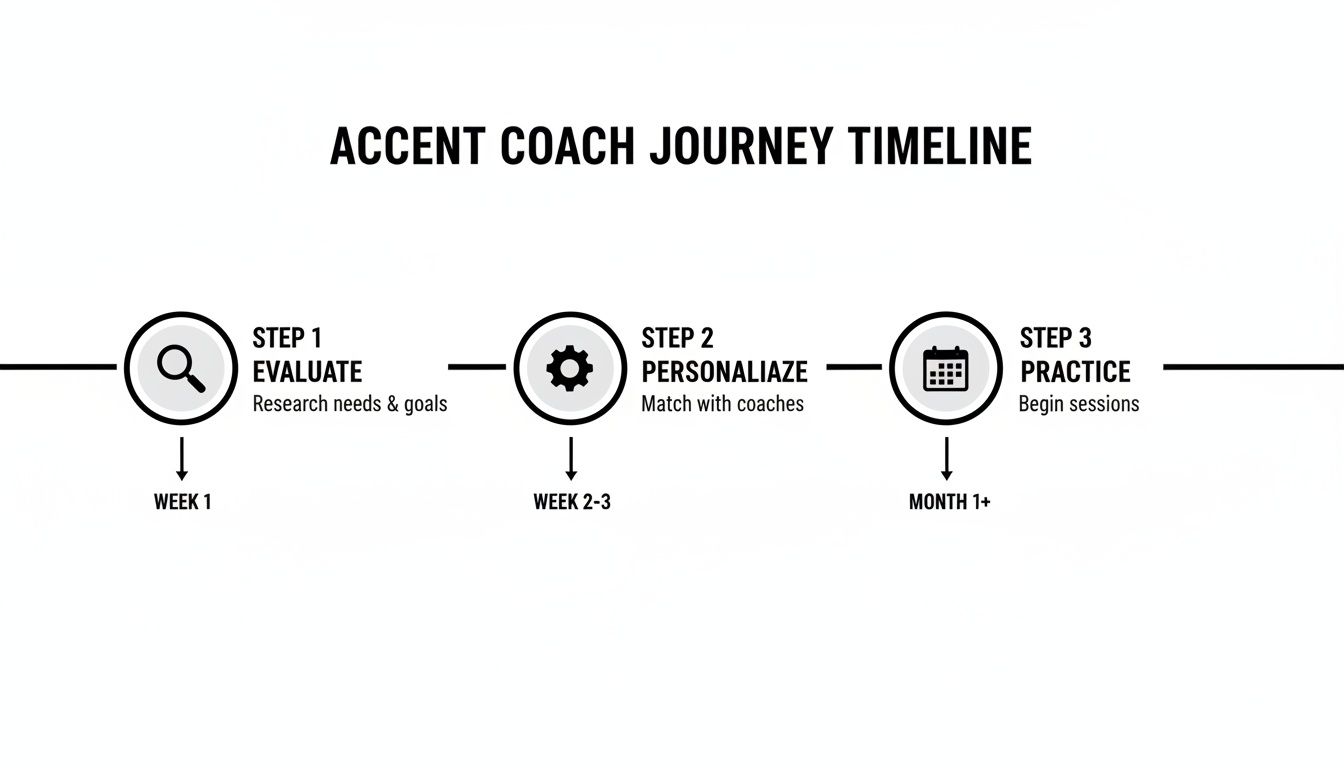
As you can see, success isn’t random. It comes from a structured process that moves from analysis to personalized action and, finally, to forming lasting habits.
Defining and Measuring Success
So, what does “success” even look like? It’s not about erasing your accent completely. It’s about achieving clear, effortless communication so you can be heard and understood the first time.
Success is when you stop thinking about how you’re speaking and can focus entirely on what you’re saying. It’s that moment when the friction in communication disappears, and your ideas just flow.
What are the tangible results you can expect?
- You have to repeat yourself far less often.
- You feel more confident jumping into conversations or sharing your ideas in meetings.
- People start commenting on the clarity of your presentations.
- You notice listeners are engaged with your message, not distracted by your accent.
While many people feel a noticeable difference within the first 8-12 sessions, the biggest, most permanent changes come from completing the full program. The secret sauce is consistency. A focused 15-20 minutes of daily practice is vastly more effective than cramming it all into one long session per week.
For a deeper dive into what to expect, you can learn more about the average timeline for success with online accent coaching in our detailed guide.
Answering Your Questions About Online Accent Reduction
Jumping into an online accent reduction course is a big move, and it’s totally normal to have a few questions buzzing around in your head. This is an investment in yourself and your career, so let’s clear the air and tackle some of the most common concerns we hear from professionals just like you.
Will an Accent Reduction Course Erase My Identity?
This is easily the most important question we get, and I want to be crystal clear: absolutely not. A high-quality, reputable course isn’t designed to scrub away your accent or your unique cultural background. The real mission is much simpler: enhance your clarity.
Think of it less like replacing who you are and more like adding a powerful new tool to your communication toolbox. The entire focus is on modification for clarity, giving you the control to make sure you’re understood effortlessly in any professional setting. It’s about empowering your identity, not erasing it, by making sure your ideas land exactly as you intended—in your own authentic voice.
How Much Time Should I Practice Each Week?
When you’re building new speech habits, consistency is king. Cramming a two-hour practice session into one day just doesn’t work as well as spreading that effort out. You’re training muscle memory, and muscles learn best through repetition, not exhaustion.
Most effective programs will point you toward 15-30 minutes of focused practice per day, 5-6 days a week. That daily commitment is the secret sauce for making new pronunciation, intonation, and rhythm patterns feel completely natural over time.
The best programs are built for busy professionals. They offer structured, efficient practice—like audio drills you can do on your commute or AI-powered exercises—that fits right into your schedule, whether it’s on a break or in the evening.
Is an Online Course as Effective as In-Person Coaching?
For most professionals today, an online course can actually be more effective than old-school, in-person coaching. The biggest win is the incredible flexibility. You can connect with the best coaches from anywhere in the world and slot sessions into your schedule without having to rearrange your life.
Modern online programs use technology to create a rich learning environment that often goes beyond what’s possible in person. Here’s what makes it work so well:
- High-Quality Video: Crystal-clear video lets your coach see the subtle movements of your mouth and face, which is crucial for detailed feedback.
- Interactive Digital Tools: Coaches can use digital whiteboards, share resources instantly, and assign targeted exercises in real time.
- Session Recordings: This is a game-changer. Being able to record and re-watch your sessions means you can review complex feedback as many times as you need to, making sure every lesson sticks.
At the end of the day, a program’s success comes down to its quality, the coach’s skill, and your commitment—not whether you’re in the same room.
What Is the Difference Between Accent Reduction and Speech Therapy?
This is a really important distinction. The two services sound similar but are fundamentally different and serve completely different needs.
Accent reduction, or accent modification, is an elective educational service. It’s for non-native speakers who already have normal speech and language skills but want to improve their clarity and confidence when speaking English. It’s not a medical service, and it doesn’t treat any kind of disorder.
Speech therapy, on the other hand, is a clinical, medical service provided by a licensed Speech-Language Pathologist (SLP). Its purpose is to diagnose and treat medically recognized speech, language, and voice disorders. Because it addresses a medical need, it’s often covered by health insurance.
An online accent reduction course is purely focused on helping professionals like you achieve clearer communication in a business or social context.
What Is a Realistic Cost for a Quality Program?
The cost of an online accent reduction course can vary quite a bit, and it’s important to know what you’re paying for. The price tag is usually shaped by the format (self-study vs. live coaching), the coach’s credentials, and how personalized the program is.
Here’s a general breakdown of what to expect:
- Self-Study Apps & Videos: These are the most budget-friendly, often running under $30 per month or a one-time fee of about $150-$250. They’re great for flexibility but offer zero personalized feedback.
- Group Classes: A good middle ground for getting live instruction without the premium price, group classes can range from $30-$60 per month.
- Private One-on-One Coaching: This is the most effective (and premium) option. Rates typically range from $75 to over $200 per hour. A full 12-week program with a top-tier coach can land somewhere between $2,000 and $4,000.
While private coaching has a higher initial cost, the return on that investment is usually much faster. A program tailored to your specific speech patterns leads to bigger, more measurable improvements in less time, saving you a lot of frustration down the road. When you’re ready to explore options, our guide on how to choose the right accent coach can help you find a program that delivers real value.
Ready to take the driver’s seat in your professional communication and make sure your ideas are always heard? At Intonetic, we specialize in helping professionals speak with confidence and authority. Our proven 12-week program is designed to deliver results you can actually measure.
Book your free assessment today and get a complimentary PDF starter guide to kick off your journey.