
Mastering Word Stress Patterns in English
Word stress is the hidden rhythm of English. It’s the music behind the words, the beat that tells your listener what’s important. Get it right, and you sound clear, confident, and easy to follow. Get it wrong, and even perfectly pronounced words can become confusing or completely unrecognizable.
This isn’t about nit-picking your pronunciation. It’s about the fundamental difference between being understood instantly and leaving your listener scrambling to figure out what you just said.
Why Word Stress Is Your Secret Weapon for Clarity

Think of correct word stress as a powerful tool for clarity. It acts like a signpost, guiding your listener’s ear to the most important part of a word. When you hit the right syllable, you make your speech instantly easier to digest, which helps you project authority and confidence.
This has huge real-world implications. In a high-stakes client meeting or a critical presentation, unclear speech creates friction. It can undermine your entire message. Getting the stress right ensures your key terms—like project vs. project, or insight vs. incite—land with the exact meaning you intended.
The Spotlight Analogy for Word Stress
Here’s a simple way to think about it: imagine a word is a dark stage, and the stressed syllable is the only thing under a bright spotlight.
Everything outside that spotlight is still there, of course, but it fades into the background. The unstressed syllables become softer, quicker, and their vowel sounds often get reduced to a lazy "uh" sound, which linguists call a schwa.
For example, in the word "analysis," the spotlight hits the second syllable, "NA." We say it a little louder, hold it a little longer, and often at a slightly higher pitch. The other syllables ("a-", "-ly-", "-sis") are in the shadows—they’re spoken more quickly and with much less energy.
This spotlight effect is what gives English its characteristic rhythm. Native listeners are subconsciously trained to listen for these peaks of stress to identify words. If you put the spotlight on the wrong syllable—saying "analysis" or "analysis"—you've completely changed the word's "shape." This forces your listener to work overtime just to decode your meaning, often leading to them asking you to repeat yourself and breaking the natural flow of conversation.
I've seen it time and again with my clients: mastering word stress is a core pillar of clear communication. While it’s related to pronunciation, learning how to enunciate better often starts with getting this emphasis right. When you learn to control the spotlight, you don’t just say words correctly—you command the stage, hold your audience’s attention, and make sure your ideas are heard with the clarity they deserve.
Understanding the Two Core Rhythms of English
If you really want to get a handle on English word stress, it helps to think of it less like a set of rigid rules and more like music. All the complex stress patterns we see in English really just boil down to two fundamental rhythms. Once you learn to feel these two core beats, you're on your way to developing an intuitive sense for how English words are supposed to sound.
These patterns are surprisingly simple but incredibly powerful. Once you start listening for them, you’ll hear them everywhere—from casual conversations to highly technical presentations. They are the essential building blocks for everything else.
The Trochaic Rhythm: The Heartbeat of English
The most common rhythm you'll hear in English is the trochaic pattern. It follows a simple STRONG-weak sequence.
Think of it like a heartbeat: BA-dum, BA-dum, BA-dum. All the energy is loaded onto that first syllable, and the second one just fades away. It’s a forceful, direct rhythm that starts strong and trails off.
This beat is everywhere in everyday English:
- AN-swer
- PROB-lem
- BUS-iness
- MAN-age
This front-loaded stress isn't just a feeling; it's a statistical fact. Research on massive collections of English words confirms it. One analysis of the Hoosier Mental Lexicon found the trochaic (STRONG-weak) pattern is 3.4 times more frequent than its opposite in two-syllable words. This is what shapes a native listener's instinct for how a word should sound.
The Iambic Rhythm: The Polite Knock
The second core rhythm is the iambic pattern, which is the exact opposite: weak-STRONG.
Picture a polite but firm knock on a door: da-DUM, da-DUM. The energy builds up, culminating in a strong, emphasized second syllable. In speech, this rhythm creates a sense of forward momentum.
While it’s less common than the trochaic pattern, you’ll still find this rhythm in thousands of essential words, particularly verbs and prepositions:
- a-BOUT
- re-PLY
- de-CIDE
- pro-TECT
The Key Takeaway: If you’re ever looking at a new two-syllable English word and have to guess the pronunciation, bet on the trochaic (STRONG-weak) rhythm. Since it's the most common of all English word stress patterns, you'll be right far more often than you're wrong.
Seeing Both Rhythms in Action
This is where it gets interesting. The real magic happens when you realize the same set of letters can produce completely different rhythms and, therefore, different meanings. Many words in English switch from a noun to a verb just by shifting the stress.
Take a look at these pairs:
| Word Pair | Trochaic (STRONG-weak) Noun | Iambic (weak-STRONG) Verb |
|---|---|---|
| Record | Let's check the RE-cord. | Please re-CORD the meeting. |
| Content | The CON-tent is engaging. | She is con-TENT with the results. |
| Object | What is that strange OB-ject? | I ob-JECT to that statement. |
Hearing this distinction is critical for both understanding what others are saying and making sure you are understood. This dance between the trochaic and iambic rhythms is a huge part of what makes up the overall rhythm and timing in American English. When you master these two fundamental patterns, you're not just memorizing words—you're learning the very pulse that makes English flow.
Decoding the Hidden 'Rules' of Word Stress
While English stress can feel random and chaotic at times, it’s not as lawless as it seems. There’s an underlying system—a set of reliable guidelines that governs the rhythm of thousands upon thousands of words. Learning these hidden "rules" is a game-changer, especially when you come across new vocabulary. It lets you make an educated guess that, more often than not, is spot on.
Think of these patterns less like rigid laws and more like helpful shortcuts. They give you a framework for why words are stressed the way they are, moving you away from rote memorization and toward a more intuitive grasp of the language. Once these core principles click, you'll start to see the logic behind the music of English.
Two-Syllable Nouns vs. Verbs
One of the most dependable patterns you’ll find in English involves two-syllable words that can act as both a noun and a verb. The rule is incredibly simple but powerful: nouns are usually stressed on the first syllable, while verbs get the stress on the second. This one little shift in emphasis completely changes how the word functions in a sentence.
You see this play out all the time in a professional context:
-
Noun: Can you send me the final PRO-ject report? (The thing)
-
Verb: Let’s pro-JECT the sales figures on the screen. (The action)
-
Noun: We need to get an IM-port permit for this shipment.
-
Verb: Our company will im-PORT the raw materials from abroad.
-
Noun: This new software is a significant UP-grade.
-
Verb: Did you up-GRADE your computer's operating system yet?
Mastering this distinction is foundational. It’s what helps you instantly hear the difference between the object (RE-cord) and the action of creating it (re-CORD).
The Logic of Compound Words
Compound words—those created by joining two smaller words—also follow some very predictable stress patterns. And just like with our noun/verb pairs, where the stress lands tells the listener exactly what kind of word they’re hearing.
For compound nouns, the stress almost always falls on the first word. This signals that the two words have fused together to form a single, new concept.
- SOFTware (a type of program, not just ware that is soft)
- KEYboard (a single device for typing, not just a board with keys)
- DATAbase (a specific system for storing data)
But for compound adjectives (two words working together to describe a noun) or compound verbs, the stress usually hits the second word. This keeps the two words functionally linked but distinct.
- They built a state-of-the-ART facility. (Adjective)
- She is a very well-KNOWN consultant in her field. (Adjective)
- You absolutely must back-UP your files every day. (Verb)
The stress in a compound word acts like glue. For nouns, the stress on the first part glues the words together into one idea (GREENhouse). For adjectives and verbs, the stress on the second part keeps them slightly separate but working as a team (a high-SPEED connection).
This simple logic provides a reliable guide for navigating thousands of common business and technical terms. You can learn more about the basic building blocks of pronunciation by exploring the differences between stressed and unstressed syllables.
Suffixes That Control Word Stress
Perhaps the single most useful shortcut for mastering English stress is recognizing how certain word endings, or suffixes, act like magnets. If you can learn to spot these suffixes, you can predict the stress pattern of a long, complex word without ever having heard it spoken aloud.
These endings reliably pull the main stress to the syllable that comes immediately before them.
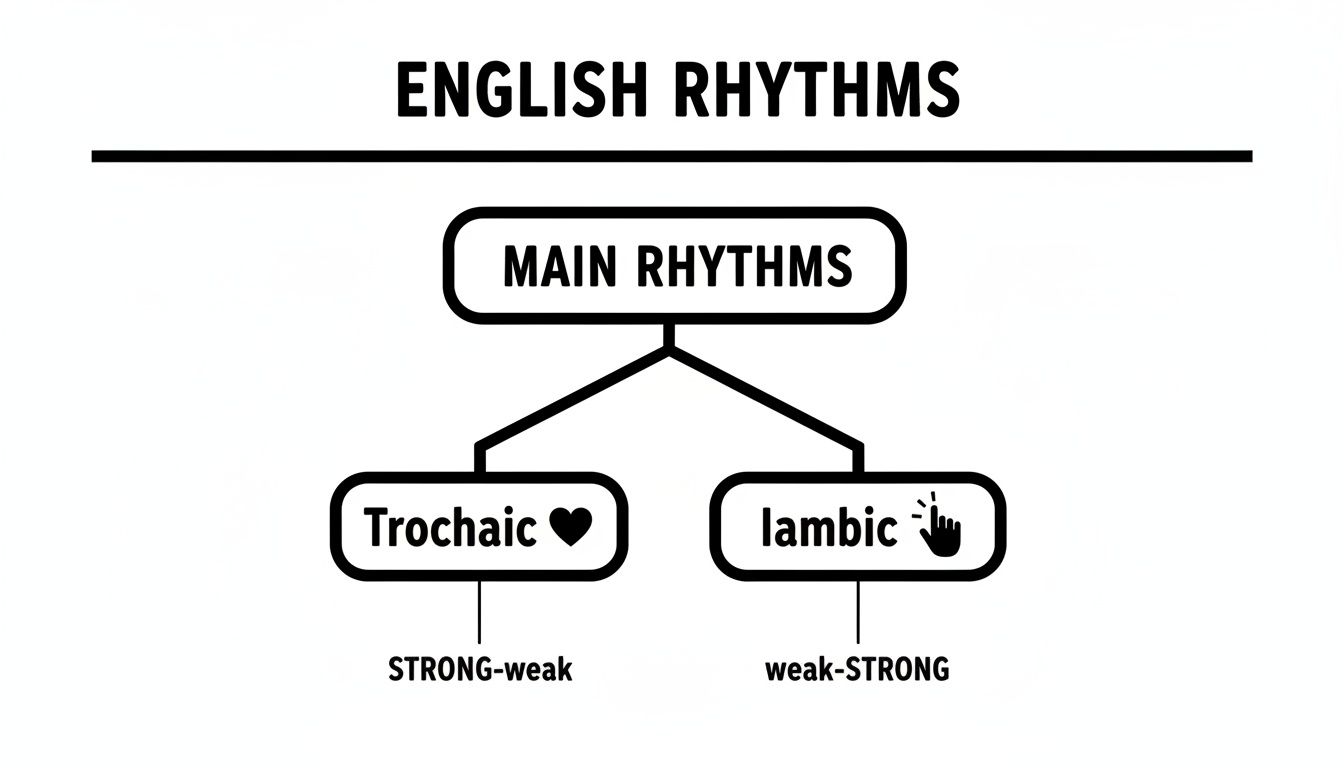
This diagram shows that while English has different rhythmic flows, the tendency to stress the beginning of words (the Trochaic pattern) is a dominant feature. Suffixes are one of the key things that can shift this default pattern.
Here is a quick look at some of the most common suffixes you'll find in professional and technical English and the predictable way they control word stress.
Common Suffixes That Control Word Stress
| Suffix | Stress Placement Rule | Example Words |
|---|---|---|
| -tion / -sion | Stress on the syllable before the suffix. | appli-CA-tion, implemen-TA-tion, de-CI-sion |
| -ic | Stress on the syllable before the suffix. | stra-TE-gic, eco-NOM-ic, a-TOM-ic |
| -ity | Stress on the syllable before the suffix. | produc-TIV-ity, secu-RI-ty, complex-I-ty |
| -graphy | Stress on the syllable before the suffix. | pho-TOG-raphy, de-MOG-raphy, bi-OG-raphy |
Recognizing these patterns is like having a cheat sheet for English pronunciation.
Once you know this, when you see a long, intimidating word like "au-then-ti-ca-tion," you don't have to guess. You just spot the -tion ending and know with 99% certainty that the stress has to fall on the syllable right before it: "au-then-ti-CA-tion." This rule alone unlocks the correct pronunciation for thousands of words you'll encounter in business, tech, and science.
Why English Stress Patterns Feel So Inconsistent
If you've ever felt like English word stress is maddeningly inconsistent, you're not alone. It can seem like for every rule you learn, a dozen exceptions are waiting to trip you up. But this apparent chaos isn't random—it's the direct result of English's unique and messy history.
What you're hearing isn't a broken system; it's the sound of two completely different languages clashing and merging over centuries. English isn't some "pure" language with a single, unified rulebook. It’s a hybrid, built on the foundation of one language family and then flooded with vocabulary from another.
A Tale of Two Stress Systems
At its core, English started as a Germanic language, the language of the Anglo-Saxons. This original system had a pretty straightforward rule for stress.
The Germanic Foundation: In Old English, the main stress was almost always fixed on the first syllable of a word. It was predictable, front-loaded, and simple.
You can still hear this ancient rhythm in many of our most common, core words. These are often short, direct words that just feel fundamentally "English."
- ANswer
- WAter
- FAther
- HAPpy
This is the original heartbeat of the language. But then, a major historical event came along and completely scrambled that simple picture. The Norman Conquest in 1066 brought French—a Romance language derived from Latin—to England. For hundreds of years, French was the language of power, law, and government, and English soaked up thousands of new words.
This huge influx of vocabulary brought a totally different stress system with it.
The Romance Influence: French and Latin-based words tend to place stress toward the end of the word. This created a competing rhythm that was the polar opposite of the original Germanic pattern.
This is exactly why so many of our more formal, academic, or technical words follow this end-stressed pattern.
- reQUEST
- maCHINE
- deCIDE
- exPLAIN
The Historical Clash in Modern Words
This blend of two competing systems is the number one reason English word stress can feel so unpredictable. The rules we have today are the product of these two major streams of vocabulary—Germanic and Romance—each with its own internal logic. As English absorbed thousands of French and Latin loanwords, it had to deal with a system where stress gravitated toward the right side of the word, clashing with its original left-side stress. You can explore more about this linguistic history and its impact on teachers and learners.
This layering effect means predicting stress isn't just about memorizing one rule. We now have word pairs in English from these two different streams that showcase the competing patterns perfectly.
| Germanic Origin (Front-Stressed) | Romance Origin (End-Stressed) |
|---|---|
| ANswer | rePLY |
| BUYing | purCHASE |
| FORward | adVANCE |
So, the next time you get frustrated by an exception, just remember you're not dealing with a flawed system. You're navigating a rich, layered linguistic history. The goal isn't to see English as illogical but to understand its dual personality.
Learning to recognize whether a word feels more like a simple, core term (Germanic) or a more formal, multi-syllable one (Romance) can often give you a clue as to which rhythm it will follow. This historical perspective can turn frustration into a deeper understanding, helping you navigate the quirks of English word stress with much greater confidence.
Actionable Drills to Master Word Stress

Knowing the rules of word stress is one thing, but actually using them in a fast-paced meeting is another story entirely. True mastery doesn't come from theory; it comes from building new physical habits.
You have to move this knowledge from your brain into your mouth—into your muscle memory. The goal is to make the correct stress patterns automatic. These practical, high-repetition drills are designed to do just that.
Start with Focused Listening and Repetition
Your ears are your best tool for learning the music of a language. The simplest and most powerful drill is just to listen and repeat. But this isn't passive hearing; it's active listening, where you hunt for the stressed syllable and mimic it perfectly.
You can grab audio clips from anywhere—online dictionaries, news broadcasts, or podcasts. Pick a few words you want to work on each day and really zero in on how a native speaker says them.
Here’s how to do it:
- Isolate the Word: Find a clear recording of a word like "tech-NOL-o-gy."
- Listen for the Peak: Play it a few times. Don't listen to the meaning; listen for the one syllable that’s longer, louder, and a bit higher in pitch.
- Exaggerate and Mimic: Now, record yourself saying it, but blow the stressed syllable way out of proportion. Think "tech-NOOOOL-o-gy."
- Compare and Refine: Play the original, then play your recording. Does the rhythm match? Keep tweaking your version until it lines up perfectly.
This kind of focused practice fine-tunes your ear to pick up on the rhythmic cues that are foundational to clear spoken English.
Feel the Difference with Contrastive Pairs
One of the quickest ways to feel the physical reality of word stress is to practice with contrastive pairs. These are words spelled the same way but whose meaning and function change completely depending on which syllable gets the stress.
Think about the classic example: RE-cord (the noun, like a vinyl record) and re-CORD (the verb, to record a video). Saying them one after the other lets you physically experience the shift in muscular effort. It makes the whole concept tangible.
A study on teaching syllable skills found that even a few hours of focused training can produce significant results. By concentrating on these high-impact pairs, your practice becomes incredibly efficient.
Here are a few common pairs to get you started:
- PRE-sent (a gift) vs. pre-SENT (to give a presentation)
- OB-ject (a thing) vs. ob-JECT (to disagree)
- CON-duct (behavior) vs. con-DUCT (to lead or guide)
- PRO-gress (advancement) vs. pro-GRESS (to move forward)
Try using each word in a short sentence to lock in both its meaning and its unique rhythm. This drill is a direct fix for a very common source of miscommunication.
Use the Rubber Band Method for Physical Feedback
Sometimes, a simple physical prop can be the key to learning a new motor skill. The "Rubber Band Method" is a surprisingly effective technique that connects the abstract idea of stress to a concrete physical action.
All you need is a small rubber band. Hold it between your hands. As you say your target word, stretch the band on the stressed syllable. This creates a powerful physical and visual cue that reinforces the feeling of emphasis.
Let's try it with a longer word like "com-mu-ni-CA-tion."
- Hold the rubber band loosely between your thumbs.
- Say the first syllables normally: "com-mu-ni-"
- On the stressed syllable, -CA-, stretch the band wide.
- Let the band go slack on the final syllable: "-tion."
This simple trick makes the stressed syllable feel more powerful and helps burn the pattern into your memory. It’s fantastic for breaking old habits, especially on words you know you stumble over. And for more ways to get your mouth ready for speaking, check out these great vocal warm-ups and tongue twisters which go hand-in-hand with these drills.
Leverage Modern Tools for Instant Feedback
In the past, improving your pronunciation meant relying on a coach or just your own ear. Today, technology can give you a massive leg up. AI-powered pronunciation apps are designed to provide instant, specific feedback on your word stress.
These apps work by recording your voice and analyzing your stress patterns against a native speaker's model. They can highlight the exact syllable you need to hit harder and often give you a score so you can track your improvement.
This immediate feedback loop is priceless. It lets you practice whenever you have a spare moment and make tiny, consistent adjustments that add up to major improvements over time. When you combine modern tools with the foundational physical drills we’ve covered, you create a powerful practice routine for mastering English word stress.
Your Path to Clear and Confident Spoken English
Getting word stress right in English isn't about brute-force memorization of thousands of rules. As we've seen, the real path to clarity comes from understanding the why behind the patterns—the predictable rhythms, the historical roots, and the powerful shortcuts that suffixes provide.
True mastery is about internalizing these patterns through consistent, focused practice until they feel completely natural. This is what transforms your speaking from a string of individual words into a fluid, musical rhythm that native speakers can process effortlessly. It’s the difference between simply being heard and being truly understood.
From Practice to Professional Impact
Every single time you stress PROgress instead of proGRESS, you're doing more than just getting a word right. You're building a stronger message and killing potential confusion before it starts. This focus on the "music" of English is a direct investment in your career.
When your speech is clear and rhythmic, you:
- Build Trust: Your listeners aren't struggling to decode what you’re saying. Instead, they can focus entirely on the value of your ideas.
- Project Authority: Confident, clear delivery naturally commands respect in meetings, calls, and presentations.
- Lead with Confidence: Knowing you’ll be understood the first time allows you to speak more freely and persuasively.
This journey is about so much more than pronunciation. It's about making sure your expertise comes through, loud and clear, in every single conversation. For a broader look at enhancing your delivery, you can also explore how to improve your verbal communication skills.
Think of word stress as the foundation of your spoken presence. It’s the framework that supports everything else—your vocabulary, your ideas, and your professional authority. By focusing on this one critical skill, you are building a more powerful and effective way to communicate.
Ultimately, mastering English word stress is your roadmap to changing how you sound and, just as importantly, how you feel when you speak. It clears the way for greater impact, stronger connections, and bigger opportunities in your career.
Common Questions About English Word Stress
Once you start digging into word stress, a few key questions almost always pop up. It's one thing to understand the patterns in theory, but another to apply them on the fly. Let's tackle some of the most common hurdles people face when they're working to get this right.
Think of this as the practical side of the coin. Answering these questions is how you move from consciously thinking about every syllable to developing a natural, intuitive feel for the rhythm of English.
How Can I Find the Correct Stress for a New Word?
This is the big one. While the patterns we've covered are a fantastic starting point for making an educated guess, your single most reliable tool is a good online dictionary. Resources like Merriam-Webster or the Oxford English Dictionary don't just give you the definition; they show you the phonetic spelling with a stress mark (') right before the stressed syllable.
But don't just look—listen. Always play the audio pronunciation. Hearing the word spoken correctly is by far the fastest way to lock its rhythm into your brain.
What about those highly specialized industry terms that aren't in a standard dictionary? Your best bet is to become an active listener. Pay close attention to how native-speaking colleagues say these words in meetings and presentations. The more you check and listen, the sharper your instincts will become.
The real goal here isn't just finding the answer for a single word; it's about training your ear. Every time you look up a word and listen, you're building a mental library of correct word stress patterns in English, making every future guess more accurate.
Does My Native Language Affect My English Stress?
Absolutely. This is a huge factor, and it's a completely normal part of learning a new language. Your native language has its own distinct "music"—its own rhythmic rules—and your brain will naturally try to apply those familiar rules to English.
Languages with fixed stress patterns are a perfect example of this interference.
- French: Stress usually lands on the very last syllable of a word or phrase.
- Polish: The stress almost always falls on the second-to-last syllable.
- Finnish: You'll consistently hear the stress on the first syllable.
If you speak one of these languages, you might find yourself defaulting to that familiar rhythm, which can sound a bit off to a native English listener. The first step is simply awareness. Once you can identify how your native language's rhythm is influencing your English, you can start building new, more natural-sounding habits.
What's More Important: Pronunciation or Word Stress?
This is a fantastic question, and the answer often surprises people. While both are obviously important for clear speech, many linguists will tell you that incorrect word stress damages intelligibility more than a single mispronounced sound.
Think about it like this: if you mispronounce one sound in a word, it might sound a little "off," but the overall shape and rhythm of the word are still there, so it's usually recognizable.
But when you get the stress wrong, you completely change that shape. You've altered the word's entire rhythmic identity. A native listener's brain is wired to identify words based on their stress patterns, so when that pattern is wrong, the word can become completely unrecognizable.
For example, saying "pro-JECT" when you mean "PRO-ject" isn't a minor error—you're effectively saying a different word. True clarity comes from mastering both, but for many professionals, focusing on stress delivers the biggest and fastest improvements in being understood. If you want to go deeper, you can explore detailed strategies on how to train yourself to recognize and produce American English stress.
At Intonetic, we zero in on these foundational skills, like word stress and rhythm, because they are the bedrock of clear, confident communication. Our personalized coaching uses targeted drills and expert feedback to help you rebuild your pronunciation habits from the ground up, making sure you are understood the first time, every time. Book your free assessment today.