8 Powerful Exercises on Pronunciation to Master in 2026
For ambitious non-native English professionals, clear pronunciation is not just about being understood. It is about commanding respect, conveying authority, and building the trust essential for leadership. Generic advice often falls short, leading to frustrating plateaus where progress stalls despite significant effort. The key to transformative progress lies in a structured, targeted approach that builds new muscle memory and retrains your ear for the specific sounds, rhythms, and intonation patterns of American English.
This guide moves beyond basic tips, offering a comprehensive roundup of powerful exercises on pronunciation, complete with actionable steps, practice schedules, and integration strategies. Each drill is designed to address a specific component of spoken clarity, from precise sound formation to the melodic flow of natural conversation. These techniques are systematic and repeatable, allowing you to measure your improvement and build lasting habits.
Whether you are a tech leader presenting a product roadmap, a healthcare provider explaining a complex diagnosis, or a C-suite executive addressing stakeholders, these drills provide a direct path to speaking with the clarity and confidence your expertise deserves. You will learn to isolate and correct persistent errors, master the nuances of connected speech, and develop an intuitive sense for vocal rhythm and stress. This collection is your blueprint for moving from simply being understood to speaking with impact. By practicing these exercises consistently, especially within a structured framework like Intonetic’s 12-week program, you will unlock a new level of professional presence and communication effectiveness.
1. Shadowing Practice
Shadowing is one of the most dynamic exercises on pronunciation available. It involves listening to a native English speaker and repeating what they say in real-time, just a fraction of a second behind them. This isn’t simple repetition; the goal is to mimic the speaker’s intonation, stress patterns, and rhythm as closely as possible. It trains your mouth and brain to produce natural-sounding English speech by building muscle memory.

This technique is incredibly effective for non-native professionals because it bridges the gap between passive listening and active speaking. It forces you to move beyond individual sounds and focus on the prosody, or the “music,” of the language. This is crucial for executives, tech leads, and healthcare providers who need to communicate with authority and clarity.
How to Implement Shadowing
Successful shadowing requires a structured approach. Instead of randomly picking content, select audio or video that is relevant to your professional field. For a deeper dive into the methodology, you can learn more about how to use the shadowing technique to improve your accent fast.
- Tech Professionals: Shadow an industry leader’s keynote presentation on YouTube.
- Healthcare Providers: Use recordings of patient interactions (with consent and privacy respected) to practice medical terminology and empathetic tone.
- Executives: Shadow earnings calls or TED Talks from respected figures in your industry to master a confident and persuasive delivery.
Actionable Tips for Effective Practice
To get the most out of your shadowing sessions, follow these guidelines:
- Start Slow: Begin with speakers who enunciate clearly and speak at a moderate pace. You can use YouTube’s playback speed setting to slow down the audio if needed.
- Focus on Prosody First: In the beginning, concentrate on matching the speaker’s intonation and stress. Don’t worry about getting every single word perfect. The rhythm is more important initially.
- Record and Compare: Record yourself shadowing a 1-2 minute clip. Then, listen to your recording and compare it side-by-side with the original. This self-assessment is key to identifying areas for improvement.
- Stay Consistent: Aim for 10-15 minutes of shadowing practice daily rather than one long session per week. Consistency builds muscle memory faster. Pairing this with a coaching program like Intonetic’s ensures you get corrective feedback to accelerate your progress.
2. Tongue Twisters and Minimal Pairs Drills
Tongue twisters and minimal pairs are powerful, targeted exercises on pronunciation that build muscular control and auditory discrimination. Tongue twisters challenge your articulation with rapid sequences of similar sounds, while minimal pairs train your ear to distinguish between two words that differ by only a single sound (like ship vs. sheep). This dual approach hones in on specific phonemes with surgical precision.
This method is exceptionally valuable for non-native professionals because it directly addresses the 10-12 priority sounds that most commonly impact intelligibility. Instead of general practice, you are isolating and correcting the precise phonetic elements that can cause misunderstanding in high-stakes professional conversations. Mastering these subtle differences ensures your message is received exactly as you intend.
How to Implement Tongue Twisters and Minimal Pairs
A successful strategy involves focusing on sounds that are critical to your professional vocabulary. By drilling these sounds, you improve both your general pronunciation and your confidence when discussing job-specific topics. For a more comprehensive look at this technique, you can explore the use of minimal pairs in English to train your ear and correct pronunciation.
- Tech Professionals: Drill the /r/ sound using technical terms like, “The router’s repository requires a new architecture.”
- Healthcare Providers: Practice the ‘th’ sound in essential medical terms such as, “Therapy for this pathogen requires a three-tier approach.”
- Executives: Perfect the difficult /l/ and /r/ distinction in leadership vocabulary, for instance, “We must be clearly and really reliable.”
- Sales Professionals: Drill /s/ and /z/ sounds in product discussions: “This system’s size is its most sustainable feature.”
Actionable Tips for Effective Practice
To maximize the impact of these drills, approach them with deliberation and consistency:
- Prioritize Sounds: Identify your personal priority sounds (the ones most difficult for you) and select tongue twisters and minimal pairs that target them specifically.
- Start Slow, Then Accelerate: Perform 5–10 repetitions of each drill slowly and deliberately, focusing on precise mouth movements. Only increase speed once you can produce the sounds accurately.
- Use a Mirror: Watch your mouth as you practice. A mirror provides instant visual feedback, helping you verify that your tongue and lip positioning match the requirements of the target sound.
- Record and Analyze: Record yourself performing the drills. Listen back critically to identify any lingering inaccuracies and to track your improvement over time.
- Exaggerate Movements: Initially, exaggerate the mouth movements for each sound. This helps build strong muscle memory, making the correct articulation feel more natural over time.
3. Vowel Chart Exercises
Vowel chart exercises offer a highly systematic and physical approach to mastering one of the most challenging aspects of English pronunciation: vowels. These exercises on pronunciation use a visual map of the mouth, known as the vowel quadrilateral, to show where the tongue should be positioned for each distinct vowel sound. This method demystifies vowel production by connecting an abstract sound to a concrete physical action.
This technique is a game-changer for professionals whose native languages have fewer vowel sounds than English. Mispronounced vowels are a primary cause of communication breakdown, affecting the clarity of critical information. By mastering the physical placement for each vowel, speakers can ensure their words are understood correctly, which is vital for leaders in tech, healthcare, and business. For a comprehensive overview, you can explore the full range of English vowel sounds.
How to Implement Vowel Chart Exercises
Effective use of the vowel chart involves deliberate, focused practice. Instead of just repeating sounds, you actively position your tongue, jaw, and lips according to the chart, turning pronunciation into a conscious, repeatable skill.
- Tech Professionals: A Japanese-speaking engineer can use the chart to physically differentiate the tongue position for /i/ (as in “fleece”) and /ɪ/ (as in “kit”), preventing confusion between words like “leave” and “live.”
- Healthcare Providers: A Spanish-speaking doctor can master the /ʌ/ sound (as in “strut”), which has no direct Spanish equivalent, ensuring clarity when discussing conditions like a “blood” test.
- Executives: A Mandarin-speaking executive can practice the /æ/ sound (as in “trap”), a sound absent in their native language, to confidently articulate terms like “annual financial plan.”
Actionable Tips for Effective Practice
To integrate vowel chart exercises into your routine, focus on building physical awareness and muscle memory.
- Start with the Extremes: Begin by mastering the “corner” vowels on the chart: high-front /i/ (fleece), high-back /u/ (goose), and low /a/ (father). Feeling these distinct positions creates a reference frame for all other vowels.
- Use a Mirror: Watch your mouth as you practice. Visual feedback helps confirm that your jaw height and lip rounding match the requirements for each sound.
- Hold and Feel: Hold each vowel sound for 3-5 seconds, exaggerating the mouth movement slightly. This helps you feel the precise muscle tension and tongue position required.
- Practice Transitions: Once you are comfortable with individual vowels, practice gliding smoothly from one position to another (e.g., from /i/ to /u/). This builds the agility needed for fluent, connected speech.
4. Connected Speech and Linking Drills
Connected speech drills are essential exercises on pronunciation that focus on how sounds blend, change, and disappear in natural, fluid speech. American English is highly connected; native speakers don’t pronounce each word distinctly. Instead, they link them together, which creates the smooth, flowing rhythm that is a hallmark of fluency. This practice involves mastering phenomena like linking (connecting words), elision (dropping sounds), and assimilation (sounds adapting to their neighbors).
For non-native professionals, this is a game-changer. Speaking word-by-word can sound robotic and hesitant, undermining your authority and conversational rapport. Mastering connected speech allows you to communicate with a natural cadence that builds trust and conveys confidence, whether you are leading a team meeting, presenting a sales pitch, or consulting with a patient.
How to Implement Connected Speech Drills
A targeted approach to connected speech involves identifying and practicing common sound links within your professional vocabulary. Instead of just learning abstract rules, apply them directly to the phrases you use daily. For a comprehensive overview, you can learn more about the key sound changes in American English.
- Executives: Practice phrases like “get back to you” or “let’s take a look at,” focusing on how the words flow together smoothly, not as separate units.
- Tech Professionals: Work on linking sounds in technical phrases like “push it to production” or “run a test,” making sure they sound fluid and natural in daily stand-ups.
- Sales Professionals: Drill common conversational connectors like “what I mean is” or “for example,” which helps build rapport and makes a pitch sound less scripted.
Actionable Tips for Effective Practice
To integrate connected speech into your daily speaking habits, focus on consistent, mindful practice.
- Start with Consonant-to-Vowel Linking: This is the most common and easiest type of link to master. Practice phrases like “an apple” (a-napple) or “turn it off” (tur-ni-toff) until they feel natural.
- Practice Weak Forms: Native speakers don’t always fully pronounce function words like ‘for,’ ‘to,’ or ‘and.’ Practice using their weak forms, such as saying “for” as /fər/ in “This is for you.”
- Drill Common Contractions: Actively use contractions like “gonna” (going to), “wanna” (want to), and “gotta” (got to) in informal contexts to sound more conversational.
- Record and Analyze: Record yourself saying a sentence first word-by-word, and then again using connected speech. Compare the two recordings to hear the dramatic difference in flow and naturalness. This self-analysis is a powerful tool for improvement.
5. Stress and Intonation Pattern Drills
Mastering individual sounds is only half the battle; stress and intonation drills are the exercises on pronunciation that give your speech life and meaning. English is a stress-timed language, which means the rhythm is created by emphasizing certain syllables in words and certain words in sentences. Incorrect stress can make words like “PREsent” (a gift) and “preSENT” (to give) completely unrecognizable, while a flat intonation can undermine your authority and fail to engage listeners.
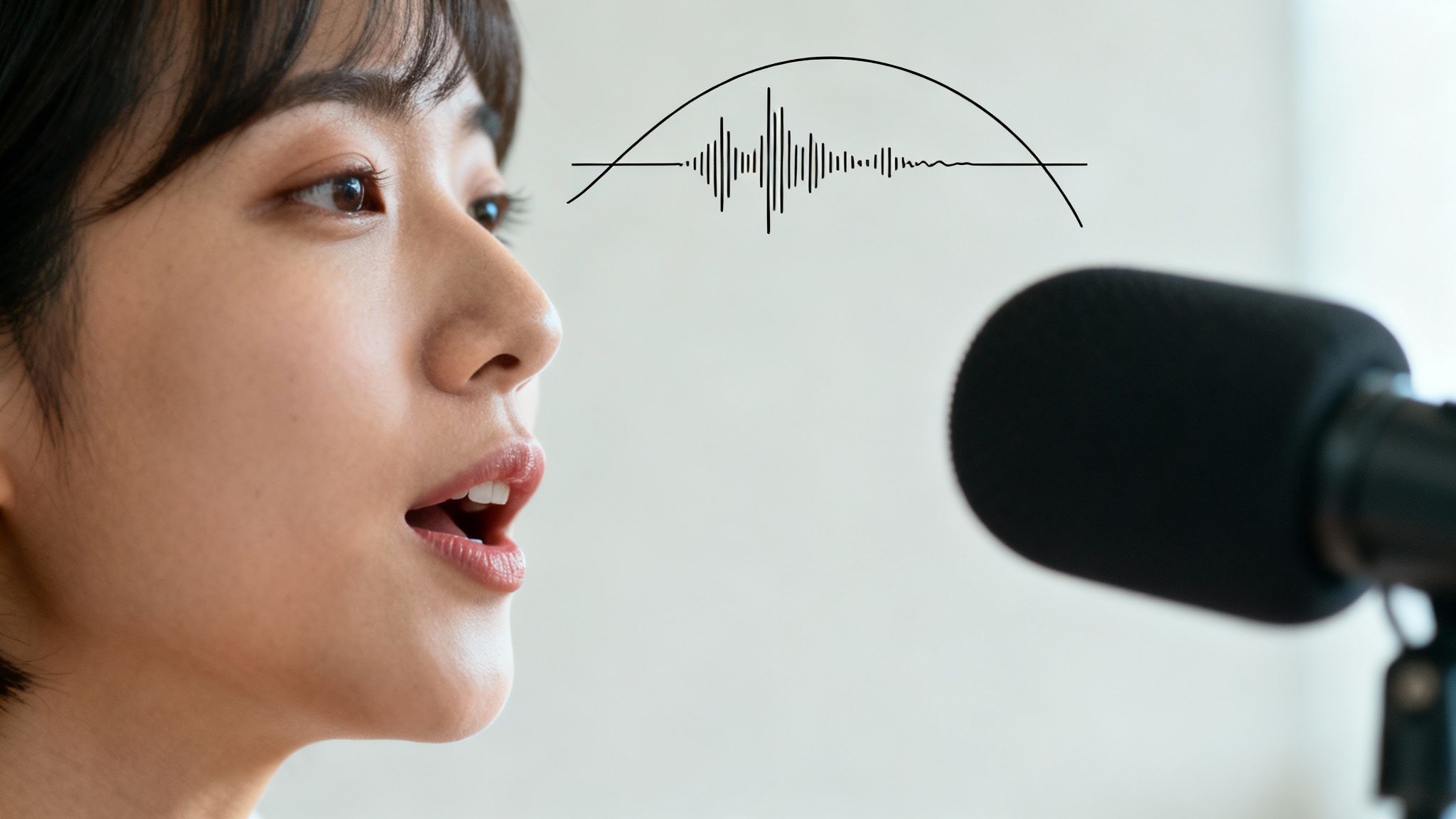
These drills focus on the “music” of English: word stress, sentence stress, and the rising and falling pitch patterns that convey emotion and grammatical meaning. For non-native professionals, developing strong prosodic skills is non-negotiable. It is what allows executives to sound confident, sales leaders to be persuasive, and healthcare providers to communicate with both clarity and empathy.
How to Implement Stress and Intonation Drills
A targeted approach is crucial for improving prosody. Instead of guessing, focus on the specific patterns that are most relevant to your professional communication. For a comprehensive guide, you can learn more about how to recognize and produce American English stress and intonation.
- Tech Professionals: Practice compound noun stress, distinguishing between ‘WHITEboard’ (a thing) and a ‘white BOARD‘ (a board that is white). This is critical for technical accuracy.
- Executives: Drill key messages by emphasizing different words to change the meaning and impact. For example, “I believe we will succeed” versus “I believe we will succeed.”
- Healthcare Providers: Use drills to master the rising intonation for questions (“Are you feeling any pain?”) and falling intonation for confident statements (“This medication will help.”).
Actionable Tips for Effective Practice
To integrate these drills into your routine effectively, follow these best practices:
- Exaggerate Deliberately: When first practicing, dramatically over-emphasize stressed syllables and pitch changes. This helps build the necessary muscle memory and makes the natural pattern feel easier.
- Mark Your Scripts: Take a presentation or meeting script and mark the stressed words and the rising/falling intonation at the end of phrases. Practice reading it with the marks, then without.
- Use Visualization Tools: Apps like Praat or other pitch analyzers can show you a visual representation of your intonation. Compare your pitch curve to that of a native speaker to get direct feedback.
- Focus on Word Families: Learn the predictable stress patterns for words with common suffixes, such as -tion, -ity, and -ic. For instance, words ending in -tion almost always have the stress on the syllable right before it (e.g., ‘inforMAtion’).
6. Record-and-Compare Self-Assessment Drills
Record-and-compare drills are powerful exercises on pronunciation that build critical self-awareness. This technique involves recording yourself speaking a specific phrase or passage and then directly comparing your recording to a native speaker’s version of the same content. By listening to the two versions side-by-side, you train your ear to spot subtle differences in vowel sounds, consonant articulation, intonation, and rhythm.
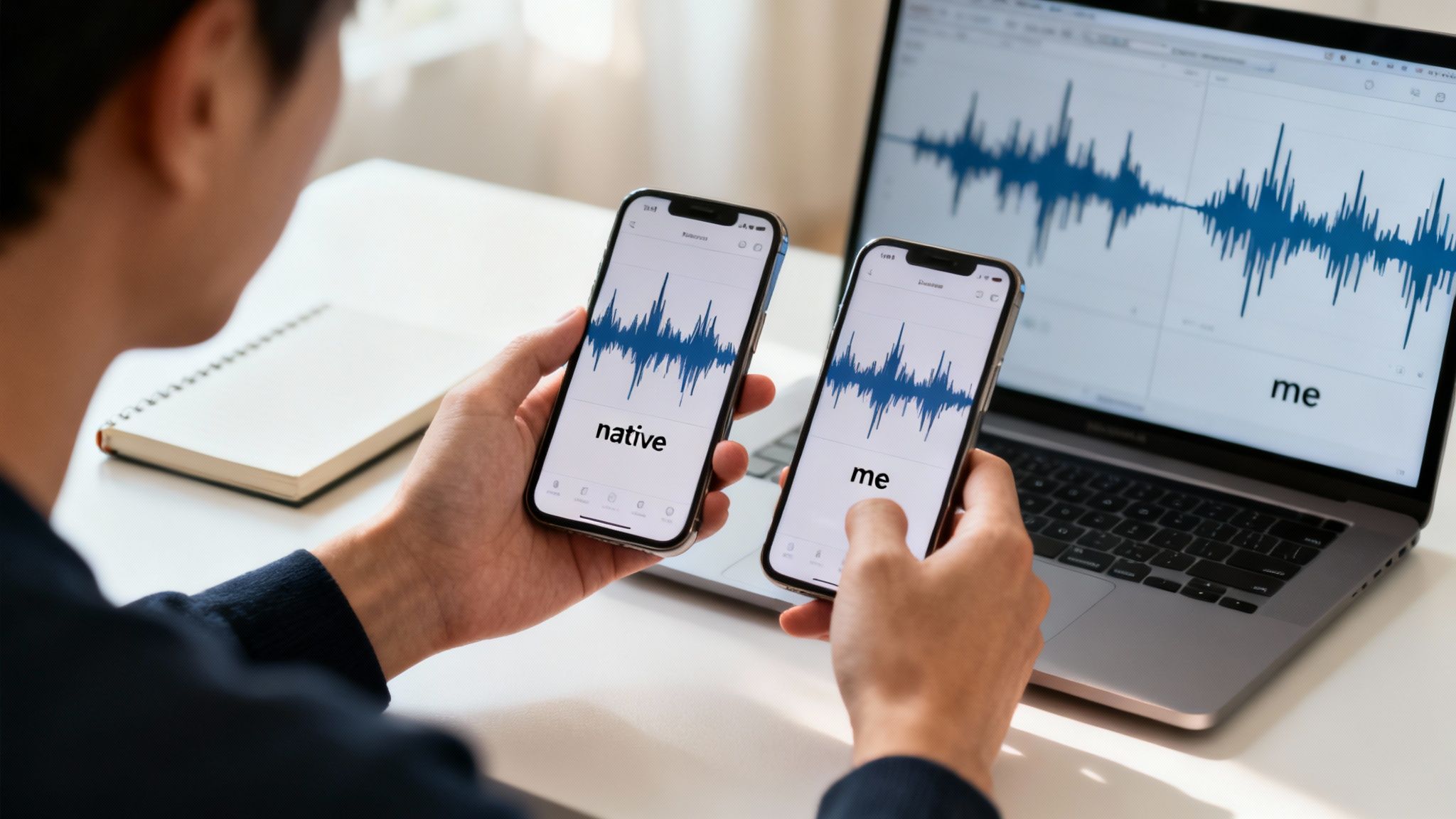
This method is highly effective for non-native professionals because it fosters independence and accelerates learning beyond formal coaching sessions. It develops your “auditory feedback loop,” the ability to monitor and correct your own speech in real-time. For leaders and technical experts, this skill is invaluable for maintaining clear, credible, and impactful communication in high-stakes environments.
How to Implement Record-and-Compare Drills
A systematic approach is key to making self-assessment work. Focus on content that mirrors your daily professional interactions, allowing you to practice the specific language you use most often.
- Sales Professionals: Record yourself delivering a key segment of your sales pitch. Compare it to a recording of a top-performing colleague or a training model.
- Executives: Record your elevator pitch or a portion of an upcoming presentation. Compare it against recordings of influential leaders in your field.
- Tech Professionals: Explain a complex technical concept aloud and record it. Compare your explanation to a clip from a conference talk or an expert tutorial on the same subject.
Actionable Tips for Effective Practice
To maximize the benefit of your self-assessment drills, focus on quality and consistency.
- Ensure Audio Clarity: Use a quality microphone to capture the nuances of your voice accurately. To accurately assess your pronunciation, high-quality audio recordings are essential, and choosing the best microphone for recording your voice can make a significant difference.
- Focus on Small Chunks: Instead of comparing entire passages, analyze one or two sentences at a time. Play the native version, then your version, and repeat. This makes it easier to pinpoint specific discrepancies.
- Take Detailed Notes: As you listen, jot down specific observations. For example: “My /æ/ in ‘manager’ sounds more like /e/,” or “My intonation was flat on the question.”
- Track Progress Over Time: Record the same script or passage weekly. Comparing your new recordings to older ones provides concrete evidence of your improvement and helps you stay motivated. Sharing these recordings with your Intonetic coach allows for expert feedback on what to prioritize next.
7. Rhythm and Pacing Exercises
Mastering the “music” of English requires more than just correct sounds; it demands control over rhythm and pacing. These exercises on pronunciation focus on developing the timing and flow characteristic of natural American English. English is a stress-timed language, meaning the rhythm is dictated by stressed syllables, not the total number of syllables. Many non-native speakers use syllable-timed patterns from their native language, resulting in a robotic or choppy delivery that can be difficult for listeners to follow.
Rhythm and pacing exercises train you to hold stressed syllables longer while compressing unstressed ones, creating a natural ebb and flow. For professionals, this is not a minor detail. Proper pacing conveys confidence, enhances clarity, and keeps your audience engaged, whether you’re presenting a product demo, explaining a diagnosis, or delivering a keynote address. It is the key to sounding fluent and authoritative.
How to Implement Rhythm and Pacing Exercises
A systematic approach is crucial for internalizing the stress-timed nature of English. The goal is to move from conscious, mechanical practice to an intuitive sense of timing in spontaneous speech. Select practice materials that mirror your professional communication needs.
- Tech Leaders: Practice the script of a product launch presentation, marking stressed syllables and strategic pauses to build anticipation and ensure clarity.
- Healthcare Professionals: Rehearse delivering complex medical information, using deliberate pacing and pauses to give patients time to process and ask questions.
- Executives: Work with transcripts of impactful speeches, analyzing how leaders use rhythm and silence to command attention and add gravitas to their words.
Actionable Tips for Effective Practice
To effectively integrate rhythm and pacing into your speech, focus on deliberate and consistent drills:
- Mark Your Scripts: Before practicing, go through your text and mark the primary stressed syllable in each thought group. Use visual cues like underlines or bolding to guide you.
- Use a Metronome: Start with a metronome app to build a steady beat. Tap out the rhythm on the stressed syllables only, saying the full sentences. This helps internalize the stress-timed pattern.
- Practice “Rubber Band” Stretching: Imagine a rubber band. As you say a stressed syllable, stretch the band out by elongating the vowel sound. For unstressed syllables, let it snap back by saying them quickly and lightly.
- Incorporate Strategic Pauses: Pauses are as important as words. Practice inserting a 2-3 second pause after delivering a key point or before revealing important information. This gives your audience time to think and dramatically increases your impact.
- Record and Analyze: Record yourself speaking a short paragraph. Listen back specifically for rhythm. Does it flow naturally, or does it sound staccato? Compare your recording to a native speaker delivering similar content.
8. Conversational Practice and Role-Play Simulations
Conversational practice and role-play simulations are powerful exercises on pronunciation that bridge the gap between isolated drills and real-world application. This method immerses you in realistic professional scenarios, compelling you to use target pronunciation patterns under authentic, high-stakes conditions. Instead of just repeating sounds, you engage in simulated meetings, client calls, or patient consultations where clear pronunciation directly impacts your communication goals.
This contextualized practice is essential for building automaticity and confidence. For non-native executives, tech professionals, and healthcare providers, role-play simulations test whether pronunciation improvements made in drills successfully transfer to spontaneous, functional speech. It forces your brain to recall and produce correct sounds, stress, and intonation while simultaneously managing the cognitive load of a real conversation.
How to Implement Role-Play Simulations
Effective role-play requires structuring simulations that mirror your most critical professional interactions. The goal is to create a safe environment to practice and receive targeted feedback before the stakes are real. This approach makes pronunciation an integral part of your overall communication effectiveness.
- Tech Professionals: Practice a product pitch presentation with a focus on clear enunciation and confident intonation to prepare for investor meetings.
- Healthcare Providers: Simulate patient consultation scenarios to ensure diagnoses and treatment plans are explained with clarity and empathy.
- Executives: Conduct mock board presentations or earnings calls, concentrating on an authoritative delivery that conveys leadership and credibility.
Actionable Tips for Effective Practice
To maximize the benefits of your role-play sessions, integrate these specific strategies:
- Start with Relevant Scenarios: Select situations that directly reflect your most important professional communication goals. Focus on the conversations that matter most to your career.
- Record and Review: Always record your simulations. Reviewing the recording with a coach provides an objective basis for detailed feedback on pronunciation, intonation, and pacing.
- Gradually Increase Complexity: Begin with lower-stakes simulations, like discussing an internal project, before advancing to high-stakes scenarios like a major sales negotiation or board presentation.
- Reduce Script Reliance: Start with a script if needed, but aim to gradually reduce your reliance on it. This builds your ability to produce correct pronunciation spontaneously. In a coaching program like Intonetic, this progression is carefully managed to build confidence and automaticity in tandem.
8-Exercise Pronunciation Comparison
| Method | Implementation 🔄 | Resources ⚡ | Expected outcomes ⭐ 📊 | Ideal use cases | Key advantages 💡 |
|---|---|---|---|---|---|
| Shadowing Practice | Moderate–High 🔄: real-time mimicry; cognitively demanding | Low–Medium ⚡: audio (podcasts/TED), headphones; coach helpful | High ⭐: faster prosody acquisition, improved naturalness and confidence 📊 | Executives, public speakers, tech/healthcare pros practicing presentations | Trains intonation/stress/rhythm and builds muscle memory |
| Tongue Twisters & Minimal Pairs Drills | Low–Medium 🔄: short repetitive drills | Low ⚡: none required; mirror/recorder optional | Medium–High ⭐: targeted articulation gains for priority phonemes 📊 | Busy professionals targeting specific sounds (/r/, /l/, /th/, /s/ vs /z/) | Isolates problematic phonemes; quick, repeatable practice |
| Vowel Chart Exercises | Medium 🔄: requires kinesthetic and anatomical understanding | Low–Medium ⚡: vowel chart, mirror, audio models; best with coach | High ⭐: clearer vowel production across vocabulary 📊 | Speakers from vowel-sparse languages (Japanese, Spanish, Mandarin) | Systematic mapping of tongue position → consistent vowel clarity |
| Connected Speech & Linking Drills | High 🔄: complex phonological patterns to internalize | Medium ⚡: natural speech samples, shadowing materials, coach feedback | High ⭐: smoother, more natural phrasing and better listening comprehension 📊 | Professionals needing conversational fluency and natural delivery | Converts isolated pronunciation into fluent, connected speech |
| Stress & Intonation Pattern Drills | High 🔄: needs pitch perception and integrated practice | Medium ⚡: audio samples, pitch-visualization tools, coach recommended | High ⭐: improved intelligibility and perceived authority 📊 | Executives, presenters, client-facing roles needing impact | Teaches stress timing and pitch contours that convey meaning/confidence |
| Record-and-Compare Self-Assessment Drills | Low–Medium 🔄: simple routine but requires discipline | Low ⚡: smartphone/computer recorder, model samples; coach optional | Medium ⭐: better self-awareness and measurable progress tracking 📊 | Learners practicing independently between coaching sessions | Objective side-by-side comparison; fosters autonomous correction |
| Rhythm & Pacing Exercises | High 🔄: integrates stress, timing, and pauses | Low–Medium ⚡: metronome/apps, scripts, recordings, coach guidance | High ⭐: perceived fluency, better pacing and listener comprehension 📊 | Presenters, healthcare explanations, speeches where timing matters | Teaches stress-timed rhythm and strategic pausing for clarity |
| Conversational Practice & Role-Play Simulations | High 🔄: time-intensive, realistic complexity | High ⚡: coach, participants, scenario prep, recording equipment | Very High ⭐: strong transfer to real-world performance and confidence 📊 | High-stakes contexts (pitches, consultations, board meetings) | High-transfer, contextualized practice with immediate corrective feedback |
From Practice to Performance: Integrating Your Pronunciation Workflow
Mastering the nuances of American English pronunciation is a journey of transformation, moving from conscious effort to subconscious skill. The comprehensive collection of exercises on pronunciation we’ve explored, from the mimicry of Shadowing to the precision of Minimal Pairs, are not just isolated drills. They are the fundamental building blocks of a powerful, integrated system designed to reshape your speech habits and amplify your professional impact. The true measure of success isn’t just knowing how to perform these exercises; it’s in building a consistent, intelligent workflow that embeds these new patterns into your everyday communication.
Think of it like building physical strength. You wouldn’t go to the gym once, do a random assortment of exercises, and expect lasting results. Instead, you follow a structured program that targets different muscle groups systematically. Your pronunciation practice deserves the same strategic approach.
Weaving the Threads: From Drills to Daily Habit
The ultimate goal is to bridge the gap between structured practice and spontaneous performance. The journey from the practice room to the boardroom requires a deliberate strategy for integration. This means moving beyond simply completing drills and starting to apply the underlying principles in real time.
Here’s how to synthesize the exercises from this guide into a cohesive workflow:
- Foundation First (Weeks 1-4): Dedicate this initial phase to awareness and accuracy. Your primary tools will be the Vowel Chart Exercises and Record-and-Compare Drills. Focus intensely on isolating individual sounds you struggle with. The goal isn’t speed; it’s precision. You are training your ear to hear the difference and your mouth to produce the target sound correctly.
- Building Fluency (Weeks 5-8): Now, begin connecting the dots. Shift your focus to Connected Speech and Linking Drills and Rhythm and Pacing Exercises. This is where you learn to blend those accurate individual sounds into the natural, melodic flow of American English. Shadowing becomes a critical daily habit here, helping you internalize the music of the language, not just the words.
- Performance Polish (Weeks 9-12): With a solid foundation in both accuracy and fluency, the final phase is about application and automation. This is where Conversational Practice and Role-Play Simulations take center stage. You’re no longer just drilling sounds; you’re delivering messages. Use these simulations to practice for high-stakes scenarios: a client presentation, a team negotiation, or a difficult conversation. This is also the perfect time to explore performance-based activities where your newfound clarity can truly shine, such as public speaking or even creating your own podcast, where vocal delivery is paramount.
The Power of a Systematized Approach
Without a system, even the best exercises on pronunciation can feel directionless, leading to frustration and stalled progress. A structured workflow, whether self-directed or guided by a coach, provides the necessary accountability and direction. It ensures you are not just practicing, but practicing the right things at the right time to achieve your specific goals.
This methodical progression-from sound-level accuracy to conversational confidence-is the key to unlocking lasting change. It transforms pronunciation from a daunting academic challenge into a manageable, empowering skill. You build not just clarity, but the unshakable confidence that comes from knowing you will be understood the first time, every time, allowing your expertise and ideas to take center stage. Your voice becomes a powerful asset, a tool that reflects the authority and intelligence you’ve worked so hard to achieve.
Ready to stop guessing and start transforming? A personalized roadmap is the fastest way to achieve clear, confident American English pronunciation, and Intonetic provides the expert guidance and structured framework to get you there. Let us build a custom plan using these very exercises, tailored to your unique voice and professional goals.
Book your free assessment today and discover your path to confident communication.