Pronunciation and Enunciation Mastery: Speak Clearly Today
People often use the words pronunciation and enunciation as if they mean the same thing, but they actually point to two very different parts of speaking well. Think of it this way: pronunciation is about making the correct sounds for words, while enunciation is about delivering those sounds clearly and distinctly.
One is about accuracy, the other is about clarity. Both are critical.
The Difference Between Sounding Right and Speaking Clearly
Have you ever listened to someone who clearly knows the right words, but you still find yourself leaning in, struggling to catch what they’re saying? The problem isn’t their vocabulary. It’s almost always a breakdown in the mechanics of their speech—and that’s where the distinction between pronunciation and enunciation becomes so important.
Let’s use a simple analogy. Imagine you’re a chef.
Pronunciation is like choosing the right ingredients. If a recipe calls for basil and you grab mint instead, the final dish is going to taste fundamentally wrong, no matter how skilled you are. In speech, saying “ship” when you mean “sheep” is a pronunciation error. You’ve used the wrong sound “ingredient.”
Enunciation, on the other hand, is your culinary skill. It’s how you prepare and present the dish. Did you chop the vegetables precisely? Did you combine the ingredients so that each flavor stands out? Mumbling, slurring, or speaking too quickly is like throwing all those perfect ingredients into a blender and serving up an indistinct mush. The right parts are there, but they’re delivered without clarity.
Why This Distinction Matters
Getting this difference is the first real step toward becoming a more effective and powerful speaker. Many non-native speakers, for example, pour all their energy into pronunciation—mastering new vowels and consonants. That’s essential, but it’s only half the battle.
Interestingly, many native speakers struggle more with enunciation. They fall into lazy speech habits like talking too fast, not opening their mouths enough, or trailing off at the end of sentences.
Both skills are absolutely essential if you want your ideas to land with impact. Mastering both is what separates merely adequate speech from truly professional communication. You can learn more about how accents can shape perception in our article on the real-world impact of having a foreign accent.
Clear speech isn’t just about being understood; it’s a direct reflection of your credibility and confidence. When you speak clearly, you command attention and build trust with your audience, ensuring your message is not only heard but also respected.
To give you a clearer picture, here’s a quick-glance table breaking down the two concepts.
Pronunciation vs Enunciation At a Glance
| Concept | What It Is (The Analogy) | Common Problem Example |
|---|---|---|
| Pronunciation | The correct ingredients in a recipe. | Saying “sink” instead of “think” (using the wrong sound). |
| Enunciation | The skillful preparation and presentation of the dish. | Mumbling the word “probably” so it sounds like “prolly” (slurring sounds together). |
This table makes it easy to see how both elements work together to create a polished, professional final product: clear speech.
This concept map below illustrates perfectly how these two pillars work together to support overall speech clarity.
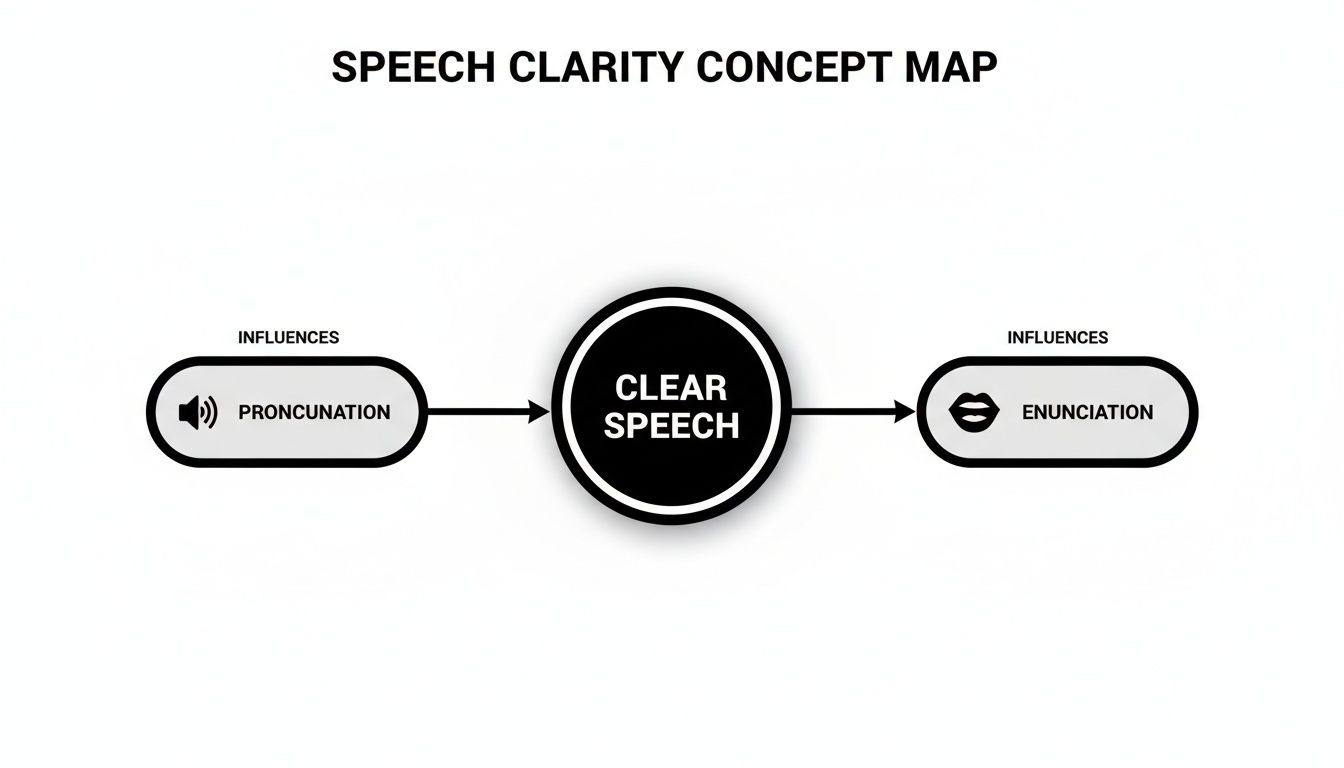
As the visual shows, you need both the accuracy of sounds (pronunciation) and the clarity of their delivery (enunciation) to be truly understood.
The Professional Impact of Clear Speech
The stakes here are much higher than just being understood in a casual chat. Research shows that listeners often judge a speaker’s competence and credibility based on their speech clarity.
In fact, one study found that clear speech can influence up to 80% of hiring decisions in competitive job markets. It’s not just about sounding polished; it’s a critical tool for professional advancement. Improving your pronunciation and enunciation is a direct investment in your career.
Pronunciation: Building Your Foundation of Sound
If enunciation is all about the delivery of your message, pronunciation is the very substance of it. Think of it this way: pronunciation gives you the raw materials—the individual sounds—that you need to speak a language clearly. Without the right materials, even the most skilled builder can’t construct a sturdy house.

At the heart of pronunciation are phonemes, which are just the smallest, distinct units of sound in a language. Don’t let the technical term intimidate you. They’re like the primary colors on an artist’s palette. With just a handful of colors, an artist can mix and blend them to create a masterpiece. English works the same way with its roughly 44 phonemes. Mastering each one is the first real step toward clear, accurate speech.
The Physical Craft of Making Sounds
Producing a sound isn’t an abstract concept; it’s a physical act. Your mouth, tongue, lips, and vocal cords are your instruments, and learning to play them together is a skill. Tiny adjustments in how you use these “instruments” can create completely different sounds.
This is exactly why some English sounds are so tough for non-native speakers. The difference between the vowel in ‘live’ and ‘leave,’ for example, is just a small shift in how high and tense your tongue is. That tricky ‘th’ sound? It requires you to place the tip of your tongue gently between your teeth—a movement that simply doesn’t exist in many other languages.
To really improve your pronunciation and enunciation, you have to become a student of these micro-movements. Once you understand the mechanics, it all starts to click.
- Tongue Placement: Where is your tongue? For a ‘k’ sound, the back of your tongue rises to touch the roof of your mouth. For an ‘l’ sound, the very tip of your tongue touches just behind your top front teeth.
- Airflow: Are you stopping the air completely, like in a ‘p’ or ‘b’ sound? Or is it flowing continuously, like in an ‘s’ or ‘f’? This tiny distinction is what makes consonants sound crisp and clear.
- Voicing: Are your vocal cords vibrating or not? Try this: put your hand on your throat and say “zoo,” then “sue.” You’ll feel a buzz for “zoo” but not for “sue.” That vibration is the only difference—your mouth is in the exact same position for both.
If you want to go deeper on this, our complete guide on how to pronounce all 44 sounds in English is the perfect next step.
Understanding Sound Variations in Natural Speech
Here’s where it gets interesting. Perfect pronunciation isn’t just about making sounds in isolation. It’s about understanding how those sounds change and adapt in the flow of natural, everyday conversation. Native speakers are constantly making tiny, predictable tweaks to sounds based on what comes before and after them.
A classic example in American English is the “flap t,” where the /t/ sound in words like ‘water’ or ‘pretty’ softens to sound more like a ‘d’. This isn’t a mistake; it’s a standard feature of the accent. In fact, it happens in over 80% of cases where a ‘t’ falls between two vowel sounds.
Research actually shows that native listeners process these flapped forms 15-20% faster than the “textbook” versions because they are so common and expected. The brain is wired to anticipate these natural shortcuts.
This highlights a huge challenge for learners. You can’t just master the dictionary version of a word; you also have to learn its common variations in real-world speech. This is why listening to and imitating native speakers is non-negotiable. It helps you develop an intuitive feel for the rhythm and melody of the language, moving you away from robotic, word-by-word pronunciation and toward smooth, connected speech.
Enunciation: Turning Sounds Into Crystal-Clear Words
If pronunciation gives you the right ingredients for speech, enunciation is the masterful technique that turns them into a polished, memorable meal. It’s the art of delivering those sounds with absolute precision and clarity.
Enunciation is what separates a crisp, confident speaker from someone whose words blur into an unintelligible stream.

Think of a beautiful string of pearls. Pronunciation makes sure each pearl is perfectly round and lustrous—the correct sound. But enunciation is the strong, invisible string holding them together, giving each pearl its own space while creating a coherent, elegant whole. Without it, you just have a jumbled mess.
The Physical Skill of Clarity
Great enunciation isn’t a matter of luck; it’s a physical skill, much like an athlete training for an event. The primary muscles involved are your articulators: the jaw, lips, and tongue. When these muscles are weak or undertrained, speech becomes lazy and indistinct.
This leads to common pitfalls that undermine even the most well-pronounced words:
- Mumbling: This is what happens when you don’t open your mouth enough, trapping sounds and causing words to bleed into one another.
- Rushing: Speaking too quickly forces syllables to collide, making it nearly impossible for your listener to keep up and process your message.
- Dropping Word Endings: A very common habit is clipping off the ends of words, like saying ‘runnin’ instead of ‘running’ or ‘frien’ instead of ‘friend’.
These habits are often subconscious, but they can dramatically reduce how well you’re understood. The good news is that, like any muscle group, your articulators can be strengthened with targeted practice. For a deeper dive, our guide offers practical advice on how to enunciate better.
Enunciation is the final polish on your speech. It ensures that the effort you put into correct pronunciation isn’t wasted, allowing every word to be heard and understood exactly as you intend.
Why Enunciation Creates Authority
When someone speaks with sharp, clear enunciation, we instinctively perceive them as more credible and authoritative. Crisp articulation signals confidence and conviction. Mumbled or slurred speech, on the other hand, can project uncertainty or a lack of care, even if that’s not what you intend at all.
Take the word “probably.” Many people casually say “prolly” or “probly.” While common, this slurring of syllables can detract from a professional tone. Clearly articulating all three syllables—pro-ba-bly—instantly makes your speech sound more deliberate and polished. The same goes for saying “going to” versus “gonna” or “want to” versus “wanna.”
It’s about making a conscious choice to be clear. That choice translates directly into how much weight your words carry.
Building Enunciation Muscle Memory
The key to improving is consistent, conscious practice. It’s about retraining the muscles of your mouth to move more deliberately and completely. You have to break old, lazy habits and build new ones based on precision.
Here are a few foundational principles to get you started:
- Exaggerate Your Movements: When practicing, intentionally over-articulate words. Open your jaw wider than feels natural. Stretch your lips more. This helps build strength and flexibility.
- Focus on Consonants: Crisp consonants are the skeleton of clear speech. Pay special attention to final consonants like ‘t’, ‘d’, ‘k’, and ‘g’, making sure they are fully formed and audible.
- Slow Down Your Pace: Deliberately slowing your speech rate gives your articulators the time they need to move correctly from one sound to the next without tripping over words.
Mastering pronunciation and enunciation together is the ultimate goal. While pronunciation provides the accuracy, enunciation delivers that accuracy with undeniable clarity and impact, making sure your message isn’t just spoken, but truly heard.
Your Daily Practice Plan for Audible Improvement
Knowing the theory behind clear speech is one thing, but real change happens when you put that knowledge into action—consistently. This is where you start building muscle memory. Think of a daily practice plan as the bridge between knowing what to do and actually hearing a difference in your own voice.
You don’t need hours. Just a few focused minutes each day can lay the foundation for huge improvements in both your pronunciation and enunciation. When it comes to building a new skill, consistency beats intensity every single time. A short, manageable routine creates a powerful habit that pays dividends down the road.
Drills for Sharpening Pronunciation
Pronunciation drills are all about retraining your ear to hear subtle differences and your mouth to produce specific sounds accurately. They’re designed to isolate those tricky sounds that might not exist in your native language, forcing your brain and mouth to get on the same page.
- Minimal Pair Exercises: This is the cornerstone of effective pronunciation work. Minimal pairs are two words that are identical except for one single sound. Practicing them back-to-back is like weightlifting for your ears and mouth—it trains you to both hear and produce the tiny distinctions that change a word’s entire meaning.
- Example 1 (‘ee’ vs ‘i’): sheep / ship, leave / live, heat / hit
- Example 2 (‘th’ vs ‘s’): think / sink, thigh / sigh, mouth / mouse
- Targeted Tongue Twisters: Forget the generic ones from childhood. Pick twisters that specifically target the sounds you find challenging. If the ‘r’ sound gives you trouble, repeating “Around the rugged rock, the ragged rascal ran” is far more valuable than a random twister about seashells. It focuses your effort where it will make the biggest impact.
Practice Blueprint: Spend just 5 minutes a day on minimal pairs. Say each pair out loud three times, really focusing on the different mouth shapes and sounds. Better yet, record yourself on your phone to hear what an objective listener hears.
Exercises for Crystal-Clear Enunciation
While pronunciation is about getting the sounds right, enunciation is about delivering them clearly. These drills build the physical strength and control you need for crisp, precise articulation. Think of it as a workout for your jaw, lips, and tongue.
- Exaggerated Mouth Movements: Grab a book or an article and read a paragraph out loud in front of a mirror. Intentionally over-articulate every single word. Open your jaw wide, stretch your lips, and make every consonant pop. It feels ridiculous, but it’s incredibly effective at building the muscle memory needed for clear speech.
- The Pencil Drill: This is a classic for a reason—actors and public speakers have been using it for decades. Just place a clean pencil or cork horizontally between your front teeth and try to read a text out loud. Your tongue and lips have to work overtime to form words around the obstacle. After a minute of this, take the pencil out. You’ll be amazed at how much clearer and more effortless your speech feels.
- Self-Recording and Analysis: Your phone’s voice recorder is your most honest coach. Record yourself reading a few sentences or just talking about your day. When you listen back, be a detective:
- Am I dropping the final sounds off words like “and” or “friend”?
- Am I mushing words together, like saying “gonna” instead of “going to”?
- Is my pacing too fast, causing my words to blur into each other?
For anyone serious about upgrading their delivery, exploring a variety of practical exercises for improving speaking skills can provide that extra boost of confidence and clarity.
Putting It All Together in a Weekly Plan
A structured plan takes the guesswork out of practice. When you know exactly what to do each day, you’re far more likely to stick with it and see real progress.
Here’s a simple schedule to get you started.
Your Weekly Speech Clarity Practice Plan
| Day | Focus Area | Drill Example (5-10 minutes) |
|---|---|---|
| Mon/Wed/Fri | Pronunciation | Minimal pairs for a target vowel sound (e.g., ‘a’ in cat vs. ‘u’ in cut) |
| Tue/Thu/Sat | Enunciation | Pencil drill followed by reading a news article aloud with exaggeration |
| Sunday | Review & Relax | Record a 1-minute summary of your week and listen for improvements |
And this isn’t just theory—it’s backed by research. One study showed that language learners who used targeted pronunciation strategies saw major gains in just 10 weeks. The groups using these strategies improved their narration clarity by 28% compared to those who didn’t.
This just goes to show that a dedicated, strategic plan truly is a game-changer. For a deeper dive into making this a sustainable habit, our guide on how to practice English pronunciation daily for rapid progress has you covered.
By combining these targeted drills for both pronunciation and enunciation, you create a powerful synergy that turns deliberate daily practice into audible, real-world improvement.
Using Technology to Accelerate Your Progress
You don’t have to practice your speech in a vacuum, blindly guessing whether you’re making any real progress. Today, a whole suite of powerful tools can act as your personal, on-demand speech coach, giving you the kind of objective feedback that used to be available only through one-on-one training. Tapping into this tech can seriously speed up your journey to clearer pronunciation and enunciation.
The most powerful of these tools are the AI-driven speech applications. These apps do way more than just record your voice; they provide instant, data-driven analysis of how you speak.
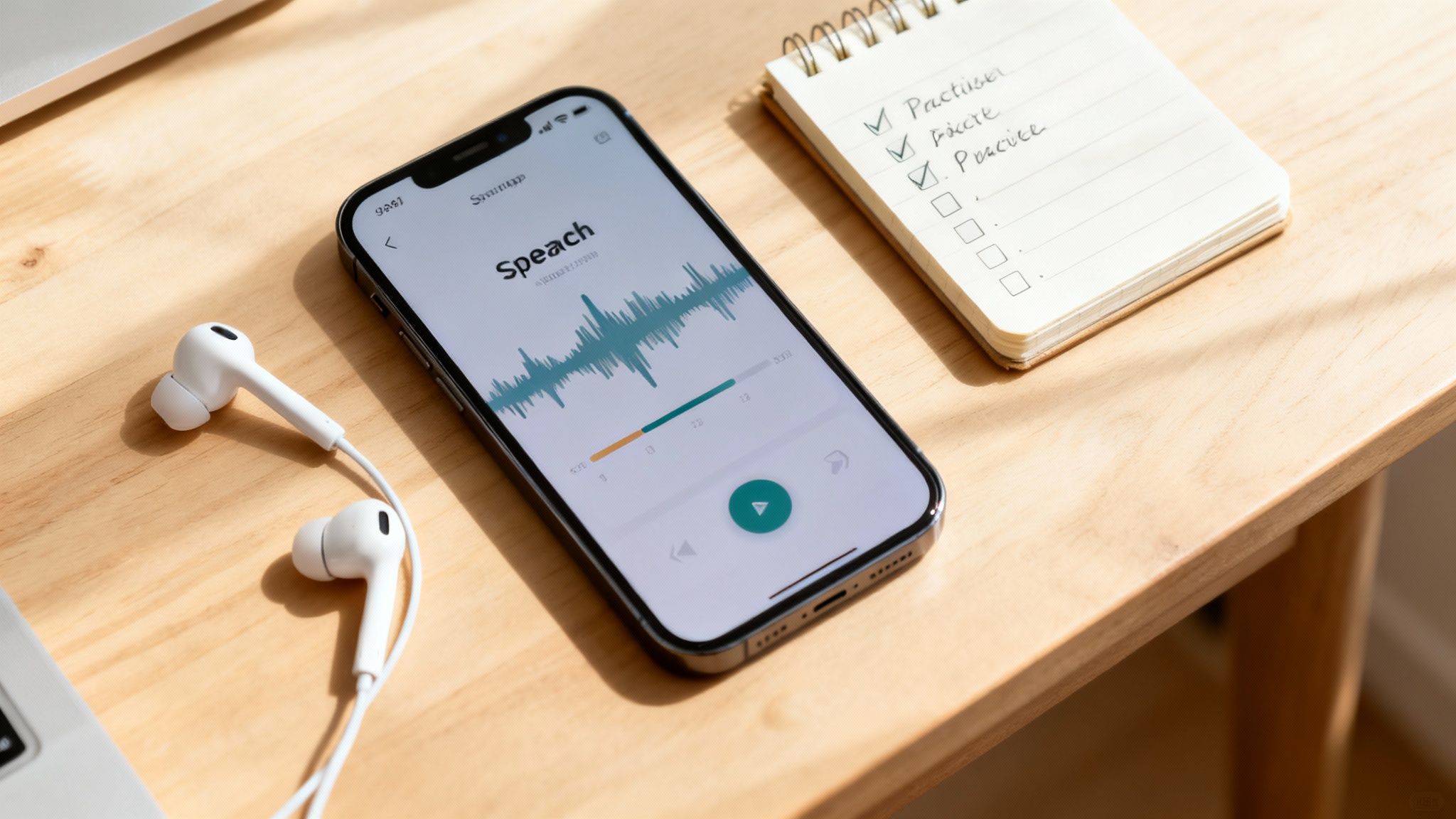
They can pinpoint the exact sounds you’re struggling with, flag mispronounced words, and even show you a visual of your sound waves compared to a native speaker’s. This kind of detailed feedback is a total game-changer for making targeted improvements. There are even tutorials showing how to train AI with pronunciation guides, which gives you a peek behind the curtain at how this tech works.
Key Features in Modern Speech Apps
When you’re looking at these tools, keep an eye out for a few specific features that will give you the most bang for your buck. Not all apps are built the same, and the right features make all the difference.
- Waveform Analysis: This gives you a picture of your sound. It lets you visually compare the pitch, stress, and rhythm of your speech against a native model. Suddenly, abstract concepts like intonation become tangible things you can see and fix.
- Phoneme-Level Feedback: The best apps don’t just say a word was wrong; they tell you why. They can isolate specific sounds—like flagging that your /æ/ in “cat” is too close to the /ɛ/ in “ket”—giving you surgical precision in your practice.
- Shadowing Exercises: Many platforms have exercises where you listen to a native speaker and repeat the phrase right after them. This is fantastic for mastering the natural flow of English and moving beyond robotic, word-by-word speech.
If you want a deeper dive, our guide on how to improve American English pronunciation using online tools and apps has a comprehensive list of options.
Technology’s greatest strength is its ability to provide immediate, unbiased feedback. An app won’t hesitate to tell you you’ve mispronounced a word for the tenth time, turning what could be a frustrating blind spot into a clear area for improvement.
The Power of Your Smartphone Recorder
While AI apps are great, don’t overlook the simple but incredibly effective tool that’s already in your pocket: your phone’s voice recorder. Recording yourself is the most direct way to close the gap between how you think you sound and how you actually sound.
The trick is to listen back with a critical ear, as if you were your own coach. Don’t just listen for mistakes; listen for patterns.
Try this simple checklist as you review your recordings:
- Pacing: Am I talking way too fast? Do my words sound rushed or jumbled together?
- Clarity: Are there any mumbled words or phrases? Can I clearly hear the beginning and end of every single word?
- Consonants: Am I dropping the final consonants on words like “friend,” “and,” or “kept“? Crisp consonants are the backbone of clear enunciation.
- Fillers: How often am I leaning on crutch words like “um,” “ah,” or “like”?
By consistently recording and analyzing your own speech, you become the active driver of your progress. This self-awareness is empowering, letting you spot and systematically fix the specific habits holding you back and making every practice session count.
Self-practice and technology are great for building a solid foundation in clearer speech, but sometimes you just hit a wall. Your progress stalls, and those same stubborn errors keep popping up no matter what you try. This plateau is a crucial signal—it might be the perfect time to think about investing in a professional speech or accent coach.
A coach brings something to the table that apps and self-recording just can’t: expert, personalized feedback on your unique speech patterns. They are trained to hear the subtle issues you’ve long since stopped noticing in your own voice. We often call these fossilized errors—mistakes that have become so ingrained they feel completely normal to you, yet they may still trip up your listeners.
Beyond Basic Drills
Working with a coach is a world away from running through generic exercises. Their job is to build a custom roadmap just for you and your goals, giving you a level of precision that makes progress happen much faster than self-study ever could.
This specialized guidance is especially powerful in a few key situations:
- High-Stakes Communication: If you’re gearing up for a major presentation, a make-or-break job interview, or a conference talk, a coach can help you polish your delivery so you’re clear and impactful, even under pressure.
- Nuanced Speech Elements: Nailing individual sounds is only part of the puzzle. A coach provides focused training on the more complex layers of spoken English, like rhythm, word stress, and intonation—the very things that make speech sound natural and authoritative.
- Targeted Error Correction: Instead of a scattergun approach, a coach helps you pinpoint and zero in on the 10-12 highest-impact sounds that will give you the biggest boost in your overall clarity.
A professional speech coach acts as both a mirror and a guide. They show you exactly where the friction points are in your speech and give you the specific tools and strategies to smooth them out for good.
Ultimately, hiring a coach is a strategic investment in your professional growth. When you’ve pushed self-practice as far as it can go, an expert provides that final push to break through barriers. It’s about moving from just being understood to becoming a truly clear, compelling, and confident communicator in any professional setting.
A Few Common Questions About Speech Clarity
Even when you have a solid game plan, a few questions always pop up along the way. Let’s tackle some of the most common ones I hear from clients to clear up any confusion and keep you moving forward with confidence.
How Long Does It Take to Improve Pronunciation and Enunciation?
This is always the first question, and the honest answer is: it really depends. Your starting point, native language, and how consistently you practice are the biggest factors.
That said, with focused daily practice of just 15-20 minutes, most people tell me they can feel and hear a real difference in their clarity and confidence within just 4 to 6 weeks. Getting to the point where the changes feel completely natural and automatic—that often takes several months of dedicated effort.
The secret isn’t cramming for hours on the weekend. It’s the consistent, deliberate daily practice that builds new muscle memory for your mouth and retrains your ear. That’s where the magic happens.
Can I Reduce My Accent Without Losing My Identity?
Absolutely. In fact, this is a critical point we need to get right. The goal of accent modification is never to erase who you are or where you come from. It’s about enhancing your clarity so that you’re easily and accurately understood by the widest possible audience.
I encourage my clients to think of it as accent addition, not accent elimination. You’re simply adding a new communication style to your professional toolkit. A good coach focuses on tweaking the specific sound patterns that cause miscommunication, all while preserving the unique character of your voice. Your identity is a strength; clear speech just makes sure it gets heard.
What Is the Single Most Effective Habit for Better Enunciation?
If I had to pick just one habit to build, it would be this: slow down. I’ve seen it time and time again—consciously reducing your speaking rate by just 10-15% has an immediate and massive impact on your clarity.
Slowing down gives your brain a moment longer to line up your thoughts and your mouth the time it needs to physically form each word correctly. This one simple change stops words from blurring together, cuts down on mumbling, and gives every consonant and vowel the space it needs to be heard. It truly is the foundation for every other improvement in enunciation.
Ready to see how personalized guidance can transform your professional communication? At Intonetic, we build a plan focused on your unique voice and goals, helping you speak with the clarity and confidence you deserve. Book your free assessment today to get started.