
Mastering Influence With Executive Communication Skills Training
Executive communication skills training isn’t just about polishing your public speaking. It’s a specialized program designed to completely reshape how leaders convey their vision, influence stakeholders, and ultimately, drive action. It goes far beyond the basics, building the strategic capabilities you need for high-stakes interactions. Done right, every single communication becomes an opportunity to strengthen your influence and align your entire organization.
Unlocking Leadership Potential Through Strategic Communication
At its heart, executive communication training isn’t about memorizing a script; it’s about mastering an instrument.
Think of a CEO. Their ideas might be groundbreaking, but if they can’t articulate them with genuine clarity and conviction—whether in a boardroom, an all-hands meeting, or a media interview—those ideas lose their power. This training is what bridges that critical gap between a great vision and real-world impact.
It’s a common myth that great communicators are just born that way. The truth is, the most influential leaders I’ve worked with are the ones who continuously refine their abilities. They learn to command a room not through sheer volume, but through presence. They persuade not by dumping data, but by weaving compelling stories that make complex strategies relatable and impossible to forget. This is the very essence of what this training delivers.
From Good Speaker to Influential Leader
The leap from being a competent manager to a truly influential executive almost always hinges on mastering a unique set of communication skills. This is so much more than just being articulate. It’s about developing the ability to:
- Build Consensus: Unify diverse groups, from skeptical board members to frontline employees, around a single, shared objective.
- Navigate Crisis: Communicate with calm, clarity, and authority when the pressure is at its absolute highest, maintaining trust when it matters most.
- Inspire Action: Move teams from simple compliance to genuine, passionate commitment, motivating them to pour their best efforts into the company’s mission.
Effective executive communication is the ability to turn strategy into a story, a directive into a dialogue, and a moment of pressure into an opportunity for trust. It is the operational engine of leadership.
This is fundamentally different from generic business communication training. To even begin, you have to understand the core principles, which you can explore further in these 10 Business Communication Best Practices. This targeted training equips executives to handle the distinct challenges of their roles, transforming every single interaction into a strategic asset.
The Core Competencies of Influential Executives
True leadership influence isn’t some magic trait you’re born with; it’s a set of distinct, coachable skills. Executive communication skills training is designed to build these exact capabilities, transforming a leader from an effective manager into a genuinely influential figure. These competencies are the bedrock that allows executives to build trust, inspire action, and drive real business results.
At its heart, executive communication is a pyramid of skills. It all starts with clarity, which then supports strategy, and ultimately leads to influence.
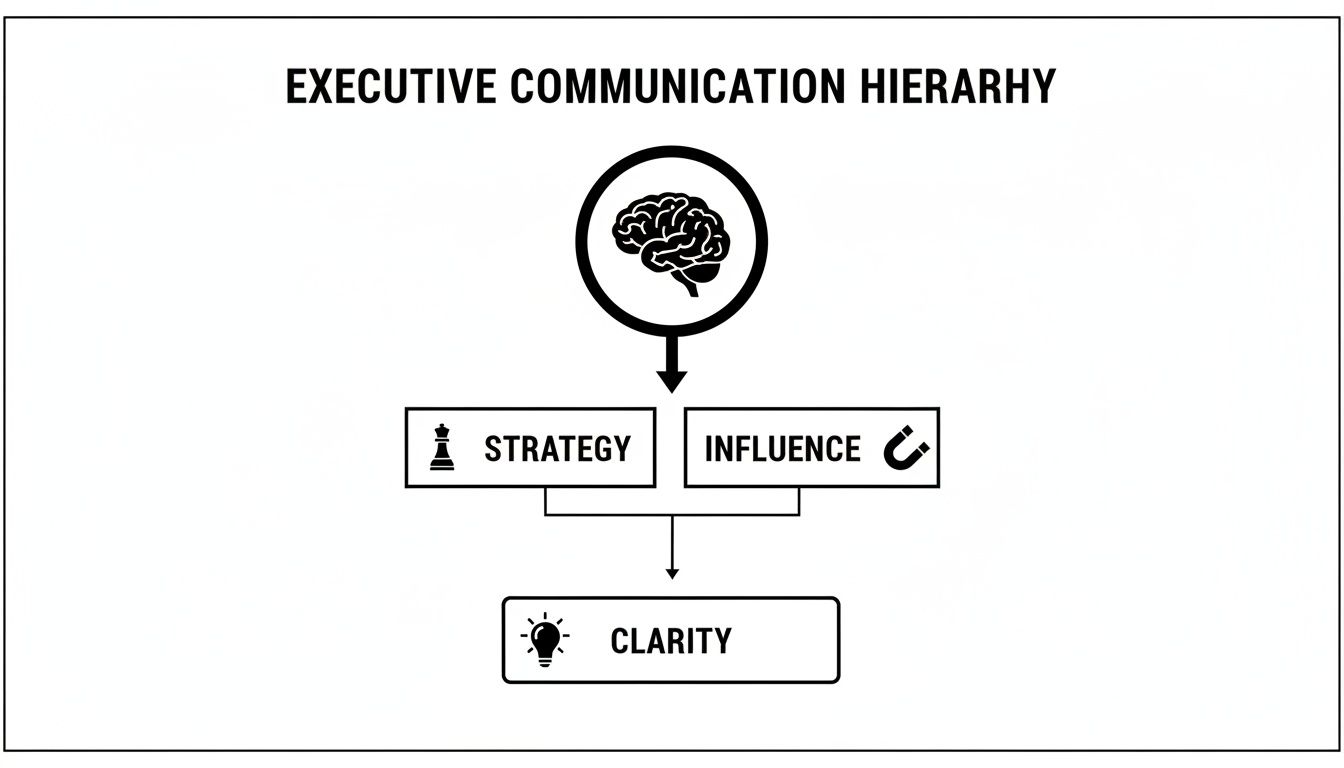
This hierarchy makes one thing clear: without a solid foundation of clarity, advanced skills like strategy and influence are simply out of reach. Let’s break down the core skills that make it all happen.
To really grasp the shift in thinking, it helps to see how these executive skills build upon everyday communication.
Comparing Basic Communication vs Executive Communication Competencies
This table shows the leap from simply conveying information to strategically shaping outcomes.
| Competency | Basic Communication Skill | Executive Communication Skill |
|---|---|---|
| Clarity | Giving clear instructions | Distilling complex strategies into a simple, compelling vision |
| Presence | Speaking confidently | Commanding a room with gravitas, even under pressure |
| Persuasion | Making a good argument | Aligning stakeholder interests and driving consensus toward action |
| Storytelling | Sharing an anecdote | Weaving data and vision into a narrative that inspires commitment |
| Crisis | Relaying updates | Projecting calm, control, and a clear path forward in high-stakes situations |
As you can see, executive communication isn’t just a more polished version of basic skills—it operates on a completely different strategic level.
Executive Presence and Gravitas
Have you ever met someone who commands a room the moment they walk in, even before they say a word? That’s executive presence. It’s a powerful mix of composure under fire, confident body language, and a vocal tone that just radiates authority.
It’s the difference between merely presenting data and truly owning the narrative. This is critical because stakeholders, investors, and employees make snap judgments about a leader’s competence. A leader with gravitas can calm a tense room, build instant rapport, and project unshakable conviction.
Strategic Storytelling
Facts and figures inform, but they rarely inspire. Stories are what persuade. Strategic storytelling is the art of weaving data, company goals, and your vision into a narrative that sticks with people. Instead of just listing quarterly targets, an influential leader frames them as the next chapter in the company’s story of growth and overcoming challenges.
This works because our brains are fundamentally wired for story. A well-crafted narrative makes a complex strategy feel simple, relatable, and worth fighting for. It helps every employee see their part in a bigger mission, turning mere compliance into genuine commitment.
“Persuasion is not about pushing your ideas onto others. It’s about guiding them to a shared conclusion, making them feel the idea was theirs all along. This is the essence of communication-driven impact.”
Persuasion and Impact
Beyond just telling a good story, executives have to master the art of persuasion—moving people from listening passively to taking decisive action. This involves digging deep to understand what motivates your audience, anticipating their objections, and structuring your arguments for maximum impact.
Of course, the most persuasive argument in the world falls flat if it isn’t delivered clearly. Poor articulation can instantly undermine your authority, which is why fundamental skills like learning how to enunciate better are a non-negotiable part of the process. This foundational clarity is what gives your persuasive message its power.
The business impact is huge. Teams that communicate effectively see productivity jump by up to 25%, showing a direct line between a leader’s communication skills and the company’s bottom line. Developing these skills is also a cornerstone of Thought Leadership Marketing, where you position your ideas to naturally influence your entire industry.
Crisis Leadership Communication
Nothing tests an executive’s communication skills like a crisis. When things go wrong, the ability to project calm, clarity, and a decisive plan is everything. This is where true leaders are made.
This competency breaks down into three key actions:
- Rapid Response: Getting clear, concise information out fast to take control of the narrative.
- Empathy and Transparency: Acknowledging the problem and showing genuine concern for everyone affected.
- Confident Direction: Laying out the concrete steps you’re taking to fix the issue and restore trust.
Getting crisis communication right can save a company’s reputation, steady employee morale, and reassure stakeholders when they need it most. It’s in these moments that communication moves from a “soft skill” to a core strategic asset.
Finding the Right Training Format for Your Leaders

Effective executive training is never a one-size-fits-all solution. A format that works wonders for one leader might fall completely flat for another, which makes the selection process a strategic decision in itself. The right program has to align with an executive’s specific challenges, their preferred learning style, and—let’s be honest—their incredibly demanding schedule.
Choosing the right format is a bit like a craftsman selecting the right tool for a job. You wouldn’t use a sledgehammer for delicate woodworking, and in the same way, a generic workshop probably won’t address the nuanced communication needs of a C-suite leader navigating a unique organizational challenge. Luckily, the modern training landscape offers plenty of paths to mastery.
Despite the obvious benefits, executive-level communication training remains surprisingly inconsistent. Only about 32% of organizations offer comprehensive communication skills training across all management levels, a number that reveals a significant gap between need and action. This makes choosing the right program, when the opportunity arises, even more critical for gaining a competitive edge.
One-on-One Executive Coaching
Think of one-on-one coaching as a bespoke suit, tailored perfectly to the individual. This is the most personalized format available, designed to focus intensely on a leader’s specific goals and blind spots. It’s the ideal choice for senior executives preparing for high-stakes events like an IPO roadshow, a major media appearance, or steering the company through a complex organizational change.
The process is deeply collaborative and often involves:
- 360-Degree Feedback Analysis: The coach dives into feedback from peers, direct reports, and superiors to pinpoint exactly where to focus.
- Real-Time Scenario Practice: Sessions are spent workshopping upcoming presentations, rehearsing difficult conversations, or prepping for a pivotal board meeting.
- Confidential Sounding Board: The coach acts as a safe, confidential space for leaders to explore challenges and refine their messaging strategy away from the public eye.
This intensive, private format is all about accelerating growth by providing direct, actionable feedback that an executive can put to use immediately.
Small-Group Workshops and Cohorts
While one-on-one coaching offers incredible depth, small-group workshops provide breadth and a powerful collaborative energy. In this setting, leaders learn not only from the facilitator but also from the shared experiences and different perspectives of their peers. It’s an excellent way to build a consistent communication culture across an entire leadership team.
The dynamic nature of a small group allows for interactive exercises, peer-to-peer feedback, and group problem-solving. This creates a unique learning environment where executives can practice new skills with colleagues who are facing similar pressures.
The real magic of a group setting is the moment a leader realizes their communication challenges aren’t unique. That shared vulnerability builds trust and accelerates collective improvement, forging a stronger, more aligned leadership team.
These workshops often concentrate on specific competencies, like strategic storytelling or crisis communication, ensuring the whole team develops a common language and approach.
Virtual Masterclasses and Blended Programs
Today’s work environment demands flexibility, and virtual formats deliver it without compromising quality. Virtual masterclasses give leaders access to world-class executive communication skills training from anywhere, making it possible to fit powerful learning into a packed schedule. And to be clear, we’re talking about live, interactive sessions—not just passive webinars.
A blended program combines the best of all worlds:
- Self-Paced Learning: Executives can cover foundational concepts through online modules whenever it’s convenient for them.
- Live Virtual Sessions: Group coaching calls or workshops are used to reinforce learning and allow for real-time interaction.
- One-on-One Check-ins: Personalized coaching sessions offer targeted feedback and keep everyone accountable.
This hybrid approach respects an executive’s time while still providing a structured, multifaceted learning experience. The flexibility of online accent coaching programs is a perfect example of how modern training adapts to the needs of busy professionals. It ensures that development is a continuous journey, not just a one-time event.
How to Measure the ROI of Communication Training
Everyone knows investing in executive communication skills training is a good idea, but how do you actually prove it? When the budget meeting rolls around, “it feels right” just doesn’t cut it. You need to show that sharpening a leader’s communication skills has a direct, measurable impact on the bottom line.
The trick is to connect those so-called “soft skills” to hard data. This isn’t about executives feeling more confident in meetings—it’s about driving real business results. With the right framework, you can track the before-and-after picture and build a compelling case that shows this isn’t just an expense, it’s a high-return investment.
Identifying Key Performance Indicators
First things first: you need to figure out which business metrics are most likely to budge when communication gets better. These Key Performance Indicators (KPIs) become your yardsticks, showing the direct ripple effect of the training.
You can usually find them in a few core areas of the business:
- Operational Efficiency: Are meetings getting shorter and more decisive? Is the team spending less time going back and forth on the same topics? A 15% reduction in time wasted in unproductive meetings can free up thousands of dollars in executive salaries.
- Employee Engagement: Keep an eye on your engagement survey scores, especially questions about leadership clarity and trust. When leaders communicate well, morale goes up, and people are less likely to start polishing their resumes.
- Project and Initiative Success: How often do your big projects hit their deadlines and stay on budget? Clear communication of goals, expectations, and feedback is the glue that holds strategic initiatives together and prevents costly mistakes.
- Talent Retention: What’s your voluntary turnover rate, particularly among your top performers? Great communicators are a huge reason why A-players decide to stick around.
By getting a baseline for these numbers before the training starts, you create a clear benchmark. It’s the only way to prove that the training actually moved the needle.
“The true ROI of executive communication training isn’t found in a single grand gesture, but in the cumulative effect of hundreds of clearer, more efficient, and more inspiring interactions that happen every single day.”
A Simple ROI Calculation Model
Once you’ve got your KPIs, crunching the numbers is pretty straightforward. You don’t need a complex financial model to get a clear picture of the return.
Just follow these simple steps:
- Calculate the Total Investment: Add up everything. This includes the program fees, any materials, and—don’t forget this part—the value of the executives’ time they spend in the training sessions.
- Quantify the Gains: Now, put a dollar value on the improvements you’ve tracked. Calculate the money saved from lower employee turnover. Tally up the productivity gains from more efficient meetings.
- Determine the Net Return: This is just simple subtraction. Take your total quantified gain and subtract the total investment.
- Calculate ROI: Divide that net return by your total investment and multiply by 100. That’s your ROI percentage.
Let’s say a company puts $50,000 into a training program. Over the next year, they can trace $150,000 in value back to it—money saved from fewer project delays and lower hiring costs. The net return is $100,000. Do the math, and you get a powerful 200% ROI.
This process of calculating returns is just as important for specialized coaching. For global leaders, for instance, you can dig into the specific ROI of accent coaching and see how even a niche skill delivers a measurable financial upside. At the end of the day, tying any training program to clear financial outcomes is the most effective way to justify the spend and secure that budget for next year.
The Strategic Role of Accent Coaching for Global Leaders

In a global marketplace, how clearly you speak often determines how much impact you have. For non-native English-speaking executives, a strong accent can sometimes become an unintentional barrier, distracting stakeholders from an otherwise powerful and insightful message.
This is exactly where accent coaching fits in as a key piece of executive communication skills training. It’s not about erasing a leader’s unique identity or cultural background. It’s about sharpening their delivery so their ideas land with precision, every single time.
Enhancing Clarity, Not Changing Identity
Think of an executive’s message like a high-performance engine. Their ideas, data, and vision are the fuel. Accent coaching is the fine-tuning that ensures the engine runs smoothly, delivering maximum power without any friction.
This type of coaching dives into the subtle mechanics of spoken English that native speakers often take for granted. By focusing on a few specific elements, leaders can dramatically improve how their message is received.
Key areas of focus usually include:
- Intonation and Rhythm: Mastering the musicality and stress patterns of American English helps convey confidence and makes speech far more engaging and easy to follow.
- Precise Pronunciation: Zeroing in on specific vowel and consonant sounds that are most challenging can eliminate common points of misunderstanding.
- Word Linking and Pacing: Learning to connect words smoothly creates a more natural, fluid delivery that holds an audience’s attention.
The goal is simple: make sure the audience remembers the leader’s expertise and vision—not the effort it took to understand them.
From Misunderstanding to Unmistakable Authority
An accent only becomes a problem when it creates a cognitive load for the listener. When an audience has to strain to understand what is being said, they have less mental energy to process why it matters. This can subtly undermine a leader’s authority and dilute the impact of their message.
For example, a CFO presenting critical financial data needs every number and projection to land with absolute clarity. Even a slight mispronunciation of a key business term can create ambiguity or, worse, a misunderstanding that ripples through the organization.
Accent coaching is a strategic investment in clarity. It removes unintended communication barriers, allowing a leader’s core message to shine through with the authority and influence it deserves.
This targeted training gives leaders the confidence to command a room, knowing their words will be received with the precision they intended.
Integrating Accent Coaching into a Broader Strategy
Accent coaching is most powerful when it’s woven into a comprehensive communication strategy. It’s not a standalone fix but a vital layer that supports other executive competencies like strategic storytelling and executive presence.
A platform like Intonetic, for instance, focuses on the specific sounds and speech patterns that have the biggest impact on overall clarity.
This screenshot shows a coach guiding a professional through targeted mouth movements, a core part of building the muscle memory needed for clear speech. The focus is on precision and reinforcement, ensuring that new speech habits become second nature.
This type of focused practice makes sure that leaders can apply their improved clarity in high-stakes situations without having to consciously think about it. For any leader operating on the world stage, this skill isn’t just a bonus—it’s essential.
You can explore how this process works through specialized programs offering accent reduction for executives that are designed to build this exact capability. By sharpening pronunciation and intonation, leaders ensure their strategic vision is never lost in translation.
Choosing the Right Executive Training Partner
Picking a partner for executive communication skills training is a make-or-break decision. It often dictates whether the program succeeds or fails spectacularly. The market is flooded with options, but the right partner does far more than just run a workshop—they become a strategic ally in your leader’s growth. This means you have to look past the slick marketing brochures and dig for real, tangible proof of their expertise.
The first filter should always be direct, verifiable experience with C-suite leaders. Let’s be honest, the communication challenges a CEO faces are in a completely different league than those of a mid-level manager. A seasoned partner gets the unique pressures of the boardroom, the subtle art of investor relations, and the sheer weight of guiding an entire organization through turbulent times.
Vetting Potential Training Providers
When you start evaluating providers, your questions need to cut through the fluff. Generic, off-the-shelf programs are a waste of time for senior leaders. You’re looking for someone who can tailor their curriculum to your specific industry, your competitive pressures, and, most importantly, the leader’s individual communication style and roadblocks.
Here are a few questions I always recommend asking:
- Customization: How do you adapt your content to our industry’s unique challenges and our company’s internal culture?
- Methodology: What specific frameworks do you use to make sure these new behaviors stick long after the training is over?
- Credibility: Can you share case studies or connect me with other executives in similar roles who saw measurable improvements after working with you?
- Coaching Style: How do you approach giving direct, candid feedback to senior leaders who might not be used to hearing it?
A confident, experienced provider will welcome these tough questions. They’ll have concrete examples ready to go, and their answers should give you a gut feeling about their ability to build trust and rapport with your executives.
A great training partner doesn’t just teach skills; they diagnose the root communication challenges that are holding a leader back. They act as a combination of strategist, coach, and confidential sounding board.
Making the Final Decision
In the end, it all comes down to proven expertise and a clear track record of results. Look for a partner who can draw a straight line from their training to better business outcomes for past clients. This isn’t just about a leader “feeling” more confident; it’s about seeing improvements in team alignment, meeting efficiency, or even employee engagement scores after they’ve intervened.
The right partner provides a blueprint for lasting growth, not just a temporary shot in the arm. As you narrow down the field, think about who can offer a complete solution. To help frame this, you might explore the top reasons to choose a specialized provider who truly understands the distinct needs of senior leaders. Your investment should pay off with a leader who communicates with greater clarity, influence, and strategic impact, ultimately making the entire organization stronger.
Got Questions About Executive Communication Training?
It’s smart to ask a few questions before investing in high-level training. Here are some of the most common ones I hear, along with some straight answers.
How Quickly Can We Expect to See Results?
This is the big one, and the answer has two parts. You’ll see some changes almost immediately—often faster than you might think. Things like clearer presentations, better-run meetings, and a noticeable boost in confidence can show up after just a few focused sessions.
But the real, deep shifts—mastering executive presence, becoming a truly strategic influencer—take a bit more time to marinate. Lasting change usually solidifies over a three- to six-month period. That’s the sweet spot where leaders get to consistently apply, test, and refine their new skills in the real world, with an expert coach guiding them. Practice is everything.
Is This Training Only for the C-Suite?
Absolutely not. Even though it has “executive” in the name, this kind of training is a game-changer for anyone whose job requires them to influence others and communicate strategically. It’s not about the title on your business card.
Think about these roles:
- High-potential directors on the path to senior leadership.
- Department heads who need to get different teams pulling in the same direction.
- Emerging leaders who are building their authority and need to rally people around a vision.
The skills you learn—persuasion, presence, strategic messaging—are foundational for anyone who has to lead people and deliver on critical business goals.
The real mark of this training isn’t the job title, but the complexity of the communication challenges someone faces. It’s for anyone who needs to move past just informing people and start truly influencing them.
What Makes This Different from a Public Speaking Course?
This is a fantastic and important question. A standard public speaking course is all about the mechanics of delivery. It teaches you how to stand, project your voice, and use gestures effectively. It’s about the performance.
Executive communication skills training, on the other hand, is about the strategy behind the message. We focus on the “why” and the “what” long before we get to the “how.” We’re tackling much bigger questions:
- How do you build consensus when your stakeholders are skeptical?
- How do you frame a difficult change to inspire buy-in instead of creating resistance?
- How do you communicate with total conviction and clarity during a high-stakes crisis?
In short, this training elevates communication from a simple performance to a core leadership function. Every single interaction becomes a strategic opportunity.
At Intonetic, we specialize in the crucial final step of executive communication: making sure your speech has clarity and impact. Our targeted accent coaching ensures your powerful ideas are always heard exactly as you intend. Book a free assessment today to find out how we can help you speak with unmistakable authority.