What does an american accent sound like? A Quick Guide
Trying to answer “what does an American accent sound like?” feels a bit like trying to describe a single color in a massive, vibrant painting. The full picture is so much more complex.
But if you need a starting point, the most direct answer is what’s known as General American. This is the accent famous for pronouncing the ‘r’ in words like car and softening the ‘t’ in water so it sounds more like a ‘d’. You hear it all the time from news anchors and in Hollywood movies.
Decoding the Sound of American English
When most people try to pin down a “standard” or “typical” American accent, what they’re really talking about is General American. This isn’t some official, government-mandated way of speaking. It’s better to think of it as a collection of speech patterns that are common, widely understood, and considered fairly neutral across most of the United States.
Think of it less as a rigid set of rules and more as a baseline—a foundation from which countless regional variations spring to life.
For many non-native professionals, getting a handle on these features is a practical step toward being understood more easily. Learning more about the General American accent gives you a solid foundation for recognizing and practicing the key sounds that make up this influential way of speaking. Its dominance in global business and media makes it a familiar sound, even if it’s not universally spoken.
The core characteristics of General American are what really set it apart from other English accents, like the classic British Received Pronunciation (RP).
A huge part of the American sound comes from how it’s physically produced. It often originates from a relaxed, open throat, which lets the voice resonate lower down in the chest. This physical difference is a major reason why the accent has the acoustic quality it does.
Key Features at a Glance
So, what are the dead giveaways of an American accent? Let’s break down the most recognizable phonetic traits that instantly tell a listener they’re hearing a common American speech pattern.
The table below gives you a quick summary of the most recognizable phonetic traits of the General American accent, with some direct comparisons to a typical British (RP) accent to make the differences crystal clear.
Key Features of the General American Accent
| Phonetic Feature | General American Example | How It Sounds | Typical British (RP) Comparison |
|---|---|---|---|
| Rhoticity | “Car,” “Hard” | The ‘r’ sound is fully pronounced, with the tongue curling back. | “Cah,” “Hahd” (The ‘r’ is dropped at the end of syllables). |
| T-Flap / T-Tap | “Water,” “City” | The ‘t’ softens into a quick ‘d’ sound between vowels. | “Waw-tuh,” “Ci-tee” (The ‘t’ is sharp and distinct). |
| “Short A” Vowel | “Cat,” “Man” | A flat, bright “aah” sound, almost like a sheep’s bleat. | A more rounded, “eh” or “ah” sound. |
| “Cot-Caught” Merger | “Cot,” “Caught” | Both words are pronounced exactly the same. | The words have two distinct vowel sounds. |
These features are the building blocks of the General American sound. Once you start listening for them, you’ll begin to hear them everywhere.
The Building Blocks of American Pronunciation
If you really want to get a handle on what an American accent sounds like, you have to zoom in on the specific mechanics that create its signature sound. These aren’t just abstract linguistic rules; they’re tangible actions your mouth, tongue, and throat make. Think of them as the individual notes that, when played together, create a melody everyone recognizes.
Two of the most important “notes” in the General American accent are rhoticity and the t-flap. These features are so common that they act as instant identifiers for listeners all over the world.
Hearing the American R Sound
The first key feature is what linguists call rhoticity, which is just a technical way of saying Americans pronounce their ‘r’ sounds—especially when they pop up at the end of words or syllables. While many English speakers elsewhere tend to drop this sound, Americans voice it clearly and strongly.
- Car: An American speaker will say “carr,” with the tongue curling back to create a hard, resonant ‘r’ sound. In many British accents, it sounds closer to “cah.”
- Mother: That ‘r’ at the end is distinct—”motherr“—giving the word a finished, grounded quality. A non-rhotic speaker would say something more like “muthah.”
This isn’t just a minor detail. It fundamentally changes the texture of the speech, making it sound fuller and more pronounced. The presence of this hard ‘r’ is one of the quickest ways to peg a speaker as American.
The infographic below really puts a spotlight on rhoticity and another core feature, the T-Flap, which are both central to the General American sound.
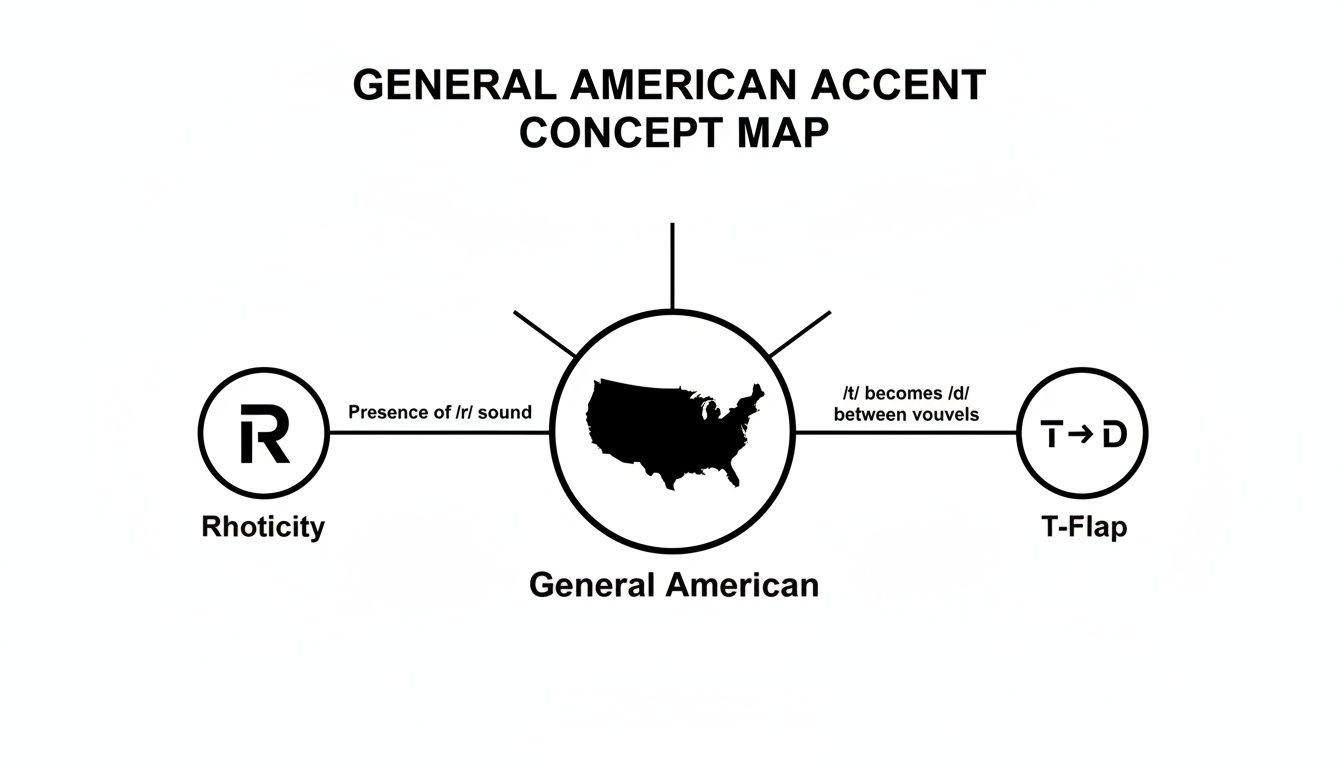
As you can see, these two phonetic habits branch directly from the core of the General American accent, showing just how foundational they are.
The Famous T-Flap Phenomenon
Next up is the t-flap, a softening of the ‘t’ sound so that it sounds almost identical to a quick ‘d’. This little trick happens when a ‘t’ is sandwiched between two vowel sounds, and it’s an absolute hallmark of casual, natural-sounding American speech.
Think of the t-flap as a shortcut. Instead of a sharp, crisp ‘t’ that stops the airflow, the tongue quickly “flaps” against the roof of the mouth. This creates a smoother, more fluid sound that helps link words together seamlessly.
You hear it all the time:
- Water becomes “wa-der.”
- City sounds like “ci-dy.”
- Butter is pronounced “bu-dder.”
This single feature contributes heavily to the rhythmic, flowing quality that people often associate with American English. For anyone curious about how modern tech analyzes such subtle phonetic shifts, looking into models like OpenAI’s Whisper AI speech technology offers a fascinating glimpse into how these intricate sounds get processed.
The Sound of American Vowels
Of course, it’s not all about consonants; vowels play a massive role. The “short a” sound in words like cat, man, and apple is famously bright and a bit flat—think of the “aah” sound in “baaa,” like a sheep. This is a stark contrast to many other accents, which use a deeper, more open “ah” sound for the same words.
There are a huge number of English vowel sounds and how many of them exist, and their specific qualities are absolutely crucial to an accent’s identity. It’s these specific building blocks—the hard ‘r’, the soft ‘t’, and the bright vowels—that come together to create that distinct and recognizable American sound.
Why There Is No Single American Accent

It’s easy to assume all Americans sound pretty much the same, but the reality is way more interesting. Believing in a single “American accent” is like assuming a massive country with over 330 million people would only have one type of food or music. It just doesn’t work that way.
American English is less of a single, unified sound and more like a sprawling family of related dialects, each with its own history and personality.
Think of it like a big family tree. The trunk represents the core features we’ve talked about, like rhoticity. But as you move up, the branches spread out, showing how accents have evolved and diverged in different parts of the country over hundreds of years. This variation is the real sound of America.
A Map of American Sounds
The United States is a mosaic of different voices. The answer to “what does an American accent sound like?” changes dramatically from one state to the next. The accent of a Boston native is fundamentally different from that of someone in Texas, yet both are undeniably American.
These aren’t just random quirks. They follow clear regional patterns shaped by centuries of settlement history, migration, and local culture.
The idea of one “American accent” is mostly a media creation. In day-to-day life, what you actually hear is a rich tapestry of regional voices. Understanding this variety is the key to truly grasping how Americans speak.
Linguists have spent decades mapping these differences, confirming that American English is a whole spectrum of regional varieties. Major studies have identified at least six broad clusters, including the North, the South, the West, New England, the Midland, and the Mid-Atlantic. If you’re curious about the nitty-gritty details, resources like Wikipedia’s page on North American English regional phonology offer a deep dive into this phonological mapping.
Meet the Major Accent Families
While there are countless local variations, we can group most American accents into a few major families, each with its own signature sounds. Getting to know them helps build a much more accurate picture of how Americans really speak.
- The South: Famous for its “drawl,” where vowels often get stretched out. A word like ride might sound more like “rahd,” and you’ll often hear the ‘g’ dropped from “-ing” endings, as in “runnin’.”
- New England: Home to the iconic Boston accent. It’s famous for dropping the ‘r’ in words like car (“cah”) but sometimes adding it to others where it doesn’t belong, like idea (“idear”).
- The West: This region’s accent is often considered the closest to the “General American” standard, but it’s not perfectly uniform. For instance, the ongoing “California Vowel Shift” is creating a distinct sound all its own on the West Coast.
This diversity means there isn’t one perfect target for learners. If your goal is clearer communication in a professional setting, you might find it helpful to read our guide on understanding what is the most neutral American accent.
Still, embracing the rich variety of American speech is the first step to truly understanding its sound.
How We Judge Accents Without Realizing It
An accent is so much more than just a collection of sounds. It’s a powerful social signal, one that triggers a whole cascade of unconscious judgments the moment we hear someone speak. Without even thinking about it, our brains start making instant assumptions about a person’s background, their education level, and even their personality.
This isn’t just a hunch; it happens automatically, often completely below our conscious radar.
Think about how different accents are portrayed in movies and TV. The “General American” accent is almost always the voice of authority—the scientist, the news anchor, the CEO. Meanwhile, regional accents are often reserved for characters meant to be seen as friendly, less educated, or simply comical. These portrayals might seem harmless, but they quietly reinforce powerful cultural stereotypes that link how we speak to who we are.
The Social Weight of Sound
The way we react to an accent is rarely just about phonetics. It’s deeply tangled up in our personal experiences and the cultural shortcuts we’ve picked up over a lifetime. These split-second judgments are known as accent bias, and they can have very real consequences in the professional world.
This isn’t just anecdotal, either—it’s backed by solid research. Studies measuring listener attitudes consistently show that speakers with a standard American accent are rated differently than those with distinct regional accents.
For example, one study found that listeners perceived standard-accented speakers as more intelligent, while Southern-accented speakers were judged as friendlier and more amusing. You can dig into the full findings to see exactly how these perceptions were measured.
It’s clear evidence that the biases we carry can influence everything from a first impression in a job interview to how seriously a colleague’s contributions are taken in a meeting.
Beyond Pronunciation in the Workplace
The impact of these snap judgments is a huge issue in professional settings. When a non-native speaker’s accent doesn’t line up with a listener’s unconscious expectations, it can create frustrating barriers to communication and career growth—barriers that have absolutely nothing to do with their actual skills or expertise.
The core issue isn’t the accent itself, but the listener’s perception of it. Understanding this distinction is the first step toward creating a more inclusive and effective communication environment for everyone.
Recognizing these hidden biases is crucial, both for non-native professionals and for their colleagues. For a deeper look into this topic, you might be interested in our guide on what accent bias is and how it presents a hidden challenge in the workplace.
Ultimately, acknowledging that our ears are not neutral is the key to judging people on the content of their words, not the sound of their voice.
How Common Is the Standard American Accent?
When people ask what an American accent sounds like, their minds usually jump to the clear, almost neutral voice of a national news anchor. This idealized sound, often called General American, feels like the default setting for English in the United States.
But here’s the thing: that perception is almost entirely shaped by television and movies. It’s a media-made myth that most Americans speak this way.
The reality on the ground is far more interesting. The United States is a massive country, and from state to state, even city to city, regional diversity is the absolute norm. The idea that one single “unaccented” voice could possibly represent over 330 million people just doesn’t add up once you start listening to how people really talk.
The Rarity of a “Standard” Voice
So, how many people actually speak with that perfectly neutral, “standard” American accent? Surprisingly few. While it’s a useful baseline for learners and broadcasters, it isn’t something you’ll hear consistently in everyday life. Variety is the very heart of American English.
The “standard” American accent is more of a media concept than a widespread reality. Regional accents aren’t a deviation from the norm; they are the norm.
This isn’t just an opinion; it’s what the data suggests. When linguists and researchers try to nail down how many people truly fit the narrow definition of a standard speaker, the numbers are shockingly low.
For instance, one analysis that factored in region, education, and language background estimated that only around 10%–12% of the U.S. population could be said to speak with a “standard” accent. You can see how this figure was calculated and what factors were considered.
That small percentage really drives the point home. For every person who sounds like a newscaster, there are nine others whose speech is rich with the unique rhythms and sounds of their local community—whether it’s the long drawl of the South, the sharp vowels of Boston, or the unmistakable cadence of a New Yorker.
How to Recognize and Practice American Pronunciation

Alright, understanding the theory behind the American accent is one thing. But turning that knowledge into a practical skill you can actually use? That’s the real challenge. For any professional trying to communicate more clearly, the goal isn’t to erase who you are. It’s about building the confidence that you’ll be understood the first time, every time.
This whole process starts with your ears. It’s a simple but powerful truth: before you can make a new sound, you have to be able to hear it accurately first. The most effective way to start building this awareness is by truly immersing yourself in the sounds of American English.
Tune Your Ear with Active Listening
Just having the TV on in the background isn’t going to cut it. That’s passive listening. What we need is active listening, which means you’re paying close attention to the specific rhythms, the intonation patterns, and those key sounds we’ve been talking about. You’re trying to notice the music in the speech.
Here are a few ways to get started:
- Listen to American Podcasts: Pick shows that are conversational and unscripted. Something like NPR’s “This American Life” or “How I Built This” is perfect. Notice the natural rise and fall in the hosts’ voices. Where do they place the stress to make a point?
- Watch American TV Shows: Dramas and sitcoms are goldmines for this. Don’t just watch—interact. Try repeating short phrases from the characters, mimicking their exact intonation and rhythm. This little exercise is huge because it connects what you’re hearing with the physical feeling of saying it.
This kind of focused practice is absolutely essential. If you want to dive deeper, our guide on how to train your ear to recognize English sounds accurately has more targeted exercises to sharpen your listening skills.
Practice Key Sounds with Simple Drills
Once you start tuning your ear, you can begin the physical work of producing these core American sounds. The goal here is to build new muscle memory through sheer repetition, making these new movements feel more natural over time.
You don’t need to tackle everything at once. Start with simple, focused drills:
- The Rhotic ‘R’: Practice words that end in ‘-er,’ like teacher, mother, and father. Pay attention to that slight pull-back of your tongue that creates the distinct American ‘r’ sound.
- The T-Flap: Say phrases like “get it on” or “a lot of” out loud. The key is to soften that ‘t’ sound until it sounds almost like a quick ‘d’—”ged-it-on,” “a-lod-of.”
As you start actively working on your pronunciation, using effective audio recording tools can be a game-changer. It’s one thing to think you sound a certain way, but hearing a recording gives you invaluable, objective feedback. Record yourself doing these drills and compare it directly to a native speaker.
Remember, the goal is always clear and confident communication, not some impossible standard of perfection. Small, consistent efforts to practice these key features will make a massive difference in how clearly you speak and how confident you feel.
Of course. Here is the rewritten section, crafted to sound like it was written by an experienced human expert, following the provided style guide and examples.
A Few Lingering Questions About American Accents
As you dig into the world of American English, a few common questions always seem to pop up. It’s only natural. Getting answers to these can clear up some of the trickiest parts of understanding what an American accent really sounds like.
Let’s tackle a few of the most frequent ones to round out your understanding.
Which US State Has the Most “Neutral” Accent?
This is the million-dollar question, but it’s a bit of a trick one. As we’ve covered, true “neutrality” is more of a concept than a concrete place on a map. No one speaks without some kind of accent.
That said, linguists often point to the Midland region as the area where speech comes closest to the “General American” standard you hear on national news broadcasts. This includes parts of states like Ohio, Indiana, and Nebraska. The speech in these areas tends to have fewer of the distinct regional markers you’d hear in, say, Boston or the Deep South.
But even there, you’ll find subtle local flavors everywhere. No single state can claim to be perfectly “accent-neutral,” but the Midland is generally where you’ll hear speech that aligns most closely with that broadcast standard.
What’s the Hardest Part of the American Accent for Learners?
Every learner’s journey is different, but a few consistent challenges emerge time and time again. For many, mastering the rhotic ‘r’—that hard ‘r’ sound in words like car and hard—is a major hurdle, especially if their native language has a softer ‘r’ or none at all.
Beyond the ‘r’ sound, learners often find these elements tough to crack:
- The Vowel Maze: The tiny but critical differences between American vowel sounds, like the ‘a’ in cat versus the ‘o’ in cot, can be incredibly difficult to hear and produce correctly.
- The Rhythm and Flow: American English has a distinct musicality. Getting the hang of its rhythm and the constant use of informal contractions (like “gonna” for “going to” or “wanna” for “want to”) is often the final piece of the puzzle.
Are American Accents Changing Over Time?
Absolutely. Like any living language, American English is in a constant state of flux. Linguists are right now tracking several major sound shifts happening across the country. It’s a fascinating, real-time evolution.
For example, the “California Vowel Shift” is changing how vowels are pronounced on the West Coast, while the “Northern Cities Vowel Shift” is doing the same around the Great Lakes. Things like mass media, new technology, and migration patterns are powerful forces that guarantee American accents will keep evolving for generations to come.
Ready to move beyond questions and start building clearer, more confident communication skills? The experts at Intonetic provide personalized coaching designed for professionals who want to be understood the first time, every time. Book your free assessment today and discover a practical path to strengthening your professional voice.